
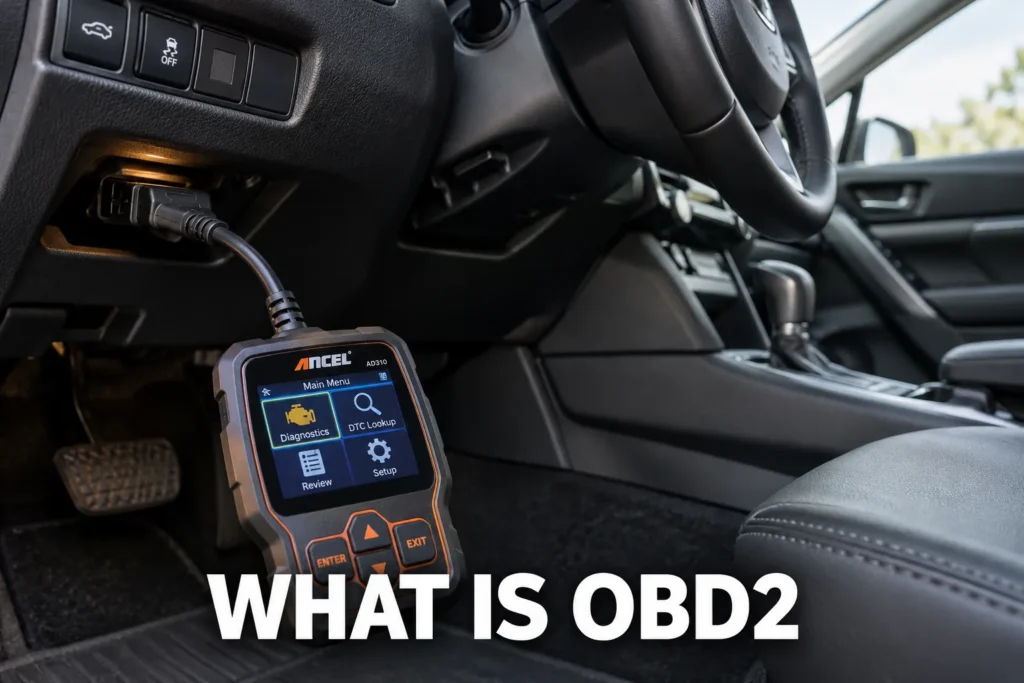
OBD2 is the standardized diagnostic system built into every car sold in the United States since 1996. Understanding what OBD2 is and how it works tells you why your check engine light came on, what a scanner is measuring, and what any of those four-digit codes actually mean. This guide covers the full picture: how the system works, what it monitors, how codes are structured, and what to do when one appears. Trax owners working with their vehicle’s OBD2 system can find a dedicated scanner comparison in my Chevy Trax OBD2 scanner guide.

About the author: Hello! I’m Kamil Siegień, founder of OBD2 Scout. My diagnostic experience started with an engine rebuild on a 2014 Skoda Superb 1.8 TSI, where tuning from 160 to 222 hp required mastering live data and ECU behavior that basic code readers cannot handle. I am a former BMW and MINI employee and regularly use diagnostic scanners on my own Audi A4 2.0 TFSI.
OBD2 stands for On-Board Diagnostics, second generation. The second generation replaced OBD (also called OBD1), an older non-standardized system in which every automaker used its own connector, its own codes, and its own diagnostic tools. OBD2 introduced one universal port, shared code definitions, and scanner compatibility across all makes.
My obd2 electric vehicles ev diagnostics covers this step by step.
My obd2 codes after car accident covers this step by step.
My j1939 heavy duty truck diagnostics obd2 covers this step by step.
My obd2 scanner different codes than mechanic covers this step by step.
My beginners guide reading obd2 data covers this step by step.
My my guide on update firmware covers this step by step.
My wired vs bluetooth obd2 scanner covers this step by step.
My my guide on read map sensor data covers this step by step.
My my guide on read live data for misfire diagnosis covers this step by step.
My obd2 diagnostic link connector dlc explained covers this step by step.
My a j2534 pass thru device explained covers this step by step.
My obd2 modes explained modes 1 through 10 covers this step by step.
My what are obd2 pids and how do they work covers this step by step.
My a full system scan obd2 scanner explained covers this step by step.
My a bidirectional obd2 scanner explained covers this step by step.
My my guide on reset transmission adaptations covers this step by step.
My my guide on reset injector coding covers this step by step.
My my guide on bleed abs brakes covers this step by step.
What OBD2 Actually Does Inside Your Car
Your car’s engine control unit (ECU) monitors dozens of sensors continuously while the engine runs. These sensors track oxygen levels in the exhaust, fuel mixture ratios, combustion timing, exhaust temperature, and emissions system performance. The ECU compares every reading against a programmed acceptable range.
When a sensor reading falls outside that range, the ECU records a diagnostic trouble code (DTC) in its memory. If the fault appears on a single drive cycle, it is stored as a pending code and the check engine light stays off. If the same fault is detected across two or more consecutive drive cycles, the code becomes active and the malfunction indicator lamp turns on. My comprehensive guide on what OBD2 codes are and how the system categorizes them covers every code category the ECU uses, what the five-character format reveals about the system and fault type, and the difference between what a stored DTC identifies and what still requires diagnosis.
The code stays in memory until you clear it with a scanner or until the ECU confirms the fault is resolved and the relevant monitor has passed enough times to verify it. The system does not alert you in real time or send updates. It stores a record and turns on a light when the fault clears the confirmation threshold. My Innova 3100RS review covers how it handles this confirmation cycle — including how it flags the transition from pending to active and whether the readiness monitor status updates correctly after the fault resolves.
Why OBD2 Was Created
Before 1996, every automaker ran its own diagnostic system. Ford used a different connector than GM. GM used different codes than Chrysler. Reading a fault on a Toyota required a Toyota-specific tool, and the same code number meant something different on a Honda. Repair shops had to stock brand-specific equipment just to cover the common makes on their lifts. Honda adopted standardized OBD2 in 1996; for the current Honda lineup, my Honda OBD2 scanner guide covers every tier from basic code readers to full bidirectional tools for Civic, CR-V, and Acura.
The California Air Resources Board drove the push for standardization. California required OBD2 compliance on all 1996 model year gasoline vehicles to give emissions testers and repair shops a consistent way to access emissions-related fault data across every brand. The EPA adopted the same requirement at the federal level.
The result was a single universal connector, a standardized set of trouble code categories and definitions, and a requirement that every compliant vehicle support the same diagnostic commands. Any OBD2 scanner communicates with any OBD2 vehicle regardless of manufacturer. My guide on how to use an OBD2 scanner with that universal port covers the step-by-step connection process, what the scanner does between plug-in and first code display, and how to get useful diagnostic results without technical knowledge. The European Union followed with its own EOBD standard: 2001 for petrol vehicles and 2004 for diesel.
Does My Car Have OBD2?
If your car was built for sale in the United States and is a 1996 model year or newer, it has OBD2. This covers virtually every car, truck, SUV, and van sold in the country over the past three decades. If you want a tool to pull those codes yourself, my roundup of reliable budget OBD2 scanners covers the wired and Bluetooth options that handle the full read-clear-live-data workflow without requiring a professional tool.
European vehicles comply with EOBD, the EU equivalent: petrol cars from 2001 and diesel from 2004. Some 1994 and 1995 model year US vehicles were manufactured with early OBD2 hardware as automakers prepared for the mandate, but these partial implementations are not fully compliant and may not communicate correctly with all scanners.
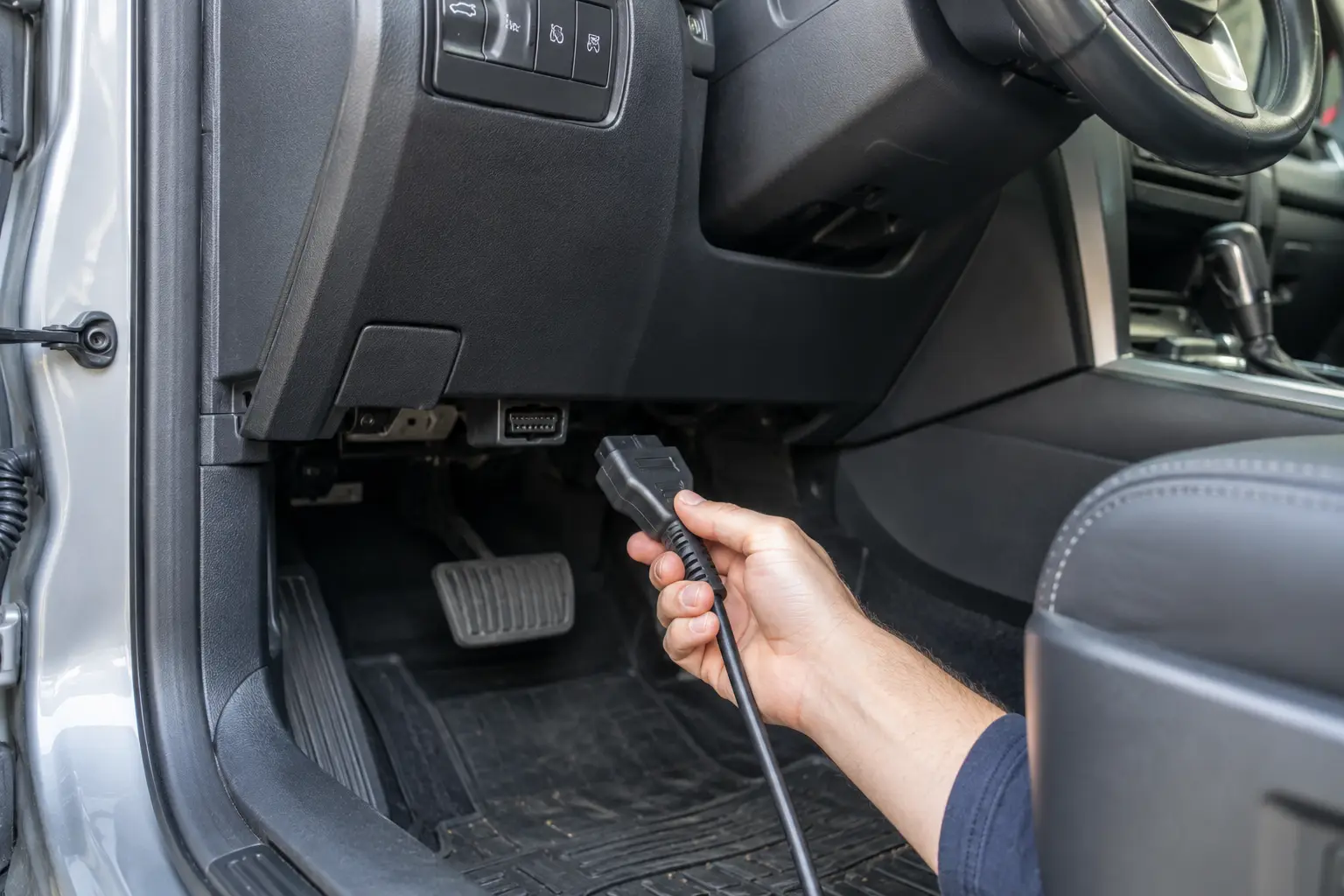
To confirm, look under your dashboard on the driver’s side within two feet of the steering column. If you see a 16-pin trapezoid connector pointing downward, your vehicle is OBD2 compliant. If you find a different connector shape or cannot locate a port at all, the vehicle likely predates the standard. My guide on where the OBD2 port is and how to find it covers the standard two-foot zone under the driver’s side dash, the technique that works without a flashlight, and the specific positions different manufacturers favor within that zone.
The OBD2 Port and How Communication Works
The OBD2 connector is a 16-pin trapezoid plug standardized as SAE J1962. Its shape accepts the scanner plug only one way. Pin 16 carries battery power and pin 4 is ground, both standardized across all vehicles. This is why most scanners power on the moment you insert them without needing separate batteries. My guide to professional OBD2 diagnostic tools covers the scanners that use the additional pins for manufacturer-specific data and bidirectional commands, not just the four pins required for basic emissions-only communication.
Behind that single connector, up to five different communication protocols have been used depending on the manufacturer and model year. Older vehicles may use ISO 9141-2, ISO 14230 KWP2000, or SAE J1850 PWM or VPW. Most vehicles produced after 2008 use CAN (ISO 15765-4), which is faster and more reliable than the older protocols. My guide to OBD2 scanners with full multi-protocol support covers the models that handle all five variants, which matters for pre-2008 vehicles that may use ISO 9141 or KWP2000 rather than CAN.
This matters in practice because some lower-cost Bluetooth adapters only support CAN and will not communicate with older vehicles running different protocols. If you own a pre-2008 vehicle and a scanner shows no communication after a confirmed connection, a protocol mismatch is the likely cause. Scanners labeled as full OBD2 protocol support handle all five. If you are using a low-cost Bluetooth adapter that stays in the port between drives, my guide on OBD2 adapter battery drain covers how continuous polling behavior affects parasitic draw.
What OBD2 Monitors (and What It Does Not)
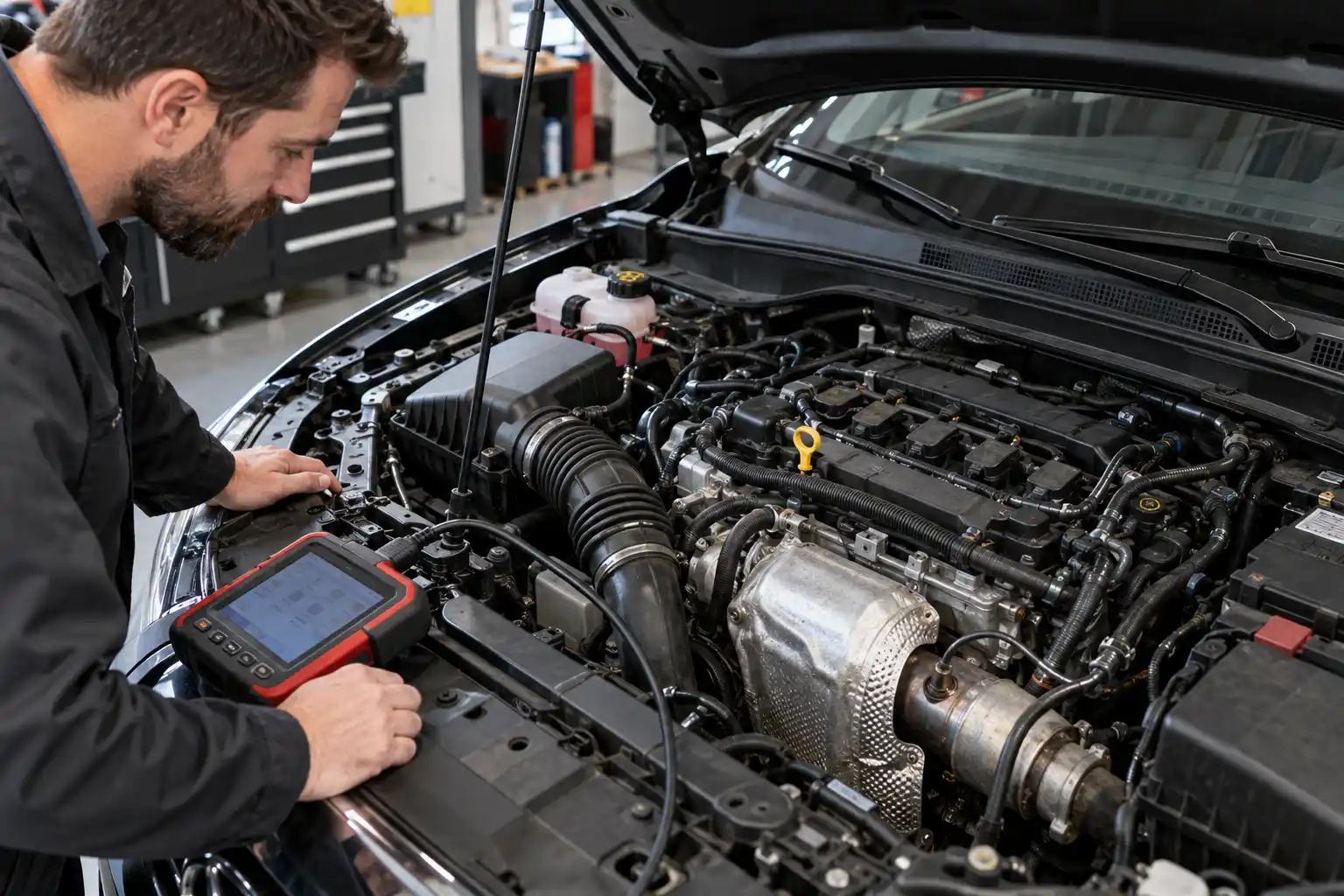
OBD2 was designed with emissions in mind, so it monitors the systems most likely to affect tailpipe output. This includes the engine, fuel delivery system, ignition, catalytic converter, oxygen sensors, exhaust gas recirculation (EGR) valve, evaporative emissions (EVAP) system, and transmission on most vehicles. My Foxwell NT630 Plus review covers how it handles emissions-specific readiness monitor checks, including which monitors it can force-run and how it presents incomplete monitor status before an emissions test.
The system runs a set of self-tests called readiness monitors. Each monitor checks one emissions-related system by evaluating sensor data under specific driving conditions. If all monitors complete successfully and no faults are detected, the vehicle is ready for an emissions inspection. My guide on the OBD2 emissions pre-check covers what the inspector’s machine reads, how to replicate that check beforehand, and what to address when a monitor shows incomplete.
What OBD2 does not monitor: purely mechanical wear such as timing belt condition, clutch wear, or brake pad thickness. ABS, airbags, and most body electronics are also outside standard OBD2 coverage. Those systems have their own control modules that require extended diagnostic access beyond what the OBD2 standard defines. A scan returning no codes means no confirmed emissions-related faults, not that the vehicle has no problems at all. Electric vehicles present a different limitation: my guide on OBD2 on electric cars covers what the standard can and cannot access on an EV powertrain and which platform-specific tools fill the gap.
My guide on OBD2 scanner for ABS and airbag codes covers why standard OBD2 cannot reach those modules, what code prefixes to expect, and how to verify scanner coverage for a specific vehicle.
What Is a Diagnostic Trouble Code?
A diagnostic trouble code (DTC) is a five-character identifier the ECU stores when a monitored value goes outside its acceptable range. Every code follows the same structure: one letter identifying the system area, followed by four digits identifying the specific fault. My guide to what OBD2 code categories mean covers how the letter prefix divides codes into four system categories, what the following digits identify within each one, and how manufacturer-specific codes differ from standardized SAE codes in both interpretation and lookup.
| Code Letter | System Area | Common Examples |
|---|---|---|
| P | Powertrain | Engine misfires, oxygen sensor faults, fuel trim, emissions components |
| B | Body | Interior electronics, HVAC faults, some safety system data |
| C | Chassis | ABS faults, traction control, steering, suspension |
| U | Network | Communication failures between two or more control modules |
The digit immediately after the letter indicates whether the code is generic or manufacturer-specific. A zero (P0xxx) means the definition is standardized across all makes. A one (P1xxx) means it is manufacturer-specific, and the same code number may mean something entirely different on a Ford versus a Honda. For P1 codes, always search with the vehicle’s brand included to get the correct definition. My guide on interpreting OBD2 trouble codes correctly covers the complete five-character code structure, what each position identifies, and how the diagnostic process changes depending on whether the code is a generic SAE definition or a manufacturer-specific fault.
Codes also have a status that changes how you read the situation. A stored or active code means the fault is confirmed and the check engine light is on. A pending code means the fault was detected once but not yet confirmed across multiple drive cycles. A permanent code cannot be cleared with a scanner alone. It requires the fault to be repaired and the relevant monitor to pass again under actual driving conditions. My guide on how OBD2 pending and confirmed codes work covers what changes in the ECU at each stage, the two-trip detection strategy behind the confirmation process, and the third code type — permanent codes — that a scanner cannot erase.
One light behavior matters more than any code: a solid check engine light means investigate the code and decide on a repair plan. A flashing or blinking check engine light means stop driving. A flashing light signals an active misfire severe enough to send unburned fuel into the catalytic converter, which can overheat and destroy it within minutes at highway speeds. My Autel MaxiSYS Elite II Pro walkthrough covers how it identifies which cylinder is misfiring, at what RPM range the misfire occurs, and what its bidirectional tests reveal about the ignition and fuel delivery components before any parts are replaced.
What OBD2 Can and Cannot Tell You
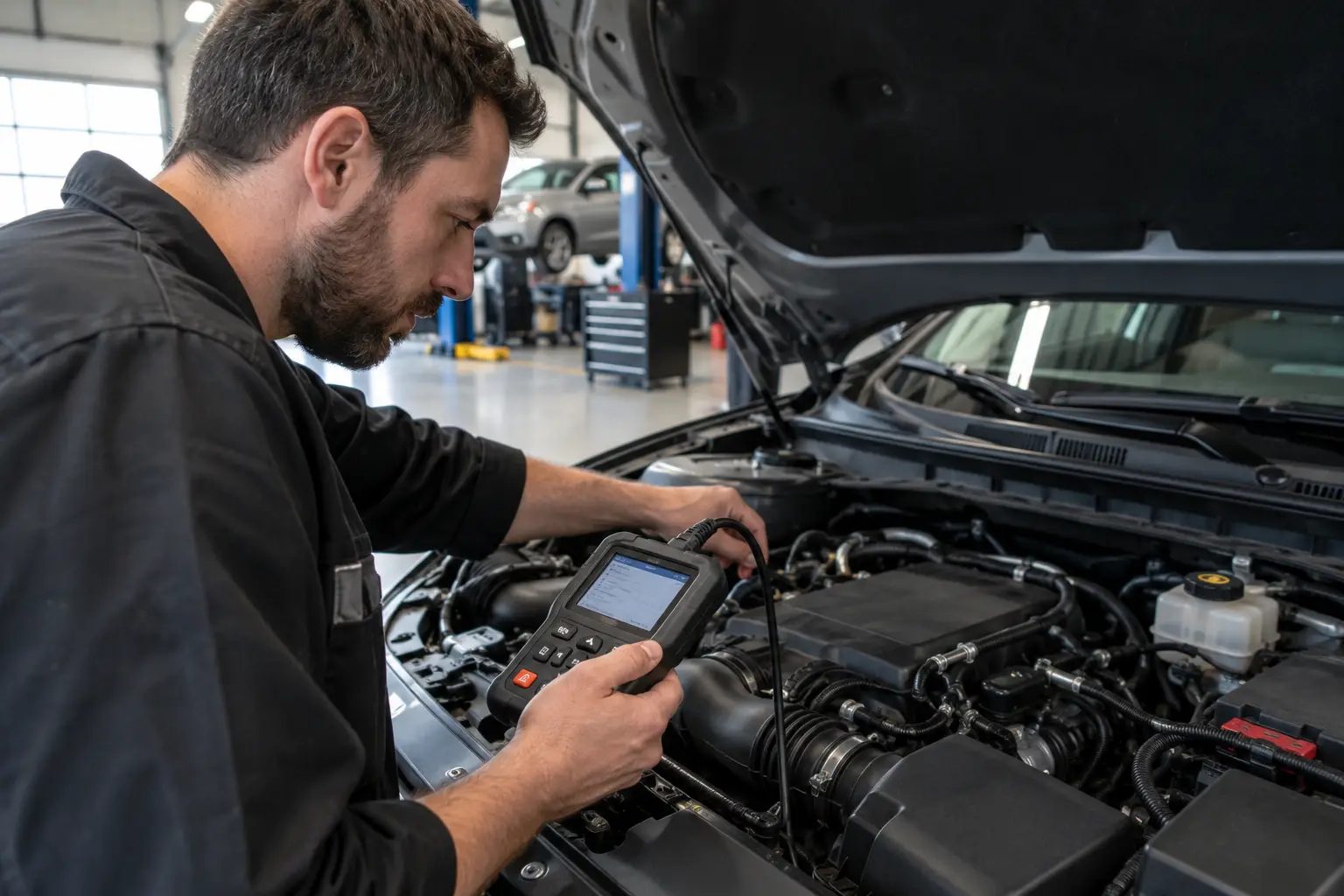
OBD2 tells you which system the ECU flagged, under what conditions the fault triggered, and what sensor readings looked like at that moment through freeze frame data. That combination gives a diagnostic process a specific and accurate starting point. My guide on the OBD2 scanner’s blind spots covers the mechanical, fluid, and structural conditions that exist beyond this starting point and cannot be detected by any scan.
What it cannot do is confirm the failed component. A P0420 code (catalyst efficiency below threshold) comes from a failing catalytic converter in some cases. It also comes from a bad downstream oxygen sensor, an exhaust leak between the sensor and converter, oil consumption affecting sensor output, or fuel trim issues skewing the data. The code names the system. Diagnosis narrows it to the actual cause. My guide on OBD2 live data readings covers the sensor parameters that do that narrowing — what normal looks like for each one, how to read them together, and the patterns that distinguish a sensor fault from a mechanical one.
Freeze frame data helps close that gap. It captures engine speed, load, coolant temperature, and fuel trim at the exact moment the fault triggered. If a misfire code fired only under heavy acceleration at high RPM, that context is more useful than the code number alone. Always check freeze frame before clearing any code. My guide to reading OBD2 freeze frame data covers every parameter in the snapshot, how to establish the operating scenario before interpreting individual values, and the lean trim patterns that help separate a vacuum leak from a fuel delivery fault.
My guide on how diagnostic tools compare by capability tier covers the spectrum from universal code readers through professional multi-system scanners, including where each tier falls short.
OBD1 vs. OBD2: What Changed
OBD1 refers to any manufacturer-specific diagnostic system predating the OBD2 mandate. There was no single OBD1 standard. Each automaker designed its own connector shape, its own code definitions, and its own diagnostic procedure. Reading a pre-1996 vehicle typically required a brand-specific tool or adapter.
My what are enhanced obd2 codes covers this step by step.
| Feature | OBD1 | OBD2 |
|---|---|---|
| Connector | Brand-specific shape and pinout | Universal 16-pin J1962 |
| Code structure | Manufacturer-specific | Standardized (P/B/C/U + 4 digits) |
| Scanner requirement | Brand-specific tool or adapter | Any OBD2-compatible scanner |
| US coverage | Pre-1996 vehicles | 1996 model year and newer |
| Readiness monitors | None or limited | Required across all compliant vehicles |
If you own a pre-1996 vehicle with a check engine light, verify the correct diagnostic approach for your specific make and model before buying any equipment. Some independent OBD1 adapters exist for common platforms, but there is no universal solution the way there is for OBD2. My guide on OBD1 vs OBD2 covers the full scope of manufacturer-specific protocols, the blink code method available on the major platforms, and the connector check that confirms which system a borderline vehicle actually uses.
What to Do When Your Check Engine Light Comes On
A check engine light means the OBD2 system confirmed a fault over at least one drive cycle. The light does not indicate severity on its own. A loose gas cap triggers the same light as a failing oxygen sensor or a misfiring cylinder. My guide on completing the OBD2 monitor drive procedure covers what the ECU is doing while the light is off, how many driving trips it takes to confirm a fault, and when the light comes back on.
Get a scan before making any repair decisions. A handheld scanner, a Bluetooth adapter paired with a phone app, or a free scan at an auto parts store can read the codes in under two minutes. Write down every code shown, including any pending codes, and record the freeze frame data before doing anything else. If the fault requires professional diagnosis, my guide on car diagnostics costs covers what different shops charge and how your scan data reduces what you pay.
Clear codes only after you understand what they indicate and have a repair plan. Clearing without repairing removes the stored data the ECU collected about the fault and resets all readiness monitors. A car that has had its codes recently cleared will fail an emissions test even with no active faults, because the monitors have not had time to complete their self-checks. My guide on OBD2 readiness monitor status covers what each monitor tracks, how to read the status screen on any scanner, and the typical conditions required to complete them after a code clear.
My guide on the full consequences of clearing OBD2 codes covers what gets removed alongside the code, why the timing matters relative to an inspection, and the cases where clearing is the right next step.
FAQs
What does OBD2 stand for?
OBD2 stands for On-Board Diagnostics, second generation. The name refers to the standardized diagnostic system required in all US vehicles from the 1996 model year onward. It replaced the earlier OBD1 era of manufacturer-specific systems with a universal connector, standardized trouble codes, and shared diagnostic commands that any scanner can read.
Does every car have OBD2?
Every car, truck, and SUV sold in the United States as a 1996 model year or newer has OBD2. European vehicles follow the EOBD standard: petrol models from 2001 and diesel from 2004. Vehicles built before these dates use OBD1 systems that are not standardized and require brand-specific diagnostic tools rather than a universal scanner.
What is a DTC in OBD2?
A DTC (diagnostic trouble code) is the five-character code the ECU stores when a monitored sensor reading falls outside its acceptable range. The first character is a letter identifying the system area (P, B, C, or U) and the remaining four digits identify the specific fault. Reading DTCs requires a scanner or adapter plugged into the 16-pin OBD2 port with the ignition in the ON position.
Can OBD2 read ABS and airbag codes?
Standard OBD2 does not cover ABS or airbag systems. Those modules have their own control units separate from the powertrain ECU. A basic scanner reading engine codes will return nothing when an ABS or airbag warning light is on, which does not mean the scanner is malfunctioning. Reading those systems requires a scanner that explicitly lists extended ABS and SRS diagnostics as supported features.
What is the difference between OBD1 and OBD2?
OBD1 is the pre-1996 era of manufacturer-specific diagnostic systems with no universal standard across brands. OBD2 replaced that with a single connector shape, a shared code structure, and universal scanner compatibility. Any OBD2 scanner works on any OBD2-compliant vehicle. OBD1 vehicles require brand-specific tools, adapters, or software designed for that particular make’s system.
Do you need a scanner to read OBD2 codes?
Yes. Reading what is OBD2 storing requires a scanner or adapter plugged into the 16-pin port. The port provides no display of its own, so the codes are only accessible through an external device. Options range from dedicated handheld scanners to Bluetooth adapters paired with a phone app. Many auto parts stores offer free code reads as well. The OBD2 system keeps codes in memory until cleared, so there is no urgency to scan immediately after the light comes on.