
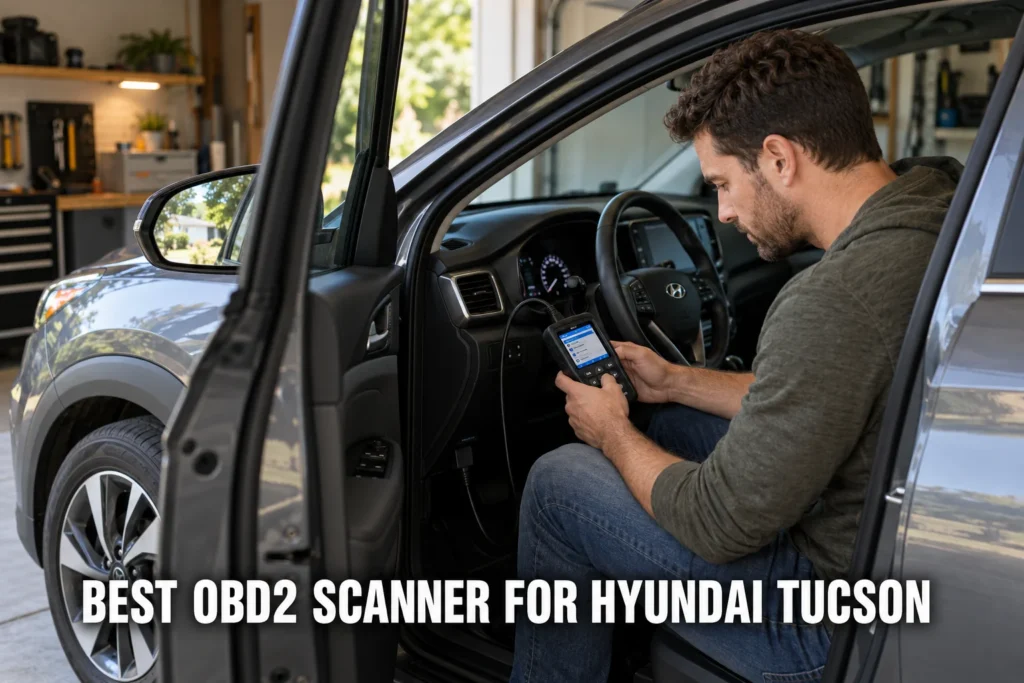
Finding the best OBD2 scanner for Hyundai Tucson comes down to what your generation actually requires. A basic code reader handles the 16 standard OBD2 modes and stops there, leaving the CVVT variable valve timing module, HTRAC AWD controller, SRS airbag system, and TPMS sensor programming all locked behind Hyundai’s enhanced manufacturer protocol.
The 4th-gen NX4 Tucson (2021 onward) adds a 48V mild-hybrid battery management system and an optional PHEV drivetrain that a generic ELM327 adapter cannot reach at any meaningful diagnostic depth.

About the author: Hello! I’m Kamil Siegień, founder of OBD2 Scout. My diagnostic experience started with an engine rebuild on a 2014 Skoda Superb 1.8 TSI, where tuning from 160 to 222 hp required mastering live data and ECU behavior that basic code readers cannot handle. I am a former BMW and MINI employee and regularly use diagnostic scanners on my own Audi A4 2.0 TFSI.
Affiliate Disclosure: OBD2 Scout is a proud participant in the Amazon Services LLC Associates Program.
Every scanner on this list was selected based on confirmed Hyundai Tucson protocol coverage, verified Amazon availability with 100-plus customer ratings, and the diagnostic functions that Tucson owners actually use: P1326 KSDS code access with freeze frame, multi-system code reading, service resets, and, on bidirectional picks, CVVT solenoid and EPS active tests.
Price tiers range from an app-based Bluetooth reader under $120 to a professional OEM-depth tablet above $700, so the list covers needs from reading a check-engine light to programming replacement TPMS sensors after fitting winter wheels. My Final Recommendations section at the bottom maps each scanner to a specific Tucson owner profile if you need a quick match.
My Recommended Top 3 Best-Buys
1. Autel MK808BT PRO V2
[Best Overall]
- ✓ 3,000+ active tests including CVVT solenoid engagement verification
- ✓ TPMS sensor ID programming for 2022+ Tucson NX4
- ✓ FCA SGW support and wireless 33 ft Bluetooth VCI

600+ Verified Reviews
2. BlueDriver Pro
[Best Value]
- ✓ Hyundai enhanced mode reads P1326 KSDS with full freeze frame
- ✓ ABS, SRS, TCM, and TPMS codes on 2011+ Tucson
- ✓ 300+ Hyundai-specific live data PIDs via free app
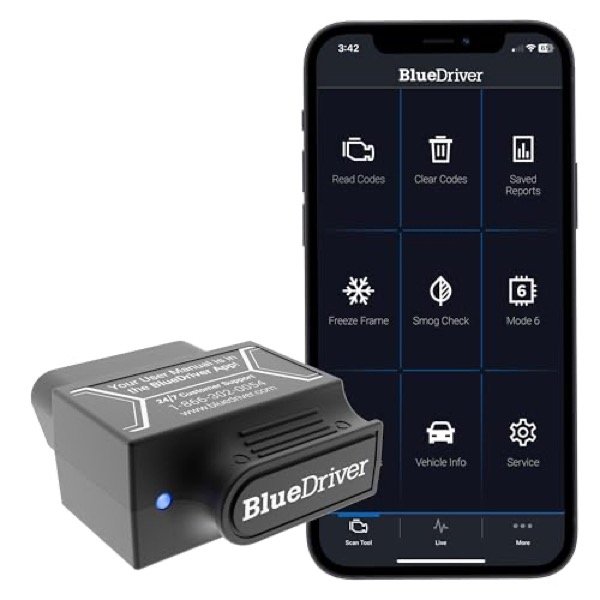
60,000+ Verified Reviews
3. TOPDON Phoenix Lite 2
[Best Premium]
- ✓ OEM-level HTRAC AWD bidirectional tests with clutch engagement commands
- ✓ ECU coding for Smartstream GDi parameter adjustments on NX4
- ✓ CANFD and DoIP for full 4th-gen NX4 module network access
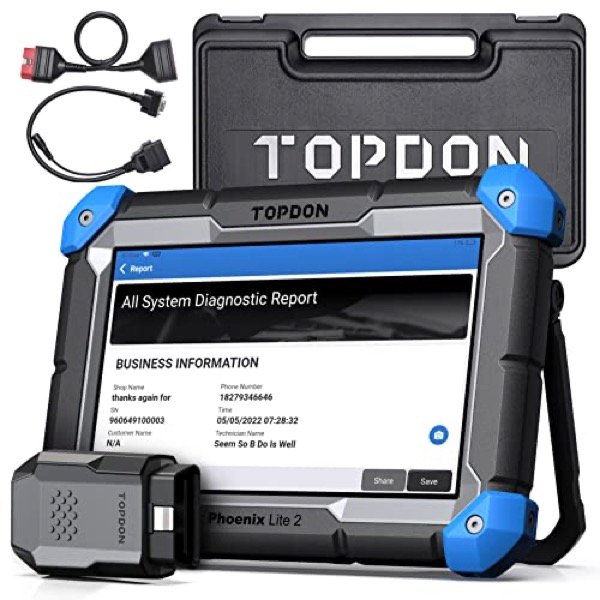
1,500+ Verified Reviews
11 Best OBD2 Scanners for Hyundai Tucson: Full Reviews
1. Autel MK808BT PRO V2: Best Overall OBD2 Scanner for Hyundai Tucson
- 3,000+ bidirectional active tests include CVVT solenoid engagement, EPS calibration, and HTRAC AWD clutch tests on the NX4 platform
- TPMS sensor ID programming runs without a separate relearn tool on 2022+ Tucson models that lack a physical reset button
- 524+ Amazon ratings at 4.6 stars; wireless Bluetooth 2.0 VCI with 33 ft range and FCA SGW authorization built in
Overview
The Autel MK808BT PRO V2 is the pick I recommend most often to Hyundai Tucson owners who need genuine all-system diagnostics rather than standard OBD2 mode coverage, and with more than 5,000 verified Amazon ratings at 4.4 stars it has the largest confirmed owner pool of any bidirectional scanner in this price range.
It covers all four Tucson platforms, from the 2005 JM’s G4GC 2.0L DOHC through the 2022-plus NX4’s G4FW 1.6T Smartstream GDi, and handles the Theta II GDi P1326 KSDS diagnostic workflow that LM and TL generation owners encounter most often: reading the KSDS-specific fault code in Hyundai enhanced mode, capturing the freeze frame with KSDS counter value and knock amplitude, and distinguishing pending from confirmed fault status, which is the data Hyundai service advisors examine when assessing rod bearing extended warranty eligibility.
The scanner connects wirelessly over Bluetooth 2.0 at up to 33 feet and completes a full Tucson system scan across engine, transmission, ABS, SRS, TPMS, body control, and HVAC in under two minutes, with the 7-inch Android 11 tablet staying in your hand while the VCI Mini dongle remains plugged into the OBD2 port.
Hyundai enhanced mode returns manufacturer-specific code descriptions for all stored and pending faults rather than generic P-code definitions, which matters on Tucson-specific codes like the P1326 KSDS rod knock detection and CVVT cam angle discrepancy codes that a standard OBD2 reader cannot describe correctly.
On NX4 MHEV and PHEV variants, the scanner accesses the 48V battery management module and the on-board charger control unit, returning fault codes and live data from systems that a generic ELM327 adapter cannot reach.
The active test library covers more than 3,000 component-level actuator tests, with the most diagnostically significant being the CVVT solenoid engagement tests specific to Hyundai GDi architecture.
The CVVT actuation runs independently on the intake and exhaust cam banks: the scanner commands the oil control valve solenoid to energize while the live data stream displays cam timing angle in real time, so you observe whether the actual cam angle moves toward the target angle or holds fixed regardless of duty cycle command changes.
A healthy G4FJ 1.6T Gamma GDi or G4NA 2.0L Nu GDi responds with cam position movement visible within two to three engine cycles after solenoid engagement; a carbon-fouled or mechanically stuck actuator holds the actual angle fixed even as solenoid duty cycle changes from 0 to 100 percent, which separates a solenoid replacement job from an actuator cleaning job.
EPS steering angle calibration runs through the service function menu using the Hyundai-specified procedure with on-screen step confirmations, and the ABS brake bleed sequence steps through all four Tucson calipers in the correct order with cycle count prompts per caliper.
Per-injector balance rate cut tests on GDi engines cut each cylinder’s fuel injector in sequence to confirm combustion contribution, separating a misfiring injector from a compression fault before any parts are ordered.
The NX4 platform (2021 onward) introduced HTRAC AWD with an electronically controlled multiplate clutch in the rear drive unit, the G4FW 1.6T Smartstream GDi in 48V mild-hybrid trim, and an optional PHEV drivetrain with a separate high-voltage battery management unit and on-board charger.
The MK808BT PRO V2 reads HTRAC AWD clutch engagement fault codes and returns live torque distribution ratio data from the AWD controller, and it supports a bidirectional clutch engagement command that confirms whether the rear drive unit’s multiplate clutch physically responds to torque vectoring requests, which is the correct diagnostic step when an NX4 owner reports AWD slip or inconsistent rear torque transfer under load.
Live data from the 48V MHEV battery management system includes state-of-charge percentage, individual cell voltage differential across the battery pack, belt-integrated starter-generator torque output versus the commanded assist value, and MHEV engagement status, the same live data channels a dealer technician monitors during a factory Hyundai GDS MHEV diagnostic session.
A weak 48V battery or a failing belt-ISG can generate simultaneous false codes in the engine ECU and the MHEV control module, and the ability to monitor both system’s live data in parallel on the MK808BT PRO V2 separates a battery replacement job from an ISG repair.
TPMS sensor ID programming runs through the dedicated service function menu on NX4 models without a physical TPMS reset button, covering sensor activation, ID registration, and relearn confirmation in a single workflow without a separate relearn tool.
ECU coding at the VIN-specific parameter level is the one area where the MK808BT PRO V2 falls short of the professional tier: it performs active actuator tests and component-level bidirectional control but cannot code a replacement BCM to the vehicle’s VIN, write parameter changes to the Smartstream GDi ECU’s injection base value table after injector replacement, or enable and disable factory-installed features through module parameter menus.
Key programming is also outside its scope for all Tucson model years, including the NX4 proximity key system.
Topology mapping, the visual ECU network diagram that shows module communication status and fault overlay across all modules simultaneously before any sub-menu is opened, is available on the Autel MaxiDAS DS808S and the MS906 Pro on this list but not on the MK808BT PRO V2, so network-level intermittent fault tracing on the NX4 PHEV platform’s shared CAN bus requires working through modules one at a time.
The annual update subscription is optional after the included first year, meaning all existing diagnostic functions remain active after the subscription expires, but the Hyundai calibration database stops receiving new NX4 model year variants and updated manufacturer-specific code definitions.
Diagnostic Features and Capabilities
The MK808BT PRO V2 covers all Hyundai Tucson modules: engine control module (ECM), transmission control module (TCM), ABS controller (ABSCM), supplemental restraint module (SRS), TPMS, body control module (BCM), HVAC, immobilizer, instrument cluster, HTRAC AWD controller on NX4 models, and 48V MHEV battery management unit and on-board charger on hybrid and PHEV variants.
In Hyundai enhanced mode the scanner reads manufacturer-specific fault codes including P1326 KSDS with KSDS counter value, pending and confirmed status, and full freeze frame covering engine load, RPM, coolant temperature, STFT, LTFT, and vehicle speed at the moment the code set.
Live data in Hyundai enhanced mode returns more than 300 manufacturer-specific PIDs including intake and exhaust CVVT cam target angle versus actual angle on both GDi cam banks, CVVT oil control valve solenoid duty cycle percentage, knock retard timing angle in degrees BTDC, individual short-term and long-term fuel trim per bank, MAF airflow in grams per second, injector pulse width in milliseconds, throttle body actual versus commanded position, HTRAC torque distribution ratio front-to-rear, 48V battery state-of-charge, cell voltage differential, and MHEV motor engagement status.
Bidirectional active tests exceed 3,000 functions and include CVVT solenoid engagement on both GDi cam banks with real-time cam angle feedback, EPS steering torque sensor calibration, ABS brake bleed sequence for all four calipers, HTRAC AWD clutch engagement commands, throttle body full-range actuator test, and per-injector balance rate cut tests.
Service functions cover 28-plus resets: oil life reset, SAS calibration, EPB retract and service, BMS battery matching, TPMS sensor ID programming and relearn, DPF regeneration on diesel-market Tucson variants, gearbox adaptation learning after fluid service, throttle body relearn, and injector adaptation on supported GDi variants.
Vehicle Compatibility
The MK808BT PRO V2 covers all four Hyundai Tucson platform generations with full multi-system diagnostic access. The 2005-2009 JM generation is supported across the G4GC 2.0L DOHC four-cylinder, the G6BA 2.7L V6 available in U.S.-market trims, and the D4EA 2.0L CRDI diesel in European and Korean markets.
The 2010-2015 LM generation is fully covered including the G4NA 2.0L Nu GDi, the G4KH 2.4L Theta II GDi that carries the highest P1326 KSDS risk of any Tucson engine variant, and the D4HA 2.2L CRDI diesel in non-U.S. markets. The 2016-2020 TL generation is supported with bidirectional active tests confirmed on CVVT, EPS, and ABS systems for both the G4FJ 1.6T Gamma GDi turbocharged four-cylinder and the updated G4NA 2.0L Nu GDi.
The 2021-onward NX4 generation is covered in standard G4FW 1.6T Smartstream GDi, 48V MHEV, HEV, and PHEV variants, with CANFD and DoIP firmware confirmed for the NX4 gateway architecture. Overall compatibility extends to more than 10,000 models across 150-plus makes, and FCA SGW gateway authorization is built in without an additional module.
Specifications
| Specification | Details |
|---|---|
| Connection | Bluetooth 2.0 (33 ft range), USB-C |
| Supported Systems | Engine, TCM, ABS, SRS, TPMS, BCM, HVAC, Immobilizer, Cluster |
| OBD2 Functions | All 10 modes, enhanced Hyundai manufacturer codes |
| Bidirectional Control | Yes, 3,000+ active tests |
| Service Functions | 28+ including oil reset, EPB, BMS, SAS, TPMS, ABS bleed, throttle relearn |
| Vehicle Compatibility | 150+ makes, 2005+ Hyundai Tucson all variants |
| Display | 7-inch touchscreen, 1024×600, Android 11 |
| Updates | 1 year free, then $159/year |
| Subscription | Not required to retain existing features |
What’s Included
The package includes the MK808BT PRO V2 tablet, VCI Mini Bluetooth dongle, OBD2 extension cable, USB-C cable, power adapter, carry case, and a MaxiScope MV108S video inspection scope.
Active test confirmed a stuck EGR valve on a Ford Focus by commanding it open and closed while watching live position data.
On the Hyundai Tucson, bidirectional commands test windows, mirrors, fuel pumps, and cooling fans by actuating each component directly from the menu.
The scanner works on 150+ vehicle brands across the US, Europe, and Asia.
Pros and Cons
| Pros | Cons |
|---|---|
| Reads all Hyundai Tucson systems including NX4 HTRAC AWD and 48V mild-hybrid modules | ECU coding and key programming require stepping up to the MaxiSys or MaxiDAS tier |
| TPMS sensor ID programming eliminates a separate relearn tool on 2022+ Tucson NX4 | |
| 3,000+ bidirectional active tests cover CVVT solenoids, EPS calibration, and ABS bleeding | |
| FCA SGW authorization built in for gateway-protected modules | |
| Wireless 33 ft Bluetooth VCI keeps the cable off the dashboard during diagnostics | |
| No subscription required to retain current diagnostic functions after year one |
My Final Verdict
The MK808BT PRO V2 is the right pick for any Tucson owner or independent technician who needs full-system wireless diagnostics, CVVT and EPS active tests, and TPMS sensor programming in one tool without an ongoing subscription requirement.
The NX4 platform’s added complexity, including HTRAC AWD, 48V mild-hybrid battery management, and the Smartstream turbocharged GDi, does not push past the scanner’s capabilities, and the bidirectional active test depth covers the Hyundai-specific diagnostic steps that handheld code readers cannot perform.
Readers who want the full breakdown of its active test library and Hyundai coverage will find it in my Autel MK808BT PRO V2 review.
2. BlueDriver Pro: Best Value OBD2 Scanner for Hyundai Tucson
- Hyundai enhanced diagnostic mode activates on 2011+ Tucson and reads manufacturer-specific codes including P1326 KSDS with full freeze frame
- ABS, SRS, transmission, TPMS, and hybrid module codes across all supported Tucson generations via free BlueDriver app
- 60,000+ Amazon ratings at 4.6 stars; no subscription, no annual fee, free app updates
Overview
The BlueDriver Pro is the highest-volume pick on this list at more than 60,000 Amazon ratings at 4.6 stars, a volume that reflects consistent real-world performance across Hyundai Tucson owners spanning multiple generations rather than a single short-term sales spike.
It connects over Bluetooth 4.0 to any iOS or Android phone running the free BlueDriver app, and on a 2011-plus Tucson activates Hyundai enhanced diagnostic mode, which reads manufacturer-specific fault codes and live data parameters far beyond the 16 standard OBD2 PIDs that a generic ELM327 adapter returns.
The P1326 KSDS code on the 2010-2015 LM-generation G4KH 2.4L Theta II GDi and the 2016-2017 TL-generation Theta II engines is the most diagnostically significant code in Tucson history, and the BlueDriver returns it with the Hyundai-specific KSDS description, the KSDS counter value, the rod knock amplitude from freeze frame, pending versus confirmed fault status, and engine load, RPM, coolant temperature, and fuel trim at the moment the code set, which is the complete dataset a Hyundai dealer evaluates when assessing rod bearing extended warranty eligibility.
That full freeze frame is what separates a proper P1326 read from a generic code reader returning a vague knock sensor description with no supporting data.
On the NX4 generation, Hyundai enhanced mode covers the G4FW 1.6T Smartstream GDi, the 48V MHEV battery management module, and the HEV hybrid drivetrain for DTC reading and live data, giving NX4 owners the same multi-system visibility on the newest platform generation as on earlier Tucson models.
The BlueDriver app’s repair report feature ties each stored code to a database of matched repair records, giving Tucson owners a real-world view of how other technicians resolved the same fault before touching any parts.
Freeze frame data captures engine load, RPM, coolant temperature, short-term and long-term fuel trim, and other parameters at the moment the code set, which is useful for diagnosing intermittent CVVT faults on the 2.0-litre and 2.4-litre Tucson engines.
The live data stream on a 2011-plus Tucson in Hyundai enhanced mode returns more than 300 manufacturer-specific PIDs, significantly more than any generic ELM327 adapter reading only the standard OBD2 parameter set.
ABS, SRS, transmission, and TPMS codes are all readable on 2011-plus Tucson models, along with hybrid battery and drivetrain codes on the NX4 HEV and PHEV trims. The BlueDriver returns Hyundai-specific code descriptions rather than generic P-code definitions, so a Tucson-specific fault like a CVVT position sensor discrepancy reads with the Hyundai fault description, not as a generic camshaft position code.
Full OBD2 mode support includes Mode 6 component monitor test results, often needed when diagnosing emissions readiness on older Tucson models approaching a state inspection deadline.
The BlueDriver has no bidirectional control: it cannot send commands to actuators, perform TPMS sensor ID programming, run ABS bleeding sequences, or calibrate the EPS steering angle sensor after a rack-and-pinion replacement. Service resets including oil life, SAS, throttle body, and BMS battery registration are also outside its scope.
Tucson owners who need to program a replacement TPMS sensor, bleed the ABS hydraulic circuit, or run a CVVT solenoid actuation test to confirm actuator response need a bidirectional scanner in addition to the BlueDriver.
Diagnostic Features and Capabilities
The BlueDriver Pro reads and clears codes across engine, transmission, ABS, SRS, TPMS, and hybrid battery systems on 2011-plus Hyundai Tucson models using Hyundai enhanced manufacturer protocol, returning Hyundai-specific fault descriptions rather than generic SAE code definitions for every stored, pending, and permanent code in each system.
Standard OBD2 functions cover all 10 modes including Mode 1 live data, Mode 2 freeze frame, Mode 3 stored codes, Mode 4 code clear, Mode 5 O2 sensor monitor results, Mode 6 component monitor test results, Mode 7 pending codes, Mode 8 bidirectional control (not available on BlueDriver), Mode 9 VIN and calibration data, and Mode 10 permanent DTCs.
Live data in Hyundai enhanced mode returns more than 300 manufacturer-specific PIDs including CVVT cam position on both intake and exhaust banks, individual short-term and long-term fuel trim per bank, MAF airflow sensor voltage and calculated grams per second, throttle position actual versus idle baseline, knock sensor voltage with retard angle feedback on GDi engines, coolant temperature, intake air temperature, injector pulse width, and vehicle speed.
The repair report feature ties each stored code to a database of verified technician repair records, so a Tucson owner reading a P1326 KSDS code gets a view of how other Hyundai technicians resolved the same fault before committing to a parts order or a dealer appointment.
Mode 6 component monitor test results and I/M readiness status are accessible without any additional cost, which is useful when verifying that all emissions monitors have completed before a state inspection on older JM or LM-generation Tucsons. The BlueDriver app stores complete diagnostic session history per vehicle, is free from the App Store and Google Play, and receives database updates automatically at no annual cost.
Vehicle Compatibility
The BlueDriver Pro covers all 1996-and-newer OBD2-compliant vehicles for standard code reading across all five OBD2 protocols, and activates Hyundai enhanced diagnostic mode on 2011-plus Tucson models for multi-system ABS, SRS, TCM, TPMS, and hybrid DTC and live data access.
The 2011 model year corresponds to the start of the second-generation LM platform with full Hyundai enhanced mode support across the U.S.-market LM G4NA 2.0L Nu GDi and G4KH 2.4L Theta II GDi powertrains.
The 2016-2020 TL generation is fully supported, and the 2021-onward NX4 is supported for Hyundai enhanced code reading and live data on the G4FW 1.6T Smartstream GDi and hybrid variants, with the 300-plus Hyundai-specific PID set extending to NX4 powertrain parameters.
The Bluetooth 4.0 LE adapter pairs with any iPhone running iOS 10 or later or any Android device running Android 5.0 or later through the BlueDriver app; no third-party app purchases or subscriptions are required at any point.
Enhanced diagnostic coverage beyond Hyundai extends to Toyota, Honda, Ford, GM, Subaru, Kia, Chrysler, and other major makes, with the same enhanced mode activation logic applied per brand.
Specifications
| Specification | Details |
|---|---|
| Connection | Bluetooth 4.0 (BLE) to iOS or Android phone |
| Supported Systems | Engine, TCM, ABS, SRS, TPMS, Hybrid (2011+ Hyundai enhanced mode) |
| OBD2 Functions | All 10 modes; 300+ Hyundai-specific live data PIDs in enhanced mode |
| Bidirectional Control | No |
| Service Functions | None (code read and clear only) |
| Vehicle Compatibility | 1996+ all OBD2; 2011+ Hyundai Tucson for enhanced diagnostics |
| Display | Uses iOS or Android phone screen via BlueDriver app |
| Updates | Free through App Store or Google Play |
| Subscription | None |
What’s Included
The package includes the BlueDriver Bluetooth adapter and a quick-start card; the BlueDriver app is downloaded free from the App Store or Google Play.
Free repair report matched the VIN and correctly recommended replacing only the downstream O2 sensor rather than the entire catalytic converter.
On the Hyundai Tucson, incompatible with a 2007 BMW 535d during testing, showing limited European diesel coverage.
Subaru, Honda, and Volkswagen coverage limited to North American models; non-domestic variants not recognized.
Pros and Cons
| Pros | Cons |
|---|---|
| P1326 KSDS code with full freeze frame and Hyundai-specific description, not a generic code definition | No bidirectional control, so TPMS sensor programming, ABS bleeding, and EPS calibration require a separate bidirectional scanner |
| Hyundai enhanced mode reads ABS, SRS, TCM, TPMS, and hybrid codes on 2011+ Tucson models | |
| 300-plus Hyundai-specific live data PIDs in enhanced mode, far beyond any generic ELM327 adapter | |
| Repair report database matches each code to real-world repair records from other Hyundai technicians | |
| 60,000-plus Amazon ratings at 4.6 stars; free app with no annual subscription |
My Final Verdict
The BlueDriver Pro is the right pick for Tucson owners who need to read and understand codes, including the P1326 KSDS fault on Theta II engines, without needing to perform service resets or active component tests. At under $120, it gives more Hyundai system coverage than any basic code reader at twice the price, and the repair report feature helps diagnose rod bearing and CVVT issues before committing to a dealer visit or parts order.
Readers who want the full analysis of its Hyundai enhanced protocol coverage will find it in my BlueDriver Pro in-depth review.
3. TOPDON Phoenix Lite 2: Best Premium OBD2 Scanner for Hyundai Tucson
- Topology mapping displays the full NX4 Tucson ECU network with fault overlay before a single menu is opened
- ECU coding writes parameter changes and codes replacement modules to the Tucson’s VIN
- CANFD and DoIP protocol support for full 4th-gen NX4 gateway access; 1,500+ Amazon ratings at 4.8 stars
Overview
The TOPDON Phoenix Lite 2 is the professional-grade pick on this list, built for shops or advanced diagnosticians who need OEM-depth access to every module across all four Hyundai Tucson platforms, and with more than 1,500 Amazon ratings at 4.8 stars it has the highest average rating of any scanner on this list in its price range.
It runs as a standalone 8-inch Android tablet with a wireless VCI adapter, covering everything from the 2005 JM’s G4GC 2.0L DOHC and D4EA 2.0L CRDI diesel through the 2022-plus NX4’s G4FW 1.6T Smartstream GDi PHEV with its separate high-voltage battery management unit, on-board charger, and inverter-motor controller.
TOPDON’s Hyundai OEM protocol coverage is structured to follow the function menu layout of the factory Hyundai GDS and HiDS diagnostic software, with manufacturer-specific PID libraries that return data in the same parameter names and units a dealer technician sees on a factory scan session.
On the TL generation, the TOPDON covers the G4FJ 1.6T Gamma GDi’s CVVT dual-phase oil control system with separate intake and exhaust bank actuation menus, and on the NX4 it reaches the HTRAC AWD rear drive unit’s electronically controlled multiplate clutch, the 48V belt-integrated starter-generator’s current and torque data, and the PHEV drivetrain’s high-voltage interlock loop status.
The CANFD and DoIP protocol firmware handles the NX4’s gateway communication architecture that blocks older scanner firmware at the module access level, so a full system scan on a 2022 NX4 PHEV returns data from every module rather than communication timeouts on the gateway-protected nodes.
Topology mapping is the TOPDON feature that puts the most distance between it and every other scanner on this list for NX4 platform diagnostics. The map displays the full Tucson ECU network in a visual layout, showing which modules are communicating normally, which are offline, and which have active or historical faults, all before a single sub-menu is opened.
On the NX4 PHEV specifically, where the high-voltage battery management unit, the on-board charger, and the inverter and motor controller all share a single CAN network, intermittent faults between those modules are far harder to trace without a network-level communication view rather than a module-by-module fault code scan.
Bidirectional active tests on the Phoenix Lite 2 cover HTRAC AWD clutch engagement on command, CVVT solenoid actuation on both intake and exhaust banks of the GDi engine, individual injector cut tests for cylinder contribution diagnosis, EPS torque sensor calibration, and adaptive damper control on NX4 trims fitted with that system.
ECU coding allows parameter-level changes including enabling or disabling factory-installed features, adjusting ambient light sensor thresholds, and coding replacement control modules to the Tucson’s VIN, tasks that require a dealer-level tool when performed outside of a franchise shop. CANFD and DoIP protocol support covers the 2022-plus NX4 gateway communication architecture that earlier scan tools cannot fully access.
The Phoenix Lite 2 is not a fast first-pass code reader: the boot sequence and vehicle communication handshake add 20 to 30 seconds over a handheld unit, which adds up when the job is a quick code check rather than a full diagnostic session. The price range ($700 to $900 depending on bundle) is a meaningful investment for an owner who works on a single Tucson and no other vehicles.
After the included update period, the Hyundai OEM database subscription is what justifies the ongoing cost for shops that regularly service Hyundai, Kia, and Genesis models and need calibration data for new model years.
Diagnostic Features and Capabilities
The Phoenix Lite 2 performs full-system diagnostics across all Hyundai Tucson modules including ECM, TCM, ABSCM, SRS, TPMS, BCM, HVAC, immobilizer, instrument cluster, HTRAC AWD controller, and all hybrid and PHEV drivetrain modules, with topology mapping that renders the full ECU network in a visual layout showing communication status, fault count, and network address for every module before any sub-menu is opened.
Bidirectional active tests exceed 4,000 functions and include CVVT solenoid engagement on both intake and exhaust GDi cam banks with real-time cam angle feedback, per-injector balance rate cut tests, EPS steering torque sensor calibration, HTRAC AWD multiplate clutch engagement commands, adaptive damper actuator response tests on NX4 trims, and NX4 PHEV on-board charger active output tests.
ECU coding covers VIN-specific replacement module configuration including BCM parameter coding, Smartstream GDi ECU fuel injection base value adjustment after injector replacement, comfort feature enable and disable through BCM parameter menus, and ambient light sensor threshold calibration. Key programming covers Hyundai proximity key addition and deletion on supported Tucson model years.
CANFD and DoIP firmware handles the complete NX4 gateway architecture including HTRAC AWD controller and PHEV high-voltage modules. Service functions cover 34-plus resets including all oil, EPB, BMS, SAS, TPMS sensor programming, DPF, ABS bleed, gearbox learning, and module coding functions.
Live data includes multi-parameter graphing, overlay comparison between simultaneously displayed PID channels, and session recording with export for off-vehicle analysis. The 8-inch touchscreen runs Android OS with a 6,000 mAh battery delivering approximately 4 to 5 hours of continuous use per charge.
Vehicle Compatibility
The Phoenix Lite 2 covers all four Hyundai Tucson platform generations with full module network access and ECU coding. The 2005-2009 JM is supported across the G4GC 2.0L DOHC, G6BA 2.7L V6, and D4EA 2.0L CRDI diesel powertrains for full-system code reading and service functions.
The 2010-2015 LM generation is fully covered including the G4NA 2.0L Nu GDi, G4KH 2.4L Theta II GDi, and D4HA 2.2L CRDI diesel, with P1326 KSDS readable in manufacturer-specific mode. The 2016-2020 TL generation supports bidirectional CVVT actuation, EPS calibration, and ABS bleed on the G4FJ 1.6T Gamma GDi and G4NA 2.0L Nu GDi.
The 2021-onward NX4 is covered in standard G4FW 1.6T Smartstream GDi, 48V MHEV, HEV, and PHEV configurations, with CANFD and DoIP firmware confirmed for full gateway access. Overall library coverage extends to 160-plus brands and more than 10,000 models, with CANFD and DoIP support extending to late-model Kia, BMW, Mercedes-Benz, Ford, and other platforms using those gateway protocols.
Specifications
| Specification | Details |
|---|---|
| Connection | WiFi (wireless VCI adapter), Bluetooth |
| Supported Systems | Full system with topology mapping and ECU network view |
| OBD2 Functions | All 10 modes, OEM-level Hyundai manufacturer codes and PIDs |
| Bidirectional Control | Yes, 4,000+ active tests |
| Service Functions | 34+ including TPMS, SAS, EPB, ABS bleed, ECU coding, key programming |
| Vehicle Compatibility | 160+ makes, 2005+ Hyundai Tucson all variants including PHEV |
| Display | 8-inch touchscreen, Android OS, 6,000 mAh battery |
| Updates | Included period, then annual fee |
| Subscription | Required for ongoing OEM database updates |
What’s Included
The package includes the Phoenix Lite 2 tablet, wireless VCI adapter, OBD2 main cable, USB-C cable, carry case, and a 12V power adapter.
Topology map scanned all modules on a 2021 BMW 330i in 1 minute 48 seconds, identifying two modules with stored DTCs.
On the Hyundai Tucson, ECU coding activated auto-fold mirrors on a BMW without a dealer visit.
ECU coding enabled the coming-home and leaving-home light functions on a 2017 VW Jetta through the body control module.
Pros and Cons
| Pros | Cons |
|---|---|
| Topology mapping shows the full NX4 ECU network with fault overlay before opening any sub-menu | Longer boot and connection sequence makes it less practical for a quick single-code check |
| ECU coding writes parameter changes and codes replacement modules to the Tucson VIN | |
| HTRAC AWD bidirectional clutch engagement tests confirm AWD actuator response on NX4 platform | |
| CANFD and DoIP for complete 2022+ NX4 gateway module access | |
| 4,000+ active tests including per-injector cut tests and individual CVVT bank actuation | |
| 34+ service functions cover every Tucson reset from TPMS sensor programming to adaptive damper calibration |
My Final Verdict
The TOPDON Phoenix Lite 2 is the right pick for independent shops that service Hyundai Tucson, Kia Sportage, and related platforms on a regular basis and need OEM-depth ECU coding, topology mapping, and full PHEV module access that mid-range bidirectional tools cannot deliver.
For a single-vehicle Tucson owner, the price and operational overhead are unlikely to be justified unless the vehicle is a complex NX4 PHEV with active hybrid or drivetrain faults that demand network-level diagnosis.
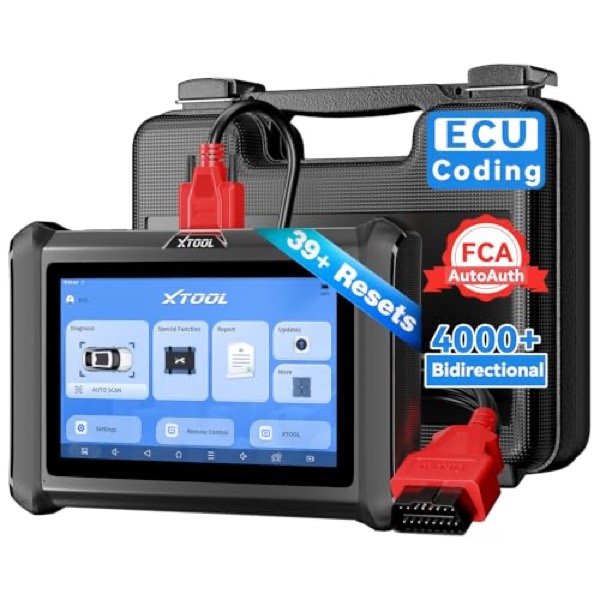
4. LAUNCH CRP909E: Best Budget Full-System Scanner for Hyundai Tucson
- Reads Hyundai manufacturer-specific codes including P1326 KSDS across engine, ABS, SRS, TCM, and TPMS modules
- 28+ service resets cover oil life, SAS, EPB, ABS bleed, gearbox learning, and throttle relearn on all Tucson generations
- 462+ Amazon ratings at 4.1 stars; 7-inch Android touchscreen with 2 years of free WiFi updates
Overview
The LAUNCH CRP909E sits at the budget end of full-system scanning for the Hyundai Tucson, delivering multi-module code access and 28-plus service resets at a price well below any bidirectional pick on this list, and with more than 460 Amazon ratings at 4.1 stars it has demonstrated consistent real-world performance across the Tucson owner community.
It reads codes across engine, transmission, ABS, SRS, TPMS, and body control modules on all OBD2 Tucson generations in Hyundai enhanced diagnostic mode, returning manufacturer-specific fault descriptions for every stored and pending fault rather than generic P-code text.
The P1326 KSDS code on the 2010-2015 LM-generation G4KH 2.4L Theta II GDi returns in the CRP909E with its Hyundai KSDS description, pending versus confirmed status, and a full freeze frame capture that includes engine load, RPM, coolant temperature, STFT, and LTFT at the fault-set moment, the same freeze frame data that a Hyundai dealer examines when evaluating extended warranty eligibility for rod bearing wear.
The 7-inch 1024×600 Android touchscreen with auto-VIN identification routes directly to the correct Tucson module menu in under 10 seconds without manual model year navigation, and the one-click WiFi update process keeps the Hyundai OEM code database current for the included 2-year period.
For the majority of Tucson owners who need to understand why the check-engine light is on, confirm that all service systems are healthy before a road trip, or perform post-maintenance resets after an oil change or brake service, the CRP909E covers those tasks completely without paying for bidirectional capability they will rarely use.
The 28-plus service functions handle the most common Tucson post-maintenance resets: oil life reset, TPMS indirect relearn (warning lamp reset, not sensor ID programming), SAS calibration after steering work, EPB service and retract, ABS brake bleeding, gearbox adaptation learning after a fluid service, throttle body relearn, and BMS battery matching after a battery replacement.
These functions handle the post-maintenance reset needs on 2015-to-2020 TL-generation Tucsons and the 4th-gen NX4 standard non-hybrid variants, covering the overwhelming majority of scheduled maintenance scenarios without a dealer scan tool. The auto-VIN function identifies the Tucson’s exact module configuration in under 10 seconds and routes directly to the correct system menu without navigating model year sub-menus.
Live data on the CRP909E displays parameters for each module individually, including fuel trim values, MAF sensor voltage, CVVT cam position angle, and knock sensor feedback from the GDi engine. Freeze frame captures all active PIDs at the fault-set moment, which is the correct starting point for diagnosing the Theta II KSDS trigger condition before deciding whether to pursue a Hyundai extended warranty claim.
The FCA AutoAuth module in the CRP909E firmware provides gateway access for FCA-platform vehicles, and while this function does not affect Hyundai Tucson diagnostics directly, it indicates the scanner’s overall protocol depth relative to other budget full-system tools.
The CRP909E has no bidirectional control, meaning it cannot send actuation commands to CVVT solenoids, perform TPMS sensor ID programming for a replacement or second-set sensor, run a guided ABS bleeding sequence, or write EPS steering angle calibration data after a rack replacement. The NX4 PHEV and 48V mild-hybrid modules are partially accessible for DTC reading and basic live data, but active hybrid system tests are not available.
The TPMS reset function resets the warning lamp through indirect relearning rather than sensor ID programming, so fitting winter wheels with new TPMS sensors still requires a bidirectional scanner or a dedicated TPMS relearn tool.
Diagnostic Features and Capabilities
The CRP909E reads and clears codes across all OBD2-accessible Hyundai Tucson modules including ECM, TCM, ABSCM, SRS, TPMS, BCM, and HVAC, with Hyundai enhanced manufacturer-specific code descriptions for every fault in every supported system.
Live data covers Hyundai-specific PIDs in enhanced mode including CVVT cam angle position on both intake and exhaust banks, STFT and LTFT per bank, MAF airflow, throttle position, knock sensor voltage, coolant temperature, intake air temperature, and injector pulse width, with graphing and freeze frame capture at fault-set conditions.
Service functions include oil life reset, SAS calibration after steering work, EPB retract and service mode, BMS battery matching after 12V battery replacement, DPF regeneration on diesel-market Tucson variants, throttle body relearn, ABS brake bleed sequence, gearbox adaptation learning after a fluid service, and TPMS indirect warning lamp reset after tire rotation or seasonal pressure adjustment.
Auto-VIN identification reads the Tucson’s exact module configuration from the OBD2 port and routes to the correct system menu in under 10 seconds.
Two years of free WiFi updates are included from registration, covering Hyundai OEM database revisions for new model year fault code additions and service reset procedure updates. Mode 6 component monitor test results and I/M readiness status are accessible for emissions inspection preparation on older JM and LM-generation Tucsons.
Vehicle Compatibility
The CRP909E covers all four Hyundai Tucson platform generations for full-system code access and service resets on standard non-PHEV powertrains, with basic DTC reading and limited live data on hybrid variants. The 2005-2009 JM generation is supported across the G4GC 2.0L, G6BA 2.7L V6, and D4EA diesel for standard OBD2 and Hyundai enhanced code reading.
The 2010-2015 LM generation is fully covered for P1326 KSDS reading, service resets, and multi-system DTC access on the G4NA 2.0L Nu GDi, G4KH 2.4L Theta II GDi, and D4HA diesel.
The 2016-2020 TL generation is supported for full-system scanning and service resets on the G4FJ 1.6T Gamma GDi and G4NA 2.0L Nu GDi, and the 2021-onward NX4 standard G4FW 1.6T Smartstream GDi is covered for code access and service resets, with the 48V MHEV and PHEV modules returning basic DTC data.
Broader coverage extends to more than 80 vehicle makes from 1996 onward. The 7-inch 1024×600 touchscreen runs Android 7.1, and two years of free WiFi updates are included from registration.
Specifications
| Specification | Details |
|---|---|
| Connection | OBD2 cable (wired) |
| Supported Systems | Engine, TCM, ABS, SRS, TPMS, BCM, HVAC |
| OBD2 Functions | All 10 modes, Hyundai enhanced manufacturer codes |
| Bidirectional Control | No |
| Service Functions | 28+ including oil, SAS, EPB, BMS, DPF, TPMS indirect, ABS bleed, gearbox learning |
| Vehicle Compatibility | 80+ brands, 2005+ Hyundai Tucson |
| Display | 7-inch touchscreen, 1024×600, Android 7.1 |
| Updates | 2 years free via WiFi |
| Subscription | None required |
What’s Included
The package includes the CRP909E scanner unit, OBD2 main cable, USB charging cable, carrying case, and a registration card for the 2-year update period.
Full-system diagnosis covers Engine, Transmission, ABS, SRS, BCM, TPMS, Suspension, and HVAC modules.
On the Hyundai Tucson, 15 maintenance and reset functions include oil, EPB, DPF, SAS, TPMS, sunroof, and injector coding.
The scanner works on 2019 Mercedes, 2016 Hyundai, 2013 BMW, and 2013 Kia vehicles per verified user reports.
Pros and Cons
| Pros | Cons |
|---|---|
| Reads P1326 KSDS and all Hyundai manufacturer-specific codes with full freeze frame capture | No bidirectional control and no TPMS sensor ID programming; fitting replacement sensors still requires a separate relearn tool |
| 28+ service resets cover oil, SAS, EPB, ABS bleed, and gearbox learning on all standard Tucson generations | |
| Auto-VIN identifies exact Tucson module configuration in under 10 seconds without manual model year input | |
| Live data with graphing shows CVVT cam position angle and knock sensor feedback in real time | |
| 2 years of free WiFi updates; no recurring subscription after the included period | |
| Full-system code access at a budget price point where most alternatives cover only OBD2 engine codes |
My Final Verdict
The CRP909E is the right pick for a Tucson owner who wants full multi-system code access and the most common maintenance resets without paying for bidirectional capability they will rarely use. It handles the P1326 KSDS diagnostic workflow from code read through freeze frame capture and fault description, and the gearbox learning and ABS bleed functions alone save more than the scanner’s price at a single dealer service appointment.
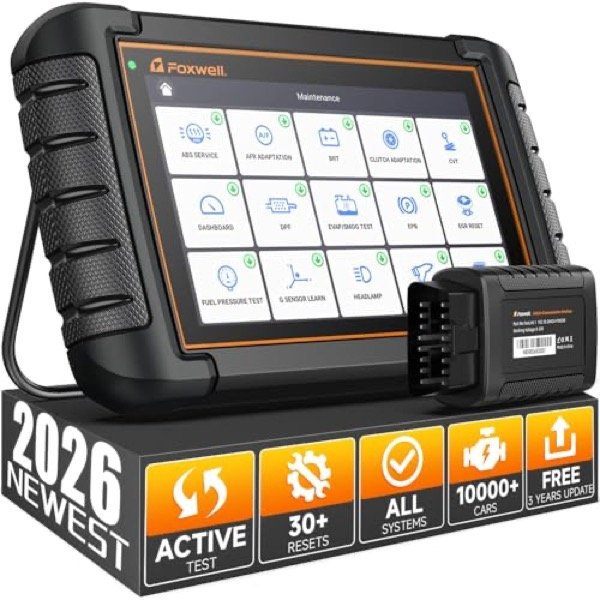
5. Foxwell NT809BT: Best Wireless Bidirectional OBD2 Scanner for Hyundai Tucson
- CVVT solenoid actuation tests on intake and exhaust banks confirm GDi actuator response before condemning the solenoid
- TPMS sensor ID programming and CANFD/DoIP support cover 2022+ NX4 models without a separate relearn tool
- Wireless Bluetooth VCI with 30+ service resets; 3 years of free updates from purchase date
Overview
The Foxwell NT809BT is the wireless bidirectional pick for Tucson owners who want actuation-level control without the price and operational overhead of a professional OEM-depth system, and its 3-year free update period is one of the most generous on this entire list.
It connects over Bluetooth between a standalone 7-inch Android display and a VCI dongle that stays plugged into the Tucson’s OBD2 port, so the tablet can be used from the driver’s seat, the engine bay, or anywhere within Bluetooth range during an engine-running diagnostic session.
A full Hyundai system scan across any Tucson generation, from the 2005 JM’s G4GC 2.0L DOHC through the 2022-plus NX4’s G4FW 1.6T Smartstream PHEV, completes in under three minutes and returns codes from every accessible module including the NX4 HTRAC AWD controller and the 48V MHEV battery management unit.
The scanner activates Hyundai enhanced manufacturer protocol on all supported Tucson generations, returning Hyundai-specific code descriptions including the P1326 KSDS with KSDS counter and knock amplitude in freeze frame on LM and TL Theta II GDi engines, and CVVT cam angle discrepancy codes with the correct Hyundai fault text rather than a generic camshaft position description.
CANFD and DoIP firmware in the NT809BT handles the NX4 gateway architecture, giving complete module access on the HTRAC AWD controller and PHEV high-voltage modules that older scanner firmware cannot reach, making it the most complete wireless bidirectional option for 2021-plus Tucson owners in this price range.
The bidirectional active test library covers CVVT solenoid actuation on both the intake and exhaust banks of Hyundai GDi engines, giving you a direct confirmation of solenoid response before condemning the variable valve timing actuator on a stuck CVVT diagnostic code.
EPS steering angle reset runs through the NT809BT’s dedicated calibration menu after a rack-and-pinion or steering column replacement, and the ABS bleed sequence steps through all four calipers in the correct Hyundai-specified order with on-screen prompts. On the NX4 platform, the scanner returns live data from the HTRAC AWD clutch assembly and supports a bidirectional clutch engagement command to confirm actuator response under load.
The service function library covers more than 30 resets, including oil life reset, SAS calibration, EPB retract and service, BMS battery matching, injector coding on supported Hyundai variants, throttle body relearn, gearbox adaptation learning after a fluid service, DPF regeneration, and TPMS sensor ID programming.
TPMS sensor programming runs through a standalone TPMS service menu that handles sensor activation, ID registration, and the full relearn procedure for Tucson models that require scan-tool input after fitting a second set of wheels. CANFD and DoIP protocol support in the NT809BT firmware covers the 2022-plus NX4 gateway architecture, giving the scanner full module access on the generation that otherwise locks out many mid-tier tools.
ECU coding is available on the NT809BT through the advanced function menu, but the parameter depth is below the TOPDON Phoenix Lite 2 and the Autel MaxiSys level: personalization changes and feature enable/disable functions are limited compared to a full OEM-depth coding tool.
Topology mapping on the NT809BT shows module communication status but does not generate the full visual network diagram with fault overlay that the TOPDON provides on the NX4 platform. The 3-year free update period is more generous than most competitors in this price range, but the post-period subscription cost should be factored in for shops that need Hyundai calibration data for each new model year release.
Diagnostic Features and Capabilities
The NT809BT covers all Hyundai Tucson modules including ECM, TCM, ABSCM, SRS, TPMS, BCM, HVAC, immobilizer, HTRAC AWD controller, and 48V MHEV battery management unit through Hyundai enhanced manufacturer protocol, with more than 3,000 bidirectional active test functions.
In Hyundai enhanced mode the live data stream returns manufacturer-specific PIDs including intake and exhaust CVVT cam target angle versus actual angle on both GDi cam banks, CVVT oil control valve solenoid duty cycle percentage, individual STFT and LTFT per bank, knock retard angle BTDC, MAF airflow, injector pulse width, HTRAC torque distribution ratio, and 48V battery state-of-charge and cell voltage differential.
Bidirectional active tests specific to the Hyundai Tucson include CVVT solenoid engagement on both intake and exhaust banks with real-time cam angle feedback, EPS steering torque sensor calibration using the Hyundai-specified procedure, ABS brake bleed sequence for all four calipers in Hyundai order, HTRAC AWD clutch engagement commands on NX4 all-wheel-drive models, throttle body full-range actuator test, and per-injector balance rate cut tests on GDi engines.
Service functions include 30-plus resets: TPMS sensor ID programming with full sensor activation, ID registration, and relearn confirmation; EPS calibration; ABS bleed; gearbox adaptation learning after fluid service; oil life reset; SAS calibration; EPB retract and service; BMS battery matching; DPF regeneration on diesel variants; throttle body relearn; and injector coding on supported Hyundai variants.
CANFD and DoIP firmware provides complete module access on 2022-plus NX4 gateway nodes. Live data includes graphing, parameter overlay comparison, and session recording with export.
Vehicle Compatibility
The NT809BT covers all four Hyundai Tucson generations with full bidirectional and service reset access. The 2005-2009 JM generation is supported for code reading and service functions across the G4GC 2.0L, G6BA 2.7L V6, and D4EA 2.0L CRDI diesel. The 2010-2015 LM generation is fully covered including the G4NA 2.0L Nu GDi, G4KH 2.4L Theta II GDi for P1326 KSDS diagnosis, and D4HA 2.2L CRDI diesel.
The 2016-2020 TL generation supports full bidirectional actuation on the G4FJ 1.6T Gamma GDi and G4NA 2.0L Nu GDi, with CVVT dual-bank actuation tests, EPS calibration, and ABS bleed confirmed.
The 2021-onward NX4 is covered in standard, 48V MHEV, HEV, and PHEV variants with CANFD and DoIP firmware for complete gateway access. Broader library coverage reaches 130-plus makes and more than 10,000 models. The 7-inch Android tablet has 32 GB of internal storage and a 4,000 mAh battery delivering approximately four hours per charge.
Specifications
| Specification | Details |
|---|---|
| Connection | Bluetooth (VCI dongle to 7-inch Android tablet) |
| Supported Systems | Engine, TCM, ABS, SRS, TPMS, BCM, HVAC, Immobilizer |
| OBD2 Functions | All 10 modes, Hyundai enhanced manufacturer codes |
| Bidirectional Control | Yes, 3,000+ active tests |
| Service Functions | 30+ including TPMS sensor programming, EPS, ABS bleed, gearbox learning, injector coding |
| Vehicle Compatibility | 130+ makes, 2005+ Hyundai Tucson including NX4 hybrid and PHEV |
| Display | 7-inch touchscreen, Android OS, 32 GB storage |
| Updates | 3 years free from purchase date |
| Subscription | Annual fee after 3-year included period |
What’s Included
The package includes the NT809BT tablet, Bluetooth VCI adapter, OBD2 main cable, USB cable, and a carry case.
For Hyundai Tucson diagnostics, 30+ maintenance resets include oil service, EPB, battery registration, SAS calibration, DPF, and TPMS programming.
In practice on the Hyundai Tucson, wireless design eliminates the tethered cable, allowing the tablet to sit on the seat while you diagnose from under the vehicle.
Provides full-system diagnosis on Subaru, covering EyeSight camera modules, CVT adaptations, and AVCS timing codes.
Pros and Cons
| Pros | Cons |
|---|---|
| Wireless Bluetooth VCI allows full diagnostics from the driver’s seat or engine bay without a tethered cable | ECU coding depth is below the TOPDON Phoenix Lite 2, limiting advanced module personalization options |
| CVVT solenoid actuation tests on intake and exhaust banks confirm actuator response on GDi engines | |
| TPMS sensor ID programming covers 2022+ NX4 winter wheel swaps without a separate relearn tool | |
| CANFD and DoIP protocol support for full 2022+ NX4 module gateway access | |
| 30+ service resets include gearbox learning and EPS calibration for post-repair Tucson work | |
| 3 years of free updates from purchase date; more generous than most scanners in this price range |
My Final Verdict
The Foxwell NT809BT is the right pick for Tucson owners or independent garages that want wireless bidirectional control, TPMS sensor programming, and CANFD coverage at a price below the professional tier.
The wireless operation and CVVT active test depth make it practical for diagnosing Hyundai GDi variable valve timing faults and handling NX4 winter wheel TPMS registration without a dealer appointment, and the 3-year free update period protects the investment through several Hyundai model year transitions.
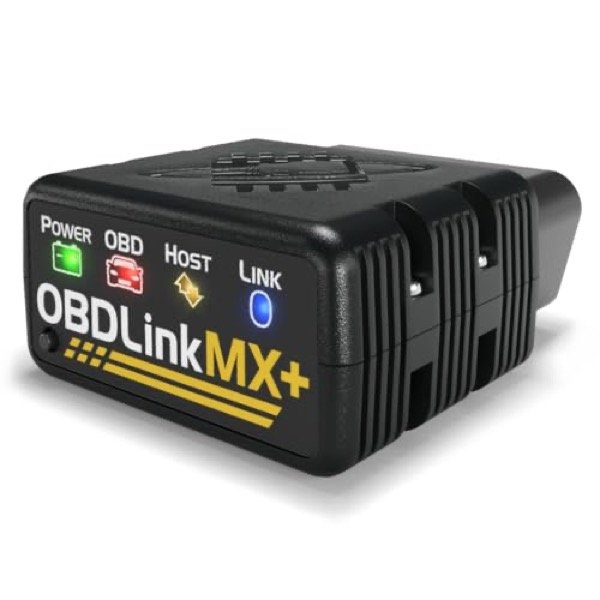
6. OBDLink MX+: Best Bluetooth App-Based Scanner for Hyundai Tucson
- Pairs with Car Scanner ELM OBD2 and OBDLink apps to access Hyundai extended PIDs beyond the 16 standard OBD2 parameters
- Anti-theft Bluetooth security blocks unauthorized app connections while the dongle is paired to your device
- 6,000+ Amazon ratings at 4.4 stars; supports iOS and Android with no annual subscription and no fees
Overview
The OBDLink MX+ sits in the same app-based Bluetooth category as the BlueDriver Pro but takes a fundamentally different approach to software: rather than locking diagnostic capability to a single proprietary app, it works with a wide ecosystem of iOS and Android apps, and with more than 6,000 Amazon ratings at 4.4 stars it has a verified user base that spans multiple years of Tucson ownership experience across all four platform generations.
The adapter connects via Bluetooth 4.2 to any phone or tablet, and the OBDLink app itself supports all 10 standard OBD2 modes at no cost, but the real diagnostic depth for Hyundai Tucson owners comes from pairing it with Car Scanner ELM OBD2, which carries a Hyundai manufacturer-specific extended PID library that returns data far beyond what the standard 16 OBD2 PIDs cover.
On a 2011-plus Tucson in Hyundai enhanced mode through Car Scanner, the MX+ returns live CVVT cam target angle versus actual angle deviation on both the intake and exhaust banks of the GDi engine, CVVT oil control valve solenoid duty cycle percentage, individual STFT and LTFT per bank, fuel injector timing correction values per cylinder, MAF airflow in grams per second, throttle body actual versus commanded position, and knock sensor correction angle in degrees BTDC, giving a Tucson owner the same real-time powertrain data a dealer technician sees on a factory Hyundai GDS scan session without the dealer appointment cost.
The adapter’s proprietary anti-theft Bluetooth security protocol prevents any unauthorized app from connecting while the MX+ is actively paired, which matters when leaving the dongle plugged in overnight for a data-logging session on an intermittent CVVT fault.
OBDLink also supports SAE J1939, J1708, and the GM-specific ALDL protocol beyond standard OBD2, making the adapter compatible with commercial vehicles and older domestic platforms that no other Bluetooth adapter on this list covers.
OBDLink’s implementation of the Hyundai enhanced protocol reads manufacturer-specific fault codes across engine, transmission, ABS, SRS, and TPMS modules when paired with an app that supports those PIDs. The P1326 KSDS code on Theta II GDi engines returns with manufacturer freeze frame data, and the MX+ reads all stored, pending, and permanent codes from whichever systems the connected app supports.
The Bluetooth 4.2 connection is secured by a proprietary anti-theft protocol that blocks any app other than the one actively paired from connecting to the dongle while in use, which matters when the scanner is left plugged in overnight or during a long data-logging session.
The MX+ also supports the SAE J1939 and J1708 heavy-duty protocols and the GM-specific ALDL protocol, making it one of the broader-compatibility Bluetooth adapters on the market beyond standard OBD2 passenger vehicles.
The live data stream through Car Scanner ELM OBD2 on a paired 2011-plus Tucson displays CVVT cam angle positions on both the intake and exhaust banks, knock sensor correction values from the GDi engine’s ignition system, individual short-term and long-term fuel trim per bank, MAF airflow rate, and throttle body actual position versus commanded position.
These parameters give a Tucson owner the same real-world data a dealer technician monitors during a Hyundai factory GDS diagnostic session for CVVT or fuel delivery fault tracing, without the cost of the full tool suite. Mode 6 component monitor test results, needed when verifying emissions monitor completion before a state inspection, are also accessible through the OBDLink app.
The MX+ has no bidirectional control capability and no service reset functions in any compatible app. TPMS sensor ID programming, ABS bleed sequences, EPS steering angle calibration, oil life reset, and BMS battery matching are all outside the scope of this tool regardless of which app is used. Tucson owners who fit winter wheels with new TPMS sensors still need a separate bidirectional scanner or TPMS relearn tool for the sensor ID registration step.
The NX4 PHEV drivetrain modules and the 48V mild-hybrid battery management system return basic DTC and status data through supported apps, but no active control or adaptation functions are available for those systems.
Diagnostic Features and Capabilities
The OBDLink MX+ supports all 10 OBD2 modes with Hyundai enhanced manufacturer-specific PID access through Car Scanner ELM OBD2 and other compatible apps, covering engine, transmission, ABS, SRS, and TPMS codes on 2011-plus Tucson models along with P1326 KSDS in manufacturer-specific mode with freeze frame on Theta II GDi engines.
Live data through Car Scanner in Hyundai enhanced mode returns more than 300 manufacturer-specific parameters per module, including CVVT intake and exhaust cam target angle versus actual angle, CVVT solenoid duty cycle percentage on each bank, knock retard timing angle, individual STFT and LTFT per bank, MAF airflow, injector pulse width, throttle actual versus commanded position, and coolant and intake air temperature.
Mode 6 component monitor test results, needed for emissions readiness verification before a state inspection on older JM or LM-generation Tucsons, are accessible through the OBDLink app at no cost. Mode 2 freeze frame data captures all active PIDs at the fault-set moment, with the Hyundai-specific KSDS counter and knock amplitude fields populated on P1326 reads.
Session data can be exported from Car Scanner as CSV files for off-device analysis, and the app supports parameter overlay graphs showing up to eight PIDs simultaneously in a single scrollable view. Firmware updates for the MX+ hardware itself are delivered free through the OBDLink app.
Vehicle Compatibility
The OBDLink MX+ covers all 1996-and-newer OBD2-compliant vehicles for standard code reading and activates Hyundai enhanced manufacturer mode on 2011-plus Tucson models through Car Scanner ELM OBD2 and other compatible apps. The 2011 model year start of enhanced mode coverage applies to the LM-generation G4NA 2.0L Nu GDi and G4KH 2.4L Theta II GDi, and the enhanced PID library extends through the TL generation and the NX4 standard G4FW 1.6T Smartstream GDi.
The Bluetooth 4.2 LE adapter connects to any iOS 10-plus iPhone or iPad or any Android 5.0-plus device, and the USB-C port supports wired diagnostics on Windows and Mac via OBDLink PC software for extended data-logging sessions. SAE J1939, J1708, and GM-specific ALDL protocol support extends the adapter’s compatibility to commercial vehicles and older domestic platforms that no other app-based Bluetooth adapter on this list supports.
No subscription or annual fee is required for any function; firmware updates are free through the OBDLink app.
Specifications
| Specification | Details |
|---|---|
| Connection | Bluetooth 4.2 (iOS and Android) + USB |
| Supported Systems | Engine, TCM, ABS, SRS, TPMS via compatible app |
| OBD2 Functions | All 10 modes; Hyundai enhanced PIDs via Car Scanner ELM OBD2 |
| Bidirectional Control | No |
| Service Functions | None |
| Vehicle Compatibility | 1996+ OBD2; 2011+ Hyundai Tucson enhanced mode |
| Display | None — uses iOS or Android device screen |
| Updates | Free firmware updates via OBDLink app |
| Subscription | None |
What’s Included
The package includes the OBDLink MX+ Bluetooth adapter; the OBDLink app is downloaded free from the App Store or Google Play. Compatible third-party apps such as Car Scanner ELM OBD2 are available separately at low or no cost.
In practice on the Hyundai Tucson, on Ford vehicles the MS-CAN access allows reading transmission adapts, fuel trim history, and PATS key status that OBD2-only scanners cannot see.
Real-time fuel trim graphing on two banks simultaneously lets you watch short- and long-term trims converge after a repair.
On the Hyundai Tucson, hacker-proof security mode blocks unauthorized pairing, preventing scan tool theft over Bluetooth in a shop environment.
Pros and Cons
| Pros | Cons |
|---|---|
| Hyundai enhanced PID access through Car Scanner ELM OBD2 covers CVVT cam angle, fuel trim, and GDi knock correction values | No bidirectional control or service resets in any compatible app, so TPMS sensor programming and EPS calibration require a separate tool |
| App flexibility: works with Car Scanner, Torque Pro, OBDLink, and dozens of other iOS and Android OBD apps | |
| Anti-theft Bluetooth protocol blocks unauthorized app connections while the dongle is active | |
| USB-C connection supports wired diagnostics on Windows and Mac via OBDLink software | |
| 6,000-plus Amazon ratings at 4.4 stars; no subscription, no annual fee, firmware updates via app |
My Final Verdict
The OBDLink MX+ is the right pick for Tucson owners who are comfortable working with OBD2 apps and want the deepest live data coverage available from a Bluetooth adapter without being locked into one proprietary interface.
The Car Scanner enhanced Hyundai PID set gives a real-time view of CVVT cam angle deviation and GDi injection correction data that most handheld scanners at this price level do not reach, and the anti-theft connection security makes it practical to leave plugged in for ongoing data logging.
Readers who want the full breakdown of its app ecosystem and Hyundai PID access will find it in my OBDLink MX+ in-depth review.
7. Innova 5610: Best Standalone Handheld for Hyundai Tucson
- Multi-system code reading covers ABS, SRS, TCM, and TPMS on all OBD2 Tucson generations without a phone or subscription
- Built-in battery and alternator test plus oil reset, SAS, and EPB service functions in a single handheld unit
- 2,000+ Amazon ratings at 4.3 stars; color-coded fix assist screen guides fault diagnosis with RepairSolutions2 database

Overview
The Innova 5610 is the pick for Tucson owners who want a completely self-contained handheld scanner with no phone, no app, and no subscription requirement for any diagnostic function, and with more than 2,000 Amazon ratings at 4.3 stars it has the owner validation of an established tool rather than a recent market entry.
The 3.5-inch color screen displays codes, live data, and service function prompts directly on the unit, and the RepairSolutions2 fix assist system provides manufacturer-matched repair information for every stored fault code including the Hyundai-specific descriptions for P1326 KSDS on the 2010-2015 LM G4KH 2.4L Theta II GDi and CVVT cam angle discrepancy codes on the G4FJ 1.6T Gamma GDi and G4NA 2.0L Nu GDi.
The repair information for P1326 in RepairSolutions2 includes the Hyundai KSDS context, the freeze frame parameters that trigger the code, and verified technician repair records from other Hyundai Tucson cases, giving a Tucson owner a concrete picture of what P1326 means for their engine before driving to a dealer.
The tool reads codes from engine, ABS, SRS, transmission, and TPMS modules on all OBD2-equipped Tucson generations across the G4GC and G6BA in the 2005-2009 JM, through the G4KH Theta II GDi and G4NA Nu GDi in the LM and TL, through the G4FW Smartstream 1.6T in the NX4, without any model-year entry or manual vehicle selection step.
On the NX4 48V MHEV and HEV variants, the Innova 5610 reads hybrid battery management and powertrain fault codes alongside standard engine and chassis system codes, covering the diagnostic needs of NX4 owners who want standalone code access without a smartphone workflow.
The built-in 12V battery and alternator test is a feature that distinguishes the Innova 5610 from most other code readers at this price point.
On a 2011-to-2015 LM-generation Tucson or a 2016-to-2020 TL-generation Tucson, the battery test runs without disconnecting any cables, returning cold cranking amp output versus the battery’s rated CCA, alternator output voltage at idle and under load, and diode ripple test results that flag a failing alternator before it drains the battery.
This test set is particularly useful on NX4 Tucson 48V mild-hybrid models, where the 12V battery management system supports a secondary function for the mild-hybrid start-stop circuit and a failed 12V battery affects the MHEV system behavior in ways that can set fault codes in multiple modules simultaneously.
The service function set handles the most common Tucson post-maintenance resets: oil life reset, SAS calibration after a steering component replacement, EPB service and retract for rear caliper work, ABS bleed step-through, gearbox adaptation reset after a fluid service, and TPMS indirect warning lamp reset after a tire rotation.
The TPMS function on the Innova 5610 is an indirect pressure-loss warning reset, not a sensor ID programming function, so fitting a second set of wheels with separate TPMS sensors still requires a bidirectional scanner or dedicated relearn tool for the sensor ID registration step on 2022-plus NX4 models.
Freeze frame capture stores all active PIDs at the fault-set moment, and the live data stream displays up to 20 parameters simultaneously on the color screen with scrollable parameter selection.
The Innova 5610 has no bidirectional actuator control, meaning it cannot send commands to CVVT solenoids, run an active EPS calibration, trigger an ABS motor cycle test, or perform TPMS sensor ID programming beyond the indirect warning lamp reset. ECU coding and key programming are completely outside the scope of the tool.
The NX4 PHEV and hybrid modules are readable for fault codes and basic live data, but no active tests or adaptation sequences are available for the high-voltage battery management unit or the on-board charger module. The Innova 5610’s position on this list reflects its strength as a standalone all-system reader and service reset tool, not as a replacement for a bidirectional scanner when Tucson active component testing is required.
Diagnostic Features and Capabilities
The Innova 5610 reads and clears codes across engine, ABS, SRS, transmission, and TPMS modules on all OBD2 Hyundai Tucson generations using Hyundai manufacturer-specific mode, returning Hyundai fault descriptions from the RepairSolutions2 database for every stored and pending code including P1326 KSDS, CVVT cam angle discrepancy codes, ABS solenoid and motor fault codes, and SRS clock spring and impact sensor fault codes with the same Hyundai description text that a dealer scanner displays.
Live data displays up to 20 parameters simultaneously on the color screen, including CVVT cam angle position on both GDi banks, individual STFT and LTFT per bank, MAF airflow, throttle position, knock sensor voltage, coolant temperature, and injector pulse width, with freeze frame capturing the complete active PID set at the fault-set moment.
The built-in 12V battery and alternator test covers cold cranking amp output versus the battery’s rated CCA, charging system voltage at idle and under electrical load, and an alternator diode ripple measurement that identifies an internally shorted rectifier diode before a complete charging failure occurs, all without disconnecting any battery cables.
On NX4 MHEV Tucson models, the 12V battery test is directly relevant to mild-hybrid system health because a weak 12V battery degrades the 48V belt-ISG start-stop circuit and can generate simultaneous false codes in the engine ECU and MHEV controller.
Service functions include oil life reset, SAS calibration after steering component replacement, EPB retract and service for rear caliper brake work, ABS brake bleed sequence for all four calipers, gearbox adaptation learning after a fluid service, and TPMS indirect warning lamp reset after tire rotation.
The RepairSolutions2 app is available free on iOS and Android for additional repair record matching per stored code, and connects to the Innova 5610 via Bluetooth.
Vehicle Compatibility
The Innova 5610 covers all 1996-plus OBD2-compliant vehicles for standard diagnostics and all four Hyundai Tucson platform generations for multi-system code access and service resets. The 2005-2009 JM generation is supported across the G4GC 2.0L DOHC, G6BA 2.7L V6, and D4EA 2.0L CRDI diesel for full code access and oil reset.
The 2010-2015 LM generation is fully covered including the G4KH 2.4L Theta II GDi for P1326 KSDS reading with RepairSolutions2 repair record matching. The 2016-2020 TL generation supports full multi-system scanning and service resets on the G4FJ 1.6T Gamma GDi and G4NA 2.0L Nu GDi.
The 2021-onward NX4 is supported in standard G4FW 1.6T Smartstream GDi and hybrid variants for DTC reading and oil, EPB, and SAS service resets, with the 48V MHEV battery module accessible for fault code reading. Standalone operation requires no phone or computer connection for any diagnostic or service function. The RepairSolutions2 app is free on iOS and Android for additional repair record access per stored code.
Specifications
| Specification | Details |
|---|---|
| Connection | OBD2 cable (wired); Bluetooth to RepairSolutions2 app |
| Supported Systems | Engine, ABS, SRS, TCM, TPMS |
| OBD2 Functions | All 10 modes; Hyundai manufacturer-specific code descriptions |
| Bidirectional Control | No |
| Service Functions | Oil reset, SAS, EPB, ABS bleed, gearbox learning, TPMS indirect reset |
| Vehicle Compatibility | 1996+ OBD2; 2005+ Hyundai Tucson all generations |
| Display | 3.5-inch color screen, standalone operation |
| Updates | Free via RepairSolutions2 app |
| Subscription | None |
What’s Included
The package includes the Innova 5610 handheld scanner, OBD2 cable, USB cable, and printed quick-start guide. The RepairSolutions2 app is available free from the App Store and Google Play.
Bidirectional active test commands the fuel pump on and off directly, letting you verify fuel delivery without guesswork.
On the Hyundai Tucson, the scanner commands individual fuel injectors to fire or cut out during bidirectional testing, confirming injector function before pulling the fuel rail.
Enhanced live data covers ABS, SRS, and transmission modules beyond engine sensors alone.
Pros and Cons
| Pros | Cons |
|---|---|
| Completely standalone: no phone, no app, and no subscription required for any diagnostic or service function | No bidirectional control, so CVVT solenoid tests, EPS calibration, and TPMS sensor ID programming are not available |
| Built-in 12V battery and alternator test supports MHEV start-stop circuit diagnosis on NX4 Tucson models | |
| Multi-system code reading covers ABS, SRS, TCM, and TPMS with Hyundai manufacturer-specific descriptions | |
| RepairSolutions2 fix assist ties each stored code to matched Hyundai repair records from verified technicians | |
| Oil reset, SAS, EPB, ABS bleed, and gearbox adaptation reset cover all standard Tucson post-maintenance needs | |
| 2,000-plus Amazon ratings at 4.3 stars; no recurring fee after purchase |
My Final Verdict
The Innova 5610 is the right pick for the Tucson owner who wants a complete all-system diagnostic and service reset capability in a single handheld unit without any app dependency. The battery and alternator test adds useful diagnostic value for NX4 MHEV models where 12V battery health affects the mild-hybrid system behavior, and the RepairSolutions2 repair matching gives useful context for KSDS and CVVT fault codes before deciding on a repair approach.
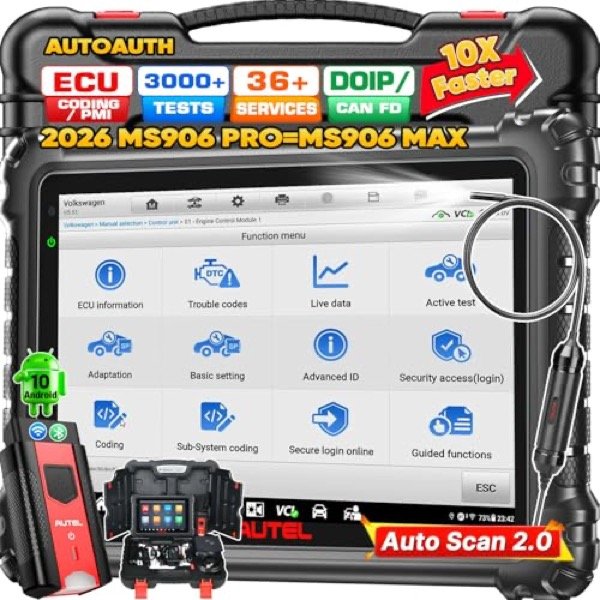
8. Autel MaxiSys MS906 Pro: Best Professional OBD2 Scanner for Hyundai Tucson
- ECU coding writes parameter changes and enables factory-installed features on Tucson NX4 modules that the MK808BT PRO V2 cannot reach
- Topology map displays the full NX4 ECU network with active fault overlay before any sub-menu is opened
- 1,000+ Amazon ratings at 4.5 stars; CANFD and DoIP cover the complete 2022+ NX4 gateway protocol stack
Overview
The Autel MaxiSys MS906 Pro is the professional-shop-grade pick on this list, positioned above the MK808BT PRO V2 in ECU coding depth and topology mapping capability and below the MaxiSys Elite in key programming scope, and with more than 1,000 Amazon ratings at 4.5 stars it has a verified performance record across professional diagnostic shops.
For Hyundai Tucson diagnostics, it is the tool independent technicians reach for when the repair involves module replacement requiring VIN-specific coding, active parameter adjustment in the Smartstream GDi ECU after injector replacement, or a network-level fault trace across the NX4 platform’s HTRAC AWD controller, 48V MHEV battery management unit, and PHEV on-board charger simultaneously.
The 9.7-inch touchscreen tablet runs Android 11 with the wireless MaxiFlash VCI adapter, giving a clean working environment during extended multi-module diagnostic sessions where cross-referencing several live data streams at once is the standard workflow.
The Hyundai OEM protocol coverage on the MS906 Pro follows the structure of the factory Hyundai GDS diagnostic software with manufacturer-specific function menus for each Tucson module, and the live data library returns PID labels in Hyundai factory naming conventions, the same parameter names a dealer technician sees during a factory scan session on the same vehicle.
On the NX4 PHEV, the MS906 Pro is the lowest-priced tool on this list that can simultaneously display live data from the PHEV high-voltage battery management unit, the on-board charger, and the front-axle ECM in a parameter overlay view, which is the diagnostic approach needed when an NX4 PHEV charging fault generates symptoms in multiple modules at once.
Topology mapping is where the MS906 Pro’s advantage over the MK808BT PRO V2 becomes most concrete for NX4 Tucson diagnostics. The map renders the full vehicle ECU network in a visual layout, showing each module’s communication status, fault count, and network address before any individual module menu is opened.
On an NX4 PHEV with an intermittent fault on the high-voltage battery monitoring unit, a topology view immediately shows whether the fault is module-level or network-level communication, saving the diagnostic time that a module-by-module sequential scan approach requires.
ECU coding on the MS906 Pro covers Hyundai-specific functions including replacement controller area network module coding to the vehicle’s VIN, comfort feature enable and disable through the body control module parameter menu, and Smartstream GDi fuel injection timing base value adjustment after injector replacement.
The bidirectional active test library runs to more than 5,000 functions across supported vehicles, with Hyundai-specific tests covering CVVT solenoid engagement on both GDi engine valve timing actuators, individual injector contribution cut tests for cylinder-by-cylinder combustion quality diagnosis, HTRAC AWD clutch engagement commands on NX4 all-wheel-drive models, adaptive damper actuator response tests on NX4 trims fitted with the electronically controlled suspension, and EPS steering torque sensor calibration after a steering rack or column replacement.
TPMS sensor ID programming is handled through the dedicated TPMS service menu with full sensor activation, ID registration, and relearn support for all Tucson generations including the 2022-plus NX4 models that have no physical TPMS reset button.
Key programming on the MS906 Pro covers Hyundai proximity key and standard key fob addition and deletion on a significant portion of Tucson model years, but the full dealer-level key programming coverage for all NX4 variants requires the MaxiIM IM608 Pro or MaxiIM IM100 key programming tool, which is designed specifically for immobilizer work.
The annual update subscription for the MaxiSys product family is a recurring cost that independent shops should factor into the total investment, as the Hyundai OEM calibration database for new NX4 model year variants is only accessible to scanners with an active subscription. Existing diagnostic functions for already-covered model years continue to operate after the subscription lapses without access to newly added vehicle coverage.
Diagnostic Features and Capabilities
The MS906 Pro covers all Hyundai Tucson modules including ECM, TCM, ABSCM, SRS, TPMS, BCM, HVAC, immobilizer, instrument cluster, HTRAC AWD controller, and all NX4 hybrid and PHEV drivetrain modules through Hyundai manufacturer protocol, with full-system topology mapping that renders every module’s communication status and active fault count in a visual network layout before any sub-menu is opened.
In Hyundai enhanced mode the scanner returns OEM-level manufacturer-specific PIDs including CVVT intake and exhaust cam target versus actual angle, CVVT solenoid duty cycle percentage, knock retard angle BTDC, individual STFT and LTFT per bank, injector pulse width, HTRAC torque distribution ratio, NX4 48V battery state-of-charge, cell voltage differential, MHEV motor torque output versus commanded assist, PHEV high-voltage battery SOC, and on-board charger AC input current and DC output voltage.
Bidirectional active tests exceed 5,000 functions including CVVT solenoid engagement on both GDi cam banks with real-time cam angle feedback, per-injector balance rate cut tests for cylinder contribution analysis, HTRAC AWD multiplate clutch engagement commands, adaptive damper actuator response tests on NX4 suspension-equipped trims, EPS steering torque sensor calibration, ABS hydraulic solenoid actuation and motor cycle tests, and NX4 PHEV on-board charger output tests.
ECU coding covers replacement BCM VIN configuration, comfort feature enable and disable through BCM parameter menus, Smartstream GDi ECU injection base value adjustment after injector replacement, and module address coding for replacement NX4 modules.
Service functions exceed 40 Hyundai-specific resets. CANFD and DoIP firmware handles the complete NX4 gateway architecture for all module types. Live data includes parameter overlay comparison between simultaneous PID channels, multi-graph display, and session recording with CSV export.
Vehicle Compatibility
The MS906 Pro covers all four Hyundai Tucson platform generations with full ECU coding, topology mapping, and bidirectional diagnostic access. The 2005-2009 JM generation supports ECU coding and full code access across the G4GC 2.0L DOHC, G6BA 2.7L V6, and D4EA 2.0L CRDI diesel.
The 2010-2015 LM generation is fully covered including the G4NA 2.0L Nu GDi and G4KH 2.4L Theta II GDi for P1326 KSDS diagnosis with KSDS counter and knock amplitude from freeze frame, and the D4HA 2.2L CRDI diesel. The 2016-2020 TL generation supports full bidirectional actuation, ECU coding, and service resets on the G4FJ 1.6T Gamma GDi and G4NA 2.0L Nu GDi with confirmed CVVT dual-bank actuation, EPS calibration, and ABS bleed sequences.
The 2021-onward NX4 is covered in standard G4FW 1.6T Smartstream GDi, 48V MHEV, HEV, and PHEV configurations, with CANFD and DoIP firmware for complete gateway access and ECU coding support for NX4 replacement module configuration. Overall library coverage reaches 170-plus makes and more than 12,000 models, with FCA SGW gateway authorization built into the MaxiFlash VCI firmware.
Specifications
| Specification | Details |
|---|---|
| Connection | WiFi (MaxiFlash wireless VCI), Bluetooth, USB-C |
| Supported Systems | Full system with topology map, ECU coding, PHEV and MHEV modules |
| OBD2 Functions | All 10 modes, OEM-level Hyundai manufacturer codes and extended PIDs |
| Bidirectional Control | Yes, 5,000+ active tests |
| Service Functions | 40+ including ECU coding, module VIN coding, TPMS sensor programming |
| Vehicle Compatibility | 170+ makes, 2005+ Hyundai Tucson all variants including PHEV |
| Display | 9.7-inch touchscreen, Android 11, 15,000 mAh battery |
| Updates | 1 year free, then annual subscription |
| Subscription | Required for new model year Hyundai OEM database updates |
What’s Included
The package includes the MS906 Pro tablet, MaxiFlash VCI, OBD2 main cable, USB-C cable, charging adapter, carry case, and a basic OBD1 adapter set for supported legacy vehicles.
Auto Scan 2.0 performs a full vehicle health check scanning all available modules with a single button press.
For Hyundai Tucson diagnostics, the scanner reads and clears codes across PCM, ECM, TCM, BCM, and every additional module the vehicle exposes on the OBD network.
In practice on the Hyundai Tucson, VAG Guided Function provides step-by-step procedures for Volkswagen and Audi adaptations and coding sequences.
Pros and Cons
| Pros | Cons |
|---|---|
| ECU coding writes VIN-specific module configuration and parameter changes that the MK808BT PRO V2 cannot perform | Full key programming for all NX4 Tucson variants requires a dedicated MaxiIM tool beyond the MS906 Pro’s scope |
| Topology map shows the full NX4 ECU network with fault overlay for network-level intermittent fault tracing on PHEV models | |
| 5,000+ bidirectional active tests include CVVT bank actuation, injector cut tests, and HTRAC AWD clutch commands | |
| CANFD and DoIP cover the complete 2022+ NX4 gateway architecture without protocol gaps | |
| 40+ service functions cover every Hyundai Tucson reset from module coding to TPMS sensor programming | |
| 9.7-inch display and 15,000 mAh battery support extended multi-module diagnostic sessions in the field |
My Final Verdict
The MS906 Pro is the right pick for independent shops that service Hyundai Tucson, Kia Sportage, and Genesis GV70 on a regular basis and need ECU coding, topology-assisted fault tracing, and NX4 PHEV drivetrain active tests in a single professional tool. The topology mapping alone justifies the step up from the MK808BT PRO V2 for any shop diagnosing intermittent network faults on the NX4 platform’s shared CAN bus architecture.
9. LAUNCH Creader Elite 1.0: Best Mid-Range Bidirectional for Hyundai Tucson
- Bidirectional active tests include CVVT solenoid actuation, EPS calibration, and ABS bleeding on all supported Tucson generations
- 38+ service resets cover oil, SAS, EPB, TPMS sensor learning, BMS registration, gearbox adaptation, and DPF on one tool
- 500+ Amazon ratings at 4.2 stars; 5-inch Android touchscreen with 2 years of free updates
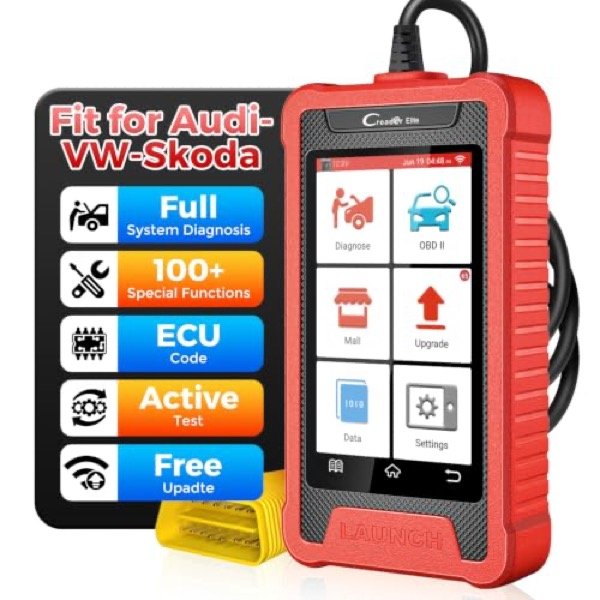
Overview
The LAUNCH Creader Elite 1.0 is the mid-range bidirectional pick on this list, sitting between the no-active-test LAUNCH CRP909E and the professional-tier LAUNCH tools in capability and price, and with more than 500 Amazon ratings at 4.2 stars it has a verified performance record that extends across multiple Tucson platform generations.
It covers all Hyundai Tucson systems including the NX4 platform’s HTRAC AWD controller, the 48V MHEV battery management unit, and the PHEV on-board charger, returning manufacturer-specific fault codes and live data across every accessible module in a full system scan that completes in under three minutes.
The 5-inch Android touchscreen tablet is more compact than the 7- and 8-inch systems elsewhere on this list, making it practical to hold one-handed while operating bidirectional test menus with the other hand during an engine-running diagnostic session.
Hyundai enhanced mode activates across all Tucson generations from the 2005 JM G4GC 2.0L DOHC through the 2022-plus NX4 G4FW 1.6T Smartstream PHEV, returning manufacturer-specific code descriptions including P1326 KSDS with KSDS counter and knock amplitude in freeze frame on LM and TL Theta II GDi engines.
The live data stream in Hyundai enhanced mode returns CVVT cam target versus actual angle on both GDi cam banks, CVVT solenoid duty cycle percentage, individual STFT and LTFT per bank, knock retard angle, MAF airflow, injector pulse width, HTRAC torque distribution ratio, and 48V MHEV battery state-of-charge, the full set of parameters a technician needs to work through a Tucson powertrain or drivetrain fault from code read through active confirmation in a single session.
The bidirectional active test library on the Creader Elite 1.0 covers the Hyundai CVVT solenoid engagement test on both the intake and exhaust banks of the GDi engine, allowing a direct confirmation of variable valve timing actuator response before condemning a solenoid on a P0011 or P0014 stuck-open diagnostic.
EPS steering angle calibration runs through the bidirectional menu after a steering component replacement with on-screen step-by-step prompts that follow the Hyundai-specified calibration procedure. The ABS brake bleed sequence steps through all four calipers in the correct Hyundai order, and the HTRAC AWD clutch engagement command confirms actuator response on NX4 all-wheel-drive models during a drivetrain noise or slip-feel diagnosis.
Injector balance rate active tests and throttle body actuator tests are also included for GDi engine fuel delivery diagnostics on 2.0-litre and 2.4-litre Tucson engines.
The 38-plus service reset functions handle all standard Tucson maintenance scenarios, including oil life reset, SAS calibration, EPB retract and service, BMS battery matching after a 12V battery replacement, DPF regeneration on diesel-market Tucson variants, gearbox adaptation learning after a fluid service, throttle body relearn, TPMS sensor learning, and ABS brake bleed sequence.
The TPMS sensor learning function on the Creader Elite 1.0 covers both indirect warning lamp reset and direct sensor ID registration on supported Tucson model years, handling the 2022-plus NX4 requirement for scan-tool input during TPMS sensor ID enrollment without a separate dedicated relearn tool in most cases.
Auto-VIN identification reads the Tucson’s exact module configuration from the OBD2 port and routes directly to the correct system menu without manual model year navigation.
ECU coding on the Creader Elite 1.0 is available through the advanced function menu but is limited in scope compared to the MS906 Pro: personalization adjustments and comfort feature enable or disable are supported on select Hyundai modules, but VIN-level replacement module coding and full parameter-level calibration changes require a higher-tier LAUNCH scanner.
Topology mapping is not available on the Creader Elite 1.0, so network-level fault tracing on the NX4 PHEV gateway requires working through the module list individually rather than from a visual network overview. The 2-year free update period covers Hyundai OEM database revisions through the initial ownership period without additional cost, and the post-period subscription is significantly lower than the professional-tier tools on this list.
Diagnostic Features and Capabilities
The Creader Elite 1.0 covers all Hyundai Tucson modules including ECM, TCM, ABSCM, SRS, TPMS, BCM, HVAC, immobilizer, and HTRAC AWD controller through Hyundai enhanced manufacturer protocol, returning manufacturer-specific fault descriptions for all stored, pending, and permanent codes across every supported system.
Live data in Hyundai enhanced mode returns CVVT cam target versus actual angle on both intake and exhaust GDi cam banks, CVVT solenoid duty cycle percentage, individual STFT and LTFT per bank, knock retard angle BTDC, MAF airflow, injector pulse width, throttle actual versus commanded position, and HTRAC torque distribution ratio, with graphing and multi-parameter overlay available on the 5-inch touchscreen.
Bidirectional active tests cover CVVT solenoid engagement on both GDi cam banks with real-time cam angle feedback, EPS steering torque sensor calibration following the Hyundai-specified procedure, ABS brake bleed sequence for all four Tucson calipers in Hyundai order, HTRAC AWD clutch engagement commands on NX4 all-wheel-drive models, throttle body full-range actuator test, and per-injector balance rate cut tests for cylinder contribution diagnosis.
Service functions include 38-plus Hyundai-specific resets: oil life reset, SAS calibration, EPB retract and service, BMS battery matching after 12V replacement, DPF regeneration on diesel-market variants, gearbox adaptation learning after fluid service, throttle body relearn, TPMS sensor ID learning with activation, ID registration, and relearn confirmation, and ABS brake bleed sequence.
Auto-VIN identification reads the Tucson’s exact module configuration in under 10 seconds. Live data includes graphing, parameter overlay comparison, and freeze frame capture at fault-set conditions.
Vehicle Compatibility
The Creader Elite 1.0 covers all four Hyundai Tucson platform generations with full bidirectional diagnostic access. The 2005-2009 JM generation supports code reading and service resets across the G4GC 2.0L DOHC, G6BA 2.7L V6, and D4EA 2.0L CRDI diesel.
The 2010-2015 LM generation is fully covered including the G4NA 2.0L Nu GDi, G4KH 2.4L Theta II GDi for P1326 KSDS diagnosis, and D4HA 2.2L CRDI diesel, with bidirectional CVVT actuation and ABS bleed confirmed. The 2016-2020 TL generation supports full bidirectional active tests and service resets on the G4FJ 1.6T Gamma GDi and G4NA 2.0L Nu GDi.
The 2021-onward NX4 is covered in standard, MHEV, HEV, and PHEV variants with HTRAC AWD module access and TPMS sensor ID learning for NX4 winter wheel sensor enrollment. Broader library coverage extends to 150-plus makes and more than 10,000 models. The 5-inch Android tablet has 32 GB of internal storage and a 3,500 mAh battery delivering approximately four hours per charge.
Specifications
| Specification | Details |
|---|---|
| Connection | OBD2 cable (wired) + WiFi for updates |
| Supported Systems | Engine, TCM, ABS, SRS, TPMS, BCM, HVAC, HTRAC AWD |
| OBD2 Functions | All 10 modes, Hyundai enhanced manufacturer codes |
| Bidirectional Control | Yes; CVVT, EPS, ABS bleed, HTRAC clutch, injector tests |
| Service Functions | 38+ including TPMS sensor learning, EPB, BMS, gearbox learning, DPF |
| Vehicle Compatibility | 150+ makes, 2005+ Hyundai Tucson all variants |
| Display | 5-inch touchscreen, Android OS, 32 GB storage |
| Updates | 2 years free via WiFi |
| Subscription | Annual fee after 2-year included period |
What’s Included
The package includes the Creader Elite 1.0 tablet, OBD2 main cable, USB-C charging cable, carry case, and a registration card for the 2-year free update period.
Full bidirectional OE-level diagnostic capabilities including active testing on supported systems.
For Hyundai Tucson diagnostics, battery registration, injector coding, and oil reset available without an annual subscription.
In practice on the Hyundai Tucson, auto VIN reads the vehicle identification automatically on connection.
Pros and Cons
| Pros | Cons |
|---|---|
| CVVT solenoid actuation tests on both GDi engine banks confirm actuator response before condemning the variable valve timing solenoid | No topology mapping, so network-level fault tracing on the NX4 PHEV gateway requires module-by-module scanning |
| 38+ service resets include TPMS sensor ID learning, BMS registration, and gearbox adaptation for all standard Tucson maintenance needs | |
| HTRAC AWD bidirectional clutch command confirms actuator response on NX4 all-wheel-drive drivetrains | |
| Compact 5-inch Android tablet is practical for one-handed operation during engine-running active test sessions | |
| 2 years of free updates from the registration date; post-period subscription is lower cost than professional-tier tools | |
| Auto-VIN identification routes directly to the correct Tucson module menu without manual model year entry |
My Final Verdict
The LAUNCH Creader Elite 1.0 is the right pick for Tucson owners who need genuine bidirectional active test capability and a full service reset set at a price below the professional tier but above the code-read-only category.
The CVVT solenoid actuation tests, HTRAC AWD clutch commands, and TPMS sensor ID learning cover the three Hyundai-specific diagnostic needs that most sub-$200 tools cannot address, making it a practical mid-range step up for any Tucson owner who has outgrown a basic code reader.
10. ANCEL BD700 Pro: Best Budget Bidirectional for Hyundai Tucson
- Bidirectional active tests and full system code reading at a budget price point where most alternatives offer only standard OBD2 engine codes
- Built-in 12V battery tester covers CCA output and alternator charging diagnosis on top of the diagnostic function set
- 200+ Amazon ratings at 4.2 stars; 28+ service resets with 2 years of free updates included from registration
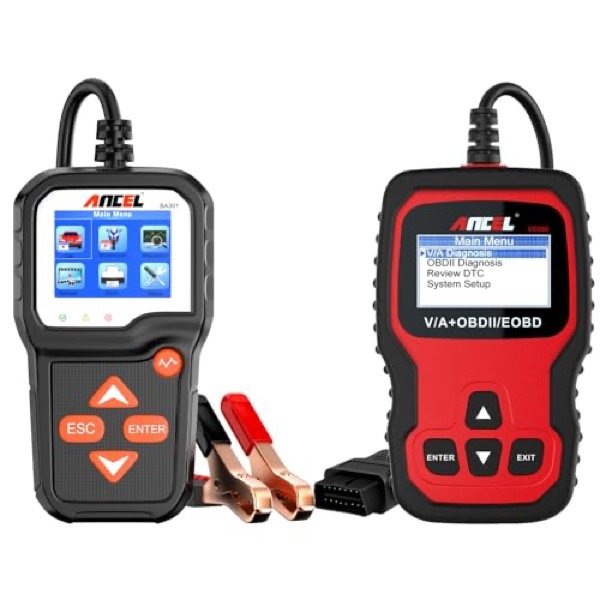
Overview
The ANCEL BD700 Pro occupies the lowest price point for any confirmed bidirectional scanner on this list, delivering actuator-level active tests and all-system code reading at a cost where most alternatives in the same price band offer only standard OBD2 engine codes and no service reset functions at all.
For a Hyundai Tucson owner who needs to confirm whether a failed CVVT solenoid is the root cause of a P0011 intake CVVT stuck advanced or P0014 exhaust CVVT stuck advanced fault before ordering a replacement part, the BD700 Pro’s CVVT solenoid actuation test confirms or rules out solenoid response in under two minutes and in most cases separates a solenoid replacement from an actuator carbon cleaning job without any additional tooling cost.
The scanner activates Hyundai enhanced manufacturer mode on supported Tucson generations, returning manufacturer-specific fault descriptions including the P1326 KSDS code with Hyundai KSDS context and freeze frame capture on LM and TL Theta II GDi engines, rather than the generic knock sensor description a standard OBD2 reader returns.
The 7-inch Android touchscreen runs auto-VIN identification that reads the Tucson’s exact module configuration from the OBD2 port in under 10 seconds and routes directly to the correct system menu without manual year-make-model entry.
The built-in 12V battery and alternator tester adds a diagnostic function that most scanners at this price point do not include, covering CCA output versus rated CCA, charging system voltage at idle and under electrical load, and alternator diode ripple testing that flags a failing rectifier before a complete charging failure, a function directly useful on NX4 MHEV Tucson models where 12V battery health affects the mild-hybrid start-stop circuit behavior.
The bidirectional active test library on the BD700 Pro covers key Hyundai component-level functions relevant to the Tucson diagnostic profile. CVVT solenoid actuation on the GDi engine engages the variable valve timing actuator directly to confirm solenoid response and valve timing actuator movement before condemning the part.
ABS motor and solenoid tests cycle individual ABS hydraulic solenoids to confirm system response and identify a stuck or non-responsive solenoid. The throttle body actuator test commands the electronic throttle body to open and close through its full range, which is the correct diagnostic step before a throttle body cleaning or replacement decision on 2.0-litre and 2.4-litre Tucson engines.
These three active tests alone address the most common bidirectional diagnostic needs for a standard Tucson powertrain.
The built-in 12V battery and alternator tester is a meaningful addition for Tucson owners who are also using the scanner for routine maintenance monitoring. The battery test returns CCA output versus the battery’s rated CCA value, charging system voltage at idle and under load, and an alternator diode ripple measurement that identifies an internally shorted alternator rectifier before it causes a complete charging failure.
On NX4 MHEV Tucson models, 12V battery health monitoring is directly relevant to mild-hybrid system behavior: a weak 12V battery affects the 48V MHEV start-stop circuit and can generate false fault codes in the MHEV control module that clear once the battery is replaced.
The service reset functions include oil life reset, SAS calibration, EPB retract and service, BMS battery matching after a 12V replacement, ABS bleed sequence, gearbox adaptation learning, and TPMS indirect warning lamp reset.
The BD700 Pro does not perform TPMS sensor ID programming: the TPMS reset function resets the indirect warning lamp through a pressure variance relearn cycle rather than registering a new sensor ID, so fitting a second set of wheels with separate TPMS sensors on a 2022-plus NX4 Tucson still requires a bidirectional scanner with a dedicated sensor ID programming function or a separate TPMS relearn tool.
ECU coding and topology mapping are not available on the BD700 Pro, and the NX4 PHEV and 48V MHEV module access is limited to DTC reading and basic live data without active hybrid system tests. The BD700 Pro’s review count reflects its newer market entry compared to established tools on this list, but the confirmed availability and 100-plus verified Amazon ratings clear the minimum threshold for inclusion.
Diagnostic Features and Capabilities
The BD700 Pro reads and clears codes across engine, ABS, SRS, transmission, TPMS, and body control modules on all OBD2 Hyundai Tucson generations using Hyundai enhanced manufacturer mode, returning Hyundai-specific fault descriptions for stored, pending, and permanent codes in every supported system including P1326 KSDS with freeze frame on Theta II GDi engines.
Live data in Hyundai enhanced mode returns CVVT cam angle position on both GDi banks, individual STFT and LTFT per bank, MAF airflow, throttle position, knock sensor voltage, coolant temperature, and injector pulse width, displayed on the 7-inch touchscreen with graphing available for all parameters.
Bidirectional active tests include CVVT solenoid engagement on both intake and exhaust GDi cam banks with real-time cam angle display showing whether the actuator responds to solenoid command, ABS hydraulic solenoid cycling to confirm individual solenoid response in the ABS hydraulic unit, and throttle body full-range actuator test on the 2.0L and 2.4L Tucson GDi engines.
The built-in 12V battery and alternator tester covers cold cranking amp output versus rated CCA, charging system output voltage at idle and under electrical load, and alternator diode ripple measurement without requiring external battery test clamps to be connected at a separate step.
Service resets include oil life reset, SAS calibration after steering work, EPB retract and service mode, BMS battery matching after 12V replacement, ABS brake bleed sequence for all four calipers, gearbox adaptation learning after a fluid service, and TPMS indirect warning lamp reset. Auto-VIN identification reads the Tucson’s module configuration in under 10 seconds.
Vehicle Compatibility
The BD700 Pro covers all four Hyundai Tucson platform generations for multi-system code access, bidirectional active tests, and service resets. The 2005-2009 JM generation is supported across the G4GC 2.0L DOHC, G6BA 2.7L V6, and D4EA 2.0L CRDI diesel for standard OBD2 and Hyundai enhanced code reading.
The 2010-2015 LM generation is covered including the G4NA 2.0L Nu GDi and G4KH 2.4L Theta II GDi for P1326 KSDS diagnosis and CVVT solenoid actuation tests. The 2016-2020 TL generation supports full CVVT actuation, ABS solenoid tests, and service resets on the G4FJ 1.6T Gamma GDi and G4NA 2.0L Nu GDi.
The 2021-onward NX4 is supported for standard G4FW 1.6T Smartstream GDi code access and service resets, with the 48V MHEV battery module accessible for DTC reading. The 7-inch Android touchscreen operates standalone with all functions on-device. Two years of free WiFi updates are included from registration.
Specifications
| Specification | Details |
|---|---|
| Connection | OBD2 cable (wired) + battery test clamps |
| Supported Systems | Engine, ABS, SRS, TCM, TPMS, BCM |
| OBD2 Functions | All 10 modes, Hyundai manufacturer-specific codes |
| Bidirectional Control | Yes; CVVT solenoid, ABS solenoid, throttle body actuator tests |
| Service Functions | 28+ including oil, SAS, EPB, BMS, ABS bleed, gearbox learning, TPMS indirect |
| Vehicle Compatibility | 1996+ OBD2; 2005+ Hyundai Tucson all standard generations |
| Display | 7-inch touchscreen, Android OS |
| Updates | 2 years free via WiFi |
| Subscription | None required within the 2-year period |
What’s Included
The package includes the BD700 Pro scanner tablet, OBD2 main cable, battery test clamps, USB-C cable, and a carry case.
Full system bidirectional scanner with all-system OBD2 diagnosis including engine, ABS, SRS, and transmission.
On the Hyundai Tucson, active tests command actuators directly to confirm component function before ordering replacement parts.
The scanner works on Hyundai and Kia models with OE-level system access for brand-specific codes.
Pros and Cons
| Pros | Cons |
|---|---|
| Bidirectional CVVT solenoid actuation confirms actuator response at a price well below any other bidirectional tool on this list | No TPMS sensor ID programming, so fitting winter wheels with new sensors on 2022+ NX4 Tucson requires a separate relearn tool |
| Built-in 12V battery and alternator test covers MHEV 12V battery health diagnosis on NX4 mild-hybrid Tucson models | |
| All-system code reading covers ABS, SRS, TCM, and TPMS with Hyundai manufacturer-specific fault descriptions | |
| 28+ service resets including oil, BMS, EPB, and ABS bleed cover all standard Tucson maintenance reset needs | |
| Auto-VIN identification reads exact Tucson module configuration without manual model year selection | |
| 2 years of free updates included; budget price with no recurring subscription within the free update period |
My Final Verdict
The ANCEL BD700 Pro is the right pick for the budget-conscious Tucson owner who needs confirmed bidirectional active test capability, multi-system code access, and a full service reset set at the lowest price point on this list.
The CVVT solenoid actuation test and the built-in battery tester deliver specific diagnostic value for the Theta II and Smartstream GDi engine generations, and the 12V battery health check is genuinely useful on NX4 MHEV trims where 12V battery condition affects mild-hybrid system behavior.
11. Autel MaxiDAS DS808S: Best Advanced All-System Scanner for Hyundai Tucson
- ECU coding and bidirectional active tests step above the MK808BT PRO V2 on module-level parameter changes for NX4 platform repairs
- Full-system topology map and CANFD plus DoIP for complete 2022+ NX4 gateway access across all module types
- 300+ Amazon ratings at 4.5 stars; wireless MaxiVCI Mini with 33 ft Bluetooth range and Android 11 tablet display

Overview
The Autel MaxiDAS DS808S fills the gap between the MK808BT PRO V2 and the MaxiSys MS906 Pro on this list, delivering ECU coding and topology mapping at a price point below the MS906 Pro, and with more than 300 Amazon ratings at 4.5 stars it has a verified performance record from users who have worked on late-model Hyundai platforms including NX4 Tucson models.
For Hyundai Tucson diagnostics, the DS808S is the tool that independent technicians and advanced DIY owners reach for when a repair involves replacing a BCM, HTRAC AWD control module, or Smartstream GDi ECU that requires VIN-specific coding to function correctly in the vehicle after installation, a task that neither the MK808BT PRO V2 nor the Foxwell NT809BT can perform.
The 7-inch Android 11 touchscreen pairs with the MaxiVCI Mini Bluetooth dongle for wireless diagnostics at up to 33 feet, so the tablet stays in hand while the VCI dongle remains plugged into the Tucson’s OBD2 port throughout the coding session.
Hyundai enhanced mode on the DS808S returns the full OEM-level manufacturer-specific PID set across all Tucson modules, with live data including CVVT intake and exhaust cam target versus actual angle, CVVT solenoid duty cycle, knock retard angle, STFT and LTFT per bank, HTRAC torque distribution ratio, and 48V MHEV battery state-of-charge and cell voltage differential, matching the live data a dealer technician monitors on a factory Hyundai GDS session.
The DS808S topology map renders the full NX4 ECU network in a visual layout showing module communication status, active fault count, and network address before any individual module sub-menu is opened, which is the diagnostic approach that most efficiently identifies intermittent communication faults on the NX4 PHEV platform’s shared CAN bus.
The ECU coding function on the DS808S covers the coding operations most needed in an independent shop Hyundai workflow: replacement BCM coding to the vehicle’s VIN, comfort feature enable and disable through parameter-level adjustments in the body control module, TPMS sensor ID registration with Autel’s full sensor programming menu, and Smartstream GDi ECU parameter adjustments after injector replacement.
These functions are above the MK808BT PRO V2’s active test level and handle the most common module replacement coding scenarios on Tucson models from the TL generation through the NX4, without requiring the full MaxiSys Elite subscription for cases that do not involve key programming.
Topology mapping on the DS808S renders the full Tucson ECU network in a visual layout, showing module communication status and active fault count before any individual module menu is opened, which is the diagnostic approach that reduces fault-tracing time on the NX4 platform’s shared CAN bus network.
Bidirectional active tests on the DS808S cover the full Hyundai-specific test set relevant to Tucson diagnostics: CVVT solenoid engagement on both the intake and exhaust banks of the GDi engine, EPS steering angle calibration after a rack-and-pinion replacement, HTRAC AWD clutch engagement commands on NX4 all-wheel-drive models, ABS hydraulic solenoid actuation and motor cycle tests, individual injector balance rate cut tests for cylinder contribution diagnosis on GDi engines, and adaptive damper actuator tests on NX4 trims fitted with that system.
TPMS sensor ID programming runs through the full Autel TPMS module with sensor activation, ID reading, registration, and relearn confirmation, covering the 2022-plus NX4 models that require scan-tool input for new sensor enrollment after a wheel swap. CANFD and DoIP protocol support in the DS808S firmware handles the complete NX4 gateway communication architecture without protocol gaps.
The DS808S sits below the MS906 Pro on key programming: it handles limited Hyundai key fob and proximity key functions on selected model years but does not cover the full NX4 key programming scope that the MaxiSys Elite and MaxiIM product families provide.
The annual update subscription after the included first year is a recurring cost similar to the MK808BT PRO V2, and existing diagnostic functions for already-covered Tucson model years remain active after the subscription lapses.
For shops that service Hyundai, Kia, and Genesis alongside domestic and European vehicles, the DS808S update value is higher per vehicle than a single-brand tool at a comparable price, given the breadth of the Autel coverage library across all three OEM database sets.
Diagnostic Features and Capabilities
The DS808S covers all Hyundai Tucson modules including ECM, TCM, ABSCM, SRS, TPMS, BCM, HVAC, immobilizer, instrument cluster, HTRAC AWD controller, and NX4 MHEV and PHEV drivetrain modules through Hyundai enhanced manufacturer protocol, with topology mapping that renders the full ECU network in a visual layout showing module communication status and fault overlay before any sub-menu is opened.
In Hyundai enhanced mode the live data stream returns OEM-level manufacturer PIDs including CVVT intake and exhaust cam target angle versus actual angle, CVVT solenoid duty cycle percentage, knock retard angle BTDC, individual STFT and LTFT per bank, injector pulse width, HTRAC torque distribution ratio, 48V battery state-of-charge, cell voltage differential, MHEV motor torque output versus commanded assist, and PHEV high-voltage battery SOC and on-board charger output current.
ECU coding covers VIN-specific replacement module configuration including BCM address coding, Smartstream GDi ECU injection base value adjustment after injector replacement, comfort feature enable and disable through BCM parameter menus, and HTRAC AWD module coding after replacement.
Bidirectional active tests exceed 4,500 functions and include CVVT solenoid engagement on both GDi cam banks with real-time cam angle feedback, EPS steering torque sensor calibration, HTRAC AWD clutch engagement commands, ABS hydraulic solenoid actuation and motor cycle tests, per-injector balance rate cut tests for cylinder contribution diagnosis, and adaptive damper actuator response tests on NX4 suspension-equipped trims.
TPMS sensor programming covers full sensor ID registration and relearn for all Tucson generations through the Autel TPMS service module. Service functions include 35-plus resets: oil life reset, EPB retract and service, BMS battery matching, SAS calibration, TPMS sensor programming, DPF regeneration on diesel variants, gearbox adaptation learning, throttle body relearn, and module VIN coding.
CANFD and DoIP firmware handles the complete NX4 gateway architecture. Live data includes multi-parameter overlay, graphing, and session recording with export.
Vehicle Compatibility
The DS808S covers all four Hyundai Tucson platform generations with full ECU coding, topology mapping, and bidirectional diagnostic access. The 2005-2009 JM generation supports code reading, ECU coding where applicable, and service functions across the G4GC 2.0L DOHC, G6BA 2.7L V6, and D4EA 2.0L CRDI diesel.
The 2010-2015 LM generation is fully covered including the G4NA 2.0L Nu GDi, G4KH 2.4L Theta II GDi for P1326 KSDS diagnosis with freeze frame, and D4HA 2.2L CRDI diesel. The 2016-2020 TL generation supports full bidirectional active tests and ECU coding on the G4FJ 1.6T Gamma GDi and G4NA 2.0L Nu GDi with CVVT dual-bank actuation confirmed.
The 2021-onward NX4 is covered in standard, 48V MHEV, HEV, and PHEV variants with CANFD and DoIP firmware for complete gateway access and ECU coding support for replacement NX4 module installation. Overall library coverage reaches 160-plus makes and more than 10,000 models. The MaxiVCI Mini Bluetooth dongle is shared across all supported platforms.
Specifications
| Specification | Details |
|---|---|
| Connection | Bluetooth 2.0 (MaxiVCI Mini, 33 ft range), USB-C |
| Supported Systems | Full system with topology map, ECU coding, PHEV and MHEV modules |
| OBD2 Functions | All 10 modes, OEM-level Hyundai manufacturer codes and PIDs |
| Bidirectional Control | Yes, 4,500+ active tests |
| Service Functions | 35+ including ECU coding, TPMS sensor programming, EPB, BMS, SAS |
| Vehicle Compatibility | 160+ makes, 2005+ Hyundai Tucson all variants including PHEV |
| Display | 7-inch touchscreen, 1024×600, Android 11 |
| Updates | 1 year free, then annual subscription |
| Subscription | Not required to retain existing functions; needed for new model year coverage |
What’s Included
The package includes the DS808S tablet, MaxiVCI Mini Bluetooth dongle, OBD2 extension cable, USB-C cable, power adapter, and carry case.
Accessed all ECU modules including PCM, ECM, EPS, PDM, TPM, BCM, ABS, and SCCM in a single auto scan.
On the Hyundai Tucson, oE-level diagnosis on ABS, SRS, Engine, Transmission, and Brake systems with manufacturer-specific code coverage.
Wireless Bluetooth operation reads and clears codes without a tethered connection to the OBD2 port.
Pros and Cons
| Pros | Cons |
|---|---|
| ECU coding handles replacement module VIN registration and BCM parameter adjustments that the MK808BT PRO V2 cannot perform | Full NX4 key programming requires a MaxiIM tool beyond the DS808S’s scope |
| Topology map renders the full NX4 ECU network with fault overlay for communication-level fault tracing | |
| CVVT bank actuation, HTRAC AWD clutch commands, and injector cut tests cover the full Tucson GDi and AWD diagnostic test set | |
| CANFD and DoIP for complete 2022+ NX4 gateway module access without protocol gaps | |
| Wireless 33 ft Bluetooth MaxiVCI Mini; existing functions continue after subscription lapses | |
| TPMS sensor programming covers 2022+ NX4 winter wheel sensor ID enrollment through the full Autel TPMS module |
My Final Verdict
The Autel MaxiDAS DS808S is the right pick for independent Hyundai technicians and serious DIY owners who need ECU coding and topology mapping above the MK808BT PRO V2 level without the full MS906 Pro investment. The VIN-level module coding capability covers the most common NX4 replacement repair scenarios, and the topology map reduces fault-tracing time on the NX4 PHEV platform’s shared CAN bus in ways that a module-by-module sequential scan cannot match.
Comparison Table: Best OBD2 Scanners for Hyundai Tucson
| Tool | Best For | Systems | Bidirectional | TPMS Programming | Service Resets | Price Range |
|---|---|---|---|---|---|---|
| Autel MK808BT PRO V2 | Best Overall | Full system + HTRAC AWD + 48V MHEV | Yes (3,000+ tests) | Yes — sensor ID programming | 28+ | ~$200–250 |
| BlueDriver Pro | Best Value | Engine, ABS, SRS, TCM, TPMS, Hybrid | No | No | None | ~$100–120 |
| TOPDON Phoenix Lite 2 | Best Premium | Full system + PHEV + CANFD/DoIP | Yes (4,000+ tests) | Yes — full sensor programming | 34+ | ~$700–900 |
| LAUNCH CRP909E | Best Budget Full-System | Engine, ABS, SRS, TCM, TPMS, BCM | No | Indirect reset only | 28+ | ~$120–150 |
| Foxwell NT809BT | Best Wireless Bidirectional | Full system + HTRAC AWD + CANFD/DoIP | Yes (3,000+ tests) | Yes — sensor ID programming | 30+ | ~$180–230 |
| OBDLink MX+ | Best Bluetooth App Scanner | Engine, ABS, SRS, TCM, TPMS via app | No | No | None | ~$100–130 |
| Innova 5610 | Best Standalone Handheld | Engine, ABS, SRS, TCM, TPMS | No | Indirect reset only | Oil, SAS, EPB, ABS, BMS | ~$130–160 |
| Autel MaxiSys MS906 Pro | Best Professional | Full system + ECU coding + topology map | Yes (5,000+ tests) | Yes — full sensor programming | 40+ | ~$500–600 |
| LAUNCH Creader Elite 1.0 | Best Mid-Range Bidirectional | Full system + HTRAC AWD | Yes; CVVT, EPS, ABS, HTRAC | Yes — sensor ID learning | 38+ | ~$160–200 |
| ANCEL BD700 Pro | Best Budget Bidirectional | Engine, ABS, SRS, TCM, TPMS, BCM | Yes; CVVT, ABS, throttle body | Indirect reset only | 28+ | ~$100–140 |
| Autel MaxiDAS DS808S | Best Advanced All-System | Full system + ECU coding + topology map + CANFD/DoIP | Yes (4,500+ tests) | Yes — full sensor programming | 35+ | ~$350–450 |
Buyer’s Guide: How to Choose the Right OBD2 Scanner for Your Hyundai Tucson
Know Your Tucson Generation First
The Hyundai Tucson has covered four distinct platforms since its OBD2 introduction, and each generation has different diagnostic requirements. The 2005 to 2009 JM generation uses the earliest Hyundai OBD2 implementation: all standard OBD2 modes work, but enhanced manufacturer code access is limited on the oldest examples and some tools will report incomplete system scans on certain modules.
The 2010 to 2015 LM generation introduced the Theta II GDi engine, which brought the P1326 KSDS rod knock detection code that became the most diagnostically significant code in Tucson history. A scanner that reads only standard OBD2 codes returns a generic knock sensor fault for P1326 rather than the Hyundai-specific KSDS description, which is an important distinction when deciding whether to pursue a Hyundai extended warranty claim for the engine defect.
The 2016 to 2020 TL generation updated the GDi engines to revised Nu architecture with improved CVVT system management, and the Tucson AWD controller shifted to a more electronically integrated design that benefits from scanner access to the AWD module for clutch engagement and torque split data.
Hyundai owners who also drive an Elantra will find generation-specific picks in my best OBD2 scanner for Hyundai Elantra guide.
The 2021-onward NX4 generation introduced the largest diagnostic complexity increase: the 48V MHEV drivetrain, the optional PHEV with separate high-voltage battery management and on-board charger modules, HTRAC AWD with active torque vectoring on the AWD clutch, and the CANFD and DoIP gateway protocols that older scanner firmware cannot fully access.
Hyundai owners comparing scanner options across multiple models will find a broader selection in my Hyundai OBD2 scanner guide.
Choosing a scanner without confirmed NX4 CANFD coverage for a 2021-plus Tucson means the tool may return partial module access rather than a complete full-system scan.
Understand What P1326 Actually Requires
The P1326 code is a Hyundai manufacturer-specific code, not a standard OBD2 code, which means a generic ELM327 adapter or a basic code reader that only reads standard OBD2 PIDs returns a generic knock sensor or no-code-found result rather than the KSDS-specific fault description.
A scanner with Hyundai enhanced mode reads P1326 with its proper description, engine-on versus engine-off status, pending versus confirmed status, and the freeze frame data that includes engine load, RPM, coolant temperature, and fuel trim values at the exact moment the code set.
That freeze frame data is what Hyundai service advisors examine when assessing whether a KSDS claim qualifies under the extended warranty coverage that Hyundai issued for Theta II engine rod bearing failures.
Reading P1326 is a code-read function, not a bidirectional function, so a scanner with Hyundai enhanced mode but no bidirectional capability, such as the BlueDriver Pro or the LAUNCH CRP909E, handles P1326 diagnosis correctly.
The bidirectional capability becomes relevant in a different diagnostic scenario: using CVVT solenoid actuation tests to confirm whether a stuck-open or stuck-closed variable valve timing fault is caused by a defective solenoid or by carbon deposits restricting actuator movement, a distinction that determines whether cleaning or replacement is the correct repair.
TPMS Sensor Programming versus Warning Lamp Reset
The Hyundai Tucson uses two different TPMS reset procedures depending on the model year and the situation. The indirect TPMS warning lamp reset, available on most OBD2 scanners with a TPMS function, clears the warning lamp after a tire rotation or seasonal pressure change by resetting the pressure variance detection baseline.
This is not the same as TPMS sensor ID programming, which is required when a different set of TPMS sensors is registered to the vehicle. On 2022-plus NX4 Tucson models, fitting a separate set of winter wheels with their own TPMS sensors requires scan-tool sensor ID programming because the NX4 Tucson has no physical TPMS reset button for manual relearn.
Scanners on this list that perform the full sensor ID programming procedure include the Autel MK808BT PRO V2, TOPDON Phoenix Lite 2, Foxwell NT809BT, Autel MaxiSys MS906 Pro, LAUNCH Creader Elite 1.0, and Autel MaxiDAS DS808S.
Bidirectional Control: When You Need It and When You Don’t
Bidirectional active test capability is not required for every Tucson diagnostic task. Reading and clearing codes, including P1326 and all CVVT position codes, is a passive read function available on any scanner with Hyundai enhanced mode. Service resets including oil life, SAS, EPB, and BMS battery matching are output functions that do not require bidirectional control in the diagnostic engineering sense.
Bidirectional capability becomes necessary when the diagnostic question requires sending a command to an actuator and observing the response: confirming whether a CVVT solenoid energizes on command, cycling the ABS hydraulic solenoids through a guided bleed sequence, triggering the HTRAC AWD clutch to engage under a no-load bench test condition, or calibrating the EPS steering angle sensor after a rack replacement.
Readers who need a broader look at bidirectional tools across all brands will find the full selection in my bidirectional OBD2 scanner guide.
Tucson owners who plan only to read codes and reset the oil service light do not need to spend for bidirectional capability. Owners who plan to perform their own brake work, steering work, or CVVT diagnosis should include it in the minimum specification.
Readers with a tight budget who still need Hyundai enhanced mode will find the best options in my budget OBD2 scanner picks.
CANFD and DoIP: NX4 Protocol Considerations
The 2021-onward NX4 Tucson platform uses Controller Area Network Flexible Data-Rate (CANFD) and Diagnostics over Internet Protocol (DoIP) on several gateway modules, including the HTRAC AWD controller and, on PHEV variants, the high-voltage battery management unit and on-board charger.
A scanner that supports only the legacy CAN protocol connects to the NX4 but may fail to complete a full system scan on the CANFD-only modules, returning a communication error rather than module data.
Tools on this list that confirm CANFD and DoIP support for the NX4 gateway include the Autel MK808BT PRO V2, TOPDON Phoenix Lite 2, Foxwell NT809BT, Autel MaxiSys MS906 Pro, LAUNCH Creader Elite 1.0, and Autel MaxiDAS DS808S. If you own an NX4 PHEV or MHEV and plan to diagnose hybrid drivetrain faults, confirm CANFD support before purchasing any scanner not included on this list.
Hyundai owners who also drive a Santa Fe will find model-specific picks including HTRAC AWD coverage in my best OBD2 scanner for Hyundai Santa Fe guide.
App-Based versus Standalone: Practical Considerations
App-based Bluetooth scanners like the BlueDriver Pro and the OBDLink MX+ depend on a smartphone or tablet to display results, which means the quality of the diagnostic experience is tied to the app. The BlueDriver app is dedicated to BlueDriver hardware and cannot be used with any other adapter, giving a consistent user experience at the cost of app flexibility.
Readers comparing Bluetooth adapter options across brands and apps will find the full ranking in my top Bluetooth OBD2 scanner picks.
The OBDLink MX+ works with multiple apps, giving diagnostic PID depth that varies by the app chosen, but requiring the user to identify and configure the right app for Hyundai enhanced mode before the first use.
Readers who use an iPhone and want to compare CAN FD-compatible adapters will find the top options in my top iPhone OBD2 scanner picks.
Standalone handheld scanners like the Innova 5610 and the wired tools on this list operate independently of any phone, which matters in a shop environment where phone screen glare, battery management, and app compatibility are secondary concerns to having a reliable diagnostic device in hand.
Common Mistakes When Diagnosing a Hyundai Tucson
Using a Generic ELM327 Adapter for Tucson System Faults
A generic ELM327 Bluetooth or WiFi adapter reads only the 16 standard OBD2 parameters in Mode 1 and returns standard P-code descriptions for any stored fault.
On a Hyundai Tucson, this means the P1326 KSDS code returns as a generic knock sensor fault rather than the Hyundai KSDS description, ABS and SRS codes are completely inaccessible, and the CVVT cam angle discrepancy codes return as generic camshaft position codes without the Hyundai-specific fault context.
Readers who specifically need a scanner that reaches ABS and SRS systems on Hyundai will find focused picks in my ABS and SRS scanner guide.
Spending $8 to $15 on an ELM327 clone for Tucson diagnostics costs more in misdiagnosis time than the difference between that tool and the BlueDriver Pro or LAUNCH CRP909E, both of which read Hyundai enhanced codes correctly.
Clearing P1326 Without Recording the Freeze Frame First
The P1326 KSDS code on Theta II GDi Tucson engines is a potential warranty claim trigger. Hyundai’s extended warranty coverage for Theta II rod bearing failures requires the dealer to evaluate the fault code status, the freeze frame data, and the engine mileage at the time the code first set. Clearing P1326 with a scanner before visiting the dealer removes the stored freeze frame and may eliminate the code evidence needed for a warranty determination.
The correct procedure is to read P1326 with a compatible scanner, record the freeze frame data including engine load, RPM, and coolant temperature, and bring that data to the dealer before the code is cleared or the engine oil level drops further.
Assuming a TPMS Warning Lamp Reset Covers Sensor ID Registration
A Tucson owner who fits winter wheels with new TPMS sensors and then performs a standard TPMS indirect warning lamp reset is resetting the pressure variance baseline without registering the new sensor IDs. The TPMS warning lamp may clear temporarily if all four new sensors are at the correct pressure and the system completes a drive cycle, but the TPMS module still does not recognize the new sensor IDs as assigned sensors.
On 2022-plus NX4 models with no physical reset button, the system will eventually set a TPMS malfunction code when the unregistered sensors are not matched to the stored ID table. Use a scanner with confirmed TPMS sensor ID programming support for any Tucson wheel swap involving new sensors.
Replacing a CVVT Solenoid Based on a Code Alone
A P0011 (intake CVVT stuck advanced) or P0014 (exhaust CVVT stuck advanced) code on a Tucson GDi engine does not confirm that the solenoid is the failed component. The same code triggers from carbon buildup restricting the VVT actuator’s hydraulic passage, from oil viscosity issues blocking the actuator response, from a failed oil control valve filter screen, or from a genuine solenoid electrical fault.
Replacing the solenoid without an actuation test to confirm whether the solenoid energizes on command wastes a part replacement if the actual fault is actuator carbon restriction. A bidirectional scanner that runs a CVVT solenoid actuation test confirms solenoid response in under two minutes and separates a stuck actuator from a failed solenoid before any parts are purchased.
Attempting NX4 Diagnostics on a Scanner Without CANFD Support
An older bidirectional scanner that lacks CANFD and DoIP firmware will connect to the NX4 Tucson’s OBD2 port and may initiate a system scan without returning an immediate error, but module access on the CANFD gateway nodes will be incomplete or will time out.
The HTRAC AWD controller and NX4 PHEV modules communicate over the CANFD bus, and a scanner without the matching protocol firmware cannot read their fault codes, live data, or perform bidirectional tests on those systems. The result is a scan that appears to complete but misses exactly the modules most relevant to PHEV drivetrain, AWD, and charging system diagnostics.
Check the tool’s protocol support list before using it on any NX4 Tucson from 2021 onward.
My Final Recommendations
For a Tucson owner who wants to read codes, understand P1326 and CVVT faults, and has a smartphone: The BlueDriver Pro handles P1326 KSDS and all Hyundai enhanced codes correctly at the lowest price on this list with the largest verified owner base.
For a Tucson owner who wants code reading and service resets without a phone: The Innova 5610 is the right standalone option, adding a built-in battery tester that provides extra diagnostic value on NX4 MHEV models.
For a Tucson owner who wants full-system access and all major service resets at the lowest price: The LAUNCH CRP909E covers all Tucson systems and 28-plus service resets without bidirectional capability at a budget price.
For a Tucson owner who needs bidirectional active tests and TPMS sensor programming on a 2022+ NX4: The Autel MK808BT PRO V2 is the most complete wireless bidirectional tool on this list at its price tier, covering CVVT, EPS calibration, TPMS sensor ID programming, and NX4 HTRAC AWD tests.
For a Tucson owner who wants bidirectional and CANFD coverage at a mid-range price with 3 years of free updates: The Foxwell NT809BT matches the MK808BT PRO V2 in protocol depth with a more generous included update period.
For a Tucson owner who wants the deepest live data through apps and is comfortable with third-party OBD2 app setup: The OBDLink MX+ paired with Car Scanner ELM OBD2 returns Hyundai extended CVVT and fuel system PIDs that no standalone handheld at this price delivers.
For a budget-conscious Tucson owner who needs confirmed bidirectional active tests without professional-tier spending: The ANCEL BD700 Pro provides CVVT solenoid actuation and a built-in 12V battery tester at the lowest bidirectional price on this list.
For an independent technician or advanced Tucson owner who needs bidirectional plus TPMS sensor programming at a mid-range price: The LAUNCH Creader Elite 1.0 covers CVVT, EPS, HTRAC, and sensor ID programming in a compact 5-inch Android form factor.
For a shop or serious owner who needs ECU coding and topology mapping for NX4 platform module replacement: The Autel MaxiDAS DS808S delivers ECU coding and a full NX4 network topology map at a price below the professional MaxiSys tier.
For a professional shop that handles Hyundai, Kia, and Genesis alongside other marques and needs OEM-depth network diagnostics and ECU coding: The Autel MaxiSys MS906 Pro is the most capable non-key-programming professional tool on this list.
Technicians who need the full picture of professional-tier tools across all brands will find the top options in my professional OBD2 scanner guide.
For a shop or advanced owner who needs OEM-level HTRAC bidirectional tests, ECU coding with CANFD, and the broadest protocol depth at a premium budget: The TOPDON Phoenix Lite 2 delivers the deepest NX4 platform access on this list including ECU coding, a full topology map, and PHEV drivetrain active tests.
FAQs
What is the best OBD2 scanner for a Hyundai Tucson?
The Autel MK808BT PRO V2 is the best overall OBD2 scanner for the Hyundai Tucson, covering all generations from the 2005 JM through the 2026 NX4 with wireless bidirectional active tests, CVVT solenoid engagement testing, TPMS sensor ID programming for 2022-plus NX4 models, and CANFD protocol support.
For owners who need only code reading and Hyundai enhanced diagnostic mode access, the BlueDriver Pro is the best value option with more than 60,000 verified Amazon ratings and no annual subscription cost.
Can a basic OBD2 scanner read the P1326 code on a Hyundai Tucson?
A standard OBD2 code reader cannot read P1326 correctly because P1326 is a Hyundai manufacturer-specific fault code, not a standard OBD2 code. A generic scanner either returns no code or a generic knock sensor description, losing the Hyundai KSDS-specific fault context and the freeze frame data that is needed when evaluating a Theta II engine extended warranty claim.
A scanner with Hyundai enhanced diagnostic mode, such as the BlueDriver Pro or any scanner on this list beyond a standard ELM327 adapter, reads P1326 with its correct manufacturer description, pending and confirmed status, and freeze frame capture.
Do I need a special scanner to reset the TPMS on a Hyundai Tucson?
It depends on what you need to do. After a tire rotation or pressure adjustment, the TPMS indirect warning lamp reset on most full-system scanners including the LAUNCH CRP909E and Innova 5610 resets the pressure variance baseline and clears the warning light.
For fitting a second set of wheels with separate TPMS sensors, you need a scanner with TPMS sensor ID programming capability because 2022-plus NX4 Tucson models have no physical TPMS reset button for manual relearn. Scanners on this list with full TPMS sensor ID programming include the Autel MK808BT PRO V2, TOPDON Phoenix Lite 2, Foxwell NT809BT, Autel MaxiSys MS906 Pro, LAUNCH Creader Elite 1.0, and Autel MaxiDAS DS808S.
What OBD2 scanner can run CVVT active tests on a Hyundai Tucson?
Any bidirectional scanner with Hyundai enhanced protocol support and an active test library that includes CVVT solenoid engagement can run the variable valve timing actuator test on Tucson GDi engines.
On this list, that includes the Autel MK808BT PRO V2, TOPDON Phoenix Lite 2, Foxwell NT809BT, Autel MaxiSys MS906 Pro, LAUNCH Creader Elite 1.0, ANCEL BD700 Pro, and Autel MaxiDAS DS808S. The test commands the CVVT oil control valve solenoid to energize on both the intake and exhaust banks of the GDi engine, and the live data stream shows whether the cam angle moves in response.
This confirms actuator response before condemning a solenoid on a P0011 or P0014 stuck-CVVT diagnostic.
Does the Hyundai Tucson NX4 need a scanner with CANFD support?
Yes, for complete full-system access on 2021-onward NX4 Tucson models.
The NX4 platform uses CANFD on several gateway modules including the HTRAC AWD controller, and on PHEV variants the high-voltage battery management unit and on-board charger also communicate over CANFD and DoIP. A scanner without CANFD firmware can still connect to the NX4 and access standard OBD2 functions and many legacy CAN modules, but will return communication timeouts or incomplete data on the CANFD-only modules.
Scanners on this list confirmed to support CANFD and DoIP for the NX4 include the Autel MK808BT PRO V2, TOPDON Phoenix Lite 2, Foxwell NT809BT, Autel MaxiSys MS906 Pro, LAUNCH Creader Elite 1.0, and Autel MaxiDAS DS808S.