
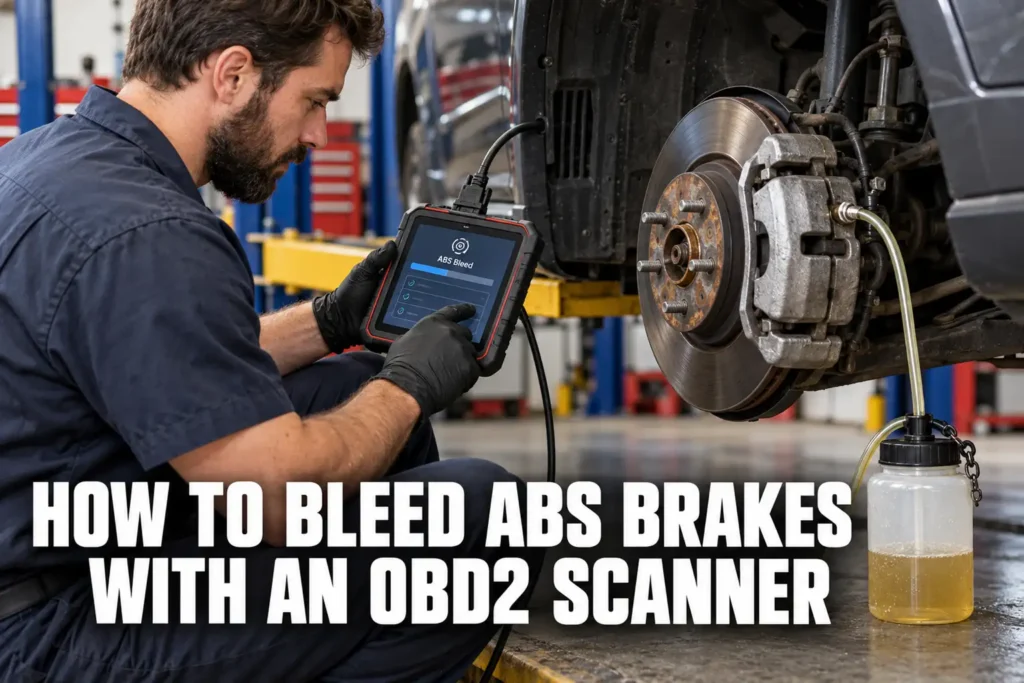
How to Bleed ABS Brakes with an OBD2 Scanner
By Kamil Siegień / October 12, 2026
Conventional brake bleeding pushes fresh fluid through the system using a vacuum pump or pressure bleeder without any scanner involvement. ABS brake bleeding requires a scanner on vehicles where the ABS hydraulic control unit (HCU) contains solenoid valves that can trap air in internal passages that gravity and pressure bleeding cannot reach. The scanner activates these solenoids in sequence to open each internal passage while brake fluid is flowing through the system, flushing any trapped air out of the HCU’s internal circuits. Without this scanner-activated sequence, air trapped inside the HCU produces a spongy brake pedal that persists even after repeated conventional bleeding attempts.
I explain this in more detail in my my guide on use an.
For scanner recommendations to perform this type of work, see my scanner comparison guide.

About the author: Hello! I’m Kamil Siegień, founder of OBD2 Scout. My diagnostic experience started with an engine rebuild on a 2014 Skoda Superb 1.8 TSI, where tuning from 160 to 222 hp required mastering live data and ECU behavior that basic code readers cannot handle. I am a former BMW and MINI employee and regularly use diagnostic scanners on my own Audi A4 2.0 TFSI.
This guide covers which ABS systems require scanner bleeding, how the HCU internal passages trap air, the scanner-assisted bleeding procedure step by step, the conventional bleeding sequence that must accompany the scanner procedure, what ABS DTCs indicate air or fluid issues, and when a spongy pedal after bleeding points to a different problem.
I explain this in more detail in my can you drive with check engine light on.
For a scanner that handles ABS and SRS diagnostics, check my best tools for ABS codes.
Which ABS Systems Require Scanner Bleeding
Not every ABS system requires scanner-assisted bleeding. Older ABS designs with simple solenoid-per-wheel circuits (found on vehicles before approximately 2005) can often be bled conventionally because the solenoid valves sit in the direct fluid path and open under pressure. Modern ABS systems with ESC and traction control integration contain an HCU with an internal pump and accumulator circuit alongside the wheel solenoid valves. These internal circuits do not open during conventional pressure bleeding because the pump and accumulator valves remain closed when the system is not actively pulsing.
I explain this in more detail in my check engine light on but no codes stored.
If you are on a tight budget, my top budget scanner picks covers the top value picks.
Vehicles that require scanner-assisted ABS bleeding include: most vehicles with ABS/ESC integration from approximately 2004 onward (particularly European vehicles with Bosch ESP systems), vehicles where the ABS HCU or master cylinder was replaced or allowed to run dry during a brake repair, and any vehicle where a spongy pedal persists after thorough conventional bleeding of all four corners. If the brake pedal feels solid at the wheel bleeder screws but remains soft when tested in the car, the air is inside the HCU rather than in the lines or calipers.
If you prefer a wireless setup, my best wireless diagnostic tools covers the best options.
The simplest test: after conventional bleeding, apply firm brake pressure and observe pedal travel. If the pedal slowly sinks under sustained firm pressure (brake pedal fade) or feels inconsistent compared to a firm, high pedal on a vehicle with known-good brakes, scanner-assisted bleeding is likely needed. A scanner that reads brake system live data also shows the individual wheel pressures during brake application — a wheel circuit that shows lower pressure than the others indicates air trapped in that circuit’s HCU solenoid passage.
Audi owners looking for the right scanner should check my top-rated scanners for Audi.
How the HCU Internal Passages Trap Air
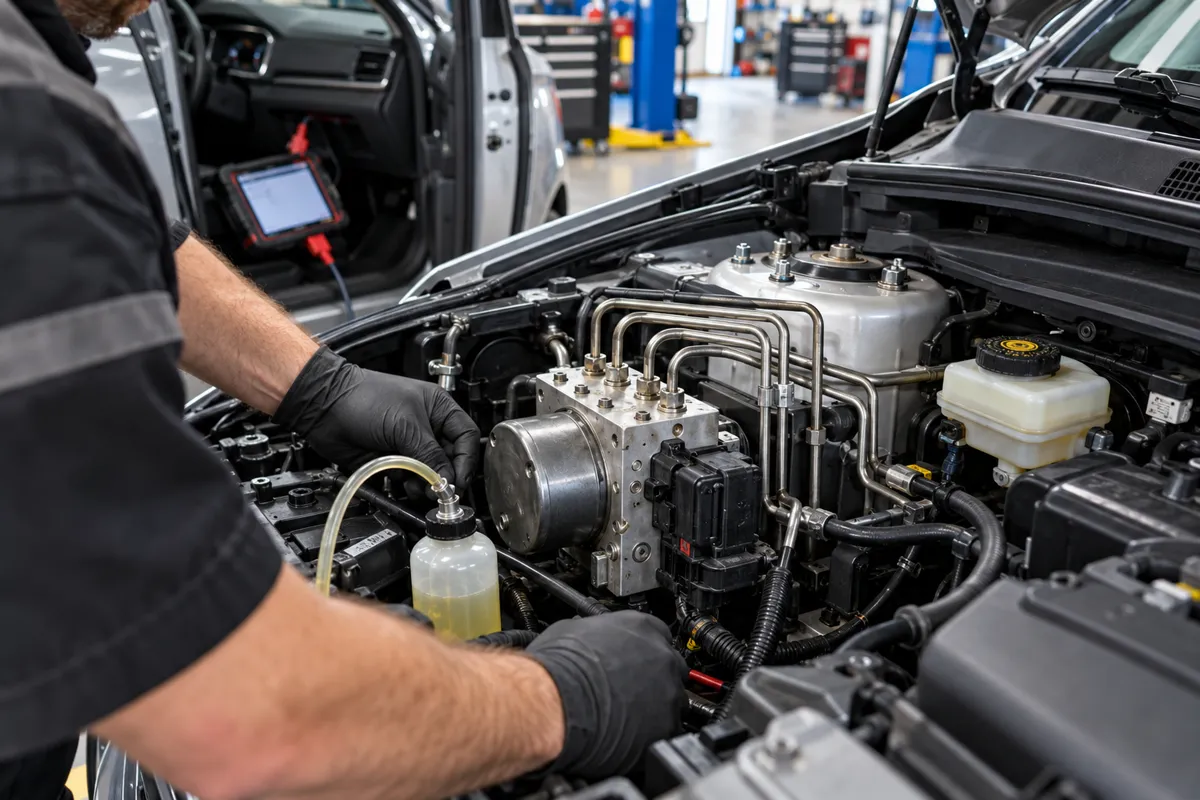
The ABS hydraulic control unit contains multiple solenoid valves, a high-pressure pump, and an accumulator. During normal braking, the inlet solenoids for each wheel circuit remain open and the outlet solenoids remain closed: this is the standard brake apply mode, and conventional bleeding works on this configuration. During ABS activation, the inlet solenoids close (to isolate the wheel from master cylinder pressure), the outlet solenoids open (to release pressure to the accumulator), and the pump runs to move fluid from the accumulator back to the master cylinder.
Honda owners looking for the right scanner should check my top-rated scanners for Honda.
The accumulator, pump, and the passages between them form a closed circuit that is not in the active fluid path during conventional bleeding. Air that enters this circuit during an HCU replacement, a pump motor failure, or a dry-out event (running the master cylinder reservoir completely empty) becomes trapped behind the closed solenoid valves. The scanner bleeding procedure activates these solenoids and runs the ABS pump while fluid flows through the system, opening the normally closed internal passages to allow air to escape through the wheel bleeder screws or back through the master cylinder reservoir.
BMW owners looking for the right scanner should check my top-rated scanners for BMW.
Scanner-Assisted ABS Bleeding Procedure

The procedure combines scanner activation with simultaneous manual bleeding at the wheel caliper bleeder screws. It requires two people: one operating the scanner while the second bleeds the calipers. Some procedures require the scanner operator to also hold the brake pedal at a specific position while the solenoids cycle. Read the specific procedure for the vehicle from the scanner menu before beginning, as the sequence and pedal position requirements vary by make and ABS system.
Ford owners looking for the right scanner should check my top Ford scanner picks.
General sequence: perform conventional bleeding first to remove air from the calipers and brake lines. This establishes clean fluid in the lines before the scanner cycling begins. Then connect the scanner and navigate to Service or Special Functions, select ABS Bleeding or ABS Automated Bleeding. The scanner shows the required pedal position (pressed, released, or pumped — varies by vehicle and scanner). The second technician opens the bleed screw on the specified wheel (the scanner typically directs which wheel to bleed first). Initiate the scanner command. The ABS pump and solenoids cycle for 10 to 30 seconds. Close the bleed screw when commanded or when the scanner indicates the cycle is complete. Repeat for each wheel in the sequence the scanner specifies (the sequence is not always the same as conventional bleeding order). Top up the reservoir between each wheel’s cycle.
Chevy owners looking for the right scanner should check my top-rated scanners for Chevy.
After completing all four wheels, perform one final conventional bleed pass on each wheel to remove any remaining air displaced into the lines by the scanner cycling. Verify pedal height and firmness at the end. A solid, high pedal that does not sink under sustained pressure confirms successful bleeding. If the pedal is still spongy after the complete scanner-assisted procedure, repeat the entire cycle once before investigating other causes.
Toyota owners looking for the right scanner should check my top-rated scanners for Toyota.
Conventional Bleeding Sequence
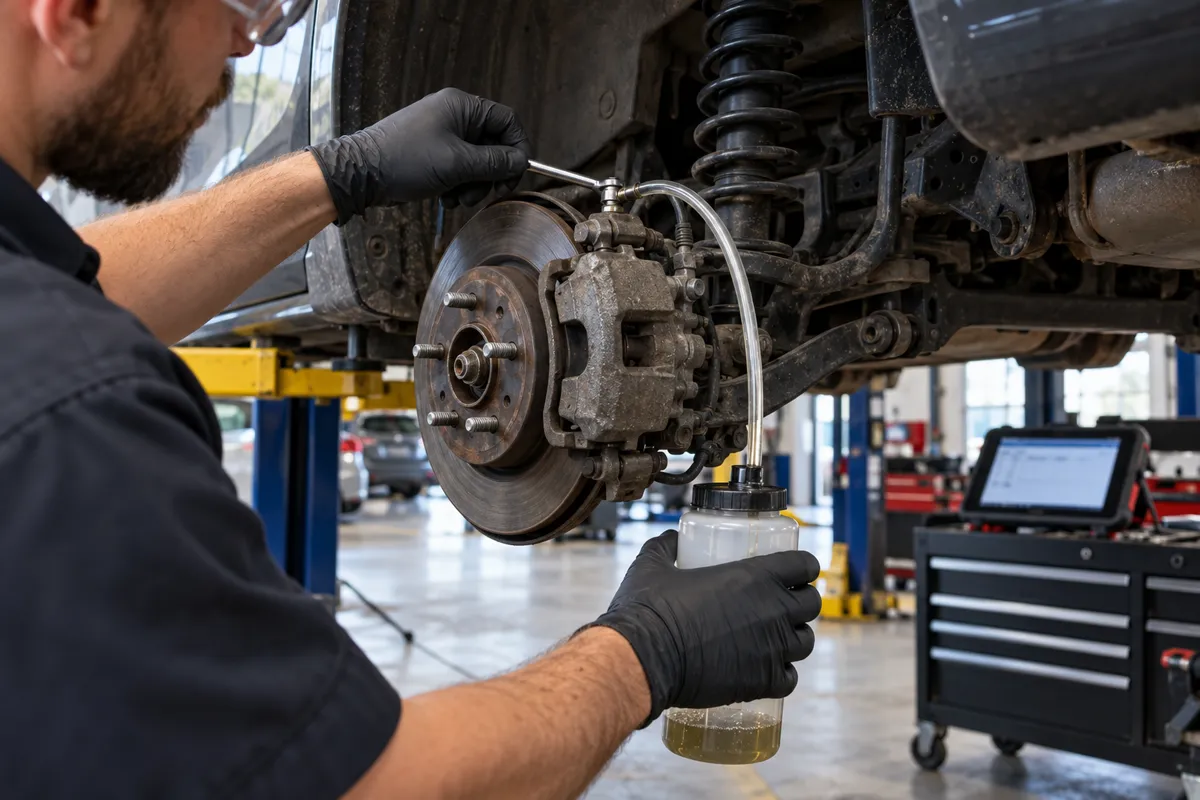
The standard conventional bleeding sequence for a vehicle with a diagonal split brake circuit (common on most passenger cars) is: right rear, left rear, right front, left front — or: furthest from the master cylinder to nearest. For a front-rear split circuit (some older vehicles and trucks), the sequence is both rears, then both fronts. The scanner-assisted bleeding sequence specified by the manufacturer may be different from this conventional sequence: follow the scanner’s specified order during the scanner-activated portion of the procedure.
My j1939 heavy duty truck diagnostics obd2 covers this step by step.
Subaru owners looking for the right scanner should check my best OBD2 scanner for Subaru.
Keep the brake fluid reservoir topped above the minimum level throughout the entire bleeding process. If the reservoir runs dry, air will enter the master cylinder bore and begin the problem again. Use fresh brake fluid of the correct specification (DOT 3, DOT 4, or DOT 5.1 as specified on the reservoir cap — never mix DOT 5 silicone fluid in a system designed for DOT 3/4). Fresh fluid from a sealed container is less hygroscopic (less water absorbed) than old fluid: the visual clarity of the fluid exiting the bleeder screws confirms when all old fluid has been flushed from each circuit.
Honda CR-V owners can find the right scanner in my top diagnostic tools for the CR-V.
ABS DTCs Related to Fluid and Pressure Issues
Air in the ABS system produces specific fault codes when the ABS activates and detects unexpected pressure behavior. C0040-C0060 series codes cover individual wheel ABS solenoid circuit faults that may appear if air in the circuit causes unexpected valve behavior during a simulated ABS activation. C1214 (system relay circuit open) and similar codes appear when the ABS pump is commanded but the pressure response is outside the expected range, which can happen when air is in the accumulator circuit.
Audi Q8 owners can find the right scanner in my top Q8 diagnostic tools.
After successful scanner-assisted bleeding, clear all ABS and ESC codes and perform a road test with a firm emergency-stop from 30 mph on an empty road (where safe) to confirm ABS activation is smooth and modulated. A road test that produces ABS pulsing consistent with normal operation (rhythmic pedal pulsation, vehicle slowing in a controlled straight line) confirms the HCU circuits are bled correctly. An ABS activation that produces an uneven, grabbing, or ineffective stop may indicate remaining air in the system requiring another bleeding cycle.
Audi Q7 owners can find the right scanner in my best scanners for the Q7.
Verifying a Successful Bleed Through Live Data
After completing the scanner-assisted bleeding procedure, use the scanner’s live data to verify the result before road testing. The most useful parameter is brake pressure at each wheel circuit (if the vehicle’s ABS module exposes individual wheel pressure PIDs in its live data). With the brake pedal pressed firmly and held, all four wheel circuits should show consistent pressure. A circuit with significantly lower pressure than the other three indicates residual air in that circuit’s HCU passage.
I cover this capability in more detail in my Innova 3100RS deep dive.
Some ABS modules also report pump motor current and accumulator pressure in live data. A pump current that shows erratic or high resistance during the scanner-activated bleeding cycle suggests air in the pump circuit rather than clean fluid. After successful bleeding, the pump motor current during an ABS test activation (commanded through the scanner’s bidirectional test function if available) should be within the specified range for the pump model.
I cover this capability in more detail in my Foxwell NT630 Plus review.
Wheel speed sensor data during a slow forward roll confirms the ABS system will function correctly when needed. All four wheel speed sensors should show consistent, smooth speed readings at identical values during straight-line movement at 5 to 10 mph. Erratic or missing wheel speed data from one corner prevents the ABS from functioning correctly on that wheel and produces an ABS fault code independent of the fluid bleeding status. Confirming sensor data is clean before road testing separates fluid-related issues from sensor-related issues in the post-service verification.
I explain this in more detail in my my guide on check used car.
FAQs
Can I bleed ABS brakes without a scanner?
On older ABS systems (pre-2004 on most vehicles) where the solenoid valves sit in the direct fluid path, conventional vacuum or pressure bleeding at the caliper bleeder screws is often sufficient. On modern ABS systems with internal HCU pumps and accumulators, conventional bleeding cannot reach the air trapped in the closed internal circuits, and a scanner is required to cycle the solenoids and pump to flush these passages. If you perform conventional bleeding thoroughly and the pedal remains spongy, scanner-assisted bleeding is the next step.
Why is my brake pedal still soft after bleeding?
A soft pedal after thorough bleeding points to one of four causes: air remaining in the ABS HCU internal circuits (requires scanner-assisted bleeding), a failing master cylinder that allows internal bypass between circuits (the pedal sinks slowly under sustained pressure even with no visible fluid loss), a caliper piston that is not retracting correctly (the piston pushes back against the pad, creating false pedal travel), or a brake hose that has delaminated internally (the inner liner collapses under pressure, restricting flow). Disconnect each brake hose at the caliper fitting and observe whether flow is restricted to isolate a collapsed hose. Perform the master cylinder bypass test (pump the pedal to build pressure, hold firm, observe sinkage) to identify master cylinder failure.
Does ABS bleeding require a specific scanner?
The scanner must support ABS service functions for the specific vehicle make and model. Generic OBD2 scanners that only read engine codes cannot access the ABS module’s service functions. A mid-range bidirectional scanner with enhanced ABS/ESC coverage (Autel, Launch, or equivalent) is required. The scanner must list ABS bleeding as a supported service function for the target vehicle in its compatibility specifications. Some ABS systems require the manufacturer’s own scan tool (STAR for Mercedes, ISTA for BMW, IDS for Ford) because the solenoid cycling sequences involve proprietary commands not exposed through generic interfaces.
How often should brake fluid be changed to prevent ABS issues?
Most manufacturers recommend brake fluid replacement every two years or 30,000 miles. Brake fluid is hygroscopic: it absorbs moisture from the atmosphere over time, which lowers its boiling point. Water in the brake fluid causes vapor lock (the water boils inside the calipers under heavy braking, creating gas bubbles that compress like air), which presents identically to air in the system. A brake fluid test strip or refractometer measures fluid water content: above 3 to 4 percent water content, the fluid should be replaced. Replacing fluid on a maintenance schedule prevents water-related pedal fade before it develops into a diagnostic problem.