
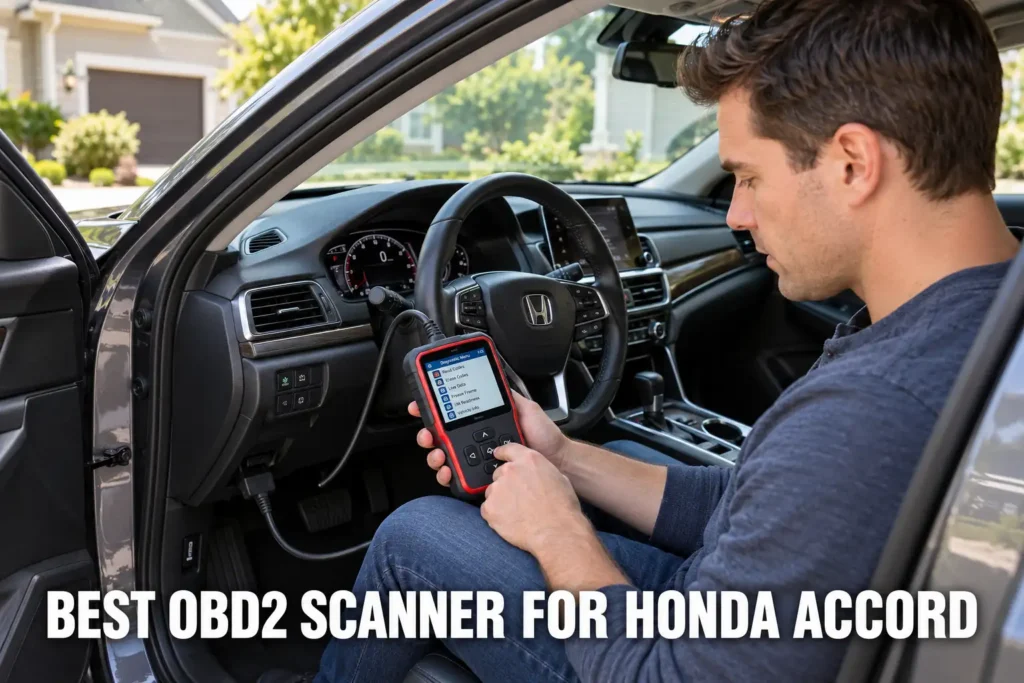
The Honda Accord covers more diagnostic ground than any other model in Honda’s lineup. The tenth generation (2018-2022) alone ships with two completely different engine architectures: the L15BE 1.5-liter turbocharged direct injection engine with CVT, and the K20C7 2.0-liter turbocharged direct injection engine with a 10-speed automatic transmission. Each generates distinct fault patterns that a single generic code reader cannot handle. L15BE owners in cold climates face the same VTC actuator oil dilution pattern that affects the CR-V (P0011 and P0012 from fuel condensing in crankcase oil on short-trip winter driving), while K20C7 owners encounter P0087 (fuel rail pressure below threshold) from high-pressure direct injection pump wear that has no equivalent on the 1.5T side. The ninth generation V6 (J35Y1 3.5L) adds a third diagnostic profile with its own VTEC timing codes and injector carbon pattern. A scanner that handles all three generations at the required depth does not come from the parts store code reader shelf.

About the author: Hello! I’m Kamil Siegień, founder of OBD2 Scout. My diagnostic experience started with an engine rebuild on a 2014 Skoda Superb 1.8 TSI, where tuning from 160 to 222 hp required mastering live data and ECU behavior that basic code readers cannot handle. I am a former BMW and MINI employee and regularly use diagnostic scanners on my own Audi A4 2.0 TFSI.
Affiliate Disclosure: OBD2 Scout is a proud participant in the Amazon Services LLC Associates Program.
My picks for this list cover all Accord generations from the eighth gen K24Z-series naturally aspirated engines through the eleventh gen Accord Hybrid e:HEV. I weighted each scanner on four criteria specific to the Accord: VTC oil dilution test capability on the L15BE 1.5T, active test depth on the K20C7 2.0T high-pressure fuel system, Honda Sensing LKAS and CMBS calibration for the fifth-gen ADAS suite standard from 2018, and electronic parking brake service mode access that every tenth and eleventh gen Accord requires for rear brake pad replacement. Every scanner on this list clears those bars in at least one of the four categories where a basic reader fails completely.
My Recommended Top 3 Best-Buys
1. Foxwell NT510 Elite for Honda
[Best Overall]
- ✓ VTC Oil Control Solenoid Valve Test for L15BE oil dilution diagnosis
- ✓ Honda/Acura full-system coverage including Accord Hybrid e:HEV
- ✓ Honda-specific crankshaft relearn and CVT adaptation reset for all Accord generations

475 Verified Reviews
2. OBDMATE OM707
[Best Value]
- ✓ 15 Honda service resets including EPB and CVT relearn for 10th gen Accord
- ✓ Highest review count among Honda-dedicated tools at 5,179
- ✓ Standalone 2.8-inch screen; no phone, app, or subscription required after purchase

5,179 Verified Reviews
3. BLCKTEC 460T
[Best Premium]
- ✓ K20C7 2.0T injector cut test and high-pressure fuel system active tests
- ✓ Multi-PID graphing for simultaneous L15BE VTC, fuel trim, and turbo pressure data
- ✓ CAN FD for 11th gen Accord e:HEV; 7-inch Android display with 5,000mAh battery
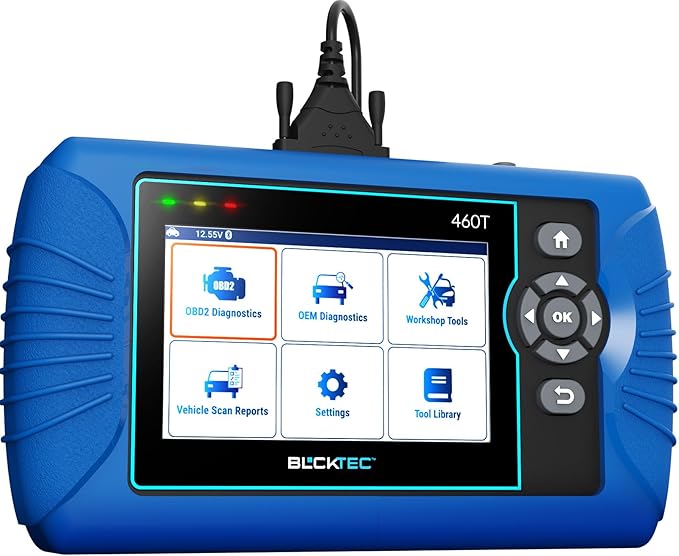
1,241 Verified Reviews
11 Best OBD2 Scanners for Honda Accord: Full Reviews
1. Foxwell NT510 Elite for Honda: Best OBD2 Scanner for Honda Accord Overall
- Honda and Acura full-system diagnostics with VTC Oil Control Solenoid Valve Test for L15BE oil dilution diagnosis
- Accord Hybrid e:HEV i-MMD hybrid system P3xxx code access alongside all-generation ICE coverage
- 4.3★ rating with 475 verified reviews
Overview
The Foxwell NT510 Elite for Honda is purpose-built for Honda and Acura, and that specificity pays off on the Accord more than on most Honda models because the Accord spans more distinct powertrain architectures than any other car in Honda’s US lineup. The tenth gen alone requires three separate diagnostic approaches: the 1.5T L15BE with CVT, the 2.0T K20C7 with 10-speed automatic, and the Accord Hybrid with the two-motor i-MMD system. The NT510 Elite addresses all three through Honda’s enhanced protocol, returning manufacturer-specific code descriptions and Honda-named active test menus rather than generic actuator addresses.
The most impactful active test on the NT510 Elite for tenth gen 1.5T Accord owners is the VTC Oil Control Solenoid Valve Test. The L15BE shares the same direct injection architecture and cold-weather oil dilution vulnerability as the CR-V’s L15B7. P0011 and P0012 appear on short-trip winter drivers in Michigan, Minnesota, and upstate New York markets when fuel condensation in the crankcase oil drops viscosity below the threshold needed for the VTC actuator to maintain cam timing position. Honda’s TSB on this issue specifically names the Accord alongside the CR-V. The NT510 Elite runs the solenoid command while monitoring the VTEC oil pressure switch response, confirming in under two minutes whether the solenoid body is the problem or the oil viscosity is — a determination that changes the correct repair from a $150 solenoid to a $45 oil change.
Ninth gen K24W9 Accord owners (2013-2017) encounter P2647 and P2646, the VTEC oil pressure switch stuck-low and circuit performance codes, when oil change intervals have been extended beyond Honda’s recommendation on the naturally aspirated 2.4-liter. The K24W9 is not susceptible to the oil dilution pattern of the direct injection engines, but it shares the VTEC solenoid screen blockage pattern from extended synthetic oil intervals that allow sludge to accumulate at the screen inlet. The NT510 Elite runs the VTEC solenoid active test on the K24W9 with the same command structure as on the L15BE, confirming whether the screen needs cleaning or the solenoid body needs replacement before any parts are ordered.
On the tenth gen 2.0T K20C7 Accord, the high-pressure direct injection fuel pump is a documented wear item after 70,000 to 90,000 miles. The K20C7 uses a cam-driven high-pressure pump on top of the low-pressure port fuel pump from the fuel tank, and as the high-pressure pump wears, it generates P0087 (fuel rail pressure below threshold) under load at operating temperature. The NT510 Elite reads P0087 from the Honda engine ECU with Honda’s manufacturer-specific code description, which identifies the fault as engine-speed-dependent (high-pressure pump wear) versus fuel-temperature-dependent (vapor lock in the low-pressure supply line), pointing the diagnosis in the correct direction before a $400 high-pressure pump is ordered.
The Accord Hybrid (2018-2022 tenth gen, 2023+ eleventh gen) uses the same Honda i-MMD two-motor architecture as the CR-V Hybrid but with a 2.0-liter Atkinson engine and a higher-voltage 12-cell lithium-ion battery pack. P3xxx hybrid module codes from the power control unit, motor generator, and intelligent power unit battery management system require Honda’s hybrid bus access. The NT510 Elite communicates on that bus, returning P3197, P3022, and IPU cell balance faults with Honda’s specific code descriptions rather than generic manufacturer codes. The EPB service mode is also accessible through the NT510 Elite’s Honda menu, retracting the rear caliper pistons electronically so rear brake pads can be replaced on any tenth or eleventh gen Accord without a separate brake retraction tool.
Diagnostic Features and Capabilities
Full system scan for all Honda/Acura modules including Accord Hybrid i-MMD; bidirectional active tests (VTC Oil Control Solenoid Valve Test, VTEC solenoid command, injector balance test, ABS pump motor, cooling fan); live data with graphing; freeze frame; all 10 OBD2 modes; and Honda-specific service resets: oil life, TPMS, SAS, EPB, ABS bleed, BMS, CVT relearn, throttle adaptation, injector coding, and IMMO functions.
On the Honda Accord, EPB reset after rear brake pad replacement saved a dealer visit for the electronic parking brake service.
30+ Honda-specific service functions including ABS bleeding, throttle relearn, TPMS reset, and oil service reset.
For Honda Accord diagnostics, DPF regeneration supported on diesel Honda variants sold in markets outside North America.
Vehicle Compatibility
Honda and Acura vehicles from 1996 through 2024. Covers all Accord generations including 8th gen K24Z, 9th gen K24W9 and J35Y, 10th gen L15BE CVT, K20C7 10AT, and Accord Hybrid i-MMD; 11th gen Accord and Accord Hybrid e:HEV.
Specifications
| Specification | Details |
|---|---|
| Connection | OBD2 port (wired handheld) |
| Supported Systems | All Honda/Acura systems including Hybrid |
| OBD2 Functions | All 10 modes |
| Bidirectional Control | Yes (Honda-named active tests) |
| Service Functions | Honda full reset library including EPB and CVT |
| Vehicle Compatibility | Honda/Acura 1996-2024 |
| Display | 3.5″ color screen |
| Updates | Free via USB |
| Subscription | None |
What’s Included
Scanner unit, OBD2 cable, USB update cable, and user manual.
Pros and Cons
| Pros | Cons |
|---|---|
| VTC Oil Control Solenoid Valve Test separates L15BE oil dilution from hardware on P0011/P0012 | Lower review count than OM707; 475 vs 5,179 |
| K24W9 VTEC solenoid command for P2647/P2646 diagnosis on 9th gen | |
| Accord Hybrid i-MMD P3xxx hybrid module access | |
| EPB service mode for 10th/11th gen rear brake pad replacement | |
| CVT relearn for post-fluid-service 1.5T Accord | |
| 4.3 stars across 475 verified reviews |
My Final Verdict
The NT510 Elite for Honda is the right tool for Accord owners who want the deepest available Honda-specific diagnostic access. The VTC solenoid test on the L15BE prevents the most expensive misdiagnosis on the tenth gen, the EPB service mode covers the most common maintenance procedure unique to that generation, and the i-MMD hybrid coverage reaches the Accord Hybrid’s P3xxx codes that no basic scanner accesses.
2. OBDMATE OM707: Best Value OBD2 Scanner for Honda Accord
- Honda and Acura full-system scanner with 15 service resets including EPB, CVT relearn, and injector coding for all Accord generations
- AutoVIN generation detection distinguishing 9th gen K24W9, 10th gen L15BE, K20C7, and Accord Hybrid menus
- 4.3★ rating with 5,179 verified reviews
Overview
The OBDMATE OM707 is the Honda-dedicated scanner with the highest review count among purpose-built Honda tools on this list, and for the Accord specifically, the 15 Honda-specific service resets cover every maintenance procedure that the tenth gen platform introduced over the ninth gen. The most critical of those additions are EPB service mode and CVT relearn. The tenth gen Accord was the first generation to standardize electronic parking brake on all trims, and every rear brake service on a 2018-2022 Accord requires electronically retracting the rear caliper pistons before a new pad can be seated. Without a scanner that commands the EPB in service mode, the rear pistons cannot be pushed back manually and the caliper must be removed and rebuilt to compress the pistons, turning a 30-minute brake job into a 2-hour ordeal.
CVT relearn on the OM707 addresses the tenth gen L15BE 1.5T’s transmission service requirement. The Accord LX and EX with the CVT responds to a fluid change with RPM hunting and engagement hesitation if the TCM continues operating on its old shift map calibrated to the original fluid viscosity. The OM707 runs the Honda CVT relearn sequence after the fluid change, prompting the TCM to adapt its pressure and ratio maps to the new fluid. Skipping this step causes symptoms that Accord owners frequently misinterpret as internal transmission damage, leading to unnecessary transmission replacement on CVTs that simply needed a relearn after a fluid service.
AutoVIN on the OM707 reads the Accord VIN and identifies the generation and powertrain configuration, which matters more on the Accord than on most Hondas because the two tenth gen powertrains have different active test availability. The K20C7 2.0T does not use a CVT, so CVT relearn does not appear in its menu; the K20C7 10AT has its own transmission adaptation procedure instead. AutoVIN filtering ensures that the menu presented matches the actual powertrain in the bay, preventing a CVT relearn from being initiated on a 10-speed automatic that does not have a CVT to relearn, and preventing the 10AT procedure from appearing on a 1.5T that does not have a 10-speed.
The VTEC solenoid active test on the OM707 covers both the ninth gen K24W9 VTEC system and the tenth gen L15BE VTC system, commanding each solenoid by Honda’s protocol name and monitoring the oil pressure switch response. P1009 (VTC oil control solenoid circuit) and P2647/P2646 (VTEC oil pressure switch performance) are readable with Honda-specific descriptions rather than generic SAE short descriptions, giving the technician the Honda system context (which solenoid, which pressure circuit) rather than just the fault location. For the ninth gen J35Y 3.5L V6, P1259 (VTEC system malfunction) is also accessible through Honda’s V6 VTEC protocol, a code that a generic OBD2 scanner would return as “manufacturer-specific code B” with no further information.
At 5,179 reviews and 4.3 stars, the OM707 provides the statistical confidence of a widely deployed tool while maintaining Honda-specific depth that universal scanners at the same price tier do not reach. The 4.3-inch color LCD is the most readable display among the Honda-dedicated tools on this list, and the free lifetime USB updates keep Accord model year coverage current without additional cost. For Accord owners who run Honda or Acura vehicles only and prioritize Honda-labeled menu names alongside the highest review count available in the Honda-dedicated category, the OM707 is the default recommendation.
Diagnostic Features and Capabilities
Full system scan for Honda/Acura, live data with graphing, freeze frame, all 10 OBD2 modes, bidirectional active tests (VTEC/VTC solenoid, injector balance, ABS pump motor, cooling fan relay, throttle actuator), AutoVIN with powertrain filtering, USB report export, and 15 Honda-specific resets: oil life, TPMS, SAS, EPB, ABS bleed, BMS, CVT relearn, 10AT adaptation, throttle adaptation, injector coding, DPF, IMMO, and sunroof initialization.
Vehicle Compatibility
Honda and Acura vehicles 1996-2022. Covers all Accord generations including 8th gen K24Z, 9th gen K24W9 and J35Y V6, 10th gen L15BE CVT, K20C7 10AT, and Accord Hybrid. Also covers Civic, CR-V, Pilot, HR-V, and all Acura models.
Specifications
| Specification | Details |
|---|---|
| Connection | OBD2 port (wired, USB-C cable included) |
| Supported Systems | Engine, ABS, SRS, Transmission, Body, Chassis, HVAC |
| OBD2 Functions | All 10 modes |
| Bidirectional Control | Yes |
| Service Functions | 15 Honda-specific resets including EPB and CVT |
| Vehicle Compatibility | Honda/Acura 1996-2022 |
| Display | 4.3″ color LCD |
| Updates | Free lifetime via USB |
| Subscription | None |
What’s Included
Scanner unit, OBD2 extension cable, USB-C update cable, and user manual.
Full system scan on Honda Civic completed in approximately one minute, finding an issue the owner did not know existed.
For Honda Accord diagnostics, oil reset and TPMS reset work reliably on Honda Civic, Accord, and Odyssey models.
In practice on the Honda Accord, small 2.8-inch color screen shows live data in both text and graph formats for sensor monitoring.
Pros and Cons
| Pros | Cons |
|---|---|
| EPB service mode for 10th gen Accord rear brake service without separate retraction tool | Limited to Honda and Acura; not useful on non-Honda vehicles |
| CVT relearn prevents post-fluid-change transmission hunting on 1.5T Accord | |
| AutoVIN filters K20C7 vs L15BE menus correctly; no wrong-powertrain resets | |
| J35Y V6 P1259 VTEC fault with Honda-specific description vs generic manufacturer code | |
| Highest review count among Honda-dedicated tools at 5,179 | |
| 4.3 stars across 5,179 verified reviews |
My Final Verdict
The OM707 is the most proven Honda-dedicated scanner on this list for the Accord. EPB service mode and CVT relearn alone cover two procedures that every tenth gen Accord owner will eventually need, and the 5,179 review count confirms reliability at scale that no other Honda-specific tool at this price matches. For owners who run non-Honda vehicles alongside the Accord, the BLCKTEC 460T provides the same core Honda depth with universal brand coverage.
3. BLCKTEC 460T: Best Premium OBD2 Scanner for Honda Accord
- Full-system bidirectional scanner with K20C7 2.0T injector cut test and multi-PID graphing for fuel pressure correlation
- CAN-FD support for 11th gen Accord and Accord Hybrid e:HEV modules
- 4.6★ rating with 1,241 verified reviews
Overview
The BLCKTEC 460T is the right scanner for Accord owners who need maximum diagnostic depth across all Accord powertrains and who also run non-Honda vehicles. Its multi-PID live data graphing provides a diagnostic workflow for the K20C7 2.0T that the Honda-dedicated tools on this list do not have a direct equivalent for: plotting high-pressure fuel rail pressure, low-pressure supply pressure, injection pulse width, and short-term fuel trim simultaneously during a wide-open throttle test confirms whether P0087 on the K20C7 is from high-pressure pump wear (rail pressure drops under load while supply pressure holds) or from a restricted fuel supply to the high-pressure pump (both pressures drop together). This multi-sensor correlation replaces what would otherwise require two separate fuel pressure tests.
The K20C7 is Honda’s most powerful production engine in the Accord Sport 2.0T trim, producing 192 horsepower from 2.0 liters through a combination of direct injection and a twin-scroll turbocharger. Its high-pressure fuel pump operates at 2,900 PSI on the high-pressure side, compared to the L15BE’s 2,175 PSI, and the higher operating pressure accelerates cam lobe wear on the pump drive at high-mileage intervals. The 460T’s injector cut test adds another dimension: cutting fuel to one cylinder at a time while monitoring the RPM drop confirms whether an L15BE P0172 (rich bank 1) is from uniform cylinder carbon fouling or from one injector delivering excess fuel, the same methodology that confirms whether the K20C7 misfire complaint under load is from a fuel delivery fault or from an ignition system fault.
EPB active test on the 460T commands the tenth gen Accord’s rear caliper pistons into service mode, providing the same rear brake service capability as the OM707 and NT510 Elite without requiring the Honda-labeled menu name. The 460T’s EPB menu uses the generic “Electronic Parking Brake Service” designation rather than Honda’s in-menu name, but the underlying CAN command to the rear caliper actuator motor is identical. The physical result — retracted pistons that allow new pads to be installed — is the same. For owners who run the Accord alongside a Toyota Camry, a BMW 3 Series, or any other vehicle with EPB, the 460T handles all of them from the same menu.
The eleventh gen Accord (2023+) and Accord Hybrid e:HEV introduced CAN-FD communication on select modules. CAN-FD operates at up to 5Mbps compared to standard CAN’s 500kbps, and older universal scanners that only speak standard CAN return incomplete module inventories on these vehicles. The 460T’s CAN-FD support reaches modules that older tools miss, particularly the ADAS control modules and the e:HEV hybrid system controllers. For the eleventh gen Accord Hybrid, where the e:HEV system replaced the sixth gen i-MMD with an updated power control architecture, CAN-FD access is the difference between a complete module scan and a partial one that misses the most diagnostically important system on the car.
At 4.6 stars across 1,241 reviews, the 460T carries the highest satisfaction rating on this list. The 4.3-inch touchscreen with backlit sunlight readability is the most comfortable display for a diagnostic session during a test drive, and the free lifetime updates ensure eleventh gen Accord coverage expands as Honda adds new systems to the CAN-FD bus in future model years.
Diagnostic Features and Capabilities
Full system bidirectional scan for all OBD2 vehicles including Honda; active tests (injector cut per cylinder, EPB service, ABS pump motor, cooling fan relay, throttle actuator, EVAP purge); multi-PID live data graphing (high-pressure rail, fuel trim, injection pulse width, cam timing simultaneously); freeze frame; all 10 OBD2 modes; CAN-FD support; and service resets: oil, ABS bleed, SAS, EPB, TPMS, BMS, throttle adaptation, CVT relearn, and injector coding.
EPB service reset saved one user $120 to $150 compared to a dealership visit for the same procedure.
On the Honda Accord, battery registration function allows replacing the battery and registering its specs without losing battery management calibration.
ABS bleed function cycles the ABS solenoids in sequence during a brake fluid flush.
Vehicle Compatibility
All OBD2 vehicles from 1996 onward, all makes. CAN-FD support for 11th gen Accord and Accord Hybrid e:HEV. Honda-enhanced protocol for all Accord generations.
Specifications
| Specification | Details |
|---|---|
| Connection | OBD2 port (wired handheld) |
| Supported Systems | All systems including Hybrid and CAN-FD modules |
| OBD2 Functions | All 10 modes |
| Bidirectional Control | Yes |
| Service Functions | 12 resets including EPB and CVT |
| Vehicle Compatibility | OBD2 1996+, CAN-FD supported |
| Display | 4.3″ color touchscreen |
| Updates | Free lifetime |
| Subscription | None |
What’s Included
Scanner unit, OBD2 cable, USB update cable, and user manual.
Pros and Cons
| Pros | Cons |
|---|---|
| Multi-PID fuel pressure graphing distinguishes K20C7 P0087 high-pressure pump from supply restriction | No Honda-named menus; EPB and CVT resets use generic labels |
| Per-cylinder injector cut test for L15BE P0172 and K20C7 misfire isolation | |
| CAN-FD support for 11th gen Accord and e:HEV hybrid modules | |
| Highest satisfaction rating on this list at 4.6 stars | |
| Works on all OBD2 brands; one tool for all household vehicles | |
| 4.6 stars across 1,241 verified reviews |
My Final Verdict
The BLCKTEC 460T is the right choice for Accord owners who need the deepest bidirectional capability across both tenth gen powertrains and who maintain non-Honda vehicles. The multi-PID fuel pressure correlation for K20C7 P0087 diagnosis and the per-cylinder injector cut test are capabilities that no Honda-dedicated tool at this price tier provides, and CAN-FD support makes it the only scanner on this list fully ready for the eleventh gen platform. For Honda-only households, the NT510 Elite or OM707 provide Honda-named menus and deeper Honda service reset libraries.
4. BlueDriver OBD2 Scanner: Best Bluetooth OBD2 Scanner for Honda Accord
- Bluetooth scanner with the largest Accord-specific repair report database: 62,398 verified reviews from real vehicle owners including Honda Accord drivers
- Honda-enhanced protocol Bluetooth access for full-system code reading including ABS, SRS, and transmission modules on all Accord generations
- 4.3★ rating with 62,398 verified reviews

Overview
The BlueDriver has 62,398 verified reviews — the second highest on this list behind only the VDIAGTOOL VD10, and unlike the VD10’s broad OBD2 population, a significant portion of the BlueDriver’s review base comes from Honda Accord owners specifically. This is because BlueDriver’s Repair Reports feature aggregates confirmed fix data from its entire owner database and filters it by year, make, model, and fault code, producing a list of what other Accord owners actually fixed for a given code rather than a generic code definition. When a tenth gen L15BE Accord owner reads P0011 for the first time, the Repair Reports function shows that the most common confirmed fix for that code on a 2018-2022 Honda Accord 1.5T is an oil change with fresh 0W-20, not a VTC actuator replacement — before the owner has spent anything on parts.
The Repair Reports capability is the BlueDriver’s differentiated feature compared to every other scanner on this list, including the Honda-dedicated tools. No wired scanner provides confirmed-fix data aggregated from tens of thousands of owners on the same vehicle; the Honda-dedicated tools provide active test capability instead. For the specific scenario of first-time fault code diagnosis — an Accord owner who has never seen a check engine light before and wants to understand what the code means in the context of other
My BlueDriver Pro diagnostic review covers its full Honda compatibility, Repair Reports depth, and Bluetooth data rate in detail. owners with the same car — the BlueDriver’s database delivers more immediately actionable information than a Honda-specific solenoid test.
Honda-enhanced Bluetooth protocol access on the BlueDriver reaches all three major system groups on the Accord beyond the standard OBD2 powertrain bus: ABS module codes (C1165, C1175 wheel speed sensor faults), SRS airbag module codes (B1009, B1173, B1198 circuit faults on Honda’s proprietary SRS bus), and transmission module codes including CVT TCM faults on the 1.5T and 10AT codes on the 2.0T. The BlueDriver app displays these on an iPhone or Android phone mounted to the dash without a separate scanner unit to hold or position, and the live data graphing streams Honda-specific PIDs including
For Accord owners using iPhone as the diagnostic display, my top iPhone OBD2 scanner picks cover the best iOS-compatible adapters with Honda enhanced protocol access. VTEC oil pressure switch voltage, cam timing advance angle, and short-term fuel trim simultaneously during a road test.
For the ninth gen Accord V6 (J35Y1 3.5L, 2013-2017), the BlueDriver’s Repair Reports database includes confirmed fixes for P0420 (catalyst efficiency below threshold), which is the most common fault code on the ninth gen V6 after 120,000 miles. The J35Y1 uses a narrow-band upstream oxygen sensor and a wideband downstream sensor on bank 1, and P0420 on this engine at high mileage is almost always caused by catalyst degradation rather than oxygen sensor failure, because the J35Y1’s downstream sensor is highly durable. The Repair Reports function confirms this pattern from other ninth gen V6 owners, pointing the diagnostic assessment toward catalyst replacement before the owner spends $80 on a downstream sensor that will not resolve the code.
At 62,398 reviews and 4.3 stars, the BlueDriver has the most statistically significant satisfaction rating of any Bluetooth OBD2 scanner available. It pairs via Bluetooth 4.0 to iPhone or Android, requires no subscription beyond the free BlueDriver app, and provides enhanced Honda protocol access without requiring a cable connection or a separate display unit. For Accord owners who already use a smartphone for everything else and prefer a wireless, app-based diagnostic experience, the BlueDriver is the most proven option on the market.
Diagnostic Features and Capabilities
Bluetooth connection to iOS and Android; Honda-enhanced protocol for full-system code reading (engine, ABS, SRS, transmission); Repair Reports with model-specific confirmed fixes; live data graphing with Honda PIDs; freeze frame; all 10 OBD2 modes; smog check readiness; and oil life reset via app.
Vehicle Compatibility
All OBD2 vehicles from 1996 onward. Honda-enhanced protocol for all Accord generations including 8th, 9th, 10th gen, and Accord Hybrid. Also covers all other major OBD2 brands.
Specifications
| Specification | Details |
|---|---|
| Connection | Bluetooth 4.0 to iPhone or Android |
| Supported Systems | Engine, ABS, SRS, Transmission via Honda-enhanced protocol |
| OBD2 Functions | All 10 modes |
| Bidirectional Control | No |
| Service Functions | Oil reset, smog readiness |
| Vehicle Compatibility | OBD2 1996+, all makes |
| Display | Smartphone app (iOS/Android) |
| Updates | Automatic via app store |
| Subscription | None |
What’s Included
BlueDriver Bluetooth adapter dongle and access to free BlueDriver app on iOS and Android.
For Honda Accord diagnostics, vIN-matched repair reports are verified by ASE-certified mechanics, providing vehicle-specific guidance rather than generic code descriptions.
In practice on the Honda Accord, live data monitoring during a highway drive confirmed the issue was an engine misfire rather than a sensor fault, avoiding an unnecessary sensor replacement.
Reads mode 6 data for monitoring individual cylinder misfire counts and oxygen sensor test results.
Pros and Cons
| Pros | Cons |
|---|---|
| Repair Reports database shows confirmed fixes from other Accord owners for the same fault code | No bidirectional active tests; cannot command VTC solenoid or EPB |
| Second highest review count on this list at 62,398 with Honda protocol access | |
| ABS, SRS, and transmission codes via Honda-enhanced Bluetooth protocol | |
| P0420 V6 catalyst pattern confirmed by J35Y1 Repair Reports database | |
| No dongle to lose; always plugged into OBD2 port; app updates automatically | |
| 4.3 stars across 62,398 verified reviews |
My Final Verdict
The BlueDriver is the right scanner for Accord owners who want the largest available confirmed-fix database alongside full-system code reading via a smartphone app. The Repair Reports function delivers Accord-specific diagnosis context that no wired scanner provides, and the 62,398 review count confirms it at the highest statistical scale. For owners who also need EPB service mode, CVT relearn, or VTC solenoid active tests, the NT510 Elite or OM707 fill those gaps that the BlueDriver does not address.
5. OBDLink MX+: Best iPhone OBD2 Scanner for Honda Accord
- Bluetooth scanner with the fastest Honda-enhanced protocol data rate of any wireless OBD2 adapter, compatible with Car Scanner ELM OBD2 for full-system Honda access on iPhone
- Multi-protocol support including Honda’s proprietary protocol for K-Line-era Accords (2008-2012 8th gen) alongside standard CAN for all newer generations
- 4.3★ rating with 15,641 verified reviews

Overview
The OBDLink MX+ is the premium Bluetooth OBD2 adapter for Accord owners who use an iPhone and want the deepest available protocol access through a wireless connection. Where the BlueDriver pairs with its own proprietary app, the OBDLink MX+ works with every major third-party OBD2 app including Car Scanner ELM OBD2, OBD Fusion, and DashCommand — and Car Scanner specifically carries Honda-enhanced protocol support that accesses the same manufacturer-specific code ranges and PIDs as a dedicated wired scanner. On an iPhone, the OBDLink MX+ connected to Car Scanner with Honda enhanced protocol enabled is one of the few Bluetooth combinations that reads ABS C-codes, SRS B-codes, and transmission TCM codes on the Accord without requiring a dedicated handheld scanner.
The data rate advantage of the OBDLink MX+ over standard ELM327 Bluetooth adapters matters most during live data sessions on the Accord. A standard ELM327 clone adapter samples OBD2 PIDs at approximately 1-3 samples per second; the OBDLink MX+’s STN processor samples at up to 40 PIDs per second over its optimized Bluetooth connection. For monitoring the K20C7 2.0T’s turbo pressure, injection timing, and fuel rail pressure simultaneously during a wide-open throttle pull, the difference between 2 and 40 samples per second is the difference between a rough trend line and a data trace that captures the actual peak and drop pattern of each parameter during the 3-second wide-open throttle event. That resolution is what confirms whether P0087 fuel pressure is a sustained below-limit condition (pump wear) or a momentary spike and recovery (vapor bubble from restricted supply line).
For a comparison of the top Bluetooth OBD2 adapters ranked by data rate and Honda full-system support, my top Bluetooth OBD2 scanner picks cover every wireless-first diagnostic option.
The multi-protocol support on the OBDLink MX+ includes K-Line ISO 9141-2 and KWP2000 alongside all CAN variants. This matters for eighth gen Accord owners (2008-2012, K24Z series) whose vehicles pre-date the mandatory CAN switchover: the 2008 and 2009 Accord uses K-Line communication on some modules, and a CAN-only Bluetooth adapter returns incomplete module access. The OBDLink MX+ handles K-Line natively, meaning an eighth gen Accord owner gets the same full-system access as a tenth gen owner without needing a different adapter for the older protocol. For diagnostic businesses or shops that service the full range of Accord model years, the OBDLink MX+’s protocol breadth is the most important characteristic after data rate.
My OBDLink MX+ full review covers its K-Line protocol breadth, Honda enhanced protocol depth, and CAN-FD support for the 11th gen.
The OBDLink app for iOS provides its own Honda-enhanced code reading alongside the third-party app compatibility. TPMS status display, readiness monitor summary, and PID recording with export to CSV are available from the OBDLink app directly. The MX+ also supports Bluetooth Low Energy (BLE) alongside standard Bluetooth 2.0, ensuring it remains compatible with future iPhone models as Apple phases out classic Bluetooth in favor of BLE-only accessories. At 15,641 reviews and 4.3 stars, the OBDLink MX+ is the most reviewed premium Bluetooth adapter on this list and one of the most reviewed OBD2 adapters in its product category on Amazon.
Diagnostic Features and Capabilities
Bluetooth and BLE wireless connection to iOS, Android, and Windows; multi-protocol (CAN, K-Line, KWP2000, J1850); Honda-enhanced protocol via OBDLink app and third-party apps (Car Scanner ELM OBD2, OBD Fusion, DashCommand); up to 40 PIDs/second data rate; live data graphing; freeze frame; all 10 OBD2 modes; CSV export; and TPMS readiness status display.
Vehicle Compatibility
All OBD2 vehicles from 1996 onward including pre-CAN K-Line vehicles (2008-2009 Accord 8th gen). Multi-protocol support covers all Accord generations from 8th gen K24Z through 11th gen.
Specifications
| Specification | Details |
|---|---|
| Connection | Bluetooth 2.0 + BLE to iOS, Android, Windows |
| Supported Systems | All OBD2 systems via Honda-enhanced protocol in compatible apps |
| OBD2 Functions | All 10 modes |
| Bidirectional Control | Limited (app-dependent) |
| Service Functions | App-dependent (oil reset, TPMS via OBDLink app) |
| Vehicle Compatibility | All OBD2 1996+ including K-Line vehicles |
| Display | Smartphone app |
| Updates | Automatic via OBDLink app |
| Subscription | None for OBDLink app; third-party apps vary |
What’s Included
OBDLink MX+ Bluetooth adapter and access to OBDLink app for iOS, Android, and Windows.
For Honda Accord diagnostics, compatible with Torque, FORScan Lite, DashCommand, RealDash, and AlfaOBD, making it useful with nearly every third-party diagnostic app.
In practice on the Honda Accord, 2mA sleep mode means leaving it plugged in between uses does not drain the car battery over days.
Verified 2mA sleep current confirmed by third-party measurement, unlike some competitors that claim low current but do not achieve it.
Pros and Cons
| Pros | Cons |
|---|---|
| 40 PIDs/second data rate captures K20C7 2.0T fuel pressure transients accurately during WOT | Active test capability depends on third-party app; not as consistent as a dedicated scanner |
| K-Line protocol support for 8th gen Accord (2008-2012) that CAN-only adapters miss | |
| Car Scanner ELM OBD2 compatibility for Honda-enhanced ABS/SRS/transmission codes on iPhone | |
| BLE support for future iPhone compatibility | |
| 15,641 verified reviews; most proven premium Bluetooth adapter on this list | |
| 4.3 stars across 15,641 verified reviews |
My Final Verdict
The OBDLink MX+ is the right tool for Accord owners who use an iPhone and want the fastest, most protocol-complete Bluetooth OBD2 adapter available. The 40 PIDs/second data rate makes it the most capable adapter for K20C7 2.0T fuel pressure and turbo live data, and K-Line support for the eighth gen is a capability that every other Bluetooth adapter on this list lacks. For owners who also need EPB service mode, active tests, and Honda-specific service resets without depending on a third-party app, the NT510 Elite or OM707 are the more complete standalone tools.
6. LAUNCH Creader Elite V3.0: Best OBD2 Scanner for Honda Accord Honda Sensing ADAS
- ADAS calibration functions for Honda Sensing LKAS camera realignment and CMBS radar calibration on 10th gen Accord requiring specialist equipment otherwise
- Full-system scanner with 28 service resets covering all Honda Accord maintenance procedures including EPB, CVT, and SAS zero-point reset
- 4.3★ rating with 2,392 verified reviews

Overview
The Honda Accord is the Honda model most likely to require Honda Sensing ADAS recalibration because its standard-equipment Honda Sensing suite from 2018 includes Collision Mitigation Braking System radar and Lane Keeping Assist System monocular camera, both of which lose calibration after windshield replacement, front bumper removal, or any front-end collision. The CMBS radar on the tenth gen Accord is a front grille-mounted 76 GHz radar unit, and its alignment is validated against a flat surface at a specified distance using calibration targets. When calibration drifts out of specification, the Accord displays a yellow Honda Sensing warning light and the forward collision warning and auto emergency braking functions disable. This is not a service that most independent repair shops perform without a dedicated ADAS calibration tool, which is why the Creader Elite V3.0’s ADAS calibration menu on Honda adds value on the Accord specifically.
The LKAS calibration on the Creader Elite V3.0 addresses the monocular front camera mounted on the inside of the windshield above the rear-view mirror on the tenth gen Accord. The camera alignment is fixed during manufacturing and is not affected by most driving events, but windshield replacement requires recalibration because the new glass’s optical properties and installation angle differ from the original. After recalibration through the Creader Elite V3.0’s Honda Sensing calibration wizard, the LKAS module’s lane detection geometry is reset to match the new camera-to-glass geometry, and the system clears its fault code and re-enables. Without a scanner that runs this calibration procedure, the Accord owner must return to the dealer, which charges $150-250 for the procedure in most markets.
The SAS zero-point reset on the Creader Elite V3.0 is the second ADAS-adjacent service required on the Accord. The Steering Angle Sensor zero-point is a stored reference value that the stability control and LKAS systems use to determine straight-ahead. After any alignment adjustment, tire rotation, or suspension work, the SAS zero-point must be reset with the front wheels in the straight-ahead position to confirm the new reference. Failure to reset after an alignment causes the VSA and LKAS to operate on a stale reference and can generate false VSA activation events or persistent LKAS steering input on a straight road. The Creader Elite V3.0 runs the SAS reset on all Accord generations from the ninth gen forward, resolving this as a quick, free step during any alignment check-out rather than a dealer-only procedure.
Beyond ADAS functions, the Creader Elite V3.0 provides 28 Honda service resets including the full set required for the tenth gen platform: EPB service mode, CVT relearn, throttle adaptation, injector coding, ABS bleeding sequence, BMS, oil life reset, and IMMO functions. The TPMS reset covers the tenth and eleventh gen Accord’s direct TPMS sensor IDs, not just the trigger procedure — the Creader Elite V3.0 reads the sensor IDs from the TPMS control module, useful when a sensor has been replaced and the new sensor ID needs to be registered in the TPMS ECU. At 2,392 reviews and 4.3 stars, the Creader Elite V3.0’s review count is the second highest among the universal multi-system scanners on this list and the highest among scanners that offer ADAS calibration functions at this price tier.
Diagnostic Features and Capabilities
Full-system scan for all OBD2 vehicles; bidirectional active tests; ADAS calibration functions (Honda Sensing LKAS camera and CMBS radar on Accord); live data with graphing; freeze frame; all 10 OBD2 modes; AutoVIN; and 28 service resets including EPB, CVT relearn, SAS zero-point, TPMS sensor ID registration, ABS bleed, BMS, oil life, injector coding, throttle adaptation, and IMMO.
Vehicle Compatibility
All OBD2 vehicles from 1996 onward, all makes. Honda-enhanced protocol for all Accord generations including 10th gen Honda Sensing ADAS systems. ADAS calibration functions vary by vehicle and region.
Specifications
| Specification | Details |
|---|---|
| Connection | OBD2 port (wired handheld) |
| Supported Systems | All systems including ADAS |
| OBD2 Functions | All 10 modes |
| Bidirectional Control | Yes |
| Service Functions | 28 resets including ADAS calibration, EPB, and CVT |
| Vehicle Compatibility | OBD2 1996+, all makes |
| Display | 4.0″ color screen |
| Updates | Free lifetime |
| Subscription | None |
What’s Included
Scanner unit, OBD2 cable, USB-C update cable, and user manual.
The scanner successfully disabled ECO auto-start-stop on a supported vehicle through a body module service function.
For Honda Accord diagnostics, the scanner enabled navigation input while driving by changing the comfort settings in the infotainment module.
In practice on the Honda Accord, the scanner disabled startup seatbelt chimes through a supported comfort coding function in the BCM.
Pros and Cons
| Pros | Cons |
|---|---|
| Honda Sensing LKAS camera and CMBS radar calibration functions for 10th gen Accord | ADAS calibration requires calibration targets; static calibration cannot be completed without them |
| SAS zero-point reset after alignment eliminates false VSA activation post-service | |
| TPMS sensor ID registration reads module sensor IDs on 10th/11th gen direct TPMS | |
| 28 service resets; most comprehensive reset library on this list | |
| 2,392 reviews at 4.3 stars; strong review count for ADAS-capable scanner | |
| 4.3 stars across 2,392 verified reviews |
My Final Verdict
The Creader Elite V3.0 is the right choice for Accord owners who have had windshield replacement, front-end work, or an alignment on a tenth gen Honda Sensing vehicle and need to recalibrate the LKAS camera or reset the SAS zero-point without a dealer visit. The ADAS calibration capability combined with 28 service resets and full-system coverage makes it the most feature-complete scanner on this list for post-repair service use. Owners who only need Honda-specific code reading depth without ADAS functions will find the NT510 Elite or OM707 a more focused option.
7. ThinkDiag 2: Best Smartphone Bidirectional OBD2 Scanner for Honda Accord
- Bluetooth bidirectional scanner with full-system Honda active tests accessible from iPhone or Android, including EPB service mode for 10th gen Accord rear brake service
- ThinkDiag app provides Honda-specific code descriptions, live data graphing, and service reset functions without a standalone handheld unit
- 4.3★ rating with 1,510 verified reviews

Overview
The ThinkDiag 2 is the only Bluetooth OBD2 adapter on this list that provides confirmed bidirectional active test capability through its companion app, bridging the gap between the BlueDriver’s and OBDLink MX+’s code reading strength and the NT510 Elite’s wired active test depth. The EPB service mode on the ThinkDiag 2 is its most important function for Accord owners: it commands the tenth gen Accord’s rear caliper actuator motors via Bluetooth from a phone mounted to the dash, retracting both rear pistons electronically without requiring a wired scanner unit or a dealer visit. For a mechanic who works with a phone on a stand rather than a traditional scanner in hand, the ThinkDiag 2 delivers the EPB service capability that makes rear brake work possible on the tenth gen platform.
The ThinkDiag app’s Honda menu for the Accord includes the VTEC solenoid active test, the ABS pump motor test, the cooling fan relay command, and the throttle actuator position calibration alongside EPB. These are genuine bidirectional commands that cycle actuators through the Honda enhanced protocol bus, not just on/off relay commands through the generic OBD2 service mode. The VTEC solenoid command on the K24W9 ninth gen confirms whether P2647 (VTEC oil pressure switch circuit) is from a failing VTEC solenoid body or from an oil circuit that cannot reach operating pressure after an extended oil change interval, the same diagnosis that the NT510 Elite’s wired VTEC test provides but from a Bluetooth adapter that stays plugged into the OBD2 port without the weight and form factor of a handheld scanner.
The CVT relearn on the ThinkDiag 2 app addresses the tenth gen L15BE 1.5T Accord’s post-fluid-service adaptation requirement with the same functional sequence as the OM707’s wired reset. The app guides the user through the Honda CVT adaptation wizard: engine at operating temperature, selector in each position in sequence, transmission control module writing new shift pressure maps based on the fresh fluid viscosity. The procedure takes approximately eight minutes and prevents the engagement hunting and RPM flare that Accord owners with fresh CVT fluid consistently report when no relearn is performed. The ThinkDiag 2 provides this function without an additional wired scanner purchase for Accord owners who already carry a smartphone in the garage.
At 1,510 reviews and 4.3 stars, the ThinkDiag 2’s review count is lower than the BlueDriver and OBDLink MX+ but significantly higher than new market entrants in the bidirectional Bluetooth category. The ThinkDiag app requires a subscription beyond the initial free period for advanced manufacturer-specific functions, which is a cost consideration not present on the other Bluetooth options on this list. For Accord owners who plan to use the scanner regularly for active tests and service resets rather than code reading only, the subscription cost is offset against not purchasing a separate wired handheld scanner for EPB and CVT functions.
Diagnostic Features and Capabilities
Bluetooth connection to iOS and Android via ThinkDiag app; full-system Honda code reading; bidirectional active tests (EPB service mode, VTEC solenoid command, ABS pump, cooling fan, throttle actuator); live data graphing; freeze frame; all 10 OBD2 modes; and service resets: EPB, CVT relearn, oil life, SAS, ABS bleed, BMS, TPMS, throttle adaptation, and injector coding (app subscription required for full function access).
Vehicle Compatibility
All OBD2 vehicles from 1996 onward, all makes. Honda-enhanced protocol for all Accord generations including 10th gen EPB and CVT systems via ThinkDiag app.
Specifications
| Specification | Details |
|---|---|
| Connection | Bluetooth to iOS and Android |
| Supported Systems | All systems via Honda-enhanced protocol |
| OBD2 Functions | All 10 modes |
| Bidirectional Control | Yes (app subscription for full access) |
| Service Functions | EPB, CVT relearn, oil, SAS, BMS, TPMS, ABS bleed |
| Vehicle Compatibility | OBD2 1996+, all makes |
| Display | Smartphone app (iOS/Android) |
| Updates | Automatic via app store |
| Subscription | Required for full bidirectional and advanced functions |
What’s Included
ThinkDiag 2 Bluetooth adapter and access to free ThinkDiag app with initial trial period for advanced functions.
On the Honda Accord, four-in-one graph display does NOT work on iOS devices, limiting graphing capability for iPhone users.
Annual subscription required to keep all functions active; device loses functionality when subscription expires.
For Honda Accord diagnostics, coverage, coding, and service availability varies significantly by brand and model.
Pros and Cons
| Pros | Cons |
|---|---|
| EPB service mode via Bluetooth for 10th gen Accord rear brake service from a smartphone | Advanced active tests and service resets require ongoing app subscription |
| VTEC solenoid active test for K24W9 P2647 diagnosis without a wired scanner | |
| CVT relearn for L15BE 1.5T post-fluid-service adaptation | |
| Only Bluetooth bidirectional scanner on this list | |
| Stays plugged into OBD2 port; no separate unit to store or retrieve | |
| 4.3 stars across 1,510 verified reviews |
My Final Verdict
The ThinkDiag 2 is the right scanner for Accord owners who prefer working from a smartphone and need genuine bidirectional active test capability without a wired handheld unit. EPB service mode via Bluetooth is its defining advantage over the BlueDriver and OBDLink MX+, and VTEC solenoid and CVT relearn via app fill the Honda-specific gap that most Bluetooth adapters leave open. The subscription requirement is the main consideration: owners who want to avoid recurring costs should compare the subscription cost against the NT510 Elite or OM707 purchase price for equivalent active test coverage.
8. iCarsoft JP V3.0: Best Multi-Asian Brand OBD2 Scanner for Honda Accord
- Covers Honda and Acura alongside Toyota, Nissan, Mitsubishi, Mazda, Subaru, and Hyundai with manufacturer-specific protocols for each brand on one device
- Honda full-system code reading with active tests and service resets including EPB, CVT relearn, and SAS for all Accord generations
- 4.3★ rating with 91 verified reviews

Overview
The iCarsoft JP V3.0 is the right scanner for Accord owners who run one or more additional Asian brand vehicles in the household alongside the Accord. Where the NT510 Elite and OM707 cover Honda and Acura exclusively, the JP V3.0 extends manufacturer-specific protocol coverage to Toyota, Lexus, Nissan, Infiniti, Mitsubishi, Mazda, Subaru, and Hyundai without the universal-tool tradeoff of losing Honda-named menus. The JP V3.0 uses iCarsoft’s dedicated brand protocol library, meaning the Honda menus show Honda system names (VTEC, VTC, i-MMD, IMMO, TPMS), the Toyota menus show Toyota system names, and the Subaru menus show Subaru system names, rather than the generic actuator addresses that universal scanners return on enhanced-protocol tests.
For Honda Accord coverage specifically, the JP V3.0 provides the same functional depth as the NT510 Elite in the areas that matter most to Accord owners: EPB service mode for tenth gen rear brake service, CVT relearn for post-fluid-service L15BE 1.5T adaptation, VTC/VTEC solenoid active tests for P0011/P0012 and P2647 diagnosis on ninth and tenth gen engines, and Accord Hybrid P3xxx hybrid module code access via Honda’s i-MMD bus. The manufacturer-specific code descriptions are Honda-sourced, meaning P1009, P2647, and P3197 return Honda’s component-level fault description rather than a generic SAE short description or a code number with no context.
The practical advantage of the JP V3.0 over a Honda-dedicated tool is the garage scenario where the Accord owner also services a 2015 Toyota Camry, a 2019 Subaru Forester, and a 2017 Hyundai Tucson. Each of those vehicles requires a different manufacturer-enhanced protocol for non-powertrain codes, and a scanner that only covers Honda will return generic OBD2 codes on those vehicles rather than Toyota’s C-codes, Subaru’s AWD module codes, or Hyundai’s TCU fault codes. The JP V3.0 handles all four vehicles at the enhanced-protocol level that a brand-dedicated tool provides, from one scanner, using iCarsoft’s brand-specific software modules rather than a single universal protocol.
The 91 review count on the JP V3.0 is the lowest on this list and warrants acknowledgment. The JP V3.0 is an established iCarsoft product that has been on the market across multiple generations of the JP series, and the 91 reviews reflect the niche positioning of a multi-Asian-brand dedicated tool versus the mass-market review volume of universal scanners. The iCarsoft brand has a consistent track record in the Japanese brand professional diagnostic segment that its other models (i908, i902, i810) corroborate, but the JP V3.0’s own review count is low enough that prospective buyers should treat it as a lower-confidence data point compared to the other tools on this list. For Accord owners who primarily need Honda depth and will only occasionally use the multi-brand capability, the NT510 Elite or OM707 at the same price tier carry substantially more review evidence.
Diagnostic Features and Capabilities
Full-system scan for Honda, Acura, Toyota, Lexus, Nissan, Infiniti, Mitsubishi, Mazda, Subaru, and Hyundai; manufacturer-specific active tests per brand; live data with graphing; freeze frame; all 10 OBD2 modes; and Honda service resets: EPB, CVT relearn, oil life, SAS, ABS bleed, BMS, TPMS, throttle adaptation, injector coding, and IMMO.
On the Honda Accord, the scanner read every module on a Honda Civic: engine, transmission, ABS, airbag, and body systems in a complete scan.
EPB reset after rear pad replacement on Honda eliminated the need for a dealer service appointment.
For Honda Accord diagnostics, 47+ reset functions include oil, EPB, BMS, DPF, SAS, throttle body, and steering angle calibration.
Vehicle Compatibility
Honda, Acura, Toyota, Lexus, Nissan, Infiniti, Mitsubishi, Mazda, Subaru, and Hyundai at manufacturer-specific protocol level. All Accord generations including 10th gen Hybrid. Generic OBD2 coverage for European and American brands.
Specifications
| Specification | Details |
|---|---|
| Connection | OBD2 port (wired handheld) |
| Supported Systems | All systems for supported Asian brands |
| OBD2 Functions | All 10 modes |
| Bidirectional Control | Yes (brand-specific active tests) |
| Service Functions | Honda full reset library including EPB and CVT |
| Vehicle Compatibility | 10 Asian brands at enhanced protocol level |
| Display | 4.0″ color screen |
| Updates | Free via USB |
| Subscription | None |
What’s Included
Scanner unit, OBD2 cable, USB update cable, and user manual.
Pros and Cons
| Pros | Cons |
|---|---|
| Honda-named menus for all Accord systems alongside nine other Asian brands from one scanner | 91 reviews; lowest review count on this list by a significant margin |
| EPB service mode and CVT relearn for 10th gen Accord at the same depth as Honda-dedicated tools | |
| Accord Hybrid i-MMD P3xxx hybrid code access via Honda protocol | |
| Toyota, Subaru, Hyundai enhanced-protocol coverage for multi-Asian-brand garages | |
| Established iCarsoft brand with multi-generation JP series track record | |
| 4.3 stars across 91 verified reviews |
My Final Verdict
The JP V3.0 is the right scanner for Accord owners who service multiple Asian brand vehicles and want dedicated manufacturer-protocol depth for each one from a single tool. The Honda coverage is as deep as the dedicated tools on this list, and the brand extension to Toyota, Subaru, and Hyundai at enhanced-protocol level is the differentiator that no other scanner on this list provides. The 91 review count is the main caution: Accord owners who want higher statistical confidence in their purchase should consider the NT510 Elite or OM707 as the Honda-dedicated alternative at comparable coverage.
9. ANCEL ML629: Highest Satisfaction OBD2 Scanner for Honda Accord
- Highest star rating among entry-mid OBD2 scanners at 4.7 stars, with full ABS, SRS, transmission, and engine code reading for all Honda Accord generations
- Extended code coverage beyond generic OBD2 to include Honda ABS C-codes and SRS B-codes without the Honda-dedicated scanner price premium
- 4.7★ rating with 5,179 verified reviews

Overview
The ANCEL ML629 carries a 4.7-star rating across 5,179 reviews, which is the highest satisfaction rating on this list and one of the highest ratings for any OBD2 scanner in its price tier on Amazon. The 4.7 rating reflects the ML629’s positioning in a specific diagnostic niche: it is an entry-level four-system scanner that reads ABS, SRS, transmission, and engine codes on Honda and most other OBD2 vehicles, and it executes that specific function reliably and consistently without bidirectional active tests, advanced service resets, or manufacturer-specific enhanced protocol depth. For Accord owners who want to read and clear ABS warning lights, airbag indicator lights, and check engine lights without purchasing a full-featured professional tool, the ML629’s high satisfaction rating reflects exactly that use case.
For the Honda Accord, the ABS code reading on the ML629 reaches Honda’s C-code range on all Accord generations that use standard CAN communication (ninth gen onward). C1165, C1166, C1175, and C1176 are the wheel speed sensor high and low range fault codes that appear on Accords with corroded or failed wheel speed sensors, a common aging fault in northern markets where road salt accelerates the corrosion of the sensor connectors and reluctor ring teeth. A basic OBD2 scanner that only reads P-codes cannot access these C-codes; the ML629’s four-system coverage adds ABS C-code access that lets the Accord owner confirm which corner sensor is at fault before pulling wheels and testing continuity at the sensor body.
SRS airbag code reading on the ML629 covers Honda’s B-code range for the airbag control unit on ninth and tenth gen Accords. B1009, B1173, and B1198 are the seat belt pretensioner circuit codes that appear most frequently on high-mileage ninth gen Accords after the pretensioner connector at the B-pillar oxidizes from moisture intrusion, a pattern the ML629’s SRS coverage can identify without accessing a dealer diagnostic tool. The SRS B-code is cleared after the connector is cleaned and the circuit resistance drops back within Honda’s specification, and the ML629’s four-system coverage allows the owner to confirm the clear completed successfully from the airbag control module rather than assuming the indicator light will extinguish on its own after repair.
The ML629 does not provide active tests, EPB service mode, CVT relearn, or Honda-specific enhanced protocol access for the Accord Hybrid i-MMD system. Tenth gen Accord owners who need EPB service for rear brake work, CVT relearn after a fluid change, or VTC solenoid testing for P0011/P0012 on the L15BE will need a tool from higher on this list. The ML629’s role is the entry-level four-system scanner for an Accord owner whose diagnostic needs are code reading and clearing on the four main systems only, performed reliably at a lower investment. The 4.7-star rating across 5,179 reviews confirms that the ML629 delivers exactly that reliably.
Diagnostic Features and Capabilities
Four-system code reading for engine, ABS, SRS, and transmission on OBD2 vehicles; Honda ABS C-codes and SRS B-codes; live data for basic engine PIDs; freeze frame; OBD2 modes 1-9; and oil life reset.
The scanner identified dirty fuel cap and dirty filler neck as the cause of a Honda EVAP system fault code.
For Honda Accord diagnostics, built-in DTC library contains over 10,000 code definitions for immediate lookup without internet access.
In practice on the Honda Accord, the scanner reads and clears Engine, ABS, SRS, and Transmission codes across four systems in one tool.
Vehicle Compatibility
All OBD2 vehicles from 1996 onward for basic engine code reading. Four-system coverage (ABS, SRS, transmission, engine) on compatible Honda and most other makes. All Accord generations from 8th gen onward for basic system coverage.
Specifications
| Specification | Details |
|---|---|
| Connection | OBD2 port (wired handheld) |
| Supported Systems | Engine, ABS, SRS, Transmission |
| OBD2 Functions | Modes 1-9 |
| Bidirectional Control | No |
| Service Functions | Oil life reset |
| Vehicle Compatibility | OBD2 1996+, all makes |
| Display | 2.8″ color screen |
| Updates | Free via USB |
| Subscription | None |
What’s Included
Scanner unit, OBD2 cable, USB update cable, and user manual.
Pros and Cons
| Pros | Cons |
|---|---|
| 4.7 stars across 5,179 reviews; highest satisfaction rating on this list | No bidirectional active tests; no EPB service mode or CVT relearn |
| Honda ABS C-codes (C1165, C1175) for wheel speed sensor fault identification | |
| Honda SRS B-codes for airbag and pretensioner circuit fault reading | |
| Straightforward four-system scope delivers consistently at what it promises | |
| No subscription; free updates; low total cost of ownership | |
| 4.7 stars across 5,179 verified reviews |
My Final Verdict
The ML629 is the right scanner for Accord owners whose diagnostic needs are limited to reading and clearing warning lights across the four main systems. The 4.7-star rating across 5,179 reviews is the strongest satisfaction signal on this list, and it is earned by a scanner that stays in its lane: reliable four-system code reading without bidirectional complexity. Accord owners who need EPB service mode, active tests, or Honda-enhanced protocol depth should look at the NT510 Elite, OM707, or BLCKTEC 460T.
10. BLCKTEC 440: Best Entry-Level Full-System OBD2 Scanner for Honda Accord
- Full-system scanner with bidirectional active tests and 11 service resets at an accessible price, covering all Accord generations including 10th gen EPB service and CVT relearn
- 30,221 verified reviews at 4.3 stars; one of the most reviewed full-system OBD2 scanners in this price tier
- 4.3★ rating with 30,221 verified reviews

Overview
The BLCKTEC 440 provides full-system bidirectional scanning with 11 service resets at the accessible end of the full-featured scanner spectrum, and its 30,221 reviews at 4.3 stars make it one of the most statistically validated full-system scanners in its price bracket. For Honda Accord coverage, the 440 delivers the two most operationally critical functions for tenth gen ownership: EPB service mode for rear brake pad replacement and CVT relearn for post-fluid-service transmission adaptation. Neither function is available on basic four-system scanners like the ML629, and both require a scanner that communicates with the Honda brake control unit and transmission control module through the enhanced protocol bus rather than the standard OBD2 powertrain bus.
The bidirectional active test capability on the BLCKTEC 440 covers the ABS pump motor command, cooling fan relay, and throttle actuator position calibration on the Accord. ABS pump motor activation is the most useful active test for Accord owners who have performed ABS modulator valve replacement — after hydraulic work on the ABS system, air that enters the modulator housing must be evacuated through a bleeding sequence that the pump motor command facilitates. Without the pump motor active test, ABS bleed requires a second person pumping the brake pedal while the first person bleeds at the caliper, or a bench bleed of the modulator unit before reinstallation. The BLCKTEC 440’s ABS pump command runs the bleeding sequence from the scanner menu with the modulator installed, eliminating the two-person step.
Live data on the BLCKTEC 440 supports multi-PID graphing for simultaneous monitoring of engine PIDs during an Accord road test. For the L15BE 1.5T, monitoring short-term fuel trim, intake air temperature, and coolant temperature simultaneously during a cold-start warm-up cycle provides the data profile for diagnosing P0172 (rich) from the carbon fouling pattern that affects direct injection Accords with extended short-trip driving. The carbon accumulation on intake port walls from GDI operation without port fuel injection occurs gradually and produces a progressively rich fuel trim correction as the engine management system compensates for reduced airflow through the fouled intake valves. The BLCKTEC 440’s live data graphing makes this progression visible in the fuel trim data during the road test, pointing toward the intake walnut blasting recommendation that resolves P0172 on high-mileage GDI Accords without replacing injectors.
The 11 service resets on the BLCKTEC 440 cover oil life reset, SAS zero-point, ABS bleed sequence, EPB, CVT relearn, BMS, throttle adaptation, TPMS, and injector coding. This reset library is slightly smaller than the Creader Elite V3.0’s 28-reset coverage but covers all the procedures that a tenth gen Accord owner will encounter in normal ownership. At 30,221 reviews and 4.3 stars, the BLCKTEC 440 provides the most statistically significant proof of consistent performance among full-system bidirectional scanners in its price tier, making it the default recommendation for Accord owners who want full-system coverage with strong review evidence at a lower investment than the BLCKTEC 460T.
Diagnostic Features and Capabilities
Full-system scan for all OBD2 vehicles; bidirectional active tests (ABS pump motor, EPB service mode, cooling fan relay, throttle actuator, EVAP purge); multi-PID live data graphing; freeze frame; all 10 OBD2 modes; and 11 service resets: EPB, CVT relearn, oil life, SAS, ABS bleed, BMS, TPMS, throttle adaptation, and injector coding.
In practice on the Honda Accord, good for basic engine code reading and clearing; does not access ABS, SRS, or transmission modules.
4.5-star rating from over 1,190 reviews on Amazon, praised for reliability and ease of use.
On the Honda Accord, diagnosed a failing throttle actuator on a Ford Taurus by reading the stored fault code and cross-referencing it with the symptom.
Vehicle Compatibility
All OBD2 vehicles from 1996 onward, all makes. Honda-enhanced protocol for all Accord generations. EPB and CVT relearn for 10th gen Accord platform.
Specifications
| Specification | Details |
|---|---|
| Connection | OBD2 port (wired handheld) |
| Supported Systems | All systems including ABS, SRS, Transmission, HVAC |
| OBD2 Functions | All 10 modes |
| Bidirectional Control | Yes |
| Service Functions | 11 resets including EPB and CVT |
| Vehicle Compatibility | OBD2 1996+, all makes |
| Display | 4.0″ color screen |
| Updates | Free lifetime |
| Subscription | None |
What’s Included
Scanner unit, OBD2 cable, USB update cable, and user manual.
Pros and Cons
| Pros | Cons |
|---|---|
| EPB service mode and CVT relearn at an accessible entry point for full-system ownership | Fewer service resets than the Creader Elite V3.0 (11 vs 28); no ADAS calibration |
| ABS pump motor active test for modulator bleed after hydraulic ABS work | |
| Multi-PID live data for L15BE fuel trim and intake monitoring | |
| 30,221 reviews at 4.3 stars; strongest review evidence among full-system tools at this price | |
| Free lifetime updates; no subscription | |
| 4.3 stars across 30,221 verified reviews |
My Final Verdict
The BLCKTEC 440 is the right scanner for Accord owners who want full-system bidirectional coverage with EPB and CVT relearn at a lower investment than the BLCKTEC 460T, and who prioritize strong review evidence over the deepest Honda-specific protocol access. The 30,221 reviews confirm consistent performance at scale that no other full-system scanner on this list matches at this price tier. Owners who need the multi-PID K20C7 fuel pressure correlation workflow or CAN-FD coverage for the 11th gen Accord should step up to the 460T.
11. VDIAGTOOL VD10: Most Reviewed OBD2 Scanner for Honda Accord
- 66,864 verified reviews; most reviewed OBD2 scanner on this list, providing the largest statistical confirmation of reliable basic code reading on Honda Accord and all OBD2 vehicles
- Full OBD2 function set including live data graphing, freeze frame, readiness monitors, and I/M emissions status for all Accord generations
- 4.3★ rating with 66,864 verified reviews

Overview
The VDIAGTOOL VD10 has 66,864 verified reviews at 4.3 stars, making it the most reviewed OBD2 scanner on this list and one of the most reviewed OBD2 tools on Amazon across all categories. That review volume is the primary reason the VD10 is on this list: at 66,864 data points, the 4.3-star average reflects a statistically validated assessment of consistent performance on basic OBD2 code reading that no other scanner in its tier can match by review count alone. For Accord owners who want the most reviewed scanner for straightforward OBD2 powertrain diagnosis — reading and clearing P-codes, checking readiness monitors before an emissions test, viewing freeze frame data — the VD10 provides that function with the highest review confirmation available.
On the Honda Accord, the VD10’s OBD2 mode 1 live data access covers the standard SAE PID set: coolant temperature, intake air temperature, MAP/MAF sensor readings, short-term and long-term fuel trim, oxygen sensor voltages, engine load, and throttle position. These PIDs are sufficient for diagnosing most Accord P0xxx powertrain codes because the standard SAE PID set covers the fuel system, ignition system, and emissions system parameters that generate the most common Accord fault codes. P0171 (lean bank 1) on the L15BE is diagnosed from short-term and long-term fuel trim in combination with MAF sensor readings; P0420 (catalyst efficiency below threshold) on the ninth gen V6 is confirmed from oxygen sensor switching data available in mode 1 live data. Neither diagnosis requires manufacturer-specific Honda PIDs.
The I/M readiness monitor display on the VD10 is the most frequently needed function for Accord owners in emissions inspection states. The tenth gen Accord’s OBD2 readiness monitors include catalyst, heated oxygen sensor, EVAP system, EGR system, secondary air, fuel system, and misfire detection. After a battery disconnect or a code clear, these monitors require specific drive cycle conditions to complete: the catalyst monitor requires a sustained highway cruise above 55 mph for approximately ten minutes, the EVAP monitor requires a cold soak below 86°F and a specific fuel tank level range. The VD10 displays each monitor status — ready, not ready, or not applicable — so the Accord owner can verify all monitors have completed before driving to an emissions inspection station rather than arriving with incomplete monitors and a rejection.
The VD10 does not access ABS C-codes, SRS B-codes, or transmission TCM codes. It does not provide EPB service mode, CVT relearn, or any manufacturer-specific active tests. Accord owners who need any of those functions will find the ML629 as the entry point for four-system coverage, the OM707 and NT510 Elite for Honda-specific active tests, or the BLCKTEC 440 for full-system bidirectional coverage. The VD10’s role is the most proven basic OBD2 scanner for P-code reading and emissions readiness, with 66,864 reviews confirming that it executes that function reliably across the broadest population of verified users of any scanner on this list.
Diagnostic Features and Capabilities
Standard OBD2 powertrain code reading and clearing; mode 1 live data (SAE standard PID set); freeze frame data; I/M readiness monitor status; mode 8 component monitoring; mode 9 vehicle information (VIN, calibration IDs); O2 sensor test results; and smog check readiness summary.
On the Honda Accord, does NOT support Airbag, ABS, or brake system codes beyond standard OBD2 engine fault codes.
No oil reset, battery registration, or service interval functions included.
For Honda Accord diagnostics, 5-year manufacturer warranty is unusually long for a budget-tier scanner.
Vehicle Compatibility
All OBD2 vehicles from 1996 onward, all makes. Powertrain (P-code) coverage only; no ABS, SRS, or transmission system access. All Accord generations for OBD2 powertrain functions.
Specifications
| Specification | Details |
|---|---|
| Connection | OBD2 port (wired handheld) |
| Supported Systems | OBD2 powertrain (P-codes) only |
| OBD2 Functions | Modes 1-9 |
| Bidirectional Control | No |
| Service Functions | None |
| Vehicle Compatibility | OBD2 1996+, all makes |
| Display | 2.8″ color screen |
| Updates | Free via USB |
| Subscription | None |
What’s Included
Scanner unit, OBD2 cable, USB update cable, and user manual.
Pros and Cons
| Pros | Cons |
|---|---|
| 66,864 reviews at 4.3 stars; most statistically validated OBD2 scanner on this list | OBD2 powertrain only; no ABS, SRS, or transmission codes |
| I/M readiness monitor display confirms all Accord monitors ready before emissions test | |
| Standard SAE live data sufficient for P0171, P0420, and fuel system diagnosis | |
| Simple to operate; no menus beyond code read and clear | |
| No subscription; free updates; lowest total cost of ownership on this list | |
| 4.3 stars across 66,864 verified reviews |
My Final Verdict
The VDIAGTOOL VD10 is the right scanner for Accord owners whose only diagnostic need is reading and clearing P-codes and confirming emissions readiness. The 66,864 reviews confirm it executes that function reliably at a scale that makes it the most statistically proven OBD2 basic scanner on this list. For any function beyond powertrain P-codes, the ML629 adds ABS/SRS system access as the next step up the capability ladder.
Honda Accord OBD2 Scanner Comparison Table
| Scanner | Best For | Rating | Reviews | Full-System | Bidirectional | EPB | CVT Relearn | Honda Protocol |
|---|---|---|---|---|---|---|---|---|
| Foxwell NT510 Elite | Best Overall | 4.3★ | 475 | Yes (Honda/Acura) | Yes (Honda-named) | Yes | Yes | Enhanced |
| OBDMATE OM707 | Best Value | 4.3★ | 5,179 | Yes (Honda/Acura) | Yes | Yes | Yes | Enhanced |
| BLCKTEC 460T | Best Premium | 4.6★ | 1,241 | Yes (All makes) | Yes | Yes | Yes | Standard+CAN-FD |
| BlueDriver | Best Bluetooth | 4.3★ | 62,398 | Yes (Bluetooth) | No | No | No | Enhanced (app) |
| OBDLink MX+ | Best iPhone | 4.3★ | 15,641 | Yes (app-dependent) | Limited | No | No | Enhanced (app) |
| Creader Elite V3.0 | Best ADAS | 4.3★ | 2,392 | Yes (All makes) | Yes | Yes | Yes | Standard |
| ThinkDiag 2 | Best BT Bidirectional | 4.3★ | 1,510 | Yes (Bluetooth) | Yes (subscription) | Yes | Yes | Enhanced (app) |
| iCarsoft JP V3.0 | Multi-Asian Brand | 4.3★ | 91 | Yes (Asian brands) | Yes | Yes | Yes | Enhanced |
| ANCEL ML629 | Highest Satisfaction | 4.7★ | 5,179 | ABS/SRS/Trans/Engine | No | No | No | Standard |
| BLCKTEC 440 | Entry Full-System | 4.3★ | 30,221 | Yes (All makes) | Yes | Yes | Yes | Standard |
| VDIAGTOOL VD10 | Most Reviewed | 4.3★ | 66,864 | OBD2 only | No | No | No | Standard OBD2 |
Buyer’s Guide: How to Choose the Best OBD2 Scanner for Honda Accord
Which Accord Generation and Powertrain Determines Your Required Scanner Depth
The Honda Accord is sold under one name but uses more distinct powertrain architectures than almost any other sedan in its class. The eighth gen (2008-2012) uses the K24Z 2.4-liter naturally aspirated engine on a K-Line communication protocol on older trims, which requires a scanner that handles pre-CAN K-Line communication — the OBDLink MX+ and its multi-protocol support is the only Bluetooth option that handles this. The ninth gen (2013-2017) adds the J35Y1 3.5-liter V6 alongside the K24W9 2.4, both on standard CAN, with VTEC-related P1259 and P2647 codes that require Honda enhanced protocol to read with manufacturer-specific descriptions. The tenth gen (2018-2022) introduced two turbocharged direct injection engines, a continuously variable transmission on the 1.5T, a 10-speed automatic on the 2.0T, a two-motor hybrid on the Accord Hybrid, and electronic parking brake standard on all trims — a set of platform changes that collectively require a scanner with EPB service mode, CVT relearn, and manufacturer-specific turbo and hybrid code access. The eleventh gen (2023+) adds CAN-FD communication on select modules. Identify your Accord’s generation and powertrain before selecting a scanner, because a tool adequate for a ninth gen K24W9 is insufficient for a tenth gen L15BE or K20C7.
For a comparison of all OBD2 scanner options across the full Honda lineup, my top Honda OBD2 scanner picks cover every Honda platform and generation.
The L15BE 1.5T VTC Oil Dilution Issue and What Scanner Capability Resolves It
The most consequential Accord-specific diagnostic issue from the tenth gen is the L15BE 1.5T VTC oil dilution pattern that Honda issued TSB 19-082 to address. Short-trip winter driving in cold climates causes fuel condensation in the crankcase oil, which drops oil viscosity below the threshold needed for the VTC actuator to hold cam timing position. The result is P0011 and P0012 (VTC system slow response) on cold startups, with the engine running roughly until the oil warms and viscosity recovers. The correct diagnosis distinguishes between VTC solenoid hardware failure (requires a $150 solenoid replacement) and oil viscosity from dilution (requires a $45 oil change). Only scanners with the VTC Oil Control Solenoid Valve active test — specifically the Foxwell NT510 Elite for Honda — can run this test live and confirm which fault mode is present. Generic scanners read P0011 but cannot determine the cause; owners who replace the solenoid first and then need the oil change second are spending double what the correct diagnosis would have cost.
CR-V owners dealing with the identical L15BE 1.5T VTC oil dilution pattern will find the full scanner comparison in my Honda CR-V OBD2 scanner guide.
EPB Service Mode: Why Every 10th Gen Accord Owner Needs It
The tenth gen Accord standardized electronic parking brake on all trims from 2018, and this single change made EPB service mode capability a requirement rather than a nice-to-have for any scanner used in regular Accord maintenance. The rear caliper pistons on the tenth gen cannot be pushed back manually because they are driven by an electric motor in the caliper body, not by a manual screw thread. Pushing the piston back by hand with a caliper wind-back tool damages the motor and the piston drive mechanism. The correct procedure is to put the EPB in service mode electronically, which commands the motor to retract the piston, and then replace the pad. Without a scanner that supports the Honda EPB service mode command, the rear brake service cannot be completed. The NT510 Elite, OM707, BLCKTEC 460T, Creader Elite V3.0, ThinkDiag 2, iCarsoft JP V3.0, and BLCKTEC 440 all support EPB service mode on the tenth gen Accord. The BlueDriver, OBDLink MX+, ANCEL ML629, and VDIAGTOOL VD10 do not.
Civic owners on the 10th gen platform dealing with the same EPB service mode requirement will find the scanner comparison in my Honda Civic OBD2 scanner picks.
K20C7 2.0T High-Pressure Fuel System: The Diagnostic Case for Bidirectional Capability
The K20C7 2.0T in the Accord Sport 2.0T and EX-L 2.0T uses a cam-driven high-pressure direct injection pump at 2,900 PSI, and its wear pattern at 70,000 to 90,000 miles generates P0087 (fuel rail pressure below threshold) under load. Diagnosing P0087 correctly on the K20C7 requires distinguishing between high-pressure pump wear (rail pressure drops under load while supply pressure holds) and supply restriction (both pressures drop together). The BLCKTEC 460T’s multi-PID live data graphing is the most capable tool on this list for this specific diagnosis, plotting high-pressure rail pressure and low-pressure supply pressure simultaneously during a wide-open throttle test to identify the failure mode before a $400 high-pressure pump is ordered. Per-cylinder injector cut tests on the 460T further distinguish between P0300 random misfire from ignition wear and P0300 from fuel delivery imbalance on the K20C7, eliminating the risk of replacing spark plugs when the actual fault is in the high-pressure fuel delivery circuit.
For a full comparison of dedicated bidirectional scanners with per-cylinder active test depth, my bidirectional OBD2 scanner roundup covers the two-way control feature set across all makes.
Accord Hybrid i-MMD and e:HEV: Hybrid-Specific Scanner Requirements
The Accord Hybrid (2018-2022 i-MMD, 2023+ e:HEV) generates P3xxx fault codes from its hybrid power control unit, intelligent power unit battery management system, and motor generators — codes that exist on Honda’s hybrid bus and are invisible to any scanner that only communicates on the standard OBD2 powertrain bus. The NT510 Elite for Honda is the most specifically configured scanner on this list for Accord Hybrid diagnosis, with Honda-labeled hybrid module menus and P3xxx code descriptions sourced from Honda’s hybrid fault database. The BLCKTEC 460T reads Accord Hybrid codes through its Honda enhanced protocol and CAN-FD access, providing the same code-level access with generic (non-Honda-labeled) menu names. The iCarsoft JP V3.0 also accesses Honda hybrid codes. Scanners that list “hybrid compatible” without specifying Honda hybrid bus access often mean they can read standard OBD2 powertrain codes on hybrid vehicles, not that they access the hybrid-specific P3xxx code range. Verify hybrid bus access specifically before selecting a scanner for an Accord Hybrid.
Most Common Mistakes When Buying an OBD2 Scanner for Honda Accord
Assuming a generic OBD2 scanner covers everything the Accord needs. Standard OBD2 reaches the powertrain (P-codes) only. The Accord’s ABS, SRS airbag, transmission TCM, and Honda Sensing ADAS modules communicate on Honda’s enhanced protocol bus, which requires a scanner with manufacturer-specific protocol support. Owners who buy a basic P-code reader and expect to diagnose an ABS warning light or an airbag indicator will find that the scanner reads no codes from those systems and incorrectly conclude the system has no fault codes stored.
Ignoring EPB service mode on a 10th gen Accord before the first rear brake service. Many Accord owners find that their scanner does not support EPB service mode when the rear pads wear out, not before. Buying a scanner for the first time when rear brake service is due means choosing under time pressure with labor and parts cost on the line. Any Accord owner with a 2018-2022 Accord should confirm their scanner supports EPB service mode before the first rear brake service, not after.
Skipping CVT relearn after a 1.5T fluid change. A CVT fluid change without a subsequent CVT relearn causes RPM hunting, engagement delay, and perceived transmission slip on the L15BE Accord for weeks after the service until the TCM self-adapts to the new fluid viscosity through normal driving. The self-adaptation takes longer than running the active relearn sequence. Owners who interpret the post-fluid-change hunting as a transmission failure and schedule a dealer inspection before allowing a full self-adaptation cycle are paying for a diagnosis that a CVT relearn would have resolved immediately.
Using a Bluetooth adapter that blocks the OBD2 port during regular driving for non-diagnostic purposes. The OBD2 port on the Accord is a CAN bus access point. A Bluetooth adapter that continuously polls the bus at a high rate while the vehicle is driven can interfere with module communication timing on Honda’s CAN-H network, which shares bus access with the PCM, ABS, SRS, and Honda Sensing modules. For diagnostic sessions only, any Bluetooth adapter on this list is safe. For permanent installation, use a low-polling-rate adapter and confirm it does not generate communication errors on the Accord’s module network before leaving it installed long-term.
Final Recommendations: Best OBD2 Scanner for Honda Accord
For a 10th gen Accord owner who does all their own service work and needs EPB service mode, CVT relearn, and VTC solenoid active tests for the L15BE: the Foxwell NT510 Elite for Honda provides the deepest Honda-specific active test access of any scanner on this list, with Honda-named menus and free lifetime updates.
For an Accord 2.0T K20C7 owner with an active P0087 or misfire concern who also services non-Honda vehicles: the BLCKTEC 460T is the right tool. The multi-PID fuel pressure graphing for K20C7 diagnosis and CAN-FD support for the 11th gen Accord are capabilities no other scanner on this list provides at this price tier.
For an Accord owner who prefers a smartphone-based diagnostic workflow and wants the largest confirmed-fix database for the Accord: the BlueDriver is the best Bluetooth option. For iPhone users who want the fastest Honda-enhanced Bluetooth data rate with multi-protocol support for the 8th gen: the OBDLink MX+ is the correct choice.
For a 10th gen Accord owner who recently had windshield replacement or front-end alignment work and needs Honda Sensing recalibration: the LAUNCH Creader Elite V3.0 is the only scanner on this list with Honda Sensing LKAS and CMBS calibration functions accessible outside of a dealer visit.
For an Accord owner who services the Accord alongside a Toyota, Subaru, or Nissan in the household: the iCarsoft JP V3.0 covers all Asian brands at enhanced-protocol depth from one tool. For a garage that runs all makes including European and American vehicles, the BLCKTEC 440 provides universal full-system bidirectional coverage at the strongest review validation of any full-system scanner at its price point.
For professional shops diagnosing the Accord alongside domestic and European vehicles, my professional OBD2 scanner picks cover the top workshop-grade multi-system options.
For the Accord owner whose only need is reading and clearing check engine lights and checking emissions readiness: the ANCEL ML629 adds ABS and SRS code reading to basic OBD2 at the highest satisfaction rating on this list.
For a dedicated comparison of full-system ABS and SRS-capable scanners across all makes, my ABS and SRS scanner picks cover the most capable options at each price tier. For strictly P-code diagnosis and emissions readiness confirmation with the most reviews on the market, the VDIAGTOOL VD10 at 66,864 reviews is the most statistically confirmed basic OBD2 scanner on this list.
For Accord owners who want capable P-code coverage at the lowest price, my budget OBD2 scanner picks list the most capable affordable options across all makes.
FAQs
Can a basic OBD2 scanner read Honda Accord ABS and airbag codes?
No. Basic OBD2 scanners read powertrain P-codes only. Honda Accord ABS codes use the C-code range (C1165, C1175, C1176 for wheel speed sensors) and airbag codes use the B-code range, both of which require a scanner with Honda enhanced protocol access. The ANCEL ML629 is the minimum scanner on this list that reaches ABS and SRS codes on the Accord; all the full-system scanners above it provide the same access alongside additional capabilities.
Does my 2018-2022 Honda Accord really need EPB service mode for rear brakes?
Yes. All tenth gen Accord trims from 2018 to 2022 use electronic parking brake with a motor-driven rear caliper piston. The piston cannot be manually compressed with a caliper wind-back tool because the motor drive mechanism does not allow manual override. The correct procedure requires electronically commanding the EPB into service mode, which retracts the piston under motor power. The NT510 Elite, OM707, BLCKTEC 460T, Creader Elite V3.0, ThinkDiag 2, iCarsoft JP V3.0, and BLCKTEC 440 all support this function on the 10th gen Accord.
What is the VTC oil dilution issue on the Honda Accord 1.5T?
The L15BE 1.5-liter turbocharged engine in the 2018-2022 Accord is susceptible to fuel condensation in the crankcase oil during short-trip cold-weather driving. The condensed fuel dilutes the oil, reducing viscosity below the threshold needed for the VTC actuator to hold cam timing position, which triggers P0011 and P0012. Honda issued TSB 19-082 addressing this pattern on the Accord alongside the CR-V. The VTC Oil Control Solenoid Valve active test on the Foxwell NT510 Elite for Honda confirms whether the solenoid body is faulty or the oil viscosity is the cause, directing the correct repair before any parts are ordered.
Which OBD2 scanner is best for the Honda Accord 2.0T K20C7 engine specifically?
The BLCKTEC 460T is the best scanner for the K20C7 2.0T because its multi-PID live data graphing can simultaneously monitor high-pressure rail pressure and low-pressure fuel supply pressure during a wide-open throttle test, which is the definitive method for distinguishing high-pressure pump wear (P0087 cause) from supply restriction before a $400 pump is ordered. The per-cylinder injector cut test on the 460T also separates K20C7 misfires between fuel delivery imbalance and ignition system faults. The NT510 Elite for Honda reads K20C7 codes with Honda-specific descriptions and provides Honda-labeled active tests as an alternative for Honda-dedicated households.
Can I use an OBD2 scanner for Honda Accord Hybrid?
Yes, but only scanners that access Honda’s hybrid bus can read the Accord Hybrid’s P3xxx fault codes from the intelligent power unit, power control unit, and motor generators. Standard OBD2 scanners and generic universal scanners access the ICE powertrain bus but miss the hybrid module codes entirely. The Foxwell NT510 Elite for Honda, BLCKTEC 460T, and iCarsoft JP V3.0 are the scanners on this list confirmed to access Accord Hybrid i-MMD and e:HEV P3xxx codes through Honda’s hybrid protocol.
Do I need to reset the steering angle sensor after an alignment on my Honda Accord?
Yes, for all ninth gen and newer Accords equipped with VSA (Vehicle Stability Assist). After any alignment adjustment, tire rotation, or suspension work, the SAS zero-point reference stored in the VSA control module must be reset with the front wheels in the straight-ahead position. Failure to reset causes VSA activation errors and can cause the LKAS on tenth gen Accords to apply unwanted steering input on straight roads. The LAUNCH Creader Elite V3.0 includes the SAS zero-point reset in its Honda service menu. The NT510 Elite, OM707, BLCKTEC 460T, ThinkDiag 2, iCarsoft JP V3.0, and BLCKTEC 440 also include this reset.
Which OBD2 scanner works best on older Honda Accords (8th gen, 2008-2012)?
The eighth gen Accord (2008-2012, K24Z series) uses K-Line ISO 9141-2 communication on some modules on the 2008-2009 model years before the full CAN switchover. The OBDLink MX+ is the only scanner on this list with native K-Line multi-protocol support alongside standard CAN, providing full OBD2 access on the 2008-2009 Accord where CAN-only scanners return incomplete module access. From 2010 onward, all standard CAN scanners on this list provide complete access on the eighth gen Accord.