
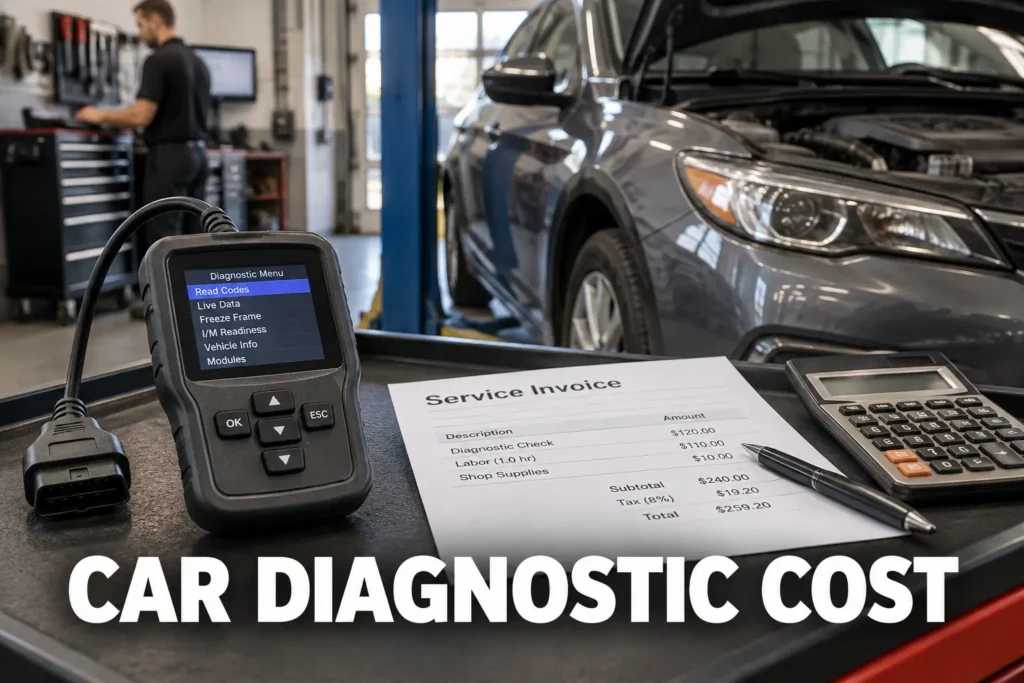
A car diagnostics appointment can cost $50 at an independent shop or $400 at a dealership for what appears to be the same service. Understanding why that range exists, what the fee actually covers beyond connecting a scanner to the OBD2 port, and when a high charge is justified versus when it is not, puts the driver in a much stronger position before authorizing any diagnostic work. This guide also covers how owning an OBD2 scanner changes the economics of car diagnostics entirely, often eliminating the need for a paid shop visit for a significant portion of common faults. My reference guide on OBD2 codes and what the ECU actually stores covers what the five-character DTC format tells you, why reading a code yourself eliminates the most common source of inflated diagnostic fees, and what the code does not tell you that still requires diagnosis.

About the author: Hello! I’m Kamil Siegień, founder of OBD2 Scout. My diagnostic experience started with an engine rebuild on a 2014 Skoda Superb 1.8 TSI, where tuning from 160 to 222 hp required mastering live data and ECU behavior that basic code readers cannot handle. I am a former BMW and MINI employee and regularly use diagnostic scanners on my own Audi A4 2.0 TFSI.
This guide covers what a diagnostic fee actually pays for, how price ranges break down by shop type, where the number on the invoice comes from, what the repair credit offer really means, when a high fee is and is not justified, how an OBD2 scanner cuts these costs significantly, what consumer rights apply before authorizing diagnostic work, and how to reduce what you pay.
For Audi Q5 owners whose DSG, EPB, or battery BMS service codes would otherwise mean a dealer visit, my Q5 scanner picks cover which tools handle those functions independently and cut the diagnostic fee out of the equation.
What the Diagnostic Fee Actually Covers
The most important thing to understand about a car diagnostic fee is that it does not pay for reading a fault code. Reading the code takes under two minutes and any parts store does it for free. What the fee pays for is everything that happens after the code is retrieved.
For Audi Q7 owners facing EAS compressor codes, HPFP faults, or ZF 8HP adaptation needs, my Q7 tool guide covers which scanners go beyond code retrieval and handle the full diagnostic and service function chain independently.
Crosstrek owners who want to read CVT and EyeSight codes themselves rather than paying dealer diagnostic rates will find my Subaru Crosstrek OBD2 scanner picks covers the right tools.
A legitimate shop diagnostic includes all of the following steps:
- OBD2 code retrieval: Connecting to the port, pulling confirmed codes, pending codes, and freeze frame data. This is the starting point, not the service itself.
- Code interpretation: Determining what the code means for this specific vehicle, what systems are involved, and which additional tests are needed to identify the root cause.
- Live data analysis: Reading real-time sensor data under load, at idle, or under simulated driving conditions to observe how the affected system is actually behaving.
- Physical inspection: Examining the affected component, its wiring, connectors, and surrounding components for visible damage, corrosion, or mechanical failure.
- Additional testing: Depending on the fault, this may include a smoke test for EVAP and vacuum leaks, voltage drop testing across circuit segments, oscilloscope waveform capture for sensor signal analysis, or actuator testing via bidirectional scanner control.
- Service bulletin review: Checking manufacturer Technical Service Bulletins (TSBs) for known issues affecting this code on this specific vehicle, model year, and engine. A TSB may describe an exact repair procedure that changes the diagnosis entirely.
- Written findings: A specific description of the fault, what was tested, what was found, and a repair recommendation with parts and labor estimate.
A P0420 code read by a parts store scanner tells the driver that the catalyst efficiency monitor failed on Bank 1. A shop diagnostic tells the driver whether the catalyst is actually degraded (confirmed by downstream O2 sensor data and Mode 6 efficiency readings), whether there is an exhaust leak ahead of the downstream sensor producing a false reading, whether a failing upstream O2 sensor is corrupting the comparison, or whether a manufacturer TSB describes a software fix rather than a parts replacement. Those are four very different outcomes. The diagnostic work is what separates them. For a breakdown of how fault code categories are structured and what each letter and number position means, my guide to OBD2 codes explained covers the complete classification.
Price Ranges by Shop Type
Car diagnostics costs vary significantly depending on where the work is done. The ranges below reflect current U.S. market rates.
Parts store free scan (AutoZone, O’Reilly Auto Parts, Advance Auto Parts, NAPA): Free. A parts store scan retrieves the fault code number and its generic description. It does not include interpretation, additional testing, live data analysis, or a repair recommendation. It is a starting point, not a diagnosis. The parts store’s interest is in selling the part the code suggests, which is why the service is free.
Independent mechanic shop: $50 to $160 for a standard diagnostic. Independent shops have lower overhead than dealerships and do not pay for manufacturer-specific tooling subscriptions. Most independent shops charge 0.5 to 1.0 hours of their labor rate. For shops charging $100 to $120 per hour, that puts the diagnostic fee between $50 and $120 in most cases.
My what are enhanced obd2 codes covers this step by step.
Forester owners who deal with CVT and EyeSight diagnostics regularly will find my Subaru Forester diagnostic scanner guide covers which scanners reduce the need for dealer visits on the Forester.
Dealership: $100 to $400 or more. Dealership labor rates typically run $150 to $250 per hour. Factory-trained technicians, proprietary diagnostic tools, and access to manufacturer technical databases contribute to higher rates. Complex electrical faults on modern vehicles with multiple networked modules can require several hours of dealer-level diagnostic time and exceed $400. For a professional-grade scanner that reaches module-level diagnostics without the dealer price tag, my guide to the high-end professional scanner guide covers the options.
Mobile mechanic: $70 to $150. Mobile mechanics come to the vehicle and have lower overhead than a fixed shop, but they carry limited testing equipment. They are suitable for straightforward fault diagnosis but may not have the equipment to perform smoke tests, oscilloscope waveform analysis, or extended module-level diagnostics.
EV and luxury vehicle specialists: $120 to $300 or more even at independent specialists. EVs require technicians with high-voltage safety certification and specialized equipment. Luxury brands (BMW, Mercedes, Audi, Porsche) often need manufacturer-specific diagnostic systems that independent shops may not have access to, pushing diagnostics toward authorized dealer networks regardless of preference. My guide on EV OBD2 diagnostic access covers why EV diagnostics require platform-specific tools that go beyond what any generic scanner can access.
The Labor Rate Formula: Where the Number Actually Comes From

Car diagnostics costs are not set as a fixed menu price at most shops. The diagnostic fee is a function of one variable: the shop’s hourly labor rate, multiplied by the minimum diagnostic time.
Most shops apply a minimum of 0.5 hours (30 minutes) of labor to any diagnostic appointment. Some apply a 1.0 hour minimum. The shop’s posted hourly labor rate determines the floor. A shop at $100 per hour charges a minimum of $50 to $100 for a diagnostic. A dealership at $220 per hour charges a minimum of $110 to $220.
For faults that are intermittent or that require extended testing to replicate, the diagnostic time is tracked and billed at the full hourly rate without a cap. A fault that requires the technician to drive the vehicle under specific conditions to trigger, then connect the oscilloscope and capture waveform data during the event, may take two to three hours. At a dealership labor rate, that is $300 to $660 before any repair work begins. A professional diagnostic scanner like the full review of the Autel MaxiSYS Elite II Pro covers this category of fault at a fraction of what the dealership bills to use similar equipment.
This formula explains why the same code can result in a $60 bill at one shop and a $200 bill at another. The code is the same. The shop’s labor rate and the time required to diagnose beyond the code are different.
The Diagnostic Credit: What It Actually Means
Almost every shop advertises that the diagnostic fee is credited toward the cost of the repair if the driver approves work at that shop. This is standard industry practice and it is not the savings it sounds like.
When a shop diagnoses and repairs the same vehicle, the technician who diagnosed it is typically the technician who repairs it. Their time on the vehicle is continuous. The diagnostic work is part of the overall labor. In this case, the diagnostic fee is effectively a deposit on the repair labor, not an additional charge on top of it. Crediting it toward the repair simply means the driver pays for the total labor once, not twice.
The situation where the credit matters is the one where the driver does not approve the repair at that shop. In this case, the diagnostic fee is charged in full with no credit. The driver takes the written findings to a different shop for a lower repair quote, pays full repair labor at shop two, and has already paid the full diagnostic fee at shop one. There is no rebate or transfer. The total cost is diagnostic at shop A plus repair at shop B.
Before authorizing a diagnostic, ask explicitly: if the fee is credited toward repairs and the driver gets the repair done elsewhere, does the credit disappear? The answer is always yes. Knowing this in advance changes the calculation for whether to commit to a shop before the diagnosis is complete.
When a High Fee Is Justified and When It Is Not
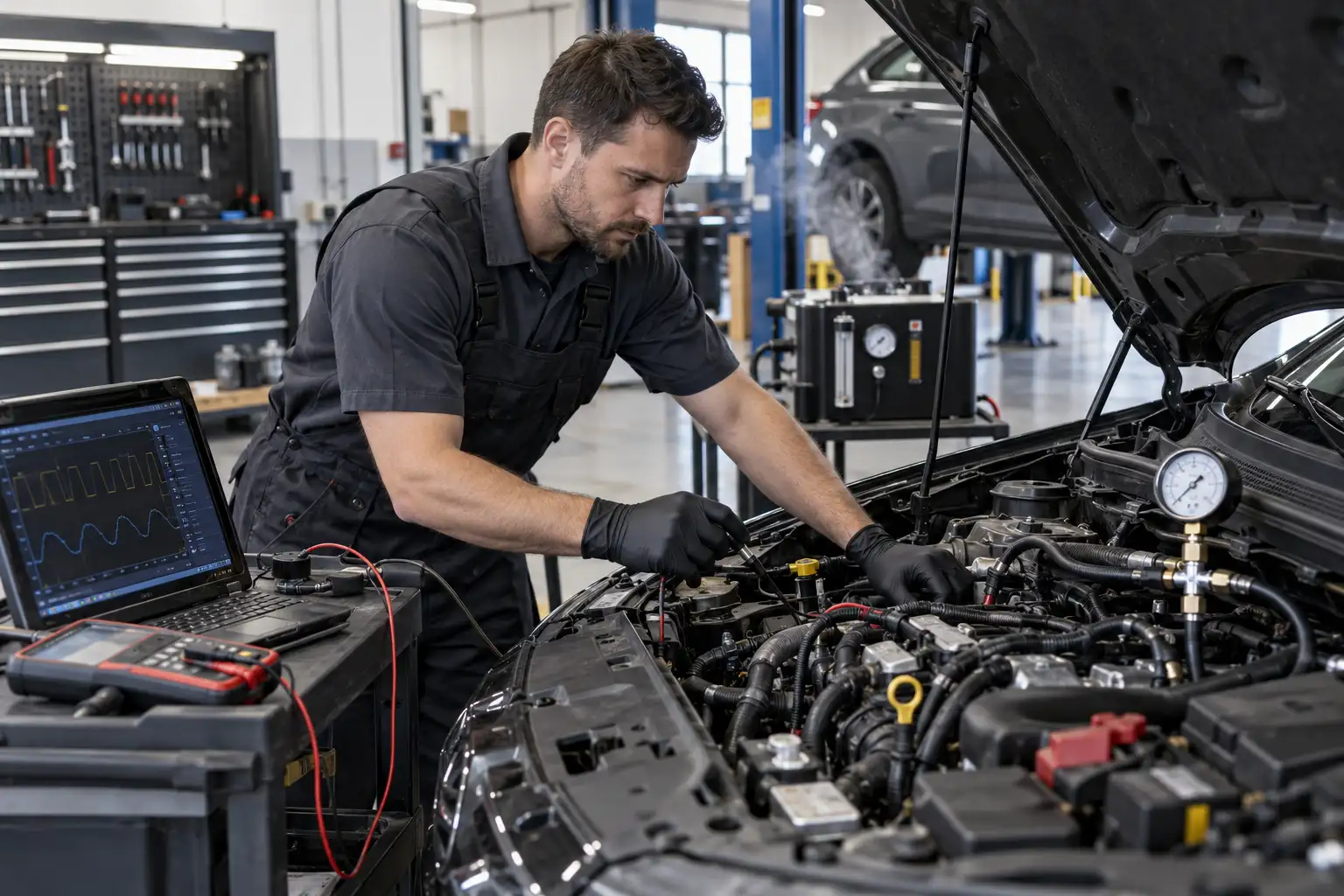
A $150 to $200 diagnostic charge is justified when the fault is complex, intermittent, or requires testing beyond a basic code scan. Specific examples: an electrical fault that only appears at a specific temperature or under load conditions, a misfire that occurs only at highway speed, a CAN bus communication fault involving multiple modules, or a fuel system fault that requires smoke testing and fuel pressure analysis to isolate.
My can bus obd2 diagnostics explained covers this step by step.
A flashing check engine light from an active misfire is one example where a full diagnostic is worth the cost, because the misfire damage mechanism and root cause can both be confirmed with live data and freeze frame analysis.
A $150 to $200 charge is not justified when the work performed was a code pull and a parts recommendation with no supporting test data. Signs that the diagnostic was not performed properly:
- The technician cannot explain specifically what tests were performed and what results each test produced.
- No written findings are provided, only a verbal recommendation to replace a part.
- The repair recommendation is for an expensive part (catalytic converter, oxygen sensor, injector) based solely on the code number, with no live data or physical test results to confirm the component failed.
- Pressure to approve the repair immediately, before the driver has had time to review the findings or get a second opinion.
- The same diagnostic fee is charged again on a return visit for the same unresolved fault.
A legitimate diagnostic produces written findings that a second technician at a different shop can review and verify. If the findings cannot withstand that scrutiny, the diagnostic work was not done.
How Owning an OBD2 Scanner Cuts Car Diagnostics Costs
A mid-range OBD2 scanner costs $80 to $150. A single avoided diagnostic visit at an independent shop covers the purchase price. Over the life of a vehicle, the savings on avoided diagnostic fees alone routinely exceed $500. Here is how the scanner delivers those savings across every scenario where a check engine light comes on. A pre-purchase scan is one of the highest-value single uses of the tool: my guide to scanning a used car with an OBD2 scanner explains the full inspection sequence and how to translate each finding into a documented price reduction.
Knowing the code before entering the shop. Arriving at a shop with the fault code already retrieved removes the justification for a code-pull charge. A technician cannot reasonably bill for retrieving information the driver already has in hand. For straightforward, single-code faults on vehicles where the code maps clearly to one likely cause (a loose gas cap triggering P0457, a failed mass airflow sensor triggering P0101 with a matching live data reading), knowing the code in advance eliminates the entire lowest tier of diagnostic work. The driver walks in with the code, the freeze frame data, and the live data reading that shows the fault. The conversation starts at the component level, not at the code-reading level.
Deciding whether to go to the shop at all. Not every check engine light requires an immediate paid diagnostic. A P0456 (small EVAP leak) on a vehicle where the gas cap was recently replaced is a candidate for tightening the cap and clearing the code to see whether the monitor passes on the next drive. A P0300 (random misfire) on a vehicle that is running noticeably rough requires prompt attention. An OBD2 scanner lets the driver make that triage call at home rather than paying $100 to be told the fault is minor. For the faults that genuinely require shop attention, the scanner still provides the code context before the appointment. My guide on how to use an OBD2 scanner covers the full process for reading codes, checking freeze frame, and assessing I/M readiness before making that call.
Preventing unnecessary upsells and scope creep. A driver who arrives at a shop already knowing that the vehicle has exactly one stored fault code, P0171 (system lean Bank 1), and no pending codes, is in a fundamentally different position than a driver who hands the keys over and waits. The shop cannot introduce additional “codes the computer flagged” that the driver’s own scan did not find. The diagnostic conversation is anchored to the specific fault the driver already identified. Equinox owners who scan before visiting a shop can find the best tool for their model in my top OBD2 scanners for the Equinox.
Verifying the repair was actually completed. Rescanning immediately after a repair confirms whether the code that triggered the visit has been cleared from memory and whether any new codes appeared during the repair process. If the same code returns within the next few drive cycles, the repair did not address the root cause. Without a scanner, the driver learns this only when the check engine light reappears, at which point the shop may argue it is a new and separate fault rather than a failed repair. My my detailed Innova 3100RS review covers one of the most reliable standalone options for this post-repair verification step.
Monitoring I/M readiness before an emissions test. Many states charge a retest fee when a vehicle fails an emissions inspection. A two-minute I/M readiness check in the driveway before the appointment confirms whether all monitors are complete and whether any permanent codes are stored. An avoided failed inspection saves $20 to $50 in retest fees plus the time cost of returning to the station.
Catching developing faults before they escalate into expensive repairs. A scanner with pending code visibility shows faults the ECU has detected but that have not yet triggered the check engine light. A pending P0300 misfire caught early is a spark plug, ignition coil, or injector service. The same misfire left to run for weeks on a catalytic converter that is now absorbing raw fuel from incomplete combustion becomes a catalyst replacement costing $500 to $2,000. The scanner catches the cheaper problem before it becomes the expensive one.
The real savings calculation. A quality OBD2 scanner at $120 cost is recovered after one avoided independent shop diagnostic. On a vehicle owned for five years, a driver who uses a scanner to triage check engine lights before shop visits, verify repairs, check emissions readiness, and monitor pending codes will typically avoid three to five paid diagnostic visits. At $80 to $150 per visit avoided, the scanner delivers $240 to $750 in avoided fees over that period, on a tool that cost $120. My guide to the best budget OBD2 scanner options covers tools that deliver this full feature set at the entry level. My guide on choosing the right scanner tier covers the full spectrum from basic code readers through professional bidirectional tools, so the decision matches the diagnostic task rather than just the price range.
State Consumer Protection Rights Before Authorizing Diagnostic Work

Several states give consumers the right to written authorization before any diagnostic or repair work begins. A shop that starts diagnostic work without prior written consent in these states cannot legally enforce the charge.
California: The Bureau of Automotive Repair requires shops to provide a written repair order before performing any work. The shop must get the customer’s authorization signature, specify what work will be done, and include the estimated cost. Diagnostic work is subject to this requirement. A shop that begins a diagnostic without a signed repair order is in violation of California BAR regulations.
Connecticut: Written consent is required before any diagnostic or repair work costing $50 or more. Shops must provide a written estimate and receive the customer’s authorization before proceeding.
Washington: Any face-to-face automotive repair or diagnostic appointment over $100 requires a written estimate provided to the customer before work begins.
Federal protection: The FTC Act prohibits deceptive business practices in all states. A shop that presents a diagnostic charge the driver did not agree to, for work whose scope was never disclosed, has grounds for an FTC complaint regardless of state law.
In any state, the practical step is to ask before handing over the keys: “Will you provide a written estimate of the diagnostic fee before you begin?” Any reputable shop will say yes immediately.
How to Reduce Car Diagnostics Costs
The most effective cost-reduction strategy is to own and use an OBD2 scanner before contacting any shop. Beyond that, several practices reduce what a shop visit costs.
My guide on whether it is safe to drive with the check engine light on is a useful first step before contacting a shop, since knowing whether the fault is urgent changes both the conversation and the diagnostic cost.
Outback owners who own a capable scanner can handle CVT fault code reading and EPB retraction at home; my Subaru Outback scanner picks covers the right tools for that.
Get a free parts store code scan before booking a shop appointment. Knowing the code gives context for whether the fault requires immediate professional diagnosis or can wait. It also allows the driver to research the fault and arrive informed.
Part of that research is knowing the reset timeline after the repair; my guide to the check engine light self-clear timeline covers the drive cycle count by fault type and what the ECU looks for before it extinguishes the light.
For Audi Q8 owners dealing with 48V MHEV BSG codes or RS Q8 biturbo faults, my Q8 scanner comparison covers which tools give the live data context to research the cause before the shop visit, or confirm whether one is necessary at all.
Ask upfront and in writing whether the diagnostic fee is credited toward repairs if work is approved at that shop. Confirm that the credit disappears if the driver takes the diagnosis elsewhere, so the decision to authorize a diagnostic is made with that cost structure understood.
Get a written quote before any work begins. In states where this is legally required, it is also the law. In states where it is not, it is still basic consumer protection. The quote should specify what diagnostic work will be performed and the rate at which time will be billed if the fault requires extended testing.
Compare quotes from at least two shops before authorizing an expensive diagnostic. A competing quote for the same diagnostic work often reveals that pricing varies significantly between shops in the same area, independent of the quality of work performed.
If the same fault code returns after each shop visit, the issue is not the shop; my guide on recurring check engine light after each repair attempt covers why some codes reconfirm regardless of who does the work and what a permanent code means for the repair conversation.
The Bottom Line
Car diagnostics costs range from free at a parts store to several hundred dollars at a dealership. The difference reflects shop type, labor rate, fault complexity, and how much testing is required beyond the code pull. The fee is a labor charge, not an arbitrary number, and the labor rate formula explains the entire pricing landscape. Knowing what the scanner misses helps identify when the code is just the starting point and a full professional diagnostic is the only way to find the actual failed component.
An OBD2 scanner changes the economics of every shop visit. A driver who arrives knowing the fault code, the freeze frame data, and the I/M readiness status is not starting from zero. They have already done the work that would have justified the first $60 to $120 of the diagnostic fee. Over a vehicle’s ownership period, a single mid-range scanner pays for itself many times over in avoided diagnostic fees alone. My guide to OBD2 live data covers the real-time parameters that strengthen this diagnostic position even further, letting you arrive at the shop with more than just the code.
FAQs
How much does a car diagnostic test cost?
At an independent mechanic, a standard car diagnostic test typically costs $50 to $160. At a dealership, the range is $100 to $400 or more depending on fault complexity and how long the diagnosis takes. Mobile mechanics typically charge $70 to $150. Parts stores including AutoZone, O’Reilly, Advance Auto Parts, and NAPA perform a basic OBD2 code scan for free, though this returns only the fault code number without any interpretation, testing, or repair recommendation. EV and luxury vehicle diagnostics cost more regardless of venue due to specialized equipment and certification requirements.
Is a $200 diagnostic fee normal?
At a dealership, yes. Dealership labor rates commonly run $150 to $250 per hour, and a minimum one-hour diagnostic charge produces a $150 to $250 bill for even straightforward faults. For intermittent or complex electrical faults requiring extended testing, $200 to $400 is within normal range. At an independent shop charging $100 to $120 per hour, $200 suggests either a complex fault requiring nearly two hours of diagnostic work or a shop with above-average rates. The key question is not whether the number is high but whether written findings document what testing was performed to justify the time billed.
Can I get a free car diagnostic at a parts store?
Yes. AutoZone, O’Reilly Auto Parts, Advance Auto Parts, and NAPA all offer free OBD2 code scans. The service connects a scanner to the OBD2 port, retrieves stored fault codes, and provides the generic code description. What it does not include is any interpretation of the code, live data analysis, physical inspection, additional testing, or a repair recommendation. The free scan is a starting point that tells the driver which system flagged a fault. Determining what actually caused the fault and which specific component needs attention requires either paid shop diagnostic work or a personal OBD2 scanner with live data capability.
Can a shop charge a diagnostic fee without my permission?
In several states, no. California, Connecticut, and Washington all require shops to obtain written authorization from the customer before beginning any diagnostic or repair work. In California, this is enforced by the Bureau of Automotive Repair. In Connecticut, written consent is required for any work costing $50 or more. In Washington, a written estimate is required for any repair over $100. In all states, the FTC Act prohibits deceptive billing practices. As a practical matter, always ask for a written quote and sign nothing that authorizes open-ended diagnostic time without a stated hourly rate and an estimate of the time required.
Should I get a second diagnostic opinion?
Yes, particularly for any repair recommendation that involves expensive components. A second diagnostic at a different shop costs money but is worth it when the first shop recommends a catalytic converter, transmission repair, engine work, or any multi-hundred-dollar parts replacement. A legitimate first diagnostic should provide written findings specific enough for a second technician to review and confirm. If the first shop cannot provide written findings that describe what tests were run and what results each test produced, that absence of documentation is itself a reason to seek a second opinion before authorizing expensive repair work.
Why does a dealership diagnostic cost more than an independent shop?
Dealership labor rates are higher than independent shop rates for several reasons: factory-trained technicians with manufacturer certification command higher wages, proprietary diagnostic tools and software subscriptions are expensive, and dealership overhead (facilities, staffing, franchise fees) is substantially higher than an independent operation. For vehicles under manufacturer warranty, dealership diagnostics are covered. For out-of-warranty vehicles, the higher cost buys access to manufacturer technical databases, factory-specific diagnostic procedures, and technicians who work exclusively on one brand. For many common faults on mainstream vehicles, an experienced independent shop provides equivalent diagnostic quality at 30 to 50 percent lower cost.
Does the diagnostic fee get applied to the repair cost?
At most shops, yes, if the repair is performed at the same shop. This is standard industry practice: the diagnostic labor is considered part of the total repair labor, so the customer is not charged separately for both the diagnosis and the repair when the same technician does both jobs. However, the credit does not transfer. If the driver takes the diagnostic findings to a different shop for the repair, the full diagnostic fee is owed to the first shop and the second shop charges its full labor rate independently. Before authorizing a diagnostic specifically to take the findings elsewhere, confirm in writing whether the shop charges a fee for a standalone diagnosis, because some shops do not perform diagnostics without a repair commitment.