
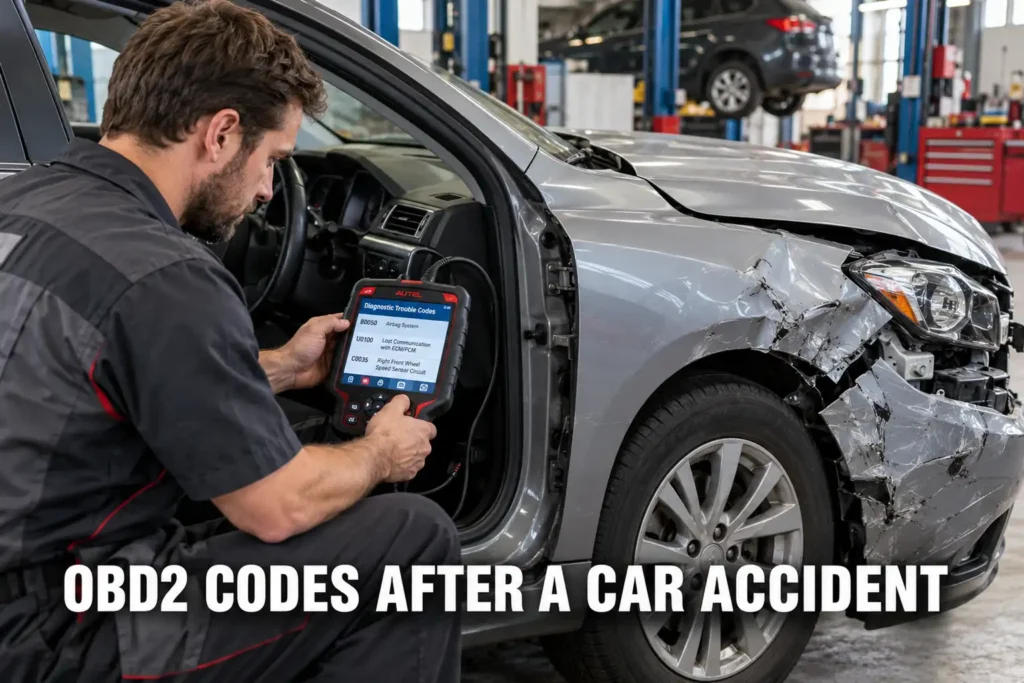
OBD2 Codes After a Car Accident: What to Expect and What to Do
By Kamil Siegień / October 12, 2026
A vehicle involved in a collision often has multiple OBD2 fault codes stored immediately afterward, some related to the impact itself and some that were already present before the accident. Sorting out which codes are collision-related, which are pre-existing, and which indicate genuine mechanical damage that needs repair before the vehicle is safe to drive is an important part of post-accident assessment. This guide explains what types of fault codes commonly appear after a collision, which codes indicate serious safety concerns, how to distinguish pre-existing codes from impact-caused codes, and the specific considerations that apply when buying or evaluating a vehicle that has been in an accident.
Audi owners looking for the right scanner should check my best diagnostic tools for Audi.

About the author: Hello! I’m Kamil Siegień, founder of OBD2 Scout. My diagnostic experience started with an engine rebuild on a 2014 Skoda Superb 1.8 TSI, where tuning from 160 to 222 hp required mastering live data and ECU behavior that basic code readers cannot handle. I am a former BMW and MINI employee and regularly use diagnostic scanners on my own Audi A4 2.0 TFSI.
This guide covers the types of OBD2 codes that appear after collisions, how the SRS module records crash data, how to distinguish impact-caused codes from pre-existing ones, which codes indicate the vehicle is not safe to drive after an accident, and what to look for in a post-accident OBD2 scan when evaluating a vehicle for purchase.
For scanner recommendations to perform this type of work, see my best diagnostic scanners.
Types of Fault Codes That Appear After a Collision
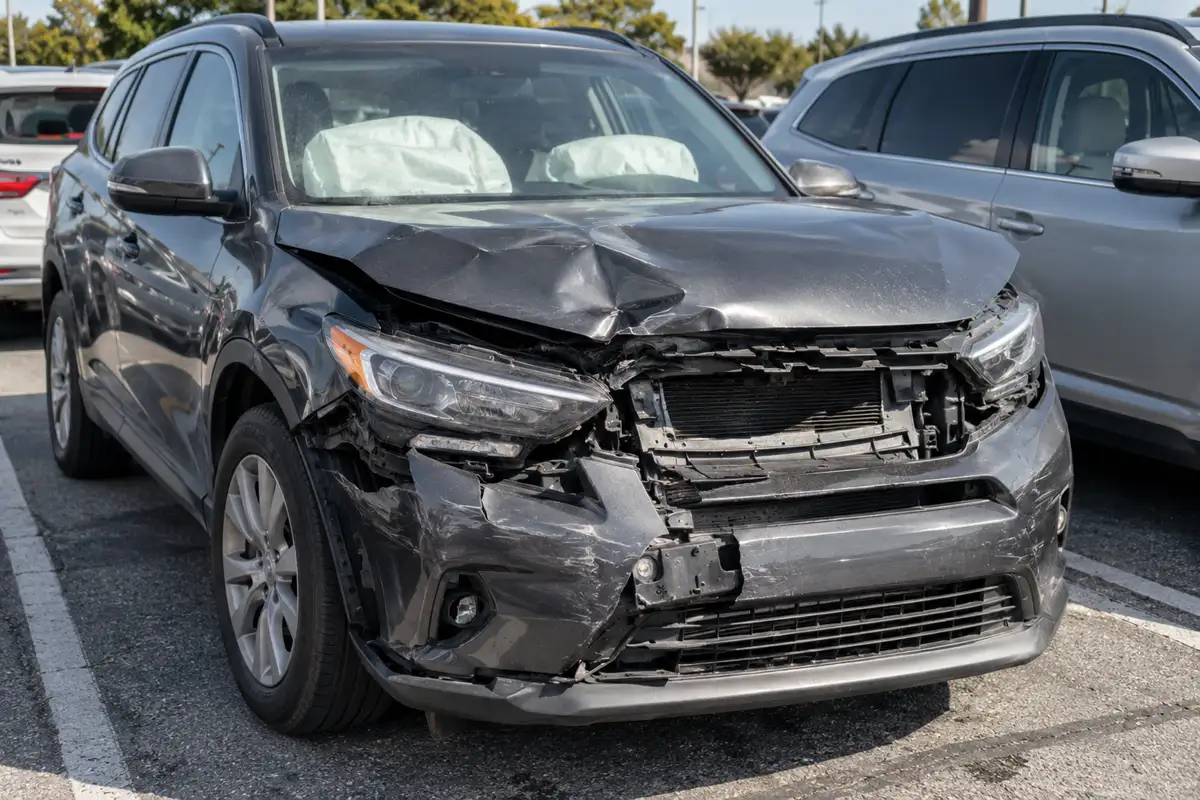
SRS and airbag codes: An impact severe enough to deploy airbags stores permanent deployment event codes in the SRS module. These cannot be cleared by any normal scanner code-clear command or battery disconnect. An impact below the deployment threshold may still trigger SRS crash sensor codes if the deceleration rate exceeded the sensor’s recording threshold without reaching the deployment decision threshold. The distinction between “crash recorded” and “airbag deployed” matters: many modern vehicles record crash events at impact levels far below the airbag deployment threshold, storing SRS data that is diagnostically significant even when all airbags remained folded.
My airbag srs codes explained covers this step by step.
Honda owners looking for the right scanner should check my best diagnostic tools for Honda.
ABS and stability control codes: Collision damage to wheel speed sensor harnesses, ABS tone ring (reluctor) damage from bent suspension components, or hydraulic damage to the ABS pump or module stores ABS and stability control codes immediately. Front-end impacts commonly affect the front wheel speed sensor wiring that runs through the engine bay. Side impacts can damage the front or rear wheel speed sensors on the struck side. ABS codes after a collision require physical inspection of the wheel speed sensor mounting, tone ring condition, and harness routing — not just reading the code and clearing it. An ABS system with an unrepaired wiring fault following a collision may have intermittent or absent wheel speed input, resulting in the ABS not activating correctly during emergency braking.
My j1939 heavy duty truck diagnostics obd2 covers this step by step.
Honda CR-V owners can find the right scanner in my top CR-V diagnostic tools.
Steering and chassis codes: The steering angle sensor (SAS) is calibrated to a specific straight-ahead position during alignment. An impact that shifts the steering rack or changes steering geometry stores SAS calibration fault codes because the sensor’s stored “straight-ahead” value no longer matches the actual steering position. Stability control (ESC/ESP) codes also appear because ESC uses SAS data as a primary input. These codes require steering angle sensor recalibration after alignment correction — clearing them without realignment accomplishes nothing because the sensor value will remain incorrect relative to the actual steering geometry.
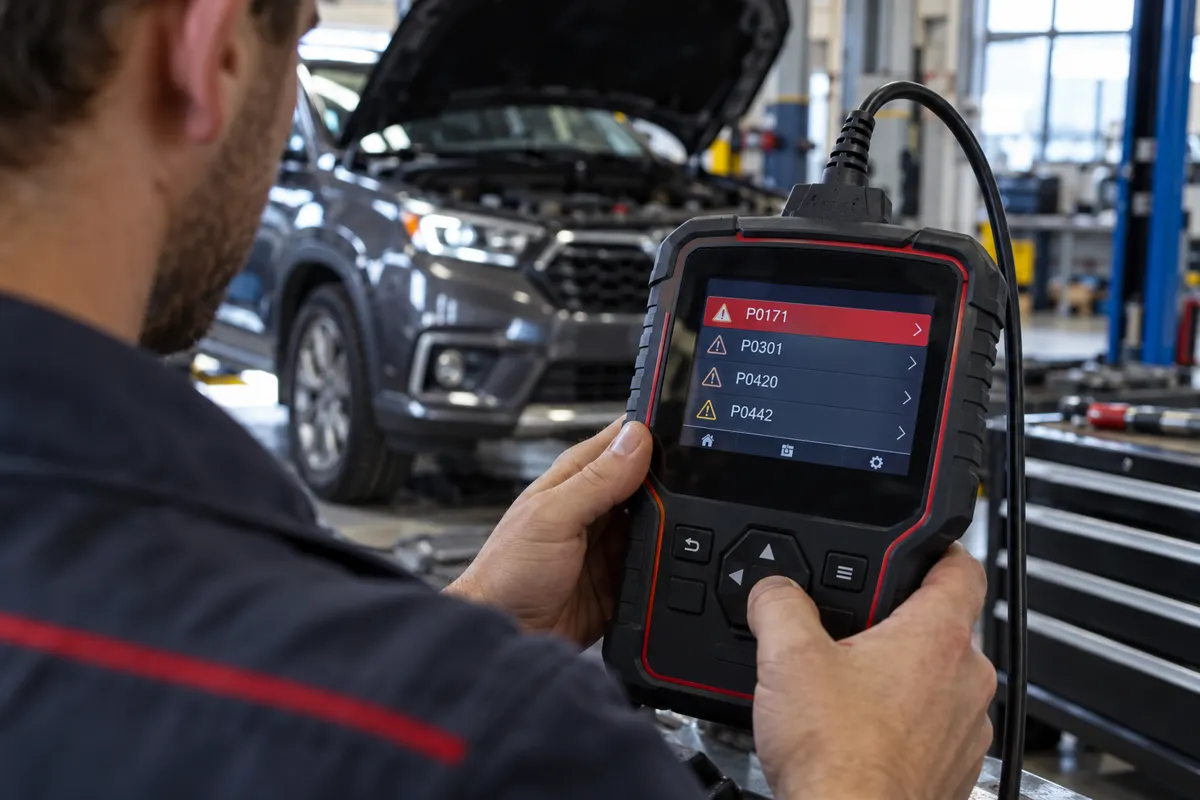
Powertrain codes from engine bay impact: Front-end collisions that intrude into the engine bay displace components, break hose and wiring connections, and in severe cases shift the engine or transmission on their mounts. Common powertrain codes after engine bay damage: P0101 or P0100 (MAF sensor circuit range or performance) from a disconnected or damaged MAF sensor, P0171 or P0174 (lean bank 1/2) from a cracked intake duct causing a massive unmetered air leak, P0125 (insufficient coolant temperature for closed-loop fuel control) from a coolant loss that prevents the engine from reaching operating temperature, and P0300 (random misfire) from a damaged ignition coil or spark plug wire. These codes indicate systems that were physically damaged in the impact and require repair rather than code clearing.
My my guide on diagnose misfires covers this step by step.
Ford F-150 owners can find the right scanner in my top F-150 diagnostic tools.
Pre-existing codes: Any codes stored before the accident remain in the ECM after the accident unchanged. After a collision, the code list will contain both pre-existing codes and new impact-related codes mixed together. Without documentation of what codes were present before the accident, distinguishing the two requires logic: a P0420 catalyst efficiency code is almost certainly pre-existing on a vehicle with a front-end collision unless the catalytic converter was physically crushed (which would produce far more dramatic driveability symptoms than a check engine light).
My my guide on test catalytic converter covers this step by step.
BMW owners looking for the right scanner should check my best diagnostic tools for BMW.
How the SRS Module Records Crash Data
The SRS module contains an Event Data Recorder (EDR), sometimes called the vehicle “black box” in media reporting. In the US, the National Highway Traffic Safety Administration (NHTSA) has standardized EDR data elements under 49 CFR Part 563 for vehicles manufactured after September 2012. Required standardized data elements include: vehicle speed in the five seconds before impact (recorded at 1-second intervals), engine throttle application, service brake application, safety belt status for the driver and front passenger, frontal airbag deployment status, and ignition cycle count. Many manufacturers record additional non-standardized data elements including steering wheel angle, yaw rate, and lateral acceleration.
The EDR records in a loop, continuously overwriting old data. When a qualifying trigger event occurs (a crash meeting the recording threshold), the EDR freezes the pre-crash data and records the crash event data. The trigger threshold is typically a deceleration of approximately 0.5g or greater. This threshold is significantly below the airbag deployment threshold — many minor collisions that do not deploy airbags still trigger the EDR recording. The recorded data window typically captures 5 seconds before the triggering event and 0.5 seconds after (timing varies by manufacturer).
Ford owners looking for the right scanner should check my best diagnostic tools for Ford.
EDR data is legally owned by the vehicle owner in most US states, though access to it varies. Law enforcement can access it through court order. Insurance companies frequently access it as part of accident investigations. In civil litigation, EDR data is commonly subpoenaed. The Bosch CDR (Crash Data Retrieval) tool, used by accident reconstruction specialists and law enforcement, can access EDR data on supported vehicles (currently over 300 make/model/year combinations). Standard OBD2 scan tools cannot read EDR data: they can only read the SRS fault codes that the SRS module stores as part of its normal diagnostic function.
For a scanner that handles ABS and SRS diagnostics, check my best tools for ABS codes.
The SRS module’s fault code record is separate from and in addition to the EDR data record. The fault codes (deployment event codes, crash sensor records, pre-existing SRS circuit faults) are accessible through normal OBD2 enhanced diagnostics with SRS capability. The EDR data requires the Bosch CDR or manufacturer-specific forensic tools. In a post-accident assessment of a vehicle’s history, what matters diagnostically is the SRS fault code record: whether deployment event codes are present, how many deployment events are recorded, and whether any crash sensor codes are stored indicating impact events even below the deployment threshold.
For a scanner with active test capability, see my top bidirectional scanner picks.
Distinguishing Impact-Caused Codes from Pre-Existing Codes
The most reliable method is to have pre-accident documentation. If the vehicle was scanned before the accident and the results were saved, comparison is direct: any code in the post-accident scan that was not in the pre-accident scan is either collision-related or newly occurred. This is the strongest argument for maintaining a current scan record of your vehicle — not just for accident situations, but for any insurance or warranty claim where the pre-existing versus new status of a fault matters.
Chevy owners looking for the right scanner should check my best diagnostic tools for Chevy.
Without pre-accident documentation, logical analysis is the primary tool. The framework: evaluate which systems the impact could have physically affected based on the collision direction and severity, then classify codes as likely impact-related or unlikely impact-related based on that analysis.
Toyota owners looking for the right scanner should check my top-rated scanners for Toyota.
Front impact (front bumper, hood, grille): likely impact-related codes include MAF sensor, intake air temperature sensor, cooling system codes, front wheel speed sensor codes (ABS), steering angle sensor, front crash sensor SRS codes, and any electrical module in the front engine bay. Unlikely impact-related (more likely pre-existing): rear wheel speed sensor faults, oxygen sensor codes deep in the exhaust system, transmission codes with no physical damage to the transmission area.
Audi Q8 owners can find the right scanner in my top Q8 diagnostic tools.
Rear impact: likely impact-related codes include rear wheel speed sensor faults, rear parking sensor faults, tailgate or trunk module codes, rear crash sensor SRS codes, and rear camera system faults. Unlikely impact-related: front-of-engine codes, fuel system codes (unless the fuel tank was in the impact zone), front structural codes.
I cover this capability in more detail in my NT630 Plus breakdown.
Code freeze frame timestamps provide additional evidence when available. A code with a freeze frame recorded at a specific odometer reading, compared to the vehicle’s mileage at the time of the accident, indicates whether the code was stored before or after the accident. Most ECMs record mileage in the freeze frame data: a P0420 with a freeze frame mileage of 87,432 on a vehicle that had the accident at 91,456 miles is definitively pre-existing.
I cover this capability in more detail in my MK808BT Pro breakdown.
Battery disconnection during collision repairs erases volatile RAM and removes pre-existing codes from the stored code memory. After the battery is reconnected and the vehicle is driven, only the persistent faults will return. This makes a scan immediately after accident — before any repair work begins and before the battery is disconnected — the most valuable data point. Pre-repair scan documentation is the most important step in any accident situation.
Mercedes owners looking for the right scanner should check my top-rated scanners for Mercedes.
Codes That Indicate the Vehicle Is Not Safe to Drive
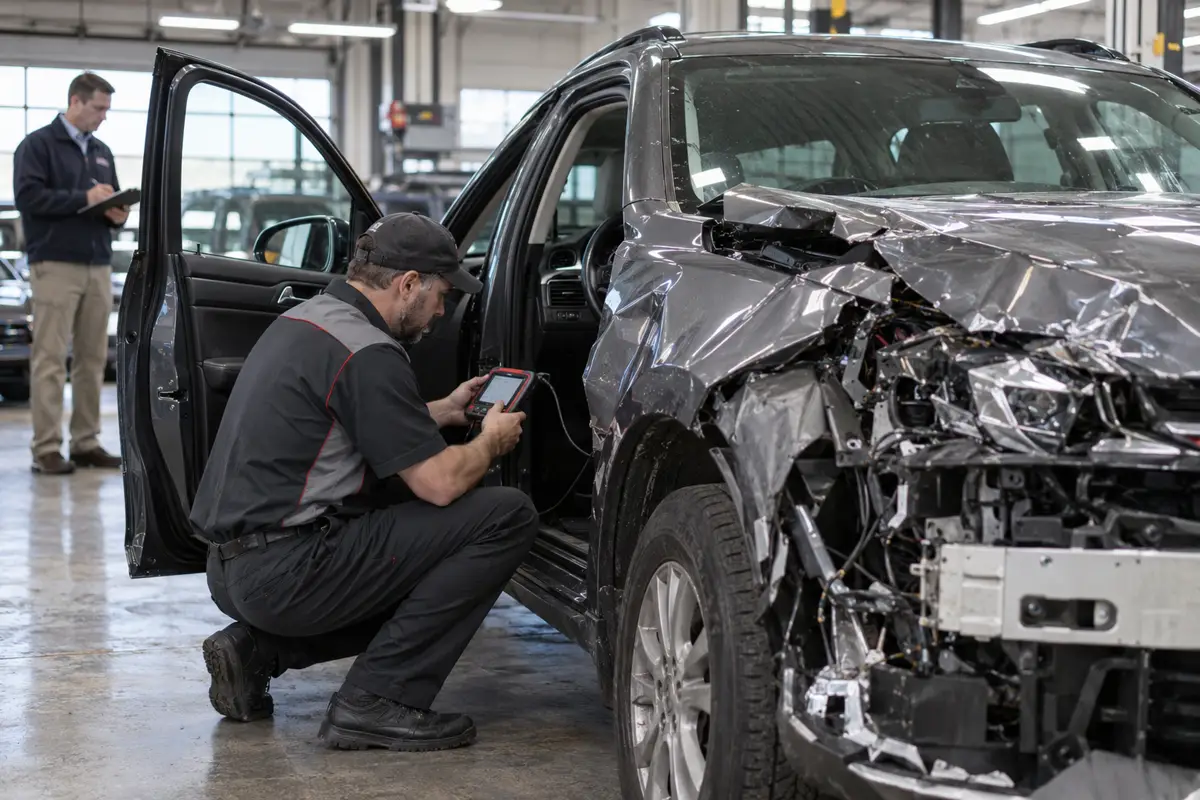
SRS deployment codes with unrepaired airbags: This is the clearest safety disqualification. Deployment event codes combined with physical evidence of airbag deployment (deployed airbag fabric visible or covered with replacement trim panels, deployed pretensioner visible in the seatbelt assembly) and no airbag replacement indicate the vehicle has no airbag protection for occupants in a subsequent collision. The SRS module records what deployed; if the replacement was not performed, the deployment codes combined with physical inspection confirm no protection is present.
I explain this in more detail in my my guide on check used car.
Active ABS fault codes with warning light illuminated: The ABS warning light on after a collision indicates the anti-lock braking system may be compromised. The vehicle’s conventional hydraulic brakes still function, but the anti-lock intervention during heavy braking is uncertain. On wet or slick roads, or during emergency stops at highway speed, ABS function can meaningfully affect stopping distance and directional stability. Do not assume ABS is functional just because the vehicle stops normally during a gentle braking test — ABS activates only when wheel lockup is detected, which typically requires hard braking above approximately 15-20 mph.
My how to bleed abs brakes with obd2 scanner covers this step by step.
I explain this in more detail in my can you drive with check engine light on.
Steering angle sensor fault with ESC disabled: Many vehicles disable electronic stability control entirely when the steering angle sensor fault is active, because the ESC algorithm relies on accurate SAS input to determine intended vehicle direction. A vehicle with ESC disabled by an SAS fault has reduced stability intervention capability during oversteer or understeer events. This is significant on any vehicle where the suspension alignment or steering geometry was affected by the collision.
I explain this in more detail in my check engine light on but no codes stored.
Engine overheating codes after cooling system damage: P0217 (engine coolant over-temperature condition) or P0128 (coolant temperature below thermostat regulating temperature) after front-end impact suggest cooling system damage. Overheating codes indicate the engine may already have been operated at damaging temperatures. Do not run the vehicle with a suspected cooling system fault until the system is inspected and filled to correct level.
Post-Accident OBD2 Scan in Vehicle Purchase Evaluation
A full-system OBD2 scan with a multi-system scanner is one of the most valuable and least expensive due-diligence steps when evaluating a post-accident vehicle for purchase. The two most important things a scanner reveals that cannot be identified by visual inspection alone:
My a full system scan obd2 scanner explained covers this step by step.
I explain this in more detail in my obd2 scanner abs airbag codes.
SRS deployment event codes: A vehicle that has had airbags deploy has been in a crash severe enough to trigger deployment. This is a structural event: modern vehicles are designed for crumple zones to deform to absorb crash energy, and that deformation is intentional and not fully reversible through cosmetic repair. A vehicle with deployment codes has had its occupant protection system fully exercised in an accident. Even if the cosmetic repair is excellent, the vehicle’s structural geometry may differ from factory specification in ways that affect how it performs in a subsequent collision. Many professional vehicle buyers and vehicle appraisers treat deployment codes as automatic disqualifiers for full market value, regardless of repair quality. The codes are permanent: they cannot be cleared, and a scan will always reveal them.
If you are on a tight budget, my best affordable code readers covers the top value picks.
Mismatched module software versions: Professional scan tools that can read module software version and hardware identification (available on tools like Autel MaxiSYS and manufacturer-specific tools) sometimes reveal replacement modules. An ECM, SRS module, or BCM with a different software version or part number than expected for the vehicle’s production date may have been sourced from another vehicle as part of a repair. This is a marker of significant electronic repair work consistent with accident damage. Module replacement is not inherently problematic if done correctly, but an undisclosed replacement module is evidence of undisclosed prior work.
Beyond these two major findings, look for: B-prefix body codes from modules showing circuit faults consistent with wiring repair (spliced or repaired harnesses sometimes show intermittent resistance faults in body module circuits), C-prefix chassis codes for steering or suspension systems that were in the impact path (indicating possibly incomplete structural repair), and any active engine or powertrain codes that the seller did not mention or explain.
FAQs
Can OBD2 codes from a collision affect my insurance claim?
The EDR data recorded by the SRS module — vehicle speed, braking, throttle inputs in the seconds before impact — can be accessed by insurance investigators, law enforcement, and legal counsel through appropriate legal processes. This data may be used to reconstruct the accident sequence and can support or contradict descriptions of the accident given by drivers. In the US, insurance adjusters can request EDR data access as part of the claims investigation with the vehicle owner’s consent (or through legal means without consent if litigation is involved). Standard OBD2 fault codes are less commonly used in insurance investigations directly, but they can provide supporting evidence about the vehicle’s condition before and after the accident. The key practical implication: do not attempt to clear or tamper with EDR or SRS data in a vehicle that was in a reportable accident, as doing so has serious legal consequences in many jurisdictions and can void insurance claims.
My airbag light came on after a minor fender-bender where airbags didn’t deploy. Is this serious?
Yes. Even an impact that does not deploy airbags can trigger crash sensor fault codes in the SRS module. These codes require SRS-capable diagnostic access — not a basic OBD2 emissions code reader — to evaluate properly. The specific code identifies which crash sensor recorded the event and what threshold was exceeded. The SRS module may also detect that the impact slightly shifted a clock spring connector, a seat belt buckle sensor connector, or a crash sensor mounting bracket, causing a circuit fault. An airbag warning light on after any collision means the SRS system has a stored fault: have it evaluated by a technician with a scanner capable of reading SRS codes before deciding whether repairs are needed. The cost of an SRS diagnostic scan ($50-$100) is minimal compared to the risk of driving with an unknown SRS fault.
How do I document the codes before my car goes to the body shop for collision repair?
Scan the vehicle immediately after the collision, before any repair work begins and before the battery is disconnected. Use a multi-system scanner (not just a basic engine code reader) and read codes from every module the scanner supports: ECM, TCM, ABS, SRS, BCM. For each module that has codes, record the exact code numbers, descriptions, and freeze frame data. Photograph the scanner screen or export the scan report if your scanner supports PDF or text export. Note the odometer reading at the time of scan. Send a copy of the scan results to yourself by email or save to cloud storage — do not rely on keeping a single copy on the scanner’s SD card or in the vehicle.
When the vehicle is returned from the body shop after repair, rescan all modules again before final payment. Compare the post-repair scan to your pre-repair scan. Codes present after repair that were not present before the collision (in modules other than the directly impacted systems, which should have been repaired) may indicate new damage introduced during the repair process. Codes from the directly impacted systems should be absent if the repair was complete. Any codes that remain from impact-related systems indicate incomplete repairs.