
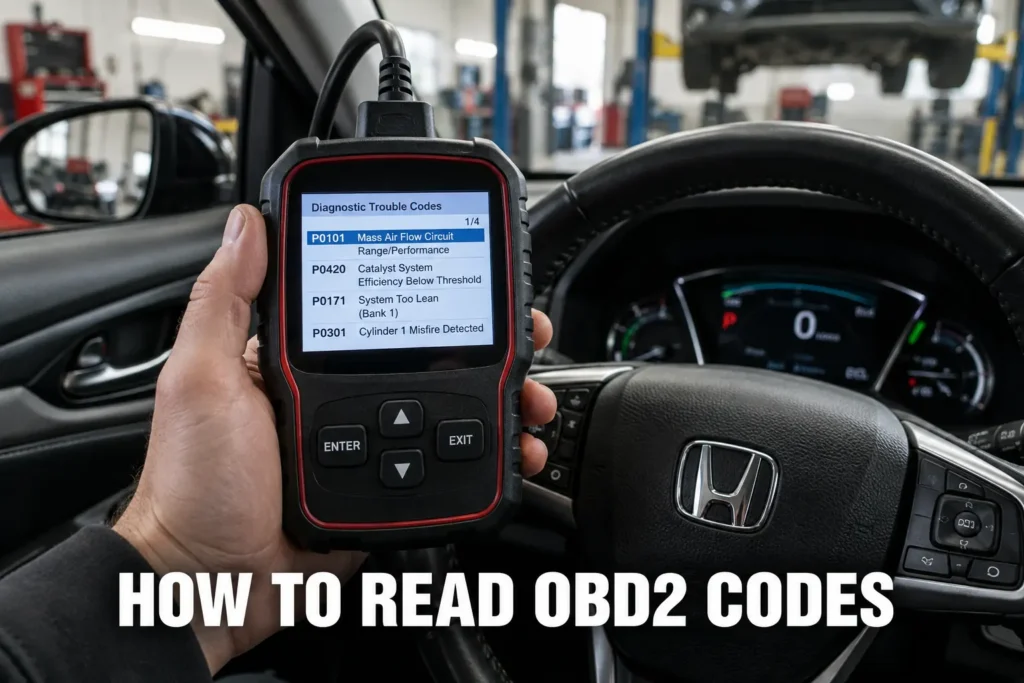
The scanner returned a code. Now you need to know what to do with it. This guide covers everything that comes after the scan: how to decode the five characters in any OBD2 trouble code, the difference between active and pending codes, how to look up codes correctly for your specific vehicle, how to read freeze frame data, and what to do when multiple codes appear at once.

About the author: Hello! I’m Kamil Siegień, founder of OBD2 Scout. My diagnostic experience started with an engine rebuild on a 2014 Skoda Superb 1.8 TSI, where tuning from 160 to 222 hp required mastering live data and ECU behavior that basic code readers cannot handle. I am a former BMW and MINI employee and regularly use diagnostic scanners on my own Audi A4 2.0 TFSI.
Reading a code is the first step. Understanding it is where the diagnostic process actually starts.
What a Trouble Code Is (and Is Not)
A diagnostic trouble code (DTC) identifies the system the ECU flagged, not the part that failed. This distinction matters more than most articles on this topic acknowledge. When a code appears, it means a monitored value crossed a threshold the system considers abnormal. It does not mean the component named in the code’s description is the one that needs replacing. My full breakdown of the OBD2 code structure and system categories covers what each letter prefix identifies, how the four-digit number narrows the fault to a circuit, and why search results differ completely between a generic SAE code and a manufacturer-specific P1 code.
P0420 is the clearest example. The code means “catalyst efficiency below threshold on bank 1.” Most people search it and immediately assume they need a catalytic converter. In many cases the actual cause is a failed downstream oxygen sensor, an exhaust leak upstream of the sensor, or fuel trim issues skewing the efficiency reading. The code tells you where the ECU detected the problem. Your job is to find out why.
How to Decode the Five Characters
Every OBD2 trouble code follows the same structure: one letter followed by four digits. Each character has a specific meaning, and reading them in order gives you a precise description of what the ECU recorded.
| Position | What It Represents | Possible Values |
|---|---|---|
| 1st character | Vehicle system area | P (Powertrain), B (Body), C (Chassis), U (Network) |
| 2nd character | Generic vs. manufacturer-specific | 0 = Generic (SAE), 1 = Manufacturer-specific, 2 = SAE-enhanced, 3 = Manufacturer-specific |
| 3rd character | Subsystem within the system area | Digit 0-9 identifying the subsystem (varies by system area) |
| 4th and 5th characters | Specific fault identifier | Two-digit number pinpointing the exact monitored condition |
Worked example using P0420. P = Powertrain. 0 = Generic, SAE standardized. 4 = Emission control system. 20 = Catalyst efficiency below threshold, bank 1. Reading it left to right, you go from broad system to specific fault in four steps. My Innova 3100RS walkthrough covers how this scanner displays P0420 freeze frame data and the live O2 sensor readings together, so you can compare catalyst inlet and outlet behavior before assuming the sensor or catalyst needs replacing.
Second example using P0301. P = Powertrain. 0 = Generic. 3 = Ignition system or misfire detection. 01 = Cylinder 1. The two-digit end of a misfire code identifies the cylinder: P0302 is cylinder 2, P0303 is cylinder 3. P0300 is a random or multiple cylinder misfire with no single cylinder pinpointed.
Active, Pending, and Permanent Codes
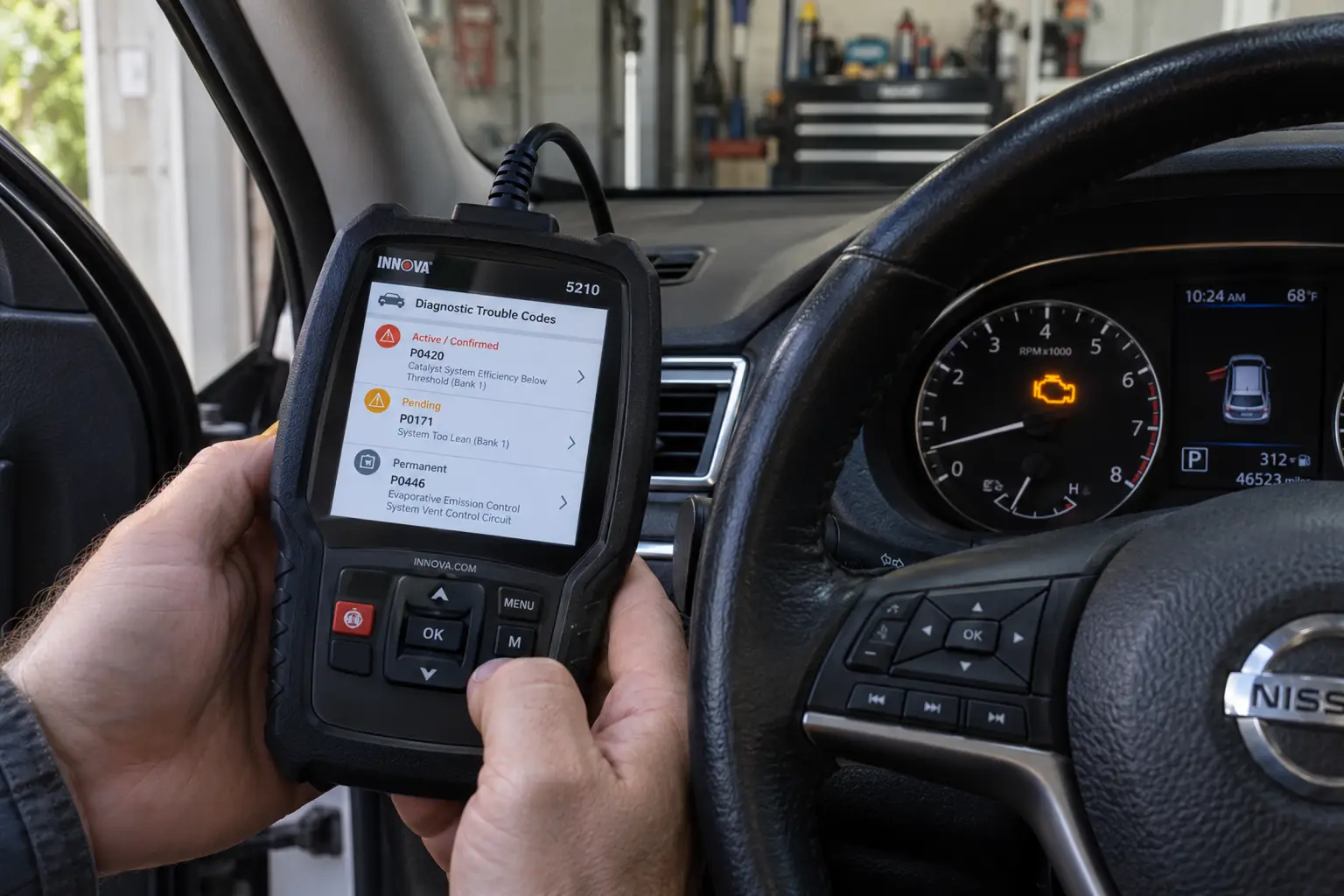
Scanners return three types of codes, and the type changes what you do next.
Active codes (also called stored or confirmed codes) are faults the ECU confirmed across multiple drive cycles. These set the check engine light. They represent a problem the system has observed enough times to trigger a warning. My guide on the difference between pending, confirmed, and permanent OBD2 codes covers exactly how many confirmation cycles the ECU requires, what makes a fault transition from pending to active, and when a permanent code overrides the clear command entirely.
Pending codes are faults detected during one drive cycle but not yet confirmed. The check engine light stays off. A pending code means the ECU saw something abnormal once and is watching for it to happen again. Many drivers ignore pending codes because the light is not on. A pending P0171 caught early is often a dirty mass airflow sensor or a small vacuum leak, and a straightforward repair. Left alone, it becomes an active P0171 plus secondary oxygen sensor codes, and the diagnosis gets more involved.
Permanent codes are confirmed faults that a scanner cannot clear. The only way to remove a permanent code is to repair the underlying fault and complete the relevant readiness monitor under actual driving conditions. Permanent codes exist specifically to prevent clearing codes before an emissions inspection without making any repairs.
How to Look Up a Code Correctly
The most common mistake when looking up a code is searching the code number alone. “P0171” in a search engine returns a generic description that applies to every make and model. The actual cause of P0171 on a 2016 Ford F-150 with a 5.0L V8 is often different from P0171 on a 2014 Toyota Camry with a 2.5L four-cylinder. The failure patterns differ by engine design, fuel system layout, and well-documented model-specific issues. My guide on clearing OBD2 codes correctly covers when removing a permanent code is actually possible, what conditions the ECU requires before it removes it on its own, and what happens when you clear other codes before those conditions are met.
The correct format is: code + make + model + engine + year. “P0171 Toyota Camry 2014 2.5L” returns forum threads, TSB results, and repair guides written for that exact application. This search takes ten additional seconds and produces significantly more accurate results than the code alone.
For P1 codes (manufacturer-specific), the vehicle make is not optional. It is the only way to get a meaningful result. P1000 on a Ford means the readiness monitors have not completed since the last battery disconnect or code clear. P1000 on a Mazda means something entirely different. Searching any P1 code without the brand name returns results that may not apply to your vehicle at all. My guide to professional OBD2 diagnostic tools covers the scanners that include manufacturer-specific P1 code definitions in their onboard databases, so you get the correct make-specific description without a separate online lookup.
Technical Service Bulletins (TSBs) are worth checking for any code that appears on a higher-mileage vehicle or has appeared repeatedly in owner forums. A TSB is a manufacturer-issued fix for a known recurring problem. When one exists for your code and vehicle, it often includes the exact repair procedure and part numbers. The NHTSA TSB database is free, searchable by make, model, year, and system, and takes about two minutes to check.
How to Use Freeze Frame Data
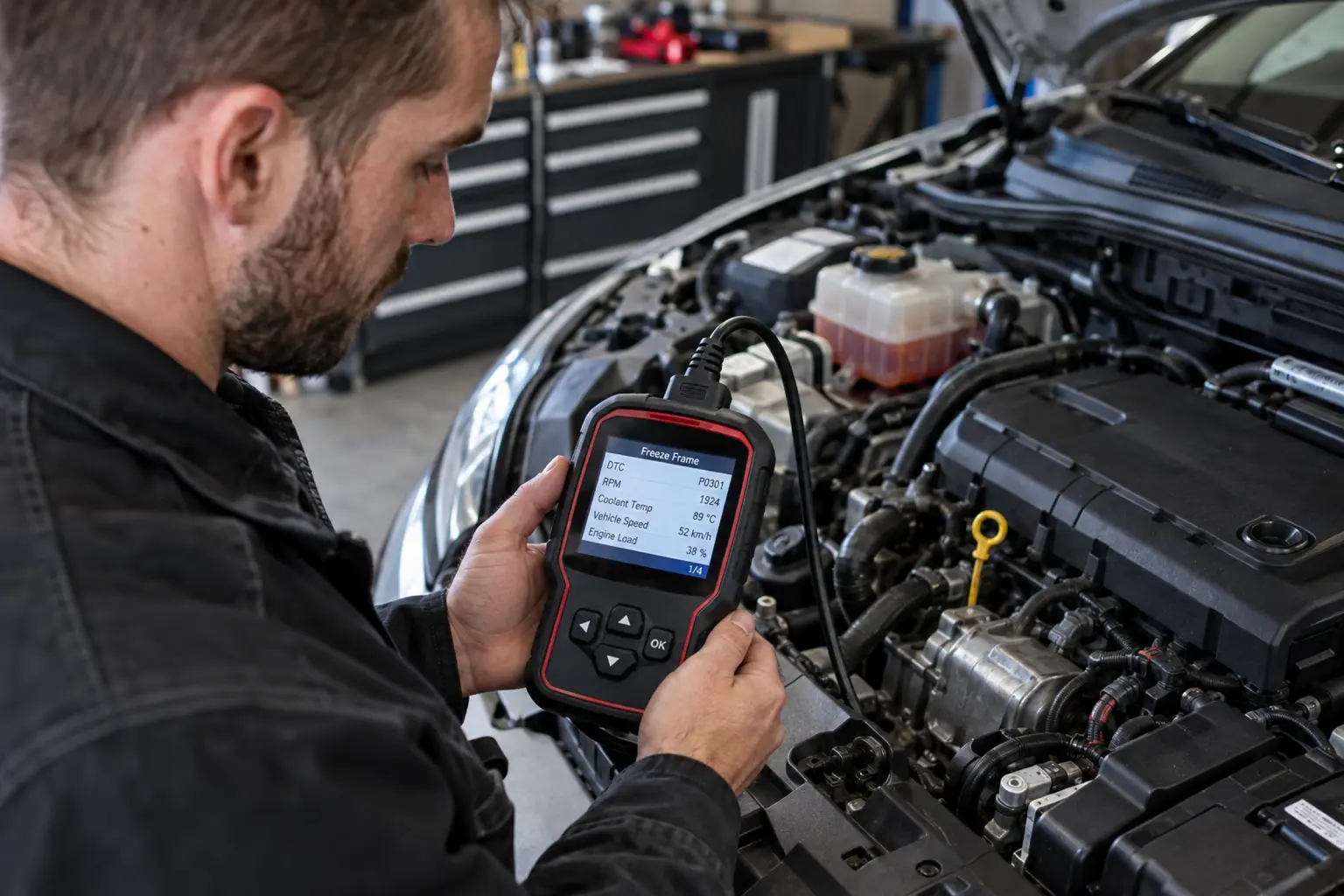
Every active code stores a freeze frame alongside it. Freeze frame is a snapshot of the engine’s sensor readings at the exact moment the fault triggered. Most scanners display it on the same screen as the code readout or one menu level deeper. It is the most underused piece of information in a standard OBD2 scan. My guide on the difference between a code reader and a full OBD2 scanner covers which tool tier provides TSB lookup access, and why a basic code reader that returns only the code number misses the additional context that makes a TSB actionable.
Freeze frame includes engine RPM, vehicle speed, engine load percentage, coolant temperature, short-term fuel trim (STFT), long-term fuel trim (LTFT), and intake manifold pressure on most vehicles. Together these readings describe the conditions the engine was operating under when the ECU logged the fault. My guide to OBD2 freeze frame data covers what each field in the snapshot means, how to use RPM, load, and fuel trim values to narrow possible causes, and why the conditions at fault trigger often matter more than the code number itself.
A misfire code with freeze frame showing high RPM and high engine load points toward ignition components under stress: coil packs, spark plugs, or plug wires that are failing under demand. The same misfire code with freeze frame showing a cold engine at idle points toward a cold-start fuel delivery issue, a stuck injector, or an idle control problem. The code is identical in both cases. The freeze frame conditions are not. My Foxwell NT630 Plus review covers how it displays both the freeze frame snapshot and live sensor data in the same session, so you can compare the fault-trigger conditions with current readings to confirm whether the misfire is load-dependent or present across all operating points.
A lean code (P0171) with high positive short-term fuel trim at idle points toward a vacuum leak or a contaminated MAF sensor. The engine is compensating for air entering the intake that the MAF did not measure. The same lean code with high positive fuel trim only at higher load and RPM points toward a fuel pressure or injector volume issue. Freeze frame does not confirm the part. It narrows the field significantly enough to test one or two likely causes rather than guessing across an entire system. Equinox owners tracking down fault codes on their vehicle can find the best diagnostic tools for their model in my recommended OBD2 scanners for the Equinox.
When You Have Multiple Codes
Multiple codes on a single scan are common, and the instinct to treat each code as a separate problem is usually wrong. Many code combinations share a single root cause, and addressing them individually leads to unnecessary parts and work that does not resolve the underlying issue. My guide on OBD2 live data covers the specific parameters most relevant to lean code diagnosis, including short-term and long-term fuel trim, MAF sensor output, and oxygen sensor voltage, and how to distinguish a vacuum leak pattern from a failing fuel injector.
The first step with multiple codes is to look for relationships. A lean code (P0171) combined with an oxygen sensor slow-response code (P0141) is a well-known pattern. A slow downstream oxygen sensor gives the catalyst efficiency monitor unreliable data, which then generates P0420 as a third code. All three codes in this case have the same cause. Replacing the downstream O2 sensor addresses all three. My roundup of reliable budget OBD2 scanners covers the models that display all stored codes simultaneously rather than one at a time, making it faster to identify the root code and recognize which downstream faults will clear once the primary fault is repaired.
When codes appear unrelated, the triage rule is straightforward. Address powertrain (P) codes before body, chassis, or network codes when driveability is the concern. Within P codes, start with the one most directly connected to the symptom you can observe or feel while driving. After any repair, clear all codes and complete a full drive cycle before concluding the fix worked. Some codes need specific driving conditions to confirm whether the fault recurs.
What the Code Cannot Tell You

A trouble code identifies a system. It does not identify a part. P0300 (random misfire) is consistent with failed spark plugs, a faulty coil pack, a clogged fuel injector, a vacuum leak, or low compression in one cylinder. The code is accurate. It is limited. My guide to OBD2 scanners built for ABS and SRS coverage covers the models that read C-codes and B-codes alongside powertrain faults, so the triage sequence can be applied across all active systems rather than only powertrain codes.
Severity is the gap that catches most DIYers off guard. A solid check engine light with P0456 (small EVAP leak) is often a loose gas cap. A solid check engine light with P0301 (cylinder 1 misfire) may be a failed coil pack on its way to damaging the catalytic converter. The light looks identical in both cases. The code gives you the system. Assessing severity requires understanding what that system does and what the consequences of continued driving are for that particular fault. My Autel MaxiSYS Elite II Pro walkthrough covers how its Mode 6 test results and component-level bidirectional tests confirm whether a low-severity code like P0456 has a mechanical root cause, or whether the EVAP system is producing a false flag from an incomplete monitor.
The code is the beginning of the diagnostic process. Live data, a visual inspection, and component testing are the steps that confirm the root cause and identify the specific part. Skipping those steps and ordering a part based on the code number alone is the reason most unnecessary repairs happen.
FAQs
Can I drive my car with a trouble code?
It depends on the code. A solid check engine light with a minor EVAP or oxygen sensor code is generally drivable while you schedule the repair. A flashing check engine light means stop driving. A flashing light indicates an active misfire severe enough to overheat and damage the catalytic converter within minutes of highway driving. Any code accompanied by rough running, loss of power, overheating, or unusual noise warrants stopping and diagnosing before continuing.
Why does the same code keep coming back after I clear it?
Clearing a code removes the stored record from the ECU but does not repair the fault. The ECU will log the same code again the next time the relevant monitor runs and detects the same abnormal condition. A code that returns after clearing means the root cause is still present. Clearing it again without repairing it only delays the light coming back on. It does not fix anything.
What is the difference between a P0 and a P1 code?
A P0 code is a generic SAE-standardized code with the same definition across all makes and models. Any OBD2 lookup database will give you accurate information for a P0 code regardless of vehicle. A P1 code is manufacturer-specific. The same P1 number can mean something entirely different on a Ford than on a Honda or a Volkswagen. For P1 codes, always include the vehicle’s make, model, and year in the search.
How do I know which code to fix first when there are multiple?
Look for codes that are likely related before treating each one as a separate problem. A lean code plus an oxygen sensor code usually share one cause. A misfire code plus an ignition system code usually share one cause. If the codes appear genuinely unrelated, start with the one most directly tied to the symptom you can observe while driving. Address powertrain codes before body or network codes when the concern is driveability or engine health.
Do I need a mechanic to read and interpret OBD2 codes?
Reading codes requires only a scanner and a few minutes. Interpreting a code accurately enough to confirm the specific failed component is where professional diagnostics add value. For simple, well-documented codes on common vehicles, a researched DIY approach works well. For unfamiliar codes, multiple simultaneous codes, or codes that do not match your observed symptoms, a mechanic with factory scan tool access and live data capability will find the root cause faster and with fewer wrong turns.