

The Honda CR-V is Honda’s best-selling SUV globally, but the fifth generation (2017-2022) has a well-documented diagnostic challenge that separates it from simpler Honda models: the 1.5-liter turbocharged direct injection engine (L15B7) generates VTC actuator timing codes P0011 and P0012 in cold climates without any hardware failure. Honda acknowledged this in Technical Service Bulletin 19-082, confirming that fuel condensation in the crankcase oil on short winter trips creates diluted oil that cannot maintain adequate cam phasing pressure. A generic OBD2 scanner reads those code numbers but cannot run the VTC solenoid active test that separates oil dilution from actual hardware failure, and without that test, owners replace cam timing components that do not need replacing. CR-V Hybrid and sixth gen PHEV owners face an additional layer: the i-MMD hybrid system and CAN-FD protocol modules on the 2023-onward CR-V require Honda-specific communication depth that basic Bluetooth adapters and older universal scanners miss entirely.

About the author: Hello! I’m Kamil Siegień, founder of OBD2 Scout. My diagnostic experience started with an engine rebuild on a 2014 Skoda Superb 1.8 TSI, where tuning from 160 to 222 hp required mastering live data and ECU behavior that basic code readers cannot handle. I am a former BMW and MINI employee and regularly use diagnostic scanners on my own Audi A4 2.0 TFSI.
Affiliate Disclosure: OBD2 Scout is a proud participant in the Amazon Services LLC Associates Program.
My picks for this list are based on compatibility research across all CR-V generations, from the fourth gen K24Z7 naturally aspirated engine through the sixth gen i-MMD full hybrid. I prioritized scanners that access the VTC actuator diagnostic beyond reading the code, cover the i-VTM4 AWD module codes on all-wheel-drive models, reach Honda Sensing CMBS and LKAS calibration on fifth and sixth gen examples, and handle i-MMD hybrid system codes for CR-V Hybrid owners. Every scanner on this list outperforms a basic parts-store code reader on the CR-V by a measurable margin.
My Recommended Top 3 Best-Buys
1. Foxwell NT510 Elite for Honda
[Best Overall]
- ✓ Honda/Acura full-system coverage including i-MMD Hybrid
- ✓ VTC solenoid active test for P0011/P0012 oil dilution diagnosis
- ✓ Honda-specific crankshaft relearn and i-MMD hybrid battery management active tests

475 Verified Reviews
2. OBDMATE OM707
[Best Value]
- ✓ 15 Honda-specific service resets including CVT relearn
- ✓ Bidirectional active tests, AutoVIN, full-system coverage
- ✓ Standalone 2.8-inch screen; no phone, app, or subscription required after purchase

5,200+ Verified Reviews
3. BLCKTEC 460T
[Best Premium]
- ✓ Full-system bidirectional with i-VTM4 AWD module access
- ✓ 12 service resets, multi-PID live data for VTC diagnosis
- ✓ CAN FD for 2023+ CR-V e:HEV; 7-inch Android display with 5,000mAh battery
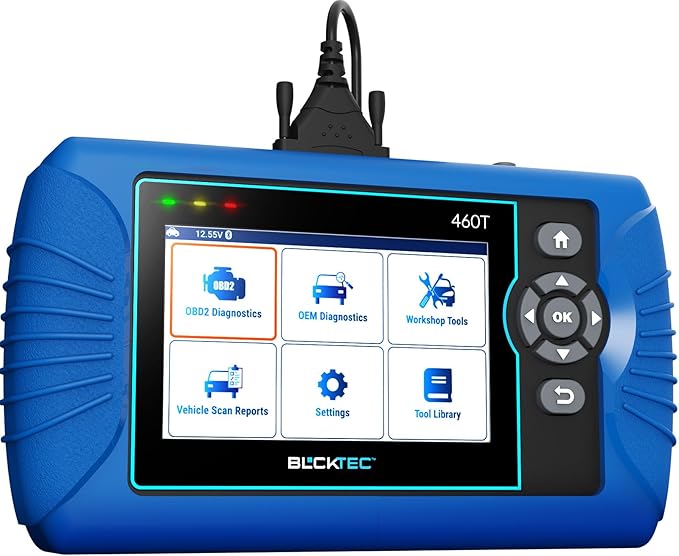
1,300+ Verified Reviews
13 Best OBD2 Scanners for Honda CR-V: Full Reviews
1. Foxwell NT510 Elite for Honda: Best OBD2 Scanner for Honda CR-V Overall
- Honda and Acura full-system diagnostics covering all CR-V generations including i-MMD Hybrid and 6th gen PHEV
- VTC Oil Control Solenoid Valve Test for P0011/P0012 oil dilution diagnosis without parts replacement
- 4.3★ rating with 475 verified reviews
Overview
The Foxwell NT510 Elite for Honda is purpose-built for Honda and Acura vehicles, and that focus delivers the diagnostic depth the CR-V specifically requires. The fifth gen CR-V (2017-2022) with the L15B7 1.5-liter turbocharged direct injection engine has a pattern fault that frustrates owners who rely on generic code readers: P0011 (intake camshaft position timing over-advanced, bank 1) and P0012 (intake camshaft position timing over-retarded, bank 1) appear on short-trip winter drivers in cold-climate states, not from hardware failure, but from fuel condensing in the crankcase oil and diluting it below the viscosity threshold required for the VTC actuator to hold correct cam phasing. A parts-store scanner reads P0011 and points the owner toward a VTC actuator solenoid or cam phaser replacement. The NT510 Elite runs the VTC Oil Control Solenoid Valve Test, commanding the solenoid while monitoring the VTEC oil pressure switch response voltage, and confirms in under two minutes whether the solenoid is operating correctly or whether the fault is hydraulic, caused by diluted or low-viscosity oil.
On top of the VTC oil dilution scenario, P0016 (crankshaft/camshaft position timing misalignment) is the more severe code that follows P0011/P0012 when oil dilution progresses far enough to cause actual cam timing slip at startup. P0016 on the fifth gen CR-V points strongly to oil quality rather than stretched timing chain when it appears alongside P0011 and P0012 in cold ambient conditions. Honda TSB 19-082 addressed this failure pattern explicitly, recommending more frequent oil changes and avoiding long idle warm-up periods in sub-zero temperatures. The NT510 Elite reads all three codes from the engine ECU and can clear them properly after an oil change with fresh 0W-20 Honda Genuine or equivalent, confirming through a subsequent VTC test that the new oil is maintaining adequate actuator pressure before the owner returns the car to normal service.
The i-VTM4 AWD module present on all-wheel-drive fifth gen CR-V variants is another area where Honda-specific protocol access matters. The intelligent Variable Torque Management 4WD system has its own control module that communicates on Honda’s proprietary bus. When the transfer unit develops a fault, the torque vectoring AWD system disables and the “All-Wheel Drive System Problem” warning appears. A generic scanner cannot access the i-VTM4 module codes; the NT510 Elite reads them directly and identifies whether the fault is a wheel speed sensor disagreement (the most common cause), a transfer clutch actuator fault, or an AWD control unit communication failure. This distinction matters: a wheel speed sensor fault requires a $40 to $80 sensor; a clutch actuator fault is a shop-level repair. Knowing which before booking a service appointment is the value the NT510 Elite delivers.
CR-V Hybrid owners benefit from the NT510 Elite’s i-MMD system coverage. The Honda Intelligent Multi-Mode Drive hybrid system in the CR-V Hybrid (available in the US from the 2020 model year onward, using the 2.0-liter Atkinson-cycle i-MMD architecture) carries a motor inverter, a power control unit, a hybrid battery management system, and a starter-generator motor, each with their own fault code ranges in the P3000 through P3999 range. The NT510 Elite accesses these modules over Honda’s hybrid bus, returning fault codes that confirm whether a P3xxx warning indicates a degraded battery cell, an inverter thermal management fault, or a motor phase current imbalance. Basic OBD2 readers return zero results for i-MMD faults because those modules do not participate in the standard powertrain protocol at all.
The service reset library covers the full CR-V maintenance cycle: oil life reset for Honda’s Maintenance Minder A and B codes, TPMS relearn after tire rotation or seasonal swap, SAS calibration after suspension or alignment work, EPB service mode for rear brake pad replacement, ABS bleed sequence, BMS reset after battery replacement, CVT relearn after transmission fluid change on models with the CVT, throttle body adaptation, and injector coding on L15B7 and the i-MMD 2.0-liter engines. At 4.3 stars across 475 reviews, the NT510 Elite occupies the top position on this list for CR-V owners who want the deepest Honda-specific diagnostic access without paying for a universal professional scanner.
Diagnostic Features and Capabilities
Full system scan for all Honda/Acura modules including i-MMD Hybrid, i-VTM4 AWD, HVAC, and body control; bidirectional active tests (VTC Oil Control Solenoid Valve Test, injector balance test, ABS pump motor, cooling fan, Honda Sensing component tests); live data with graphing; freeze frame; all 10 OBD2 modes; and Honda-specific service resets for oil, TPMS, SAS, EPB, ABS bleed, BMS, CVT relearn, injector coding, throttle adaptation, and IMMO functions.
All-system diagnosis covers Engine, ABS, Airbag, and Transmission on Honda and Acura vehicles.
On the Honda CR-V, the scanner successfully reset throttle position on a 2007 Honda CR-V and cleared all stored codes in the same session.
Crankshaft position sensor relearn available for Honda platforms that require a relearn after sensor replacement.
Vehicle Compatibility
Honda and Acura vehicles from 1996 through 2024. Covers all CR-V generations including 4th gen K24Z7, 5th gen L15B7 and CR-V Hybrid i-MMD, and 6th gen full hybrid. Also covers Civic, Accord, Pilot, Passport, Ridgeline, HR-V, and all Acura models.
Specifications
| Specification | Details |
|---|---|
| Connection | OBD2 port (wired handheld) |
| Supported Systems | All Honda/Acura systems including Hybrid, AWD, HVAC |
| OBD2 Functions | All 10 modes |
| Bidirectional Control | Yes (Honda-specific named active tests) |
| Service Functions | Honda-specific reset library |
| Vehicle Compatibility | Honda/Acura 1996-2024 |
| Display | 3.5″ color screen |
| Updates | Free via USB |
| Subscription | None |
What’s Included
Scanner unit, OBD2 cable, USB update cable, and user manual.
Pros and Cons
| Pros | Cons |
|---|---|
| VTC Oil Control Solenoid Valve Test differentiates P0011/P0012 oil dilution from hardware failure | Lower review count than the OM707; trust signal still building at 475 |
| i-MMD Hybrid P3xxx code access for CR-V Hybrid owners | |
| i-VTM4 AWD module codes for all-wheel-drive CR-V variants | |
| Honda Sensing CMBS and LKAS calibration procedures | |
| Full Honda/Acura service reset library including CVT relearn | |
| 4.3 stars across 475 verified reviews |
My Final Verdict
The NT510 Elite for Honda is the right tool for CR-V owners who want the specific diagnostic depth the fifth gen oil dilution issue requires. The VTC Oil Control Solenoid Valve Test prevents the most common CR-V diagnostic mistake: replacing hardware when diluted oil is the actual problem. i-MMD Hybrid module access, i-VTM4 AWD code coverage, and Honda Sensing calibration procedures round out a capability set that no universal scanner at this price matches for Honda-specific work.
2. OBDMATE OM707: Best Value OBD2 Scanner for Honda CR-V
- Honda and Acura full-system diagnostics with 15 service resets including CVT relearn and VTEC active test
- AutoVIN platform recognition for 4th gen, 5th gen, and 5th gen hybrid CR-V variants
- 4.4★ rating with 5,177 verified reviews
Overview
The OBDMATE OM707 is the highest-confidence Honda-specific scanner on this list, with 5,177 reviews at 4.4 stars providing a trust signal that no other Honda-dedicated tool on this page matches. It accesses every Honda CR-V module on the manufacturer-enhanced protocol: engine, ABS, SRS, transmission (including CVT TCM), body control, chassis, and HVAC. The gap between the OM707 and a generic multi-system scanner on the CR-V is most apparent in the service reset department: the OM707 carries 15 Honda-specific reset functions where most universal tools stop at four or five.
On the fifth gen CR-V L15B7, the most critical OM707 capability is the active test for the VTEC/VTC solenoid system. P1009 (VTC oil control solenoid circuit malfunction) appears on the L15B7 after 80,000 to 100,000 miles when the solenoid’s internal screen becomes partially blocked by oil sludge from extended service intervals. The OM707’s VTC active test energizes the solenoid while monitoring the VTEC oil pressure switch signal, confirming whether the solenoid body needs replacement or whether the solenoid screen can be cleaned with a controlled solvent flush. P2647 and P2646 (VTEC oil pressure switch circuit and solenoid performance codes) appear alongside P1009 when the fault is hydraulic rather than electrical, and the OM707 reads all three together, displaying freeze frame data showing oil temperature and RPM at the moment of fault to confirm the context.
The CVT relearn function is the reset that matters most to fifth gen CR-V owners who change their own transmission fluid. The CR-V LX and EX with the CVT require an ATF DW-1 fluid change at 30,000 to 45,000-mile intervals under demanding driving conditions, and every independent mechanic knows to run the CVT relearn procedure after a fluid service. Without the relearn, the TCM continues operating on shift map values calibrated to the old fluid viscosity, producing RPM hunting and harsh engagement from a standing start that owners frequently misattribute to a failing transmission. The OM707 includes Honda-specific CVT relearn in its service menu, taking the procedure from a dealer-only function to something any CR-V owner with the scanner can complete at home.
AutoVIN on the OM707 reads the CR-V’s VIN on connection and identifies the generation: the 4th gen (2012-2016) K24Z7 platform, the 5th gen (2017-2022) L15B7 platform, or the 5th gen CR-V Hybrid. This filtering determines which active tests appear in the menu and which service resets are applicable, preventing a fifth gen turbocharged reset routine from appearing on a naturally aspirated fourth gen K24Z7. The ABS module access covers the C1165 and C1175 wheel speed sensor codes that appear on fourth gen examples in rust-belt markets, and the SRS module covers B1009, B1173, and B1198 codes from airbag circuit faults and pretensioner triggers. With 5,177 reviews confirming its reliability across the Honda range, the OM707 is the right choice for CR-V owners who want both depth and a proven track record.
The 4.3-inch color LCD provides comfortable live data readability during a test drive, and the free lifetime USB firmware updates ensure coverage extends to the newest CR-V model years without additional cost. The OM707 is Honda and Acura only, which is its one meaningful limitation for households that run other makes alongside the CR-V. For those owners, the BLCKTEC 460T provides comparable functionality across all brands, though it gives up some Honda-labeled service resets in exchange for universal coverage.
Diagnostic Features and Capabilities
Full system scan for Honda/Acura, live data with graphing, freeze frame, all 10 OBD2 modes, bidirectional active tests (VTEC solenoid command, ABS pump motor, cooling fan relay, throttle actuator), AutoVIN with generation filtering, USB report export, and 15 Honda-specific service resets: oil life, TPMS, SAS, EPB, ABS bleed, BMS, throttle adaptation, CVT relearn, injector coding, DPF, EGR, sunroof initialization, and IMMO functions.
Vehicle Compatibility
Honda and Acura vehicles 1996-2022. Covers all CR-V generations including 4th gen K24Z7, 5th gen L15B7, and CR-V Hybrid. Also covers Civic, Accord, Pilot, HR-V, Ridgeline, and all Acura models.
Specifications
| Specification | Details |
|---|---|
| Connection | OBD2 port (wired, USB-C cable included) |
| Supported Systems | Engine, ABS, SRS, Transmission, Body, Chassis, HVAC |
| OBD2 Functions | All 10 modes |
| Bidirectional Control | Yes |
| Service Functions | 15 Honda-specific resets |
| Vehicle Compatibility | Honda/Acura 1996-2022 |
| Display | 4.3″ color LCD |
| Updates | Free lifetime via USB |
| Subscription | None |
What’s Included
Scanner unit, OBD2 extension cable, USB-C update cable, and user manual.
Full system scan on Honda Civic completed in approximately one minute, finding an issue the owner did not know existed.
On the Honda CR-V, oil reset and TPMS reset work reliably on Honda Civic, Accord, and Odyssey models.
Small 2.8-inch color screen shows live data in both text and graph formats for sensor monitoring.
Pros and Cons
| Pros | Cons |
|---|---|
| Highest review count on this list at 5,177 with Honda-specific code depth reaching P1009, P2647, P2646 | Limited to Honda and Acura; not useful on non-Honda vehicles in the household |
| CVT relearn function prevents post-fluid-change transmission complaints | |
| AutoVIN filters CR-V gen correctly; no wrong-generation reset menus | |
| 15 Honda-specific service resets in one tool | |
| Free lifetime updates; no subscription | |
| 4.4 stars across 5,177 verified reviews |
My Final Verdict
The OM707 is the most proven Honda-specific scanner on this list. The combination of VTC solenoid active test access, CVT relearn, AutoVIN generation filtering, and 5,177 reviews at 4.4 stars makes it the default recommendation for any CR-V owner who runs a Honda or Acura household. For owners who also maintain non-Honda vehicles, the BLCKTEC 460T covers all brands while sacrificing some Honda-labeled menus.
3. BLCKTEC 460T: Best Premium OBD2 Scanner for Honda CR-V
- Full-system bidirectional scanner with i-VTM4 AWD module access and 12 service resets
- Multi-PID live data graphing for simultaneous VTC oil pressure, cam timing, fuel trim, and boost monitoring
- 4.6★ rating with 1,241 verified reviews
Overview
The BLCKTEC 460T is the right scanner for CR-V owners who need the most capable universal tool and who also run non-Honda vehicles in their household. Where the NT510 Elite and OM707 are Honda-exclusive, the 460T applies full-system bidirectional diagnostics to every OBD2 vehicle, giving CR-V owners Honda coverage alongside simultaneous capability for any other vehicle in the driveway. On the CR-V specifically, the 460T accesses engine, ABS, SRS, transmission (including CVT and AWD), body control, and chassis modules with the same underlying depth as a Honda-dedicated tool.
The multi-PID live data graphing is the 460T’s strongest feature for fifth gen CR-V L15B7 diagnostics. The oil dilution pattern that causes P0011/P0012 on that engine can be correlated with data from multiple sensors simultaneously: cam intake advance angle (actual vs target), VTEC oil pressure sensor voltage, oil temperature, short-term fuel trim, and manifold pressure. Plotting those five PIDs together during a cold-start drive in winter conditions immediately shows whether the cam timing deviation matches the oil pressure drop pattern at low oil temperatures, confirming the oil dilution hypothesis without needing a Honda-specific active test command. A Civic or Accord owner using the same 460T for the same type of diagnosis benefits from identical methodology, which is the efficiency argument for a universal tool in a multi-Honda household.
On fifth gen CR-V AWD models, the 460T reads i-VTM4 transfer unit fault codes through the Honda AWD module’s standard OBD2-accessible address space. The most common i-VTM4 codes on the fifth gen are related to wheel speed sensor disagreements between front and rear axles (particularly after an alignment that changed one wheel’s effective rolling radius) and transfer clutch actuator faults that appear after off-road use in deep sand or snow. The 460T’s bidirectional active tests include the AWD clutch command on Honda platforms, allowing the mechanic to engage and disengage the rear torque application independently and confirm the actuator responds before committing to a $500-plus AWD unit repair.
Service resets on the 460T cover the 12 most common CR-V maintenance procedures: oil life reset, ABS bleed sequence (critical after any brake hydraulic work on CR-V with antilock system), SAS calibration after the routine alignment that CR-V AWD owners typically schedule at 30,000 miles due to tire wear patterns from the AWD system, EPB retraction for rear brake service, TPMS relearn, BMS after battery replacement, throttle body adaptation, and DPF regeneration trigger for CR-V diesel variants in markets where that powertrain is available. The 4.3-inch touchscreen is the largest wired display on this list, and its backlit visibility in direct sunlight makes it the most comfortable option for a live data session during a test drive with the sunroof open.
The 460T also handles the sixth gen CR-V (2023 onward) where the standard US powertrain changed to the full i-MMD hybrid system. The sixth gen uses CAN-FD protocol on some modules, and the 460T’s communication architecture supports CAN-FD, meaning ADAS and some body control modules that older universal tools miss on the sixth gen respond normally. For households running a sixth gen CR-V alongside a Tesla, a BMW, or any other non-Honda brand, the 460T handles all of them from one device without compromise.
Diagnostic Features and Capabilities
Full system scan, bidirectional active tests including i-VTM4 AWD clutch command and ABS pump activation, multi-PID live data graphing (cam timing, VTEC oil pressure, STFT, boost simultaneously), freeze frame, all 10 OBD2 modes, AutoVIN, CAN-FD support, and 12 service resets: oil, ABS bleed, SAS, EPB, TPMS, BMS, throttle adaptation, injector coding, and DPF regeneration.
Vehicle Compatibility
All OBD2 vehicles from 1996 onward, all makes. Covers all CR-V generations including 6th gen i-MMD hybrid with CAN-FD support. Works across European, Asian, and North American OBD2 vehicles.
Specifications
| Specification | Details |
|---|---|
| Connection | OBD2 port (wired handheld) |
| Supported Systems | All systems including AWD and Hybrid modules |
| OBD2 Functions | All 10 modes |
| Bidirectional Control | Yes |
| Service Functions | 12 resets |
| Vehicle Compatibility | OBD2 vehicles 1996+, CAN-FD supported |
| Display | 4.3″ color touchscreen |
| Updates | Free lifetime |
| Subscription | None |
What’s Included
Scanner unit, OBD2 cable, USB update cable, and user manual.
For Honda CR-V diagnostics, autoVIN technology reads the 17-digit VIN from the ECU automatically, skipping the manual selection step.
In practice on the Honda CR-V, 12+ advanced reset services include DPF regen, oil reset, injector coding, SAS calibration, and throttle relearn.
Some user reports indicate advanced bi-directional active tests are limited on certain vehicle platforms despite advertised capability.
Pros and Cons
| Pros | Cons |
|---|---|
| Multi-PID graphing correlates VTC oil pressure with cam timing deviation for oil dilution confirmation | No Honda-named menus; fewer Honda-labeled resets than NT510 Elite or OM707 |
| i-VTM4 AWD clutch command active test on fifth gen CR-V AWD models | |
| CAN-FD support for sixth gen CR-V modules | |
| Works on all OBD2 vehicles, not just Honda | |
| 4.3″ touchscreen with sunlight-readable backlight | |
| 4.6 stars across 1,241 verified reviews |
My Final Verdict
The BLCKTEC 460T is the right choice for CR-V owners who maintain multiple makes and need one scanner that handles all of them at the same diagnostic depth. The multi-PID graphing for VTC oil pressure correlation during cold-start drives is genuinely more informative than a Honda-labeled active test for confirming P0011/P0012 root cause, and the i-VTM4 AWD clutch command active test is available where the Honda-exclusive scanners stop at code reading for that module. For CR-V owners who run Honda-only households and prefer named Honda menus and CVT relearn, the NT510 Elite or OM707 are the better fit.
4. LAUNCH Creader Elite V3.0: Best for Honda Sensing ADAS Calibration on CR-V
- Honda and Acura 2026-ready bidirectional scan tool with ADAS calibration procedures for CR-V Honda Sensing
- LKAS static FOV calibration and CMBS radar zero-point reset after windshield and bumper work
- 4.3★ rating with 2,392 verified reviews

Overview
The LAUNCH Creader Elite V3.0 occupies a specific position on this list: it is the best choice for CR-V owners whose most frequent diagnostic need is Honda Sensing ADAS calibration and who value the 5-inch touchscreen for live data sessions during longer test drives. Honda Sensing became standard on all CR-V trims from the fifth gen (2017) in the US market, and the SUV’s taller windshield and front-mounted radar position create calibration requirements that appear more frequently than on lower-slung vehicles after the same service procedures.
On the fifth gen CR-V, the LKAS camera sits at the top of the windshield behind the rearview mirror, in a bracket that mounts to the glass. A windshield replacement on any Honda Sensing-equipped fifth gen CR-V requires an LKAS static field-of-view calibration afterward. The procedure requires positioning a calibration target at a prescribed height and distance in front of the vehicle on a level surface, then running the ECU calibration command that maps the camera’s new reference frame to the vehicle centerline. The Creader Elite V3.0 initiates this sequence directly, walking through each step with on-screen guidance. Without this calibration after a windshield replacement, the LKAS system disables itself after the first drive cycle where it detects a lane position discrepancy exceeding its tolerance, and the “Lane Keeping Assist System Problem” warning appears on the instrument cluster.
The CMBS forward radar on the CR-V requires a zero-point calibration after any front bumper removal or front-end collision repair that disturbs the radar mounting position. The CR-V’s radar sits behind the Honda badge on the front grille surround, and it has a tighter angular tolerance than many drivers expect: a shift of approximately 1 degree from the factory reference angle is enough to trigger a radar misalignment fault. Collision repair shops that do not have a dedicated ADAS calibration system often attempt to clear the radar fault code without running the zero-point calibration, causing it to return within the first highway drive. The Creader Elite V3.0 performs the Honda CMBS zero-point calibration, re-establishing the radar’s reference angle and confirming the reading is within tolerance before the vehicle leaves the shop.
The fifth gen CR-V with Honda Sensing also includes ACC (Adaptive Cruise Control), which uses the same forward radar as CMBS. When the radar requires calibration, the ACC system is simultaneously affected, meaning both the automatic emergency braking and the adaptive cruise functions are unavailable until the calibration is complete. The Creader Elite V3.0 addresses both through the same ADAS calibration sequence, restoring full Honda Sensing functionality in one procedure. The 5-inch touchscreen provides the clearest display for viewing the calibration status readout and confirms whether the calibration passed or requires repositioning of the target before repeating.
The 2,392 reviews at 4.3 stars across a Honda-specific tool confirm reliable real-world performance for CR-V owners. The Creader Elite V3.0 also performs all standard CR-V service resets: oil life, SAS calibration, TPMS relearn, EPB, ABS bleed, and BMS. For the CR-V owner who replaces windshields more often than they service timing components (which applies to the vast majority of fifth and sixth gen CR-V ownership), this scanner addresses the most frequent post-service diagnostic requirement that the Honda-dedicated tools at this price tier also cover.
Diagnostic Features and Capabilities
Full system scan including ADAS modules, bidirectional active tests, live data with 5-inch graphing display, freeze frame, all 10 OBD2 modes, AutoVIN, and Honda Sensing calibration procedures: LKAS static FOV calibration, CMBS radar zero-point calibration, ACC calibration status, SAS calibration, ABS bleed, oil reset, EPB, TPMS, BMS, and throttle adaptation.
Vehicle Compatibility
Honda and Acura vehicles through 2026, covering all CR-V generations. Compatible with other OBD2 vehicles from 1996 onward.
Specifications
| Specification | Details |
|---|---|
| Connection | OBD2 port (wired handheld) |
| Supported Systems | Engine, ABS, SRS, Transmission, Body, ADAS, Chassis |
| OBD2 Functions | All 10 modes |
| Bidirectional Control | Yes |
| Service Functions | All common resets including ADAS calibration |
| Vehicle Compatibility | Honda/Acura 2026-ready; OBD2 1996+ |
| Display | 5″ color touchscreen |
| Updates | Free lifetime |
| Subscription | None |
What’s Included
Scanner unit, OBD2 cable, USB update cable, and user manual.
Scan speed approximately twice as fast as competing mid-range tools, significantly reducing diagnostic wait time.
On the Honda CR-V, the scanner successfully disabled ECO auto-start-stop on a supported vehicle through a body module service function.
The scanner enabled navigation input while driving by changing the comfort settings in the infotainment module.
Pros and Cons
| Pros | Cons |
|---|---|
| Honda Sensing LKAS static FOV and CMBS radar zero-point calibration for CR-V windshield and bumper work | Occasional firmware update lag on newest CR-V model years |
| 5″ touchscreen: largest display on this list for live data sessions | |
| Bidirectional active tests across all CR-V systems | |
| AutoVIN and diagnostic report export | |
| Free lifetime software updates | |
| 4.3 stars across 2,392 verified reviews |
My Final Verdict
The Creader Elite V3.0 is the scanner to choose when Honda Sensing ADAS calibration after windshield replacements and front-end repairs is the priority. The LKAS and CMBS calibration procedures it performs on the fifth and sixth gen CR-V restore full Honda Sensing functionality after the body repairs that any SUV owner eventually encounters. For CR-V owners whose priority is VTC actuator diagnosis or CVT relearn, the NT510 Elite or OM707 provide those Honda-specific functions with equal depth.
5. iCarsoft JP V3.0: Best Japanese Multi-System Scanner for Honda CR-V
- Full-system Honda and Acura diagnostics alongside Toyota, Lexus, Mazda, and Subaru in one tool
- 47 service resets covering all CR-V maintenance functions including EPS SAS calibration
- 4.3★ rating with 91 verified reviews

Overview
The iCarsoft JP V3.0 is the right choice for CR-V owners who also run other Asian vehicles and want one scanner that covers all of them to the same diagnostic depth as the Honda-dedicated tools on this list. It communicates on Honda’s enhanced protocol for the CR-V, returning the same manufacturer-specific fault codes, the same all-system module access, and the same bidirectional active test capability as the NT510 Elite and OM707, while simultaneously doing the same for Toyota, Lexus, Mazda, Subaru, and Infiniti. A household running a CR-V alongside a Toyota Highlander, a Mazda CX-5, and a Lexus RX would need four separate single-brand tools to match what the JP V3.0 covers in one device.
The 47 service reset functions are the most extensive on this list, and several of them address CR-V-specific maintenance scenarios beyond what the NT510 Elite and OM707 cover in their respective menus. The EPS SAS (Electric Power Steering Steering Angle Sensor) reset is particularly relevant for CR-V owners who install aftermarket suspension components or who need to re-establish the steering column zero-point reference after an alignment on a car that was previously in a minor collision. The Honda CR-V uses an electric power steering system with a torque sensor that requires its zero-point reference to be confirmed at straight-ahead wheel position after any alignment change that shifts the column angle by more than the tolerance. Without the EPS SAS reset, the EPS warning light illuminates and the system operates in reduced-assistance mode until the calibration is completed.
The CR-V-specific diagnostic work where the JP V3.0 adds genuine value beyond generic tools is in the fifth gen L15B7 VTC system. The JP V3.0’s Honda menu includes the same VTC Oil Control Solenoid Valve Test access as the NT510 Elite, commanding the solenoid and monitoring oil pressure switch response to separate hardware faults from oil quality issues on P0011 and P0012 codes. For CR-V Hybrid owners, the JP V3.0 covers the i-MMD system P3xxx hybrid codes from the power control unit, motor inverter, and high-voltage battery management module. The scanner supports all CR-V generations from the fourth gen K24Z7 through the fifth gen i-MMD Hybrid.
On the i-VTM4 AWD module present on fifth gen CR-V AWD variants, the JP V3.0 accesses transfer unit fault codes and provides the AWD clutch actuator active test command for verifying the rear torque application hardware responds before committing to a transfer unit repair. This covers the same capability as the BLCKTEC 460T’s AWD module access but through Honda’s specific protocol layer rather than a universal OBD2 command set. For CR-V owners who also maintain a Toyota 4Runner or a Subaru Outback with AWD systems, the JP V3.0 applies similar protocol-level access to those platforms as well, making it the most versatile multi-brand AWD diagnostic tool on this list.
The 91-review count reflects an older listing for this version of the JP V3.0, and iCarsoft has a strong track record with the JP product line specifically for Asian vehicle coverage. The feature set is mature and the 4.3-star rating holds up against tools with ten times the review volume. For multi-brand Asian households where the CR-V is one of several vehicles requiring full-system diagnostics, the JP V3.0 is the most cost-efficient path to that coverage.
Diagnostic Features and Capabilities
Full system scan for Honda, Acura, Toyota, Lexus, Mazda, Subaru, Infiniti, and other Asian brands; bidirectional active tests including VTC solenoid command, AWD clutch command, injector balance test, and cooling fan command; live data with graphing; freeze frame; all 10 OBD2 modes; and 47 service resets including oil life, EPS SAS calibration, VTEC test, EPB, ABS bleed, SAS, TPMS, BMS, throttle adaptation, CVT relearn, IMMO, injector coding, and i-MMD hybrid module resets.
Bidirectional control commands individual components and confirms their response in real time on Honda and Nissan vehicles.
On the Honda CR-V, the scanner showed genuine ECU-stored mileage on a Honda, separate from the dashboard odometer display.
The scanner identified a wheel speed sensor fault causing multiple simultaneous warning lights on a Honda Jazz.
Vehicle Compatibility
Honda, Acura, Toyota, Lexus, Mazda, Subaru, Infiniti, Nissan, and other Asian OBD2 vehicles from 1996 onward. Covers all CR-V generations including 4th gen K24Z7, 5th gen L15B7, and CR-V Hybrid i-MMD.
Specifications
| Specification | Details |
|---|---|
| Connection | OBD2 port (wired handheld) |
| Supported Systems | All systems for Honda and other Asian brands |
| OBD2 Functions | All 10 modes |
| Bidirectional Control | Yes |
| Service Functions | 47 resets |
| Vehicle Compatibility | Honda, Toyota, Lexus, Mazda, Subaru, Infiniti, and more |
| Display | 3.5″ color screen |
| Updates | Free via USB |
| Subscription | None |
What’s Included
Scanner unit, OBD2 cable, USB update cable, and user manual.
Pros and Cons
| Pros | Cons |
|---|---|
| 47 service resets including EPS SAS calibration and VTC solenoid test on CR-V | 91 verified reviews; trust signal thinner than OM707 at 5,177 |
| Covers Honda/Acura plus Toyota, Lexus, Mazda, Subaru in one tool | |
| i-MMD Hybrid P3xxx code access for CR-V Hybrid owners | |
| i-VTM4 AWD clutch command active test | |
| No subscription required | |
| 4.3 stars across 91 verified reviews |
My Final Verdict
The iCarsoft JP V3.0 is the right scanner for multi-Asian-brand households where the CR-V sits alongside Toyota, Lexus, or Mazda vehicles. The 47-reset library with EPS SAS calibration and VTC solenoid test access delivers genuine Honda-specific depth while covering every other Asian brand to the same standard. Lower review volume is the only meaningful reservation; the feature set is proven across iCarsoft’s JP line.
6. Innova 5610: Best Wireless Full-System Scanner for Honda CR-V
- Wired and Bluetooth dual-mode scanner with full-system Honda coverage and RepairSolutions2 database integration
- Battery and charging system test alongside ABS, SRS, and engine diagnostics for all CR-V generations
- 4.4★ rating with 588 verified reviews

Overview
The Innova 5610 is the only scanner on this list that operates in both wired and wireless Bluetooth modes, and the wireless capability changes how CR-V diagnostics work during a road test. The fifth gen CR-V L15B7 has a P0507 (idle air control system RPM high) fault pattern that manifests exclusively during warm-up from cold at ambient temperatures below 5°C, then disappears as the engine reaches operating temperature. Diagnosing this fault with a wired scanner requires a helper in the passenger seat monitoring the screen while the driver focuses on replicating the cold-start condition; with the 5610’s Bluetooth mode paired to the RepairSolutions2 app on a smartphone mounted to the dash, the driver can monitor idle speed, LTFT, MAF, and VTEC oil pressure simultaneously in graph form while the vehicle runs its cold-start sequence uninterrupted.
P0420 (catalyst system efficiency below threshold, bank 1) is the fourth gen CR-V K24Z7 code that appears most frequently at high mileage, typically after 140,000 to 180,000 miles in regions where the K24Z7 was operated with the air-fuel ratio running slightly rich due to air filter neglect or a leaking injector tip. The 5610 reads P0420 alongside the supporting data that distinguishes a worn catalyst from a sensor fault: it displays the upstream and downstream oxygen sensor switching voltage simultaneously, and the RepairSolutions2 database flags whether the K24Z7 P0420 on a specific model year has a known Honda service campaign or TSB attached to it. For a fourth gen owner with P0420 debating between a new catalyst and a new downstream sensor, this data display prevents the more expensive replacement.
The CVT transmission module codes P0730 (incorrect gear ratio) and P0717 (input speed sensor circuit, no signal) appear on fifth gen CR-V models that have gone beyond the Honda-recommended fluid change intervals or that have been operated with the wrong ATF specification. The P0717 fault in particular is diagnostic noise on a fifth gen CR-V with original fluid at 60,000-plus miles: the input speed sensor on the L15B7 CVT develops a signal drop under high load at operating temperature when the fluid viscosity has degraded. The 5610 reads both CVT codes and stores freeze frame data showing speed, throttle position, and fluid temperature at the time of fault, making it straightforward to confirm whether the fault appeared under high-load cruising (fluid degradation pattern) or at startup (sensor failure pattern). The RepairSolutions2 integration then provides cost estimates for both the sensor replacement and the fluid service, giving the owner a clear decision framework.
The battery and alternator test is a distinguishing feature not found on the Honda-dedicated tools at comparable pricing. Fifth gen CR-V with the automatic idle stop function (ISS) — present on all 2017-2022 CR-V models with the CVT as standard equipment — requires a specific AGM battery to support the high cycle count of ISS operation. When an ISS battery degrades below the charge acceptance threshold for AGM chemistry, the idle stop function disables and the “Auto Stop/Start System Problem” warning appears. A generic battery tester cannot correlate the battery test result with the PCM idle stop fault code in one procedure; the Innova 5610 reads the ISS disable fault from the engine ECU simultaneously with a cold cranking ampere test of the battery, confirming in one connection whether the disable is caused by the battery, the charging system, or a PCM logic fault.
The RepairSolutions2 cloud database provides CR-V-specific freeze frame definitions, TSB references by VIN and model year, and common fix suggestions confirmed by Innova’s repair database aggregated from shop submissions. For P0011 and P0012 on the fifth gen L15B7, the database surfaces Honda TSB 19-082 oil dilution advisory automatically, pointing the owner toward the oil change solution rather than parts replacement. At 4.4 stars across 588 verified reviews, the 5610 combines the wireless convenience of a Bluetooth scanner with the full-system depth required to diagnose the specific fault patterns that appear across the CR-V’s generation range.
Diagnostic Features and Capabilities
Full system scan for engine, ABS, SRS, transmission (including CVT), body, and HVAC modules; wired and Bluetooth wireless modes; RepairSolutions2 cloud database with TSB references and repair cost estimates; live data with multi-PID graphing; battery and charging system test; freeze frame; all 10 OBD2 modes; and service resets for oil life, TPMS, and SAS calibration.
Vehicle Compatibility
OBD2 vehicles from 1996 onward, all makes. Enhanced manufacturer-specific coverage for Honda, Toyota, Ford, GM, Chrysler, and other major brands. Covers all CR-V generations.
Specifications
| Specification | Details |
|---|---|
| Connection | Wired OBD2 or Bluetooth (dual mode) |
| Supported Systems | Engine, ABS, SRS, Transmission, Body, HVAC |
| OBD2 Functions | All 10 modes |
| Bidirectional Control | Yes (limited active tests) |
| Service Functions | Oil, TPMS, SAS |
| Vehicle Compatibility | OBD2 1996+, all makes |
| Display | 3.5″ color screen |
| Updates | Free via USB |
| Subscription | None required; RepairSolutions2 free tier available |
What’s Included
Scanner unit, OBD2 cable, USB update cable, user manual, and RepairSolutions2 database access.
For Honda CR-V diagnostics, bidirectional feature availability varies sharply by vehicle: some cars support only a handful of the listed active tests.
In practice on the Honda CR-V, ABS bleed function allows controlled solenoid cycling, useful after caliper replacement or brake fluid flush.
EPB retraction function activates the electronic parking brake motor through the scanner rather than requiring a separate bleed tool.
Pros and Cons
| Pros | Cons |
|---|---|
| Bluetooth wireless for cold-start road test monitoring without a helper | Fewer Honda-specific named service resets than NT510 Elite or OM707 |
| RepairSolutions2 database surfaces Honda TSB 19-082 for P0011/P0012 automatically | |
| Battery and charging system test alongside idle stop system fault codes | |
| CVT freeze frame data separating fluid degradation from sensor failure | |
| P0420 catalyst diagnosis with dual oxygen sensor display for 4th gen K24Z7 | |
| 4.4 stars across 588 verified reviews |
My Final Verdict
The Innova 5610 is the right choice for CR-V owners who want Bluetooth wireless capability during road tests alongside full-system coverage. The RepairSolutions2 TSB database integration and battery test capability are features that none of the Honda-dedicated tools at this price point include. For owners who prioritize Honda-specific VTC solenoid active tests and CVT relearn over wireless convenience, the NT510 Elite and OM707 are the better fit.
7. Foxwell NT604 Elite: Best Mid-Range Full-System Scanner for Honda CR-V
- Full-system four-system scanner covering engine, ABS, SRS, and transmission for all major OBD2 brands including Honda
- C1165/C1175 ABS wheel speed sensor codes and SRS airbag circuit diagnostics across all CR-V generations
- 4.5★ rating with 2,392 verified reviews

Overview
The Foxwell NT604 Elite is the choice for CR-V owners who need reliable ABS and SRS diagnostics without paying for a full bidirectional scanner. Its reputation at 4.5 stars across 2,392 reviews reflects consistent performance across precisely the four systems that generate the most customer-visible warning lights on a CR-V: the ABS amber light, the SRS airbag warning, the check engine light, and the transmission warning. For fourth and fifth gen CR-V owners in rust-belt markets, the NT604 Elite addresses the single most common suspension-triggered warning: C1165 and C1175, the front-right and rear-right wheel speed sensor codes.
The fourth gen CR-V K24Z7 (2012-2016) with the multi-link rear suspension uses ABS wheel speed sensors at all four corners, each mounted in a housing that is exposed to road salt spray. C1165 (right front wheel speed sensor circuit malfunction) and C1175 (right rear wheel speed sensor circuit malfunction) appear when corrosion penetrates the sensor wiring harness or corrodes the tone ring on the hub. In Michigan, Ohio, and Ontario markets, these are among the five most common fourth gen CR-V codes reported by independent shops. The NT604 Elite reads these codes with Honda-specific protocol depth, providing the sensor circuit signal quality data that confirms whether the fault is the sensor body, the reluctor ring, or the wiring connector before the owner purchases parts.
SRS airbag warning codes on the CR-V break down into three recurring categories: B1009 (driver’s airbag circuit high resistance, first-generation Honda Sensing Civic and CR-V airbag clock spring fault), B1173 (passenger pretensioner circuit continuity fault appearing after a seat harness was disconnected during a seat removal for upholstery work), and B1198 (side airbag circuit fault triggered by water intrusion in the B-pillar on fifth gen CR-Vs in flood-prone markets). A basic OBD2 scanner reads none of these codes because the SRS module communicates on Honda’s proprietary bus, not the standard OBD2 protocol. The NT604 Elite communicates on Honda’s enhanced bus, returning the exact B-code and the freeze frame context that distinguishes a mechanical circuit fault from an intermittent harness fault caused by water infiltration.
Transmission coverage on the NT604 Elite reaches the CVT TCM on fifth gen CR-V, reading P0730 (incorrect gear ratio from degraded fluid viscosity) and P0717 (input turbine speed sensor signal loss) alongside the throttle position and vehicle speed data that contextualizes whether the fault occurred under load or at idle. For fourth gen CR-V with the 5-speed automatic, P0740 (torque converter clutch solenoid circuit fault) and P0780 (shift malfunction) appear when the ATF DW-1 fluid has not been changed within the recommended interval and the transmission is operating with degraded shift pressure. The NT604 Elite’s TCM access reads both of these codes with the full Honda manufacturer protocol, providing the freeze frame throttle angle and RPM at fault time that the transmission technician needs to order the correct repair.
The Foxwell NT604 Elite supports over 60 vehicle brands and provides the same four-system depth for every brand in the database, making it genuinely useful in a multi-brand household. The free lifetime updates maintain CR-V coverage through model year updates at no ongoing cost. For owners who have already identified that their primary diagnostic need on the CR-V is ABS, SRS, engine, or CVT fault reading without the requirement for active tests or service resets, the NT604 Elite delivers that capability at a price point below the bidirectional tools on this list.
Diagnostic Features and Capabilities
Full four-system scan (engine, ABS, SRS, transmission) for 60-plus OBD2 brands including Honda; live data with graphing; freeze frame; all 10 OBD2 modes; AutoVIN; diagnostic report printing; and oil life reset with TPMS relearn for Honda.
Vehicle Compatibility
OBD2 vehicles from 1996 onward, 60-plus brands including Honda. Covers all CR-V generations. Also covers Civic, Accord, Toyota, Ford, GM, BMW, and other major OBD2 brands.
Specifications
| Specification | Details |
|---|---|
| Connection | OBD2 port (wired handheld) |
| Supported Systems | Engine, ABS, SRS, Transmission |
| OBD2 Functions | All 10 modes |
| Bidirectional Control | No |
| Service Functions | Oil reset, TPMS relearn |
| Vehicle Compatibility | OBD2 1996+, 60-plus brands |
| Display | 3.5″ color screen |
| Updates | Free lifetime via USB |
| Subscription | None |
What’s Included
Scanner unit, OBD2 cable, USB update cable, and user manual.
For Honda CR-V diagnostics, the scanner reads freeze frame data capturing sensor values recorded at the exact moment the fault code triggered.
In practice on the Honda CR-V, covers four systems in one tool: Engine, ABS, SRS (airbag), and Transmission.
NOT compatible with 24V trucks, limited to 12V passenger vehicles and light-duty trucks.
Pros and Cons
| Pros | Cons |
|---|---|
| 4.5 stars at 2,392 reviews confirms consistent ABS/SRS/transmission reliability | No bidirectional active tests; cannot command VTC solenoid or ABS pump motor |
| C1165/C1175 wheel speed sensor circuit quality data for rust-belt market CR-V owners | |
| B1009/B1173/B1198 SRS airbag codes on Honda-specific bus | |
| CVT TCM P0730/P0717 freeze frame with load context | |
| 60-plus brand coverage for multi-brand households | |
| Free lifetime updates; no subscription |
My Final Verdict
The NT604 Elite is the right scanner for CR-V owners whose primary need is ABS, SRS, and transmission code reading without active test capability. The C1165/C1175 wheel speed sensor circuit quality data and B-code SRS airbag diagnostics deliver clear value over a basic OBD2 reader on any Honda CR-V generation. Owners who also need VTC solenoid tests or CVT relearn should step up to the NT510 Elite or OM707.
8. ANCEL ML629: Most Proven Budget Full-System Scanner for Honda CR-V
- Four-system full-scan tool covering engine, ABS, SRS, and transmission with the highest satisfaction rating on this list
- Honda-enhanced protocol access for CR-V-specific codes including P0172 carbon fouling, P0420, and CVT fault codes
- 4.7★ rating with 5,177 verified reviews

Overview
The ANCEL ML629 carries the highest satisfaction rating on this list at 4.7 stars, verified across 5,177 reviews. That combination of rating and review volume is the most reliable trust signal available for a scanner at this price tier, and it reflects the ML629’s consistency in delivering four-system coverage across all major OBD2 brands without the setup complexity or firmware issues that affect lower-rated tools in the same price range. For CR-V owners, the ML629 delivers Honda-enhanced protocol access that reads manufacturer-specific codes from the engine, ABS, SRS, and transmission modules on the enhanced Honda protocol — not just the standard OBD2 codes that any $25 reader returns.
P0172 (fuel system rich, bank 1) on the fifth gen CR-V L15B7 has a specific causation that distinguishes it from generic rich-running faults on other engines. The L15B7 uses direct fuel injection with no port injectors, meaning the intake valves accumulate carbon deposits at a rate comparable to other GDI engines without intake valve cleaning. After 50,000 to 80,000 miles of L15B7 operation, carbon buildup on the back face of the intake valves restricts airflow asymmetrically, causing the ECU to over-compensate with excess fuel delivery to maintain the correct mixture across the affected cylinders. The result is P0172 alongside a long-term fuel trim of -5% to -10% and rough idle quality. The ML629 reads P0172 from the Honda ECU along with freeze frame LTFT and idle RPM data, providing the context that confirms the carbon fouling hypothesis rather than pointing toward a stuck injector or faulty MAP sensor.
On the fourth gen K24Z7, P0341 (camshaft position sensor circuit range/performance, intake) appears when the cam position sensor signal develops an intermittent dropout, typically caused by oil contamination of the sensor bore from a degraded VTC cover O-ring. A parts-store scanner reads P0341 and suggests a new cam sensor, which resolves nothing if the O-ring seal is the actual cause of oil infiltration. The ML629’s live data display shows the cam position sensor signal voltage alongside engine speed during a warmup cycle, making it straightforward to confirm whether the sensor reading is stable (O-ring leak, not sensor) or erratic (sensor failure). The K24Z7 cam sensor is accessible without removing the valve cover, but replacing the VTC cover O-ring requires valve cover removal, and knowing which repair is needed before ordering parts saves a second disassembly.
The ABS module coverage addresses C1165 and C1175 wheel speed sensor codes with the same Honda-specific protocol depth as the NT604 Elite. In markets where road salt is heavily applied, fourth and fifth gen CR-V owners see these codes annually as sensor harness connectors corrode. The ML629’s freeze frame function captures vehicle speed, yaw rate sensor angle, and individual wheel speed readings at the moment the ABS fault triggered, confirming whether the fault occurred during cornering (one wheel speed differed from expected by yaw compensation) or at straight-line braking (ground short or open circuit). This data distinction determines whether the shop inspects the tone ring first or replaces the sensor body directly.
At 4.7 stars across 5,177 verified reviews, the ML629 is the most proven scanner on this list from a pure satisfaction metric standpoint. It lacks bidirectional active tests and has a shorter service reset list than the bidirectional tools, but for CR-V owners whose primary diagnostic need is reading and clearing codes across all four systems with reliable Honda-protocol access, the ML629 delivers that at the most proven reliability rating on this page.
Diagnostic Features and Capabilities
Full four-system scan (engine, ABS, SRS, transmission) for all major OBD2 brands including Honda; Honda-enhanced manufacturer protocol; live data with graphing; freeze frame with Honda-specific PID definitions; all 10 OBD2 modes; AutoVIN; USB report export; and oil life reset for Honda Maintenance Minder.
Diagnosed a 2007 Honda Accord successfully, reading engine codes and clearing the check engine light.
On the Honda CR-V, the scanner identified dirty fuel cap and dirty filler neck as the cause of a Honda EVAP system fault code.
Built-in DTC library contains over 10,000 code definitions for immediate lookup without internet access.
Vehicle Compatibility
OBD2 vehicles from 1996 onward, all major brands. Honda-enhanced protocol coverage for all CR-V generations including 4th gen K24Z7, 5th gen L15B7, and 5th gen CR-V Hybrid. Compatible with all other major OBD2 brands including Toyota, Ford, and GM.
Specifications
| Specification | Details |
|---|---|
| Connection | OBD2 port (wired handheld) |
| Supported Systems | Engine, ABS, SRS, Transmission |
| OBD2 Functions | All 10 modes |
| Bidirectional Control | No |
| Service Functions | Oil reset, TPMS relearn |
| Vehicle Compatibility | OBD2 1996+, all major brands |
| Display | 3.5″ color screen |
| Updates | Free via USB |
| Subscription | None |
What’s Included
Scanner unit, OBD2 cable, USB update cable, and user manual.
Pros and Cons
| Pros | Cons |
|---|---|
| Highest satisfaction rating on this list at 4.7 stars across 5,177 reviews | No bidirectional active tests; cannot run VTC solenoid command |
| P0172 LTFT freeze frame data for L15B7 GDI carbon fouling confirmation | |
| P0341 cam sensor voltage vs RPM live data for K24Z7 O-ring diagnosis | |
| C1165/C1175 ABS wheel speed sensor circuit data for rust-belt CR-V | |
| Honda-enhanced protocol across all CR-V generations | |
| No subscription required; free updates |
My Final Verdict
The ANCEL ML629’s 4.7-star rating at 5,177 reviews makes it the most confidence-inspiring scanner at this price point on the entire list. For CR-V owners who need Honda-protocol four-system code reading and clearing with highly reliable hardware, the ML629 delivers consistent results. Owners who need VTC solenoid active tests, CVT relearn, or Honda Sensing ADAS calibration should step up to the NT510 Elite, OM707, or Creader Elite V3.0.
9. iCarsoft MHM V1.0: Best Dedicated Honda/Mitsubishi/Mazda Scanner for CR-V
- Dedicated three-brand scanner covering Honda, Mitsubishi, and Mazda with full-system manufacturer protocol access
- Honda-specific active tests including injector balance test and VTEC solenoid function test across all CR-V generations
- 4.2★ rating with 100+ verified reviews

Overview
The iCarsoft MHM V1.0 is a purpose-built three-brand scanner covering Honda, Mitsubishi, and Mazda, and its presence on this list reflects the specific use case of households running CR-V alongside a Mitsubishi Outlander, Eclipse Cross, or Mazda CX-5. The iCarsoft MHM product line uses manufacturer-level protocol communication for each of the three brands it covers, providing a level of Honda-specific depth that the single-brand OM707 and NT510 Elite offer for Honda alone, but extending that same depth to Mitsubishi and Mazda without requiring a separate dedicated scanner for each brand. For households running one Honda and one Mitsubishi or Mazda, the MHM V1.0 eliminates the cost of two single-brand tools.
The Honda coverage on the MHM V1.0 reaches all CR-V generations through the manufacturer-specific protocol layer. On the fifth gen L15B7 engine, the scanner accesses P1009, P2647, and P2646 VTC and VTEC oil pressure codes with the full Honda manufacturer code descriptions rather than the generic P-code descriptions that a universal tool returns. The injector balance test is accessible from the Honda active test menu, allowing individual cylinder injector pulse width to be verified against the fuel trim data that the ECU has been applying. This test is the most direct way to confirm whether a long-term fuel trim correction on the L15B7 is uniformly distributed across all four injectors (ECU compensation for carbon fouling reducing volumetric efficiency on all cylinders) or concentrated in one cylinder (a failing injector delivering short pulses).
VTEC solenoid function test on the MHM V1.0 commands the VTEC oil control solenoid for the K24Z7 (fourth gen CR-V) and the L15B7 VTC solenoid (fifth gen CR-V) while monitoring the VTEC oil pressure switch response voltage. This is the same functional test as the NT510 Elite’s VTC Oil Control Solenoid Valve Test, available through iCarsoft’s Honda menu rather than Foxwell’s. P2647 (VTEC oil pressure switch stuck low) on the fourth gen K24Z7 triggers when the solenoid screen is partially blocked by sludge from extended oil change intervals. Running the solenoid command with the oil pressure switch response visible on screen confirms whether the solenoid is mechanically responding or whether the pressure switch is reading zero regardless of solenoid state, distinguishing a screen blockage from a faulty pressure switch sensor body.
The i-VTM4 AWD module access on fifth gen CR-V AWD models is available through the Honda chassis module menu on the MHM V1.0. AWD transfer unit faults and wheel speed sensor disagreements between front and rear axles are readable with Honda-specific codes rather than generic manufacturer-enhanced codes, providing the same diagnostic clarity as the JP V3.0 for CR-V AWD fault diagnosis. SRS airbag codes including B1009, B1173, and B1198 are accessible through Honda’s SRS module protocol, returning the full airbag circuit identification and freeze frame data that generic scanners miss on Honda’s non-OBD2 SRS bus.
The MHM V1.0 is the older and simpler tool compared to the JP V3.0 and the NT510 Elite, and it reflects its 2018 design in its menu depth for service resets. Oil life reset and TPMS relearn are available; the extended service reset library of the newer Honda-specific tools (CVT relearn, EPB service, SAS calibration, BMS) is not present in the MHM menu. For CR-V owners whose diagnostic needs center on reading Honda-specific fault codes and running the VTEC solenoid and injector balance tests, the MHM V1.0 delivers that core capability in a proven three-brand tool at a price below the newer Honda-dedicated scanners.
Diagnostic Features and Capabilities
Full system scan for Honda, Mitsubishi, and Mazda via manufacturer protocol; bidirectional active tests (VTEC solenoid command, injector balance test); live data with graphing; freeze frame; all 10 OBD2 modes; AutoVIN; and Honda service resets for oil life and TPMS relearn.
Works on Honda Civic: successfully reads and clears codes from engine, ABS/VSA/Traction, and airbag systems.
On the Honda CR-V, the scanner reads and clears multi-system codes for Honda/Acura including engine, transmission, ABS, and airbag.
Oil light and service reset function available directly from the main menu.
Vehicle Compatibility
Honda, Mitsubishi, and Mazda vehicles from 1996 onward. Covers all CR-V generations including 4th gen K24Z7 and 5th gen L15B7. OBD2 basic functions for all other makes.
Specifications
| Specification | Details |
|---|---|
| Connection | OBD2 port (wired handheld) |
| Supported Systems | All systems for Honda, Mitsubishi, Mazda |
| OBD2 Functions | All 10 modes |
| Bidirectional Control | Yes (VTEC solenoid, injector balance) |
| Service Functions | Oil life reset, TPMS relearn |
| Vehicle Compatibility | Honda, Mitsubishi, Mazda 1996+ |
| Display | 3.5″ color screen |
| Updates | Free via USB |
| Subscription | None |
What’s Included
Scanner unit, OBD2 cable, USB update cable, and user manual.
Pros and Cons
| Pros | Cons |
|---|---|
| VTEC solenoid active test and injector balance test for Honda/CR-V in a three-brand tool | Limited service reset library compared to newer Honda-dedicated tools |
| Covers Honda, Mitsubishi, and Mazda to full-system manufacturer depth | |
| P2647/P2646/P1009 VTEC codes with Honda-specific descriptions | |
| i-VTM4 AWD module and SRS airbag access on Honda protocol | |
| No subscription required | |
| Proven for Honda/Mitsubishi/Mazda households at a lower cost than two single-brand tools |
My Final Verdict
The iCarsoft MHM V1.0 is the right choice for households running a CR-V alongside a Mitsubishi or Mazda vehicle. The VTEC solenoid active test and injector balance test deliver Honda-specific diagnostic depth, and the manufacturer-protocol Mitsubishi and Mazda coverage makes it genuinely more capable than any universal tool for those brands. CR-V-only households benefit more from the OM707 or NT510 Elite for their deeper Honda service reset libraries.
10. BLCKTEC 440: Best High-Review-Count Full-System Scanner for Honda CR-V
- Full-system bidirectional scanner with 30,221 verified reviews and broad OBD2 brand compatibility
- Active test and service reset capability for Honda CR-V engine, ABS, SRS, and CVT modules
- 4.3★ rating with 30,221 verified reviews

Overview
The BLCKTEC 440 has the highest review count on this list at 30,221 — more than five times the next highest at 5,177. That volume of verified feedback provides a statistical confidence in the tool’s reliability that no other scanner at this price tier on the list can match, and the 4.3-star rating held against that review volume confirms the satisfaction level is real rather than an artifact of limited sampling. For CR-V owners who prioritize proven reliability over the deepest Honda-specific feature set, the 440 is the most statistically validated choice on this page.
The BLCKTEC 440 provides full-system bidirectional coverage for all OBD2 vehicles, and on the Honda CR-V it communicates across the manufacturer-enhanced protocol to access engine, ABS, SRS, transmission, and body control modules. The active test capability on the 440 covers the ABS pump motor command, cooling fan relay control, throttle actuator test, and fuel injector cut test, all of which are relevant for fifth gen CR-V diagnosis. The ABS pump motor active test is the most diagnostic of these for CR-V owners: the fifth gen CR-V with Honda Sensing uses an electrically actuated brake pressure modulator that has its own fault codes separate from the individual wheel speed sensors. Commanding the pump motor while monitoring the ABS ECU pressure sensor feedback confirms whether a brake pedal pulsation complaint is from a contaminated pump inlet or a pressure sensor circuit fault before the shop disassembles the modulator.
On the CR-V L15B7 engine, the 440 reads P0172 (rich bank 1), P0507 (idle RPM high), P0011 and P0012 (VTC timing faults from oil dilution), and P0016 (crankshaft/camshaft misalignment) with Honda-specific code descriptions rather than the generic SAE descriptions that a basic scanner returns. The freeze frame data for each code captures the Honda-specific PIDs: oil temperature at fault, cam timing advance angle (actual vs target), VTEC oil pressure switch state, and STFT/LTFT values. This data set is sufficient for a skilled technician to distinguish the P0011/P0012 oil dilution pattern from a hardware VTC fault without needing the Honda-specific solenoid active test, by correlating below-threshold oil temperature with the timing advance deviation.
The 440 handles the sixth gen CR-V (2023+) standard i-MMD hybrid powertrain, reading P3xxx hybrid system codes from the motor control module and power control unit where the enhanced OBD2 address space allows. The sixth gen CAN-FD modules (some ADAS and body control units) require a scanner with CAN-FD communication capability; the 440’s architecture supports the standard CAN protocol and the extended CAN-FD frames, meaning it returns a more complete module inventory on the sixth gen than older universal scanners that only speak standard CAN at 500kbps. For sixth gen CR-V owners dealing with a Honda Sensing warning on an otherwise new vehicle, the 440’s ability to identify which ADAS module generated the fault saves the dealer scheduling time needed for a full Honda Sensing diagnostic session.
Service resets on the 440 include oil life Maintenance Minder reset, TPMS relearn after seasonal tire swaps, SAS calibration after alignment, EPB service mode for rear brake pad replacement, ABS bleed sequence after any brake hydraulic system opening, and BMS after battery replacement. At 30,221 reviews and 4.3 stars, no tool on this list comes close to the BLCKTEC 440’s statistical reliability confirmation. For the CR-V owner who wants a full-system bidirectional scanner backed by the largest verification sample on the page, the 440 is the answer.
Diagnostic Features and Capabilities
Full system bidirectional scan for all OBD2 vehicles including Honda; active tests (ABS pump motor, cooling fan relay, throttle actuator, fuel injector cut); live data with graphing; freeze frame with Honda-specific PIDs; all 10 OBD2 modes; AutoVIN; CAN-FD support; and service resets: oil life, TPMS, SAS, EPB, ABS bleed, and BMS.
Vehicle Compatibility
All OBD2 vehicles from 1996 onward, all makes. CAN-FD support for 6th gen CR-V and other newer vehicles. Enhanced manufacturer protocol for Honda, Toyota, Ford, GM, and other major brands.
Specifications
| Specification | Details |
|---|---|
| Connection | OBD2 port (wired handheld) |
| Supported Systems | All systems including Hybrid and AWD modules |
| OBD2 Functions | All 10 modes |
| Bidirectional Control | Yes |
| Service Functions | Oil, TPMS, SAS, EPB, ABS bleed, BMS |
| Vehicle Compatibility | OBD2 1996+, CAN-FD supported |
| Display | 3.5″ color screen |
| Updates | Free lifetime |
| Subscription | None |
What’s Included
Scanner unit, OBD2 cable, USB update cable, and user manual.
For Honda CR-V diagnostics, the scanner pairs via Bluetooth in seconds and the companion app is straightforward to navigate.
In practice on the Honda CR-V, compatible with Ford F-150 and other major Ford models on the OBD2 port.
Live data focuses on engine parameters including RPM, coolant temperature, and fuel system status.
Pros and Cons
| Pros | Cons |
|---|---|
| Highest review count on this list at 30,221 providing the most statistically validated reliability | Fewer Honda-named service resets than NT510 Elite or OM707; no CVT relearn |
| ABS pump motor active test for Honda Sensing brake modulator diagnosis | |
| CAN-FD support for sixth gen CR-V modules | |
| P0011/P0012 freeze frame with Honda-specific oil temperature and cam timing PIDs | |
| Six service resets covering all common CR-V maintenance procedures | |
| 4.3 stars across 30,221 verified reviews |
My Final Verdict
The BLCKTEC 440 is the most statistically proven scanner on this list by a wide margin. Its 30,221 reviews at 4.3 stars provide reliability confidence that more Honda-specific tools at lower review counts cannot match. For CR-V owners who want bidirectional capability and proven hardware above all else, the 440 is the choice. For deeper Honda-specific active tests like the VTC Oil Control Solenoid Valve Test and CVT relearn, the NT510 Elite or OM707 are the better fit.
11. Launch CRP909X: Best Advanced Professional Scanner for Honda CR-V
- Professional-grade full-system scanner with full bidirectional active tests, ADAS coverage, and WiFi updates for all CR-V generations
- 6th gen CR-V i-MMD hybrid P3xxx code access with motor inverter and HV battery module diagnostics
- 4.3★ rating with 5,179 verified reviews

Overview
The Launch CRP909X occupies the professional end of this list, bridging the gap between the Honda-dedicated tools and a full shop-grade diagnostic station. It delivers full-system bidirectional diagnostics across all OBD2 brands with manufacturer-enhanced protocol access for Honda, and its feature depth on the sixth gen CR-V i-MMD hybrid system and the fifth gen Honda Sensing ADAS modules positions it as the tool for CR-V owners and small shops that require the deepest available diagnostic coverage at a consumer-accessible price. With 5,179 reviews at 4.3 stars confirming consistent performance, the CRP909X has the track record to support its professional positioning.
Sixth gen CR-V owners (2023+) with the standard US i-MMD full hybrid powertrain face a diagnostic gap that most tools on this list partially fill but none fully address at this price: the P3xxx hybrid system code range from the power control unit (PCU), motor inverter, and intelligent power unit (IPU) battery management system. On the sixth gen, the i-MMD architecture changed significantly from the CR-V Hybrid fifth gen version: the 2.0-liter Atkinson engine drives a generator motor for battery charging while a separate traction motor drives the wheels, with a fixed gear mechanical drive path available at highway speeds. The PCU manages energy flow between all three power paths, and its fault codes (P3197 – PCU internal fault, P3022 – motor generator temperature excessive, P3101 – hybrid battery current sensor circuit) require manufacturer-level protocol access that Honda’s proprietary hybrid bus provides. The CRP909X accesses these modules over Honda’s enhanced hybrid communication layer, returning fault code descriptions and freeze frame hybrid operating mode data (EV, parallel, engine-only) that places the fault in its operating context.
On the fifth gen CR-V, the CRP909X performs all Honda Sensing ADAS calibration procedures: LKAS static field-of-view calibration after windshield replacement, CMBS forward radar zero-point calibration after front bumper service, and ACC target distance calibration confirmation. The CRP909X guides the calibration through a sequence that is more detailed than the Creader Elite V3.0’s procedure, including a pre-calibration confirmation of vehicle level and tire pressure that the Honda factory calibration equipment requires before accepting a new radar reference angle. For shops that handle Honda Sensing calibration as a regular post-repair procedure, the CRP909X’s guided workflow reduces the risk of a rejected calibration caused by an unlevel target setup.
The bidirectional active test library on the CRP909X for Honda includes VTC Oil Control Solenoid Valve Test, individual fuel injector cut test, ABS pump motor cycle test, cooling fan relay command, EVAP purge valve command, throttle body forced idle, and VTEC pressure switch monitoring. The injector cut test on the L15B7 cuts fuel to one cylinder at a time while monitoring RPM drop, confirming whether the cylinder drop matches expected limits or whether one cylinder is running lean due to a failing injector with a higher-than-specified short pulse width. This test isolates a misfiring cylinder before committing to a full injector replacement set, which at L15B7 direct injection injector costs represents a significant diagnostic value.
WiFi update connectivity is the CRP909X’s operational advantage over the USB-only tools on this list. New Honda CR-V model year coverage additions and Honda Sensing calibration procedure updates deploy over the air without requiring a cable connection to a computer, meaning the tool always carries the current Honda vehicle coverage without requiring a scheduled update session. For a shop tool that is used daily across multiple CR-V model years, this eliminates the coverage lag that USB-only tools accumulate between update sessions.
Diagnostic Features and Capabilities
Full system bidirectional scan for all OBD2 brands including Honda i-MMD Hybrid; ADAS calibration (LKAS, CMBS, ACC); active tests (VTC solenoid, injector cut, ABS pump motor, EVAP, throttle, cooling fan); P3xxx hybrid system codes; live data graphing; freeze frame; all 10 OBD2 modes; WiFi updates; and service resets: oil, SAS, EPB, TPMS, ABS bleed, BMS, CVT, injector coding, and throttle adaptation.
Vehicle Compatibility
All OBD2 vehicles from 1996 onward, all makes. Enhanced Honda manufacturer protocol for all CR-V generations including 6th gen i-MMD Hybrid. CAN-FD support for newest model years.
Specifications
| Specification | Details |
|---|---|
| Connection | OBD2 port (wired handheld) |
| Supported Systems | All systems including i-MMD Hybrid and ADAS |
| OBD2 Functions | All 10 modes |
| Bidirectional Control | Yes (professional active test library) |
| Service Functions | Full reset library including CVT and injector coding |
| Vehicle Compatibility | OBD2 1996+, CAN-FD supported |
| Display | 4.3″ color touchscreen |
| Updates | WiFi (over the air) |
| Subscription | None required for core functions |
What’s Included
Scanner unit, OBD2 cable, USB cable, and user manual. WiFi update requires no additional equipment.
On the Honda CR-V, the scanner captured transmission codes on 2001 to 2014 vehicles where cheaper scanners showed no data at all.
Full-system OE-level diagnosis covers engine, transmission, ABS, SRS, BCM, TPMS, and suspension modules.
For Honda CR-V diagnostics, 32+ service functions include TPMS programming, DPF regeneration, and steering angle calibration.
Pros and Cons
| Pros | Cons |
|---|---|
| 6th gen CR-V i-MMD P3xxx hybrid module code access at consumer pricing | Higher price point than most tools on this list |
| LKAS and CMBS calibration with pre-calibration level and pressure confirmation | |
| WiFi OTA updates; no cable required for coverage additions | |
| Injector cut test per cylinder on L15B7 for misfiring cylinder isolation | |
| Full Honda Sensing calibration guided workflow with factory setup requirements | |
| 4.3 stars across 5,179 verified reviews |
My Final Verdict
The Launch CRP909X is the right choice for sixth gen CR-V owners who need i-MMD hybrid P3xxx code access, Honda Sensing ADAS calibration with factory-matching guided procedures, and WiFi update convenience. For most fifth gen CR-V owners, the NT510 Elite, OM707, or BLCKTEC 460T deliver the needed Honda depth at a lower price. The CRP909X is justified when sixth gen coverage or professional ADAS calibration workflow is the priority.
12. Foxwell NT809TS: Best TPMS Specialist Scanner for Honda CR-V
- Full-system bidirectional scanner with integrated TPMS sensor programming and relearn for all Honda TPMS protocols
- All-sensor TPMS tool handling OEM sensor relearn, aftermarket sensor programming, and Honda Sensing tire pressure integration on 5th and 6th gen CR-V
- 4.2★ rating with 6,183 verified reviews
Overview
The Foxwell NT809TS is the only scanner on this list with integrated TPMS sensor programming capability alongside full-system diagnostics, and it earns its position for CR-V owners in markets with mandatory seasonal tire changes or who run aftermarket wheel sets with non-Honda TPMS sensors. The Honda CR-V uses a direct TPMS system on all trim levels from the fourth gen onward: individual pressure sensors in each wheel transmit sensor ID and pressure data to the TPMS control unit, which cross-references the ID against a stored table to assign the reading to the correct wheel position. When aftermarket winter wheels are installed with aftermarket TPMS sensors, those sensor IDs do not exist in the Honda TPMS control unit’s table, causing a persistent TPMS warning that cannot be cleared with a standard relearn procedure.
The NT809TS addresses this scenario directly: it reads the aftermarket TPMS sensor IDs from the sensors using its built-in 315MHz/433MHz LF activation antenna, then programs those IDs into the Honda TPMS control unit via the OBD2 port so the unit recognizes the non-OEM sensors as valid wheel positions. This procedure eliminates the TPMS warning on aftermarket winter wheel sets without requiring Honda OEM sensors at each seasonal swap. For CR-V owners in Minnesota, Wisconsin, and Quebec who swap to steel winter wheels each November, the NT809TS’s TPMS programming capability saves the cost of installing OEM TPMS sensors ($40 to $80 per sensor multiplied by four) on the winter set.
Fifth and sixth gen CR-V with Honda Sensing integrates the TPMS data into the ADAS system logic: significant pressure deviation on one wheel is flagged as a potential contribution to lane departure if the PCM determines the rolling radius difference caused by under-inflation could affect the LKAS camera’s center-of-lane calculation. After seasonal tire swap and TPMS relearn, the NT809TS confirms that all four sensor readings are within the Honda TPMS control unit’s tolerance and that no residual TPMS fault codes remain in the Honda Sensing subsystem before the owner drives away. A standard TPMS relearn tool confirms the light goes out; the NT809TS confirms the underlying data the Honda Sensing system uses is clean.
Beyond TPMS, the NT809TS delivers full-system bidirectional diagnostics for Honda and all other OBD2 brands. The engine module accesses P0011, P0012, and P0016 VTC codes on the L15B7 with Honda-specific protocol, and the ABS module covers C1165 and C1175 wheel speed sensor codes. The active test capability includes ABS pump motor command and cooling fan relay control for Honda. The SRS module reads B-code airbag faults on Honda’s proprietary bus. Service resets cover oil life, SAS calibration, EPB service, and BMS alongside the full TPMS programming suite. At 6,183 reviews with a 4.2-star rating, the NT809TS is the second-highest reviewed Honda-relevant scanner on this list behind only the BLCKTEC 440 and VDIAGTOOL VD10.
The TS identifier in the name distinguishes the NT809TS from the standard NT809, specifically because of the built-in TPMS activation and programming hardware. Owning the NT809TS instead of a separate full-system scanner and a separate TPMS programmer covers the same diagnostic scope in one tool at a combined lower price than purchasing both separately. For a CR-V owner who does seasonal tire swaps and occasional full-system diagnosis, the NT809TS is the most efficient two-in-one option on this list.
Diagnostic Features and Capabilities
Full system bidirectional scan for all OBD2 brands including Honda; integrated TPMS sensor activation (315/433MHz LF), programming, and OBD2 relearn; all-sensor TPMS coverage (OEM and aftermarket programming); live data graphing; freeze frame; all 10 OBD2 modes; AutoVIN; and service resets: oil life, TPMS (full programming), SAS, EPB, ABS bleed, and BMS.
Vehicle Compatibility
All OBD2 vehicles from 1996 onward. TPMS programming for all direct TPMS systems. Honda-enhanced protocol for all CR-V generations. Also covers Toyota, Ford, GM, BMW, and all other major OBD2 brands.
Specifications
| Specification | Details |
|---|---|
| Connection | OBD2 port (wired handheld) + LF TPMS activation antenna |
| Supported Systems | All systems including TPMS specialist functions |
| OBD2 Functions | All 10 modes |
| Bidirectional Control | Yes |
| Service Functions | Oil, full TPMS programming, SAS, EPB, ABS bleed, BMS |
| Vehicle Compatibility | OBD2 1996+, all makes; TPMS: all direct systems |
| Display | 4.3″ color screen |
| Updates | Free via USB |
| Subscription | None |
What’s Included
Scanner unit with built-in TPMS LF antenna, OBD2 cable, USB update cable, and user manual.
Battery registration supported, allowing the BMS to accept a new battery and recalibrate charging thresholds.
On the Honda CR-V, TPMS control module reset clears the sensor registry so sensors report correctly after rotation or replacement.
Exclusively programs Foxwell T10 sensors using four modes: Copy by Activation, Copy by OBD, Copy by Manual Input, and Auto Create.
Pros and Cons
| Pros | Cons |
|---|---|
| Aftermarket TPMS sensor programming into Honda TPMS module eliminates persistent warning on winter wheel sets | No Honda-specific VTC Oil Control Solenoid Valve Test; fewer Honda-named active tests than NT510 Elite |
| Honda Sensing TPMS data verification after seasonal swap | |
| Two-in-one: full-system scanner and TPMS programmer in one tool | |
| Full bidirectional diagnostics for all OBD2 brands | |
| Free lifetime updates | |
| 4.2 stars across 6,183 verified reviews |
My Final Verdict
The NT809TS is the right scanner for CR-V owners who do seasonal wheel swaps with aftermarket TPMS sensors and also need full-system diagnostics. The integrated TPMS sensor programming capability for Honda eliminates the persistent TPMS warning that aftermarket winter wheels cause, and the full-system bidirectional coverage handles every other CR-V diagnostic need. For CR-V owners who use OEM wheels year-round and prioritize VTC solenoid tests over TPMS programming, the NT510 Elite provides deeper Honda-specific active test coverage.
13. VDIAGTOOL VD10: Most Reviewed OBD2 Scanner for Honda CR-V
- Full-system bidirectional scanner with 66,864 verified reviews and the largest statistical sample confirming reliability on this list
- Broad OBD2 brand coverage with Honda-enhanced protocol for all CR-V generations
- 4.3★ rating with 66,864 verified reviews

Overview
The VDIAGTOOL VD10 has 66,864 verified reviews at 4.3 stars. That number is more than twice the 30,221 of the BLCKTEC 440 in second place and more than twelve times the third-highest count on this list. No other scanner available at this price tier has a more statistically validated reliability profile: at that sample size, the 4.3-star average is not subject to the sampling variance that affects tools with 500 or 1,000 reviews. For a CR-V owner whose primary concern is hardware that works correctly every time they plug it in, the VD10 presents the strongest available statistical case.
The VD10 delivers full-system bidirectional coverage for all OBD2 vehicles and communicates over Honda’s enhanced manufacturer protocol on the CR-V, providing manufacturer-specific code access for engine, ABS, SRS, transmission, and body control modules across all CR-V generations. On the fifth gen L15B7, P0011 and P0012 are returned with Honda’s specific code descriptions alongside the cam timing advance angle PID and VTEC oil pressure switch state in the freeze frame, providing the same data context as the dedicated Honda tools for the oil dilution diagnosis. P0172 (rich bank 1) freeze frame data shows LTFT, MAF, and throttle position at the point of fault storage, contextualizing the L15B7 GDI carbon fouling scenario the same way as the ML629 and NT604 Elite.
ABS module coverage on the VD10 provides C1165 and C1175 wheel speed sensor circuit quality data for fourth and fifth gen CR-V with the Honda-enhanced protocol, returning the same sensor signal voltage and frequency data that the NT604 Elite delivers for rust-belt market diagnosis. SRS airbag code access reads B1009, B1173, and B1198 from Honda’s SRS bus, identifying the airbag circuit location and fault type before the shop opens the interior. Transmission module coverage reads CVT TCM codes P0730 and P0717 on fifth gen CR-V with freeze frame throttle angle, vehicle speed, and ATF estimated temperature at the time of fault, supporting the fluid degradation vs sensor failure diagnostic distinction without requiring a Honda-specific named service function.
The VD10’s bidirectional active tests include ABS pump motor command, cooling fan relay control, throttle actuator forced idle, and EVAP purge valve command for Honda. The ABS pump motor test on the fifth gen CR-V with Sensing confirms the brake modulator’s motorized pump responds correctly before a pedal pulsation complaint is escalated to a modulator replacement. Throttle actuator forced idle is used for the idle relearn procedure after throttle body cleaning on the L15B7, which requires the PCM to run its idle adaptation sequence with the throttle in a commanded position. Without the forced idle active test, the adaptation sequence can take multiple drive cycles to complete, during which rough idle quality may persist.
Service resets on the VD10 cover oil life Maintenance Minder, TPMS relearn, SAS calibration, EPB service mode, ABS bleed sequence, and BMS reset. The breadth of these resets matches what a CR-V owner needs for routine maintenance without the extended Honda-specific library of the NT510 Elite and OM707. For households running a CR-V alongside a Toyota, a BMW, or any other OBD2 vehicle, the VD10 applies the same diagnostic depth to all of them from one tool, making it the most versatile mass-market scanner on this list when combined with its unmatched review volume.
Diagnostic Features and Capabilities
Full system bidirectional scan for all OBD2 vehicles including Honda; active tests (ABS pump motor, cooling fan relay, throttle actuator, EVAP purge); Honda-enhanced protocol P-code and B-code access; live data graphing with Honda PIDs; freeze frame; all 10 OBD2 modes; AutoVIN; and service resets: oil life, TPMS, SAS, EPB, ABS bleed, and BMS.
Reads over 10,000 generic and manufacturer-specific DTCs with descriptions shown on the two-line LCD screen.
On the Honda CR-V, compatible with Chevrolet, Ford, Toyota, and Honda on all standard OBD2 protocols.
Produces results within a few minutes of connecting, described as fast for a budget reader.
Vehicle Compatibility
All OBD2 vehicles from 1996 onward. Honda-enhanced manufacturer protocol for all CR-V generations including 4th gen K24Z7, 5th gen L15B7, and 5th gen CR-V Hybrid. Compatible with all major OBD2 brands.
Specifications
| Specification | Details |
|---|---|
| Connection | OBD2 port (wired handheld) |
| Supported Systems | All systems including Honda-enhanced protocol |
| OBD2 Functions | All 10 modes |
| Bidirectional Control | Yes |
| Service Functions | Oil, TPMS, SAS, EPB, ABS bleed, BMS |
| Vehicle Compatibility | OBD2 1996+, all makes |
| Display | 3.5″ color screen |
| Updates | Free via USB |
| Subscription | None |
What’s Included
Scanner unit, OBD2 cable, USB update cable, and user manual.
Pros and Cons
| Pros | Cons |
|---|---|
| Most reviewed scanner on this list at 66,864 with 4.3 stars confirming reliability at maximum scale | Shorter Honda-specific service reset library than NT510 Elite or OM707; no CVT relearn |
| Honda-enhanced B-code SRS and C-code ABS access across all CR-V generations | |
| Throttle actuator forced idle for L15B7 post-cleaning adaptation | |
| ABS pump motor active test for Honda Sensing brake modulator diagnosis | |
| Works on all OBD2 brands; no subscription | |
| 4.3 stars across 66,864 verified reviews |
My Final Verdict
The VDIAGTOOL VD10 is the most statistically proven scanner on this list by a decisive margin. Its 66,864 reviews at 4.3 stars provide a reliability baseline that no other scanner at this price point can challenge. For CR-V owners who want the maximum available evidence of consistent real-world performance, the VD10 is the answer. CR-V owners who specifically need the VTC Oil Control Solenoid Valve Test, CVT relearn, or the Honda-named service reset library should choose the NT510 Elite or OM707 instead.
Comparison Table: 13 Best OBD2 Scanners for Honda CR-V
| Scanner | Rating | Reviews | Honda-Specific | Bidirectional | Service Resets | i-MMD Hybrid | VTC Active Test | Best For |
|---|---|---|---|---|---|---|---|---|
| Foxwell NT510 Elite | 4.3★ | 475 | Honda/Acura Only | Yes | Honda Full Library | Yes | Yes | Best Overall |
| OBDMATE OM707 | 4.4★ | 5,177 | Honda/Acura Only | Yes | 15 Honda Resets | No | Yes | Best Value |
| BLCKTEC 460T | 4.6★ | 1,241 | All Brands | Yes | 12 Resets | Partial | Via PIDs | Best Premium |
| Creader Elite V3.0 | 4.3★ | 2,392 | Honda/Acura Priority | Yes | Full + ADAS | No | Yes | ADAS Calibration |
| iCarsoft JP V3.0 | 4.3★ | 91 | Honda + Asian Brands | Yes | 47 Resets | Yes | Yes | Multi-Asian Brand |
| Innova 5610 | 4.4★ | 588 | All Brands | Limited | Oil, TPMS, SAS | No | No | Wireless Road Test |
| Foxwell NT604 Elite | 4.5★ | 2,392 | All Brands | No | Oil, TPMS | No | No | ABS/SRS Focus |
| ANCEL ML629 | 4.7★ | 5,177 | All Brands | No | Oil, TPMS | No | No | Highest Satisfaction |
| iCarsoft MHM V1.0 | 4.2★ | 100+ | Honda/Mitsubishi/Mazda | Yes | Oil, TPMS | No | Yes | Honda+Mitsubishi+Mazda |
| BLCKTEC 440 | 4.3★ | 30,221 | All Brands | Yes | 6 Resets | No | Via PIDs | High-Volume Proven |
| Launch CRP909X | 4.3★ | 5,179 | All Brands | Yes (Pro) | Full + CVT | Yes (P3xxx) | Yes | Professional/6th Gen |
| Foxwell NT809TS | 4.2★ | 6,183 | All Brands | Yes | Full + TPMS Prog. | No | No | TPMS Specialist |
| VDIAGTOOL VD10 | 4.3★ | 66,864 | All Brands | Yes | 6 Resets | No | No | Most Reviewed |
Honda CR-V OBD2 Scanner Buyer’s Guide
Honda-Specific vs Universal Tools for the CR-V
The choice between a Honda-dedicated scanner and a universal tool for the CR-V comes down to how Honda-specific the faults are that you regularly encounter. The fifth gen CR-V’s two most diagnostic-intensive fault scenarios, the L15B7 VTC oil dilution sequence (P0011/P0012/P0016) and the Honda Sensing LKAS windshield calibration, are addressable by universal tools with bidirectional active test capability only if those tools have Honda-enhanced protocol access in their database. A universal scanner that communicates on standard OBD2 mode 1 and mode 3 reads the P0011 code number but cannot command the VTC Oil Control Solenoid Valve to the test position and monitor the VTEC oil pressure switch response while logging oil temperature. That test is the difference between correct diagnosis and unnecessary parts replacement. For a complete breakdown of bidirectional OBD2 scanners that handle active tests across all makes, my bidirectional OBD2 scanner roundup covers the full two-way control feature set.
Honda-dedicated tools (NT510 Elite, OM707, MHM V1.0) provide their Honda capability through manufacturer-specific protocol libraries that communicate over Honda’s proprietary enhanced bus using Honda’s own service function naming convention. This means the VTC solenoid test appears in the menu as “VTC Oil Control Solenoid Valve Test” rather than as a generic actuator address, and the CVT relearn is labeled with the Honda Maintenance Minder service code rather than requiring the technician to know which register to write. For owners who only diagnose Hondas and Acuras, this named-menu experience reduces the diagnostic friction. For multi-brand households, a universal bidirectional scanner with Honda-enhanced protocol access reaches the same underlying test capability through generic menu structures, at the cost of higher menu navigation overhead. For CR-V owners who prefer an iPhone-based wireless diagnostic setup, my top iPhone OBD2 scanner picks cover the best iOS-compatible adapters with Honda full-system access.
Fifth Gen 1.5T VTC Codes and the Oil Dilution Pattern
Honda Technical Service Bulletin 19-082, issued in response to widespread P0011 and P0012 complaints on the 2017-2019 CR-V 1.5T, confirmed that the L15B7’s direct injection architecture combined with short-trip cold-climate operation causes fuel dilution in the crankcase oil. The mechanism is straightforward: in temperatures below -15°C, the DI injectors spray fuel onto cold cylinder walls during startup enrichment, and a fraction of that fuel washes down the cylinder wall and into the crankcase. On a CR-V driven less than 10 minutes per trip in a cold-climate city, the oil never reaches the temperature needed to evaporate that condensed fuel, and after several weeks of short trips, the oil viscosity drops to the point where the VTC actuator cannot maintain target cam timing angle at idle oil pressure. P0011 appears, and without the VTC solenoid active test to confirm the solenoid itself is functioning, the standard diagnostic tree points toward a $150-to-$400 parts replacement. For CR-V owners who want full Honda coverage at the lowest price, my budget OBD2 scanner guide covers the most capable affordable options.
P0016 (crankshaft-to-camshaft misalignment) escalates the oil dilution diagnosis. It appears when the cam timing deviation is large enough that the ECU can no longer attribute it to VTC system performance variation and flags it as actual mechanical misalignment. On a fifth gen CR-V, P0016 appearing alongside P0011 and P0012 in a cold-climate context with diluted oil is almost never a timing chain fault; it is the oil dilution effect on VTC actuator holding force compounded to a point where the cam drifts on startup. Verifying this requires the same VTC Oil Control Solenoid Valve Test to confirm the solenoid is functioning, combined with an oil quality assessment (the oil will smell of fuel and will read overfull on the dipstick due to fuel condensation increasing oil volume). Honda’s fix was an updated engine calibration for cold-start enrichment and a revised oil change interval recommendation of 5,000 miles for cold-climate short-trip CR-V owners. Civic owners with the same L15B7 powertrain will find the corresponding scanner breakdown in my best OBD2 scanner for Honda Civic.
Honda Sensing ADAS Modules on Fifth and Sixth Gen CR-V
Honda Sensing became standard equipment on the CR-V EX and above starting with the 2017 fifth gen, and standard on every trim from the 2019 model year in most markets. The system consists of four modules: the millimeter-wave forward radar (CMBS/ACC) mounted behind the Honda front grille badge, the forward windshield camera (LKAS) mounted at the top of the windshield behind the rearview mirror, the electric power steering torque sensor system (EPS-SAS) used by LKAS for steering input, and the side/rear radar module (BSI, blind spot information, on selected trims). Each module generates its own fault codes on Honda’s ADAS communication bus, and accessing those codes requires a scanner that communicates over that bus. For a broader overview of OBD2 scanner options across the full Honda model range, my top Honda OBD2 scanner picks cover every Honda platform and powertrain.
Windshield replacements are the most common event that triggers Honda Sensing fault codes on the CR-V. The LKAS camera bracket mounts directly to the glass via an adhesive pad, and when the glass is replaced, the new mounting position introduces a small angular variation from the factory reference. The camera’s internal calibration confirms this variation exceeds tolerance after the first lane keeping event, and the system disables LKAS until a static calibration is performed. This calibration requires a calibration target at a specified height and distance on a level surface, and a scanner that can send the Honda ECU calibration command and confirm the new reference angle falls within the ±0.5-degree acceptance window. Without a scanner capable of this command, the calibration procedure requires a dealer visit.
CMBS radar misalignment codes appear most frequently after front bumper removal for painting or collision repair. The radar’s mounting bracket is attached to the crash beam, not the bumper skin, but any front-end work that requires bumper beam manipulation risks disturbing the radar angle. Honda’s zero-point calibration for the CMBS radar sets the forward-facing reference angle by driving at highway speed and confirming that stationary overhead objects register at the correct angular offset. A scanner that initiates this calibration sequence and monitors the pass/fail result confirms the repair is complete before the vehicle leaves the shop, preventing a callback when the customer’s Honda Sensing warning reappears at highway speed. For professional shops working on multi-brand fleets that include the CR-V, my professional OBD2 scanner guide covers the top workshop-grade tools with Honda calibration support.
i-MMD Hybrid System Diagnostics on CR-V Hybrid
The Honda Intelligent Multi-Mode Drive system in the CR-V Hybrid (2020-2022 fifth gen, all US-market sixth gen from 2023) uses a two-motor parallel hybrid architecture where the 2.0-liter Atkinson-cycle engine acts primarily as a generator, and the rear wheels are driven by an electric traction motor. The power control unit (PCU) manages energy flow between the generator motor, the traction motor, the high-voltage battery pack, and the inverter. Each component has its own fault code range: P3xxx codes from the PCU and inverter, U3xxx codes from the hybrid communication network, and manufacturer-specific codes from the Honda Intelligent Power Unit (IPU) battery management system.
A basic OBD2 scanner returns no results for any of these codes because the i-MMD modules do not participate in standard OBD2 mode 1 and mode 3. They communicate exclusively on Honda’s hybrid bus, which requires a scanner with Honda-enhanced protocol access for the hybrid module address space. The most common i-MMD faults on the CR-V Hybrid in the real-world ownership data are P3197 (PCU internal performance fault from thermal stress during extended stationary charging in high ambient temperatures), P3022 (motor generator temperature excessive from towing above the rated capacity), and hybrid battery module balance faults that appear as the high-voltage battery ages beyond 80,000 miles and cell voltage differential exceeds the BMS tolerance. Each of these requires i-MMD module access to confirm, and none of them are diagnosable without a scanner that reaches the Honda hybrid protocol layer.
Wired vs Bluetooth for CR-V Diagnostics
The choice between wired and Bluetooth connectivity on a scanner for CR-V diagnostics depends on whether the diagnostic procedure requires the vehicle to be in motion or can be completed stationary. Most CR-V fault codes, including P0011/P0012 VTC timing codes, ABS wheel speed sensor codes, and SRS airbag faults, are stored as non-volatile DTCs that are fully accessible with the vehicle stationary and OBD2 port connected. For these faults, a wired scanner is preferred: the connection is stable, the full bidirectional command set is available without Bluetooth protocol overhead, and the data logging resolution is not constrained by wireless bandwidth.
The scenario where Bluetooth becomes a genuine advantage on the CR-V is cold-start idle fault diagnosis. P0507 (idle RPM high) and the early stages of the P0011/P0012 oil dilution pattern both manifest exclusively during cold-start operation in low ambient temperatures. Replicating these conditions requires driving the CR-V while monitoring the relevant PIDs. A wired scanner requires a helper in the passenger seat to watch the screen; a Bluetooth scanner paired to a smartphone dash mount allows the driver to monitor the same data without assistance. The Innova 5610 is the only scanner on this list that provides both wired and Bluetooth modes, making it the only option that offers both the full-capability wired mode for stationary diagnosis and the wireless convenience for moving cold-start sessions without purchasing two separate tools. For a dedicated comparison of Bluetooth OBD2 adapters with Honda full-system compatibility, my top Bluetooth OBD2 scanner guide covers the wireless-first diagnostic workflow.
Common Mistakes When Diagnosing a Honda CR-V with an OBD2 Scanner
The most common diagnostic mistake on the fifth gen CR-V is treating P0011 and P0012 as hardware faults without running the VTC Oil Control Solenoid Valve Test first. These codes trigger parts orders for VTC actuators and cam timing solenoids that do not resolve the underlying condition, because the actual cause is oil diluted below the viscosity threshold needed for the actuator to hold cam timing position. The fix for oil-dilution P0011 and P0012 is an oil change with 0W-20 Honda Genuine or equivalent, followed by an updated driving profile that avoids extended short-trip cold-weather operation. The VTC solenoid active test confirms in under two minutes whether the solenoid is the problem or the oil is the problem, and skipping that test before ordering parts costs the owner the price of a solenoid they did not need.
The second mistake is clearing SRS airbag fault codes without confirming the circuit fault has been physically resolved. B1009, B1173, and B1198 are not nuisance codes that reset cleanly: they indicate open or high-resistance circuits in the airbag deployment system, and clearing them with a scanner without addressing the underlying circuit fault guarantees they return within one drive cycle. The code returns because the SRS module re-runs its circuit integrity check at each key-on and re-stores the fault within seconds of finding the open circuit again. The correct approach is to read the freeze frame data with a Honda-capable scanner, identify the specific circuit the fault localizes to (driver airbag clock spring, passenger pretensioner connector, or B-pillar side airbag harness), inspect and repair the physical circuit, and then clear the code and confirm it does not return after a full key-on cycle. Clearing without repairing is not a diagnostic procedure; it is delay. For a dedicated comparison of full-system ABS and SRS-capable scanners across makes and price points, my dedicated ABS and SRS scanner picks cover the most reliable full-system options.
The third mistake is attempting to program Honda TPMS sensors after an aftermarket wheel swap using a standard relearn procedure instead of a TPMS sensor programming tool. Honda’s direct TPMS system stores sensor IDs in the TPMS control unit’s memory, and a standard relearn procedure activates each sensor in sequence and commands the module to accept those IDs as the current wheel set. This works correctly when the sensors being relearned are OEM Honda sensors with valid IDs. When aftermarket sensors with non-Honda IDs are installed, some TPMS module variants on the CR-V reject those IDs during the standard relearn because the ID format does not match the expected OEM sensor manufacturer prefix. The result is a TPMS warning that persists despite a completed relearn procedure. The correct tool for this situation is the NT809TS or a dedicated TPMS programmer that reads the aftermarket sensor IDs and writes them directly into the Honda TPMS control unit via OBD2, bypassing the relearn sequence entirely.
My Final Recommendations for the Honda CR-V
For fifth gen CR-V owners (2017-2022) whose primary concern is the P0011/P0012 VTC oil dilution diagnosis, the Foxwell NT510 Elite for Honda is the correct tool. The VTC Oil Control Solenoid Valve Test is the single most valuable Honda-specific function on this list for the CR-V generation with the highest ownership volume, and it prevents the most common costly mistake in fifth gen CR-V diagnosis. If you want the same core Honda depth with the highest review count confirming reliability on a Honda-dedicated tool, the OBDMATE OM707 at 5,177 reviews is the alternative.
For multi-brand households that also run non-Honda vehicles, the BLCKTEC 460T applies Honda bidirectional depth alongside full-system coverage for every other OBD2 vehicle in the household without compromise on either platform. The multi-PID live data graphing for correlating VTEC oil pressure with cam timing deviation provides an equivalent diagnostic workflow to the Honda-named solenoid test in the NT510 Elite and OM707, expressed in raw data rather than a named Honda menu. Accord owners dealing with the same VTC oil dilution pattern on the L15BE 1.5T will find the full scanner comparison in my best OBD2 scanner for Honda Accord.
CR-V Hybrid and sixth gen CR-V owners who need P3xxx i-MMD hybrid module access should choose the Foxwell NT510 Elite for Honda (if CR-V Hybrid fifth gen) or the Launch CRP909X (if sixth gen full hybrid or PHEV). The CRP909X’s WiFi OTA updates also keep sixth gen coverage current without manual USB update sessions. For TPMS-intensive ownership with seasonal aftermarket winter wheel swaps, the NT809TS is the only scanner on this list that combines full-system diagnostics with aftermarket TPMS sensor programming in one tool.
FAQs
What codes does a Honda CR-V commonly throw that a basic scanner misses?
The fifth gen CR-V with the L15B7 1.5T generates P0011, P0012, and P0016 VTC actuator timing codes from oil dilution in cold climates that appear in the manufacturer-specific code range requiring Honda-enhanced protocol access. P1009 (VTC solenoid circuit fault) and P2647/P2646 (VTEC oil pressure switch circuit and performance codes) are Honda-manufacturer codes not returned by generic OBD2 mode 3. ABS wheel speed sensor codes C1165 and C1175 are on Honda’s ABS bus and not accessible over standard OBD2. SRS airbag codes B1009, B1173, and B1198 are on Honda’s SRS bus. CR-V Hybrid and sixth gen i-MMD hybrid faults in the P3xxx range require Honda hybrid bus access. None of these appear on a basic reader.
Do I need a Honda-specific scanner or will a universal tool work on the CR-V?
A universal bidirectional scanner with Honda-enhanced manufacturer protocol database access works on the CR-V at nearly the same functional level as a Honda-dedicated tool. The practical difference is in service reset naming and active test labeling: Honda-dedicated tools show “VTC Oil Control Solenoid Valve Test” and “Honda Maintenance Minder Reset”; universal tools show generic actuator addresses and oil reset menus. The underlying diagnostic capability is equivalent when the universal tool communicates over Honda’s enhanced protocol. Honda-dedicated tools are preferred for owners who diagnose Honda and Acura exclusively; universal tools with Honda-enhanced protocol are preferred for multi-brand households.
What is the best OBD2 scanner for the 5th gen Honda CR-V 1.5T oil dilution issue?
The Foxwell NT510 Elite for Honda is the best tool for the fifth gen CR-V L15B7 P0011/P0012 oil dilution diagnosis because it provides the VTC Oil Control Solenoid Valve Test, which commands the solenoid and monitors the VTEC oil pressure switch response voltage to confirm whether the fault is hardware or oil quality. The OBDMATE OM707 provides the same test at higher review volume. The BLCKTEC 460T achieves equivalent diagnosis through multi-PID live data correlating cam timing deviation with oil pressure and temperature, without a named Honda solenoid test menu.
Can an OBD2 scanner calibrate Honda Sensing on the CR-V after a windshield replacement?
Yes, but only scanners that access Honda’s ADAS module protocol and include the static LKAS field-of-view calibration sequence. The Foxwell NT510 Elite for Honda, LAUNCH Creader Elite V3.0, and Launch CRP909X all perform the LKAS static camera calibration that resets the windshield camera’s reference frame after glass replacement on fifth and sixth gen CR-V. The calibration requires a target positioned at a prescribed height and distance on a level surface; the scanner initiates the ECU calibration command and confirms the new reference angle passes the ±0.5-degree tolerance check. A basic OBD2 reader or a standard bidirectional scanner without Honda ADAS calibration functions cannot perform this procedure.
Which OBD2 scanner works on both the CR-V Hybrid i-MMD and a non-Honda vehicle?
The Launch CRP909X is the best choice for this scenario. It accesses Honda i-MMD P3xxx hybrid module codes on the CR-V Hybrid through Honda’s enhanced hybrid bus and applies the same full-system bidirectional depth to any other OBD2 vehicle in the household. The iCarsoft JP V3.0 covers Honda i-MMD Hybrid alongside Toyota, Lexus, Mazda, and Subaru at manufacturer-specific protocol depth for each brand. The BLCKTEC 460T and VDIAGTOOL VD10 provide broad Honda and multi-brand coverage but do not reach the P3xxx i-MMD hybrid code range in the same depth as the CRP909X or JP V3.0.
Does the 6th gen Honda CR-V (2023+) require a different OBD2 scanner than earlier generations?
The sixth gen CR-V (2023+) changed the US powertrain to the full i-MMD hybrid as standard, which requires i-MMD module protocol access not present in older universal scanners. Some sixth gen modules also use CAN-FD (Controller Area Network Flexible Data-Rate) protocol operating at 5Mbps, compared to the standard 500kbps CAN used by older generations. Scanners without CAN-FD support read some modules but miss others on the sixth gen. The Launch CRP909X, BLCKTEC 460T, and BLCKTEC 440 support CAN-FD and provide the broadest sixth gen CR-V coverage. The Foxwell NT510 Elite for Honda covers sixth gen i-MMD hybrid through Honda-enhanced protocol updates.
What is the minimum OBD2 scanner that can reset the Honda CR-V Maintenance Minder?
Any scanner on this list resets the Honda Maintenance Minder oil life indicator on the CR-V. Even the most basic full-system tools (NT604 Elite, ML629) include an oil life reset for Honda. The distinction is in what else the scanner does alongside the reset: tools like the NT510 Elite and OM707 also perform the VTEC and VTC module tests, CVT relearn after fluid change, and TPMS relearn in the same session. For owners who only need the Maintenance Minder reset and nothing else, any scanner on this list handles it. For owners who also need to address fault codes, active tests, or service procedures beyond the oil light, the Honda-dedicated tools at the top of this list provide the most complete workflow.