
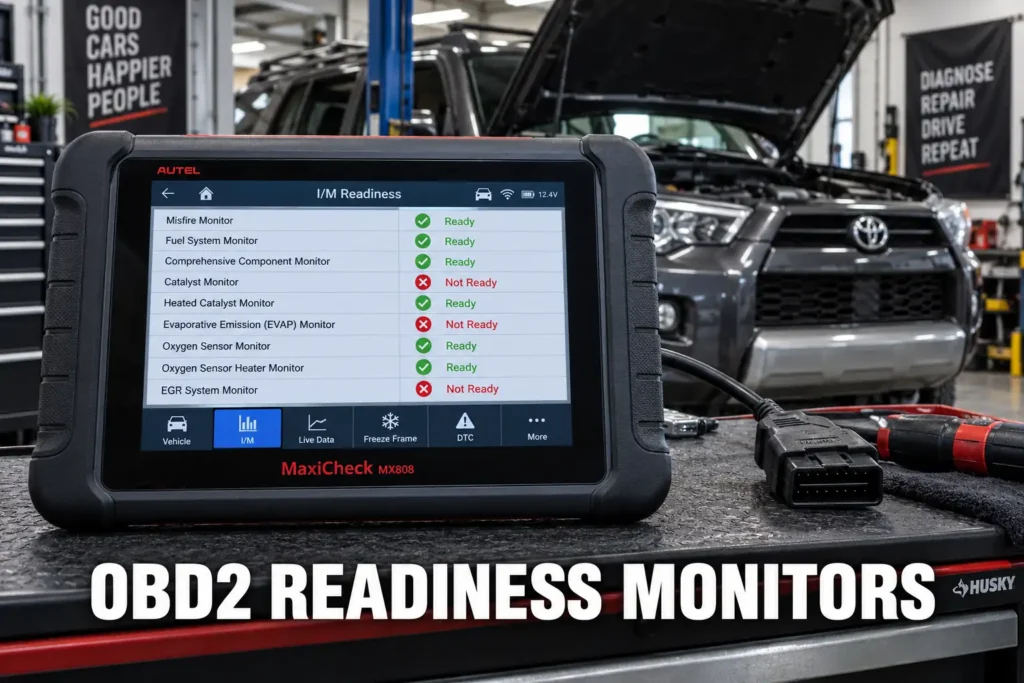
Most drivers encounter OBD2 readiness monitors for the first time at an emissions inspection, not from researching their vehicle. The technician scans the port, looks at a screen, and tells them the vehicle failed because monitors are not ready. The check engine light is off. The car runs fine. It fails anyway. Understanding what readiness monitors are and why they reset prevents that outcome.
My obd2 electric vehicles ev diagnostics covers this step by step.
My obd2 scanner different codes than mechanic covers this step by step.
My beginners guide reading obd2 data covers this step by step.
My wired vs bluetooth obd2 scanner covers this step by step.
My my guide on read live data for misfire diagnosis covers this step by step.
My obd2 diagnostic link connector dlc explained covers this step by step.
My a j2534 pass thru device explained covers this step by step.
My my guide on bleed abs brakes covers this step by step.
My why does check engine light come on after oil change covers this step by step.
My my guide on reset check engine light without a scanner covers this step by step.

About the author: Hello! I’m Kamil Siegień, founder of OBD2 Scout. My diagnostic experience started with an engine rebuild on a 2014 Skoda Superb 1.8 TSI, where tuning from 160 to 222 hp required mastering live data and ECU behavior that basic code readers cannot handle. I am a former BMW and MINI employee and regularly use diagnostic scanners on my own Audi A4 2.0 TFSI.
This guide covers every readiness monitor in the OBD2 system, what each one tests, what the status labels actually mean, why monitors reset after a battery disconnect or code clear, and how to get them completed before an emissions test.
My battery disconnect obd2 codes monitors covers this step by step.
What OBD2 Readiness Monitors Are
OBD2 readiness monitors are self-diagnostic tests the ECU runs automatically during normal driving to verify that each emissions-related system is functioning correctly. Also called I/M readiness monitors, from Inspection and Maintenance, they are required on all OBD2-compliant vehicles sold in the United States from 1996 onward. My guide on what OBD2 is and what the federal mandate covers covers why Congress required the standard, which systems the ECU is required to monitor, and what the 1996 compliance date actually required of every vehicle sold in the US.
Each monitor tests a specific emissions system. The ECU runs the test when the enabling conditions are met during a drive, then records the result: the system passed, the test has not yet run, or the test cannot run under current conditions. Emissions inspectors read these results directly from the OBD2 port. Most modern state inspection programs check both the check engine light status and the monitor readiness status, which means a vehicle with no check engine light can still fail if too many monitors have not completed their tests. My guide on pending, confirmed, and permanent codes covers how each code type interacts with monitor status at inspection and why a vehicle with no active light can still carry a permanent code that triggers a failure.
Continuous vs. Non-Continuous Monitors
OBD2 monitors fall into two categories: continuous and non-continuous. The distinction matters because the two types behave completely differently after a reset.
My my guide on obd2 mode 6 explained use for diagnosis covers this step by step.
Continuous monitors run every time the engine runs. They are always active and do not require specific enabling conditions. A healthy vehicle with no fault in these systems will never show them as incomplete.
Non-continuous monitors only run when specific enabling criteria are met. Each one requires a particular combination of coolant temperature, engine load, vehicle speed, ambient temperature, or other conditions before the test will execute. After a reset, the vehicle must accumulate enough driving under the right conditions for each non-continuous monitor to run and complete. My guide on how to pull and read readiness monitor status with a scanner covers the monitor screen navigation that avoids this specific failure point, how to confirm status before the inspection, and what the status labels mean in practical terms.
| Monitor | Type | What It Tests |
|---|---|---|
| Misfire Monitor | Continuous | Detects misfires that cause emissions or catalyst damage |
| Fuel System Monitor | Continuous | Monitors fuel trim corrections from closed-loop O2 feedback |
| Comprehensive Component Monitor (CCM) | Continuous | Checks sensors and circuits for rationality and continuity |
| Catalyst Efficiency | Non-continuous | Compares upstream and downstream O2 sensor activity to assess converter health |
| Heated Catalyst | Non-continuous | Verifies catalyst warm-up heater function on applicable vehicles |
| EVAP System | Non-continuous | Pressure-tests the fuel vapor containment system for leaks |
| Secondary Air Injection | Non-continuous | Verifies secondary air pump delivers air into the exhaust on cold starts |
| O2 Sensor | Non-continuous | Checks oxygen sensor response time and switching rate |
| O2 Sensor Heater | Non-continuous | Tests the heater circuit that brings the sensor up to operating temperature quickly |
| EGR / VVT System | Non-continuous | Verifies exhaust gas recirculation or variable valve timing operation |
Vehicles sold from 2010 onward with diesel engines also include additional non-continuous monitors: NMHC catalyst, NOx/SCR catalyst, boost pressure, exhaust gas sensor, particulate matter filter, and EGR/VVT. Not every vehicle supports every monitor. If a system does not exist on a specific vehicle, the monitor shows as Not Applicable.
My j1939 heavy duty truck diagnostics obd2 covers this step by step.
My my guide on read map sensor data covers this step by step.
What the Status Labels Mean
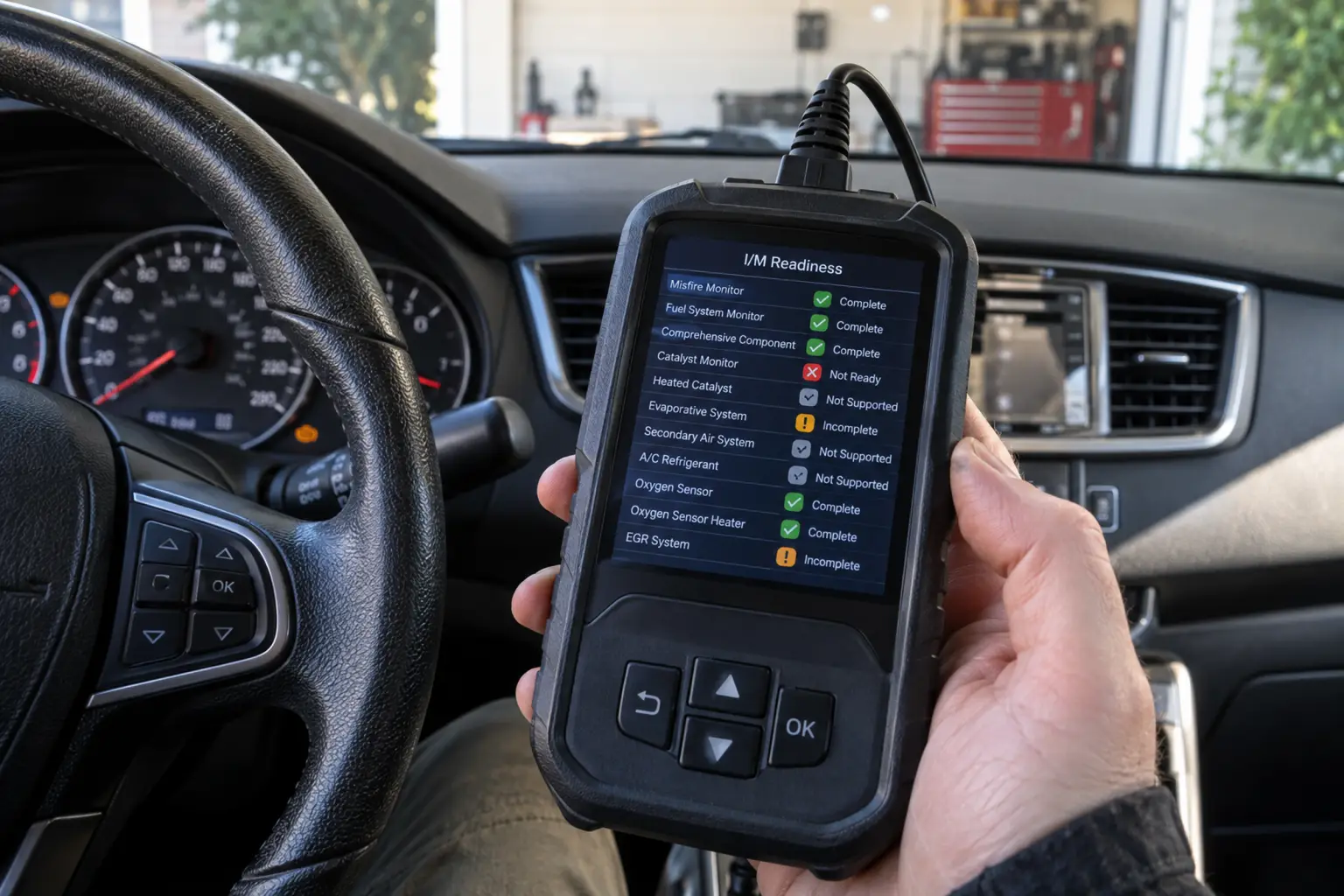
A scanner displays one of four possible statuses for each monitor. Misreading these labels is one of the most common causes of unnecessary concern before an emissions test.
Complete (Ready): The monitor ran and passed. The ECU verified the system is functioning within acceptable limits. My detailed Innova 3100RS review covers how this budget scanner displays the complete/incomplete labels for each monitor and where it sits relative to scanners that show the underlying numerical test results.
Incomplete (Not Ready): The monitor has not yet run, or ran and detected a fault. The system either needs more driving to meet the enabling conditions, or has a genuine problem preventing completion.
Not Applicable (N/A): The vehicle does not have the system that monitor tests. A vehicle without secondary air injection will show N/A for that monitor. This does not count against the inspection.
Disabled: The monitor temporarily cannot run because current conditions make the test impossible or unreliable. Extreme ambient temperature, a fuel level outside the acceptable range for the EVAP test, or other environmental factors can disable a monitor temporarily. A disabled monitor is not the same as an incomplete monitor. It is not a fault, it does not count against the inspection in most state programs, and it does not mean anything is broken. Drivers who see Disabled on a scanner in winter often mistake it for a failure when it is expected behavior.
The Two Events That Reset All Monitors
Two actions erase every readiness monitor simultaneously and set them all back to incomplete. My guide on OBD2 freeze frame data covers what else gets erased in that same action, including the stored snapshot of engine conditions at the moment of the fault, and why recovering that data before clearing is almost always the right sequence.
The first is disconnecting the battery. The ECU stores monitor completion status in keep-alive memory (KAM). Removing battery power erases that memory. Every monitor resets to incomplete. The battery disconnect trap is one of the most common emissions test failures: a driver disconnects the battery to turn off a check engine light, drives to the inspection a day or two later, and fails because every monitor is incomplete. The check engine light may be off, but the monitor status the inspector reads is a clean slate. The same reset pattern appears in used car sales: my guide on how to use an OBD2 scanner on a used car covers how to identify this red flag during a pre-purchase inspection.
The second is clearing codes with a scanner. Pressing the clear or erase function on an OBD2 scanner wipes stored codes, pending codes, freeze frame data, and all monitor completion status in one action. Drivers who clear codes the night before an emissions test hoping to pass with the light off create the identical problem. The monitors reset and the vehicle needs days of driving to complete them again. My guide to the OBD2 drive procedure for monitor completion covers the enabling conditions for each non-continuous monitor and the standard sequence that satisfies most of them in one attempt.
The correct sequence is always: repair the underlying fault, drive to complete the monitors, then test. Clearing codes without repairing the fault accomplishes nothing because the code returns the next time the relevant monitor runs. My guide on how clearing OBD2 codes works covers every consequence of the clear command, including the monitor reset, what else gets deleted alongside the codes, and the only scenario where clearing before diagnosis is the right call.
Monitor Dependencies: The Sequence That Matters
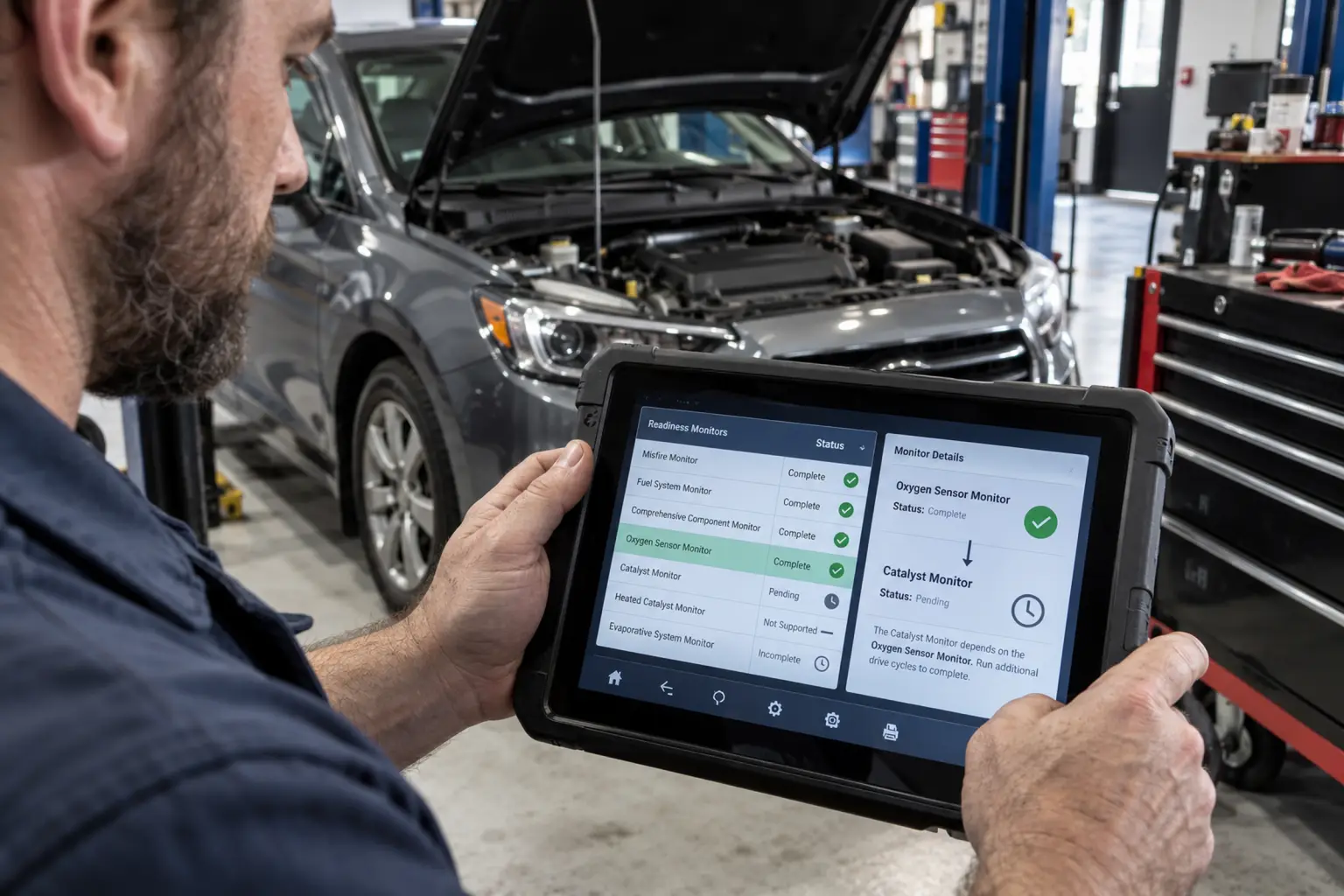
Non-continuous monitors do not complete independently of each other. Some monitors require a different monitor to complete first before they are allowed to run. The most important dependency is between the oxygen sensor monitor and the catalyst efficiency monitor. My guide to multi-system OBD2 scanner options covers the scanners that display monitor dependency sequences clearly and provide live data during the drive, so you can confirm the O2 sensor monitor completes before the catalyst monitor attempts.
The O2 sensor monitor must complete before the catalyst efficiency monitor can run. The catalyst monitor compares the switching activity of the upstream O2 sensor with the downstream sensor to determine converter efficiency. If the O2 sensor monitor has not yet verified that the upstream sensor is responding correctly, the catalyst monitor has no reliable baseline to compare against and will not execute.
This dependency explains one of the most common post-reset frustrations: a driver completes multiple drive cycles, checks the scanner, and finds the catalyst monitor is still incomplete while other monitors have already finished. The reason is usually that the O2 sensor monitor has not completed yet. Checking which monitors are still incomplete on the scanner before driving more identifies whether the vehicle is waiting for a prerequisite or has a genuine system fault blocking completion. My guide on what separates a code reader from a full OBD2 scanner covers why reading I/M readiness status requires a scanner rather than a basic code reader, and what the capability gap means in practice.
The EVAP Monitor: Why It Takes the Longest
The EVAP monitor consistently takes the longest to complete and is the one most likely to show Disabled at any given time. It has more demanding enabling criteria than any other monitor.
For the EVAP monitor to run, all of the following must be true: fuel level must be between approximately one-quarter and three-quarters of a full tank, ambient temperature must be between roughly 30 and 95 degrees Fahrenheit, and the vehicle must have sat with the engine off for at least eight hours before the test drive begins. After the overnight soak, the drive must include a cold start, a period of city driving, and a highway cruise.
The eight-hour soak requirement exists because the EVAP system tests the fuel vapor containment system by pressurizing the fuel tank and checking for leaks. This test relies on a temperature differential between the cold-soak state and the warmed operating state to generate meaningful pressure behavior. Stopping for an hour and restarting does not create the cold-soak conditions the test requires.
If the ambient temperature is below 30 degrees Fahrenheit or above 95 degrees Fahrenheit, the EVAP monitor shows Disabled rather than Incomplete. This is expected and does not count against the inspection in most states. If the fuel tank is overfull or below the quarter-tank threshold, the EVAP monitor will not attempt to run at all. Checking fuel level before a drive cycle attempt is a step most guides skip. My Foxwell NT630 Plus walkthrough covers a mid-range scanner that displays live data alongside monitor status, so you can see in real time whether the EVAP and catalyst monitors are meeting their enabling conditions.
How Many Incomplete Monitors Can You Have and Still Pass
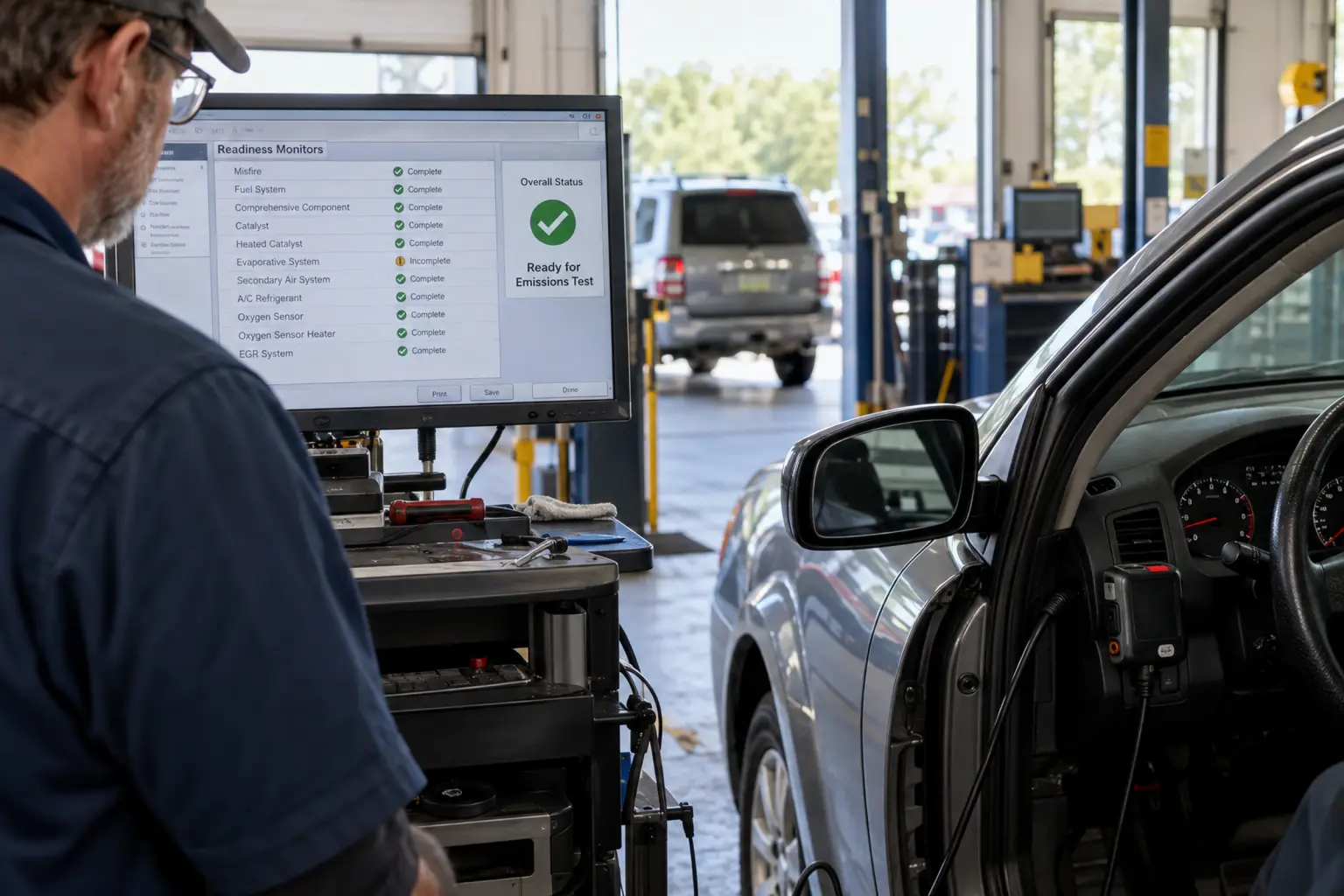
Most states follow EPA guidelines that allow a limited number of incomplete monitors at inspection without failing the vehicle. The exact number depends on the model year and, in some cases, the state.
For 1996 through 2000 model year vehicles, most states allow one incomplete monitor, with the EVAP monitor typically excluded from the count because early EVAP implementations were less reliable. For 2001 and newer vehicles, the typical limit is one incomplete monitor. A small number of states allow two incomplete monitors on 2001 and newer vehicles. The inspector checks the total count of incomplete monitors, not which specific monitor is incomplete. Equinox owners preparing for a state emissions check can find the right scanner for their model in my Chevy Equinox OBD2 scanner comparison.
Checking your state’s specific rules before an emissions appointment takes two minutes and can prevent a wasted trip. Some states publish their exact allowances online. If one monitor is still incomplete after extended driving, knowing the state’s rule tells you whether the appointment is worth making or whether more driving is needed first.
How to Complete Monitors After a Reset
Normal mixed driving over 50 to 100 miles across two to five days is the most reliable path to completing all monitors. A single highway trip will not complete them. A single city loop will not complete them. The different non-continuous monitors each have different enabling conditions, and monotonic driving that never varies load, speed, or temperature will not meet all of them.
A drive pattern that meets most enabling conditions: cold start with the engine fully cold, idle for two to three minutes, city driving at 20 to 40 mph for ten minutes with moderate acceleration and deceleration, highway driving at 55 to 65 mph for ten to fifteen minutes at steady throttle, then a gentle deceleration and brief idle. Repeat across multiple days rather than multiple times on the same day.
For the EVAP monitor: set the fuel level between one-quarter and three-quarters full the night before, let the vehicle sit overnight, and run the drive pattern starting from a cold engine the following morning in ambient temperatures between 30 and 95 degrees Fahrenheit.
The EVAP monitor requires that fuel level range for the overnight soak, which is also why EVAP leak codes are among the few faults where my guide on can you drive with the check engine light on confirms that continuing to drive is safe.
Check monitor status on the scanner after each day of driving rather than waiting until the day of the inspection. That way there is time to continue driving if a monitor is still incomplete, rather than discovering the problem at the testing station. My guide on OBD2 live data covers the parameters most relevant to monitoring enabling conditions during a drive, including oxygen sensor switching, fuel trim, and coolant temperature readings that confirm whether each monitor’s prerequisites are being met.
My guide to professional OBD2 diagnostic tools covers the scanners where manufacturer-specific enabling condition data, Mode 6 test results, and bidirectional access combine to diagnose a monitor that refuses to complete.
How to Check Monitor Status on Your Scanner
Any OBD2 scanner can display readiness monitor status. The menu label varies by brand: I/M Readiness, Monitor Status, Readiness Tests, or similar. Selecting it shows each monitor name alongside its current status. This check takes under a minute. My roundup of reliable budget OBD2 scanners covers the models that display the I/M readiness status screen clearly, including which ones show monitor names rather than just a pass/fail count.
Running this check before making an emissions appointment is the most time-saving step most drivers skip. Two minutes with the scanner in the driveway confirms whether the vehicle is ready before driving to the station. Some states also offer free pre-inspection monitor checks at DMV locations or emissions testing stations where a technician reads the monitors at no charge. My guide on the OBD2 pre-inspection check covers how to replicate that same check at home before the appointment, including what to do when a monitor shows incomplete.
My detailed Autel MaxiSYS Elite II Pro review covers the professional end where Mode 6 numerical test results show exactly how far above or below threshold each monitor’s last measurement landed, not just whether it passed.
The Bottom Line
OBD2 readiness monitors are the ECU’s proof of work. They record whether each emissions system has been tested and verified during actual driving conditions. An inspection that fails on incomplete monitors is not failing because the car has an emissions problem. It is failing because the ECU has not yet finished its verification process after a reset event. My guide on car diagnostics pricing covers what an emissions retest fee and a professional diagnostic appointment cost, and how a scanner helps you avoid both.
The difference between a vehicle that passes and one that fails on monitors usually comes down to three things: knowing what reset the monitors, understanding that normal driving takes several days to complete them, and checking monitor status with a scanner before making the appointment rather than after arriving at the station. One scenario that resets monitors without the driver’s intent is a battery drained by a Bluetooth adapter left in the port: my guide on Bluetooth adapter drain covers which types cause this and how to prevent it.
FAQs
How long does it take for OBD2 readiness monitors to complete after a reset?
Most drivers complete all non-continuous monitors within 50 to 100 miles of mixed driving spread across two to five days. The exact time depends on which monitors reset, what driving conditions the vehicle sees each day, and whether the enabling criteria for each monitor are being met. Short, repetitive commutes on the same route at the same speed are the slowest path because they may only meet the conditions for a few monitors. Varied driving that includes cold starts, city driving, and highway segments completes monitors faster.
Will disconnecting my battery reset my readiness monitors?
Yes. Disconnecting the battery erases the ECU’s keep-alive memory, which is where monitor completion status is stored. Every monitor resets to incomplete when the battery is disconnected, regardless of whether codes were cleared at the same time. This happens even if the battery was disconnected only briefly for other maintenance. After reconnecting, the vehicle needs multiple days of normal driving to complete all monitors before it can pass an emissions inspection.
Why is my catalyst monitor still showing incomplete after days of driving?
The most common reason is that the upstream O2 sensor monitor has not yet completed. The catalyst monitor requires the O2 sensor monitor to finish first because it uses O2 sensor data as the basis for its own comparison. Check which other monitors are still incomplete on the scanner. If the O2 sensor monitor is also incomplete, focus the drive cycle on meeting its enabling conditions first. If the O2 sensor monitor is complete but the catalyst monitor still will not run, the vehicle may have a borderline catalyst that is failing the efficiency test rather than simply not running it yet.
Can I pass an emissions test with one monitor not ready?
In most states, yes. Most state programs following EPA guidelines allow one incomplete monitor on 2001 and newer vehicles without failing the inspection. For 1996 through 2000 vehicles, one incomplete monitor is typically allowed, and the EVAP monitor is often excluded from the count on older vehicles. A small number of states allow two incomplete monitors. Check your state’s specific rules before the appointment. If the EVAP monitor is the only incomplete one and the vehicle is a 1996 to 2000 model year, many states will pass it regardless.
What does “Disabled” mean on a readiness monitor?
Disabled means the monitor temporarily cannot run because current conditions make the test impossible to execute reliably. It is not a fault, not the same as Incomplete, and does not indicate a broken system. Common reasons include ambient temperature outside the acceptable range for that monitor, fuel level outside the required range for the EVAP monitor, or other environmental conditions that prevent the test from producing a valid result. In most state inspection programs, a Disabled monitor does not count against the incomplete monitor allowance. If a monitor shows Disabled consistently and conditions seem right, verify that all enabling criteria for that specific monitor are being met.
Do all states allow the same number of incomplete monitors at inspection?
No. Most states follow EPA guidelines, which allow one incomplete monitor on 2001 and newer vehicles and one on 1996 to 2000 vehicles with EVAP typically excluded. Individual states set their own rules, and some deviate from the EPA baseline. California has stricter requirements than the federal standard. A few states allow two incomplete monitors on newer vehicles. The only reliable way to know your state’s allowance is to check your state motor vehicle or air quality agency website before making an emissions appointment.
Why is the EVAP monitor the hardest to complete?
The EVAP monitor has more enabling criteria than any other monitor. It requires a fuel level between roughly one-quarter and three-quarters of a full tank, an ambient temperature between 30 and 95 degrees Fahrenheit, and an overnight cold soak of at least eight hours before the test drive. Missing any one of these conditions prevents the monitor from running. The overnight soak requirement means extra driving on the same day after a brief stop does not help. The temperature requirement means the EVAP monitor may show Disabled through most of winter in cold climates. Filling the tank above three-quarters also disables it. Of all the monitors, EVAP benefits most from deliberate preparation rather than just driving normally and hoping it completes.