
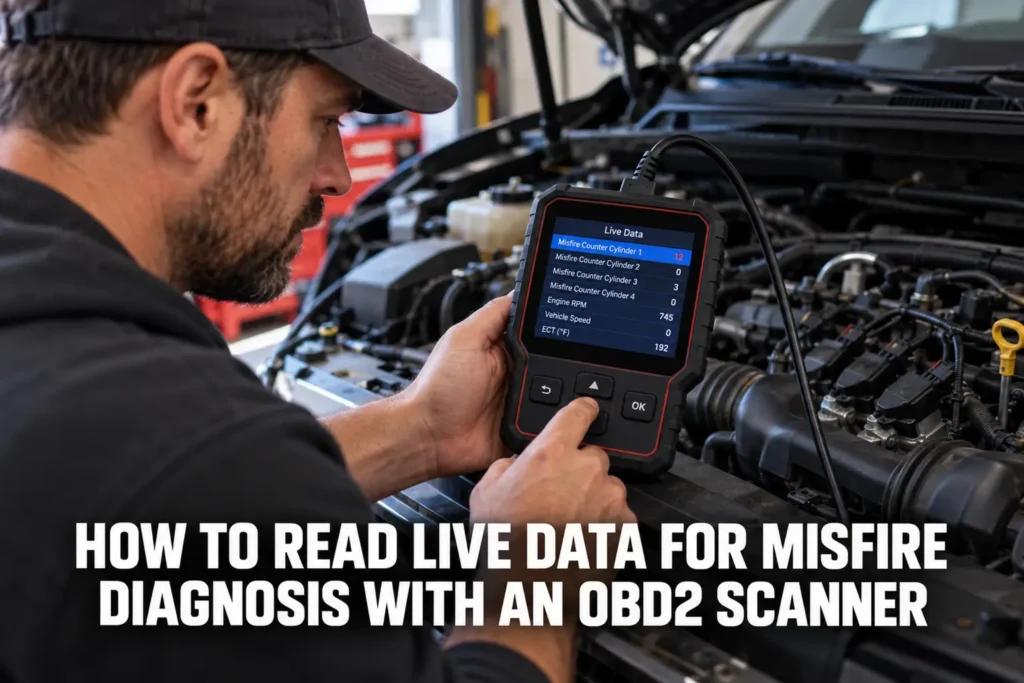
How to Read Live Data for Misfire Diagnosis with an OBD2 Scanner
By Kamil Siegień / October 12, 2026
A misfire DTC tells you that a cylinder fired incorrectly, but the code alone does not explain why. Live data during active misfiring reveals the pattern and context that determines whether the fault is in the ignition system, fuel delivery, compression, or the mechanical condition of the cylinder itself. Reading misfire-specific live data parameters alongside fuel trim, RPM stability, and oxygen sensor data creates a diagnostic picture that narrows the root cause before any disassembly is required. Knowing which parameters to monitor and what their values mean at idle versus under load separates a misfire diagnosis that finds the fault quickly from one that replaces parts in sequence until something works.
Toyota owners looking for the right scanner should check my top Toyota scanner picks.

About the author: Hello! I’m Kamil Siegień, founder of OBD2 Scout. My diagnostic experience started with an engine rebuild on a 2014 Skoda Superb 1.8 TSI, where tuning from 160 to 222 hp required mastering live data and ECU behavior that basic code readers cannot handle. I am a former BMW and MINI employee and regularly use diagnostic scanners on my own Audi A4 2.0 TFSI.
This guide covers which live data parameters matter for misfire diagnosis, how to interpret misfire counters, what fuel trim and O2 data reveal about the misfire cause, how to use RPM graph data to identify firing pattern, how load conditions affect misfire behavior, and how to distinguish ignition from fuel from compression misfires using live data alone.
I explain this in more detail in my can you drive with check engine light on.
For scanner recommendations to perform this type of work, see my top-rated diagnostic tools.
Misfire Counter Data
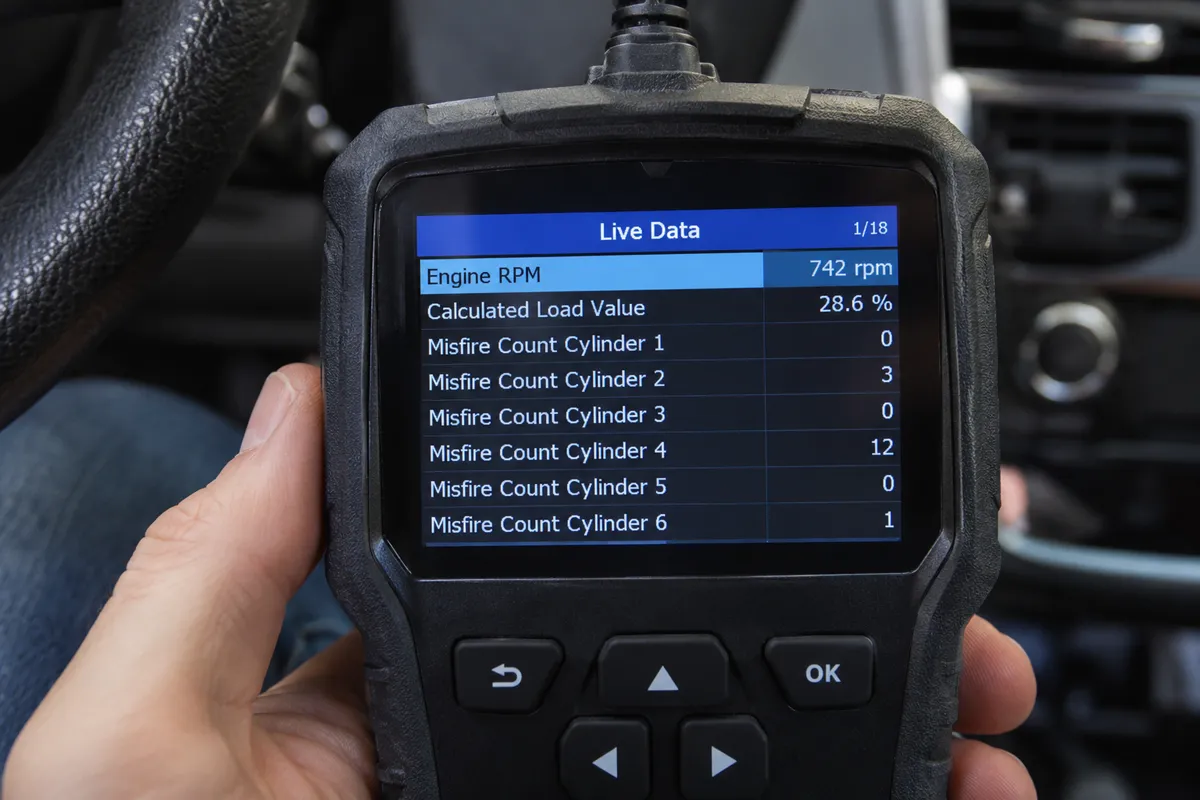
The most direct live data for misfire diagnosis is the misfire counter, typically labeled “Cylinder X Misfire Count” or “Misfire Counter Cylinder X” for each individual cylinder. This parameter shows the cumulative count of misfire events detected by the ECM’s crankshaft-based misfire detection algorithm since the counter was last cleared. A cylinder actively misfiring shows an increasing count. A cylinder that misfired in the past but is currently firing correctly shows a static count that does not change.
I explain this in more detail in my my guide on use an.
If you are on a tight budget, my best value OBD2 scanners covers the top value picks.
Interpreting the counters: a single cylinder with a significantly higher count than all others (cylinder 2 at 45 while cylinders 1, 3, and 4 show zero or near-zero) indicates a cylinder-specific fault. Roughly equal counts across all cylinders suggests a misfire source that affects all cylinders equally (low fuel pressure, a vacuum leak at the intake manifold that affects all runners equally, ignition timing error, low compression on multiple cylinders). A random distribution of counts across different cylinders each time you observe the data suggests an intermittent random misfire without a persistent cylinder-specific cause.
Hyundai owners looking for the right scanner should check my best diagnostic tools for Hyundai.
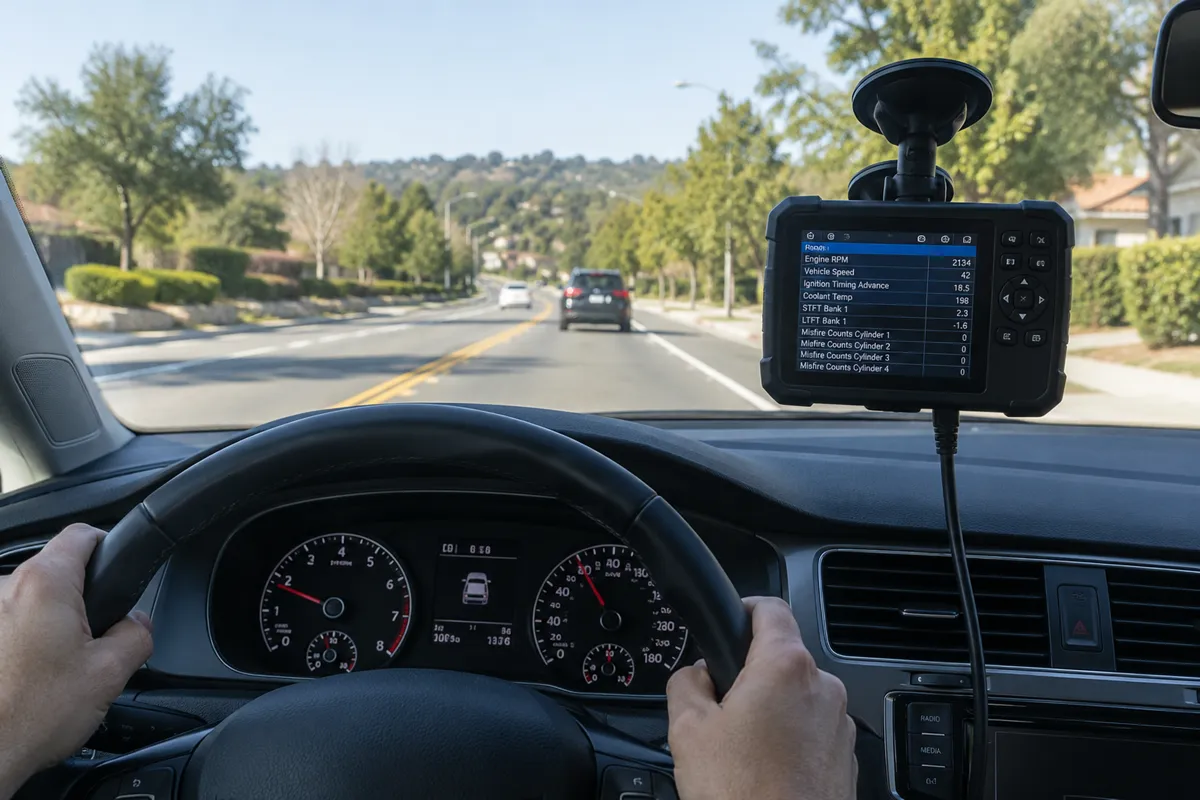
Clear the misfire counters before beginning a diagnostic observation session (clear using the scanner’s reset counter or clear codes function). Then monitor the counters with the engine running at idle for two minutes, then under load (rev to 2,500 to 3,000 RPM with the vehicle in park on an automatic, or drive under mild load). The cylinder accumulating counts most rapidly during these observations is the cylinder to focus investigation on first.
I explain this in more detail in my check engine light on but no codes stored.
For a scanner that handles ABS and SRS diagnostics, check my top ABS-capable scanner picks.
RPM Stability and Misfire Severity
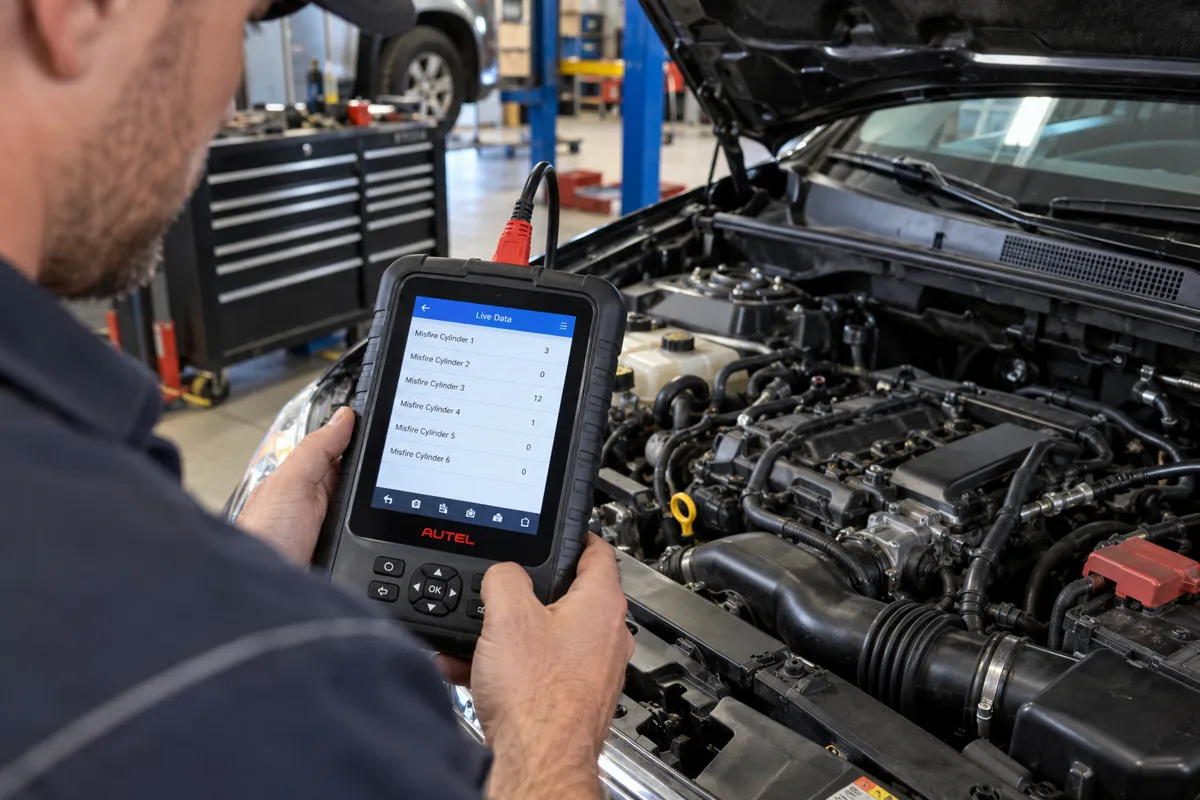
Engine RPM at idle shows the effect of each cylinder firing (or failing to fire) as small oscillations in the RPM value. Each cylinder contributes a combustion event that briefly accelerates the crankshaft. A misfiring cylinder contributes nothing, and the crankshaft decelerates slightly at that combustion event’s position before the next cylinder fires. On a healthy engine, the RPM oscillations at idle are small and regular. On an engine with an active single-cylinder misfire, the RPM trace shows a pattern of slightly larger dips at the frequency corresponding to that cylinder’s firing interval.
Honda CR-V owners can find the right scanner in my best scanners for the CR-V.
The amplitude of the RPM dip correlates with misfire severity. A cylinder that contributes zero combustion energy (complete miss: spark, fuel, and compression all absent or completely failed) produces a larger RPM dip than a cylinder that partially fires (partial combustion from a weak spark or slightly lean mixture). A very severe misfire on a single cylinder may be visible as a rhythmic idle roughness synchronized with each revolution of that cylinder’s firing event.
Ford F-150 owners can find the right scanner in my F-150-compatible diagnostic tools.
Fuel Trim Data During Misfire
Fuel trim values during misfire reveal whether the misfire is fuel-related. Short-term fuel trim (STFT) responds to real-time mixture feedback from the upstream oxygen sensor. When a cylinder misfires from a fuel delivery problem (clogged injector, low fuel pressure for that cylinder’s injector), unburned oxygen passes through that cylinder into the exhaust. The O2 sensor reads this as a lean mixture and the ECM adds fuel (positive STFT). If the misfire is ignition-based (spark plug or coil failure), fuel passes through unburned as well, but the effect on the O2 sensor also shows lean due to the unburned fuel not contributing to the heated electrode’s signal in the same way.
My my guide on stft vs ltft read fuel trims covers this step by step.
Audi Q8 owners can find the right scanner in my best scanners for the Q8.
A useful correlation: a misfire from a clogged or failed injector produces a lean fuel trim response. A misfire from a failed ignition component (no spark but fuel delivered) produces an initially lean response but may be accompanied by a fuel-rich sensor signal from the raw hydrocarbon in the exhaust as the catalyst receives unburned fuel. High LTFT (long-term fuel trim) with a persistent single-cylinder misfire count suggests the lean condition has been occurring long enough to accumulate in the long-term trim correction.
For a scanner with active test capability, see my top bidirectional scanner picks.
Oxygen Sensor Response During Misfire
The upstream O2 sensor (before the catalyst) responds to the overall mixture from all cylinders combined on its bank. A single-cylinder misfire on a 4-cylinder engine means one of four cylinders is misfiring: the lean signal from the misfiring cylinder combined with normal signals from the other three produces a moderately lean average O2 reading. The sensor voltage drops from its normal rich-lean switching pattern toward a more consistently low voltage (lean signal). This is not specific enough on its own to identify which cylinder is misfiring, but it confirms that the misfire is producing a lean condition in the exhaust, consistent with either an ignition or injection failure.
I cover this capability in more detail in my BlueDriver Pro deep dive.
On a V6 or V8 engine with two banks, a single-cylinder misfire affects only the O2 sensor on the bank where that cylinder is located. Observing which bank’s O2 sensor shows the lean response confirms which bank contains the misfiring cylinder, which combined with the individual misfire counter confirms the specific cylinder.
Audi owners looking for the right scanner should check my top Audi scanner picks.
Distinguishing Ignition, Fuel, and Compression Misfires with Live Data
Live data patterns that suggest ignition system misfire: the misfire counter is consistent for one cylinder, the O2 sensor shows lean, fuel trims are slightly positive, and the misfire worsens at cold start and improves slightly after full warm-up (ignition system faults often worsen when cold due to higher required ignition voltage). Swapping the spark plug and coil from the misfiring cylinder to a confirmed good cylinder and observing whether the misfire counter follows the coil/plug to the new cylinder confirms an ignition system fault.
My my guide on diagnose misfires covers this step by step.
Honda owners looking for the right scanner should check my top Honda scanner picks.
Live data patterns that suggest fuel delivery misfire: the misfire counter is consistent for one cylinder, fuel trims are significantly positive (lean), and a balance injection test (active test available on scanners with bidirectional capability) shows the misfiring cylinder contributes less RPM drop when deactivated than expected, or no RPM drop at all, indicating it was already contributing nothing. Injector circuit voltage tests and a fuel pressure reading at the rail complement this diagnosis.
My a bidirectional obd2 scanner explained covers this step by step.
BMW owners looking for the right scanner should check my top BMW scanner picks.
Live data patterns that suggest compression or mechanical misfire: the misfire counter is consistent for one cylinder, fuel trims are near normal (the cylinder is not contributing to the lean signal because both fuel and fresh air are escaping through a leaking valve), and the misfire occurs at all engine loads and temperatures without significant variation. A dry compression test confirming low pressure in the suspect cylinder, followed by a wet compression test (oil added to the cylinder bore), distinguishes ring wear from valve leakage.
Ford owners looking for the right scanner should check my best diagnostic tools for Ford.
Enhanced Misfire PIDs Beyond Standard Counters
Scanners with enhanced coverage for specific makes expose misfire-related parameters beyond the standard OBD2 misfire counters. Particularly useful enhanced parameters include individual cylinder contribution (labeled as “Cylinder X Contribution” or “Cylinder X Torque Contribution” on some platforms): this value shows what percentage of the engine’s total torque output each cylinder is contributing relative to the expected contribution. A healthy cylinder at idle should contribute approximately 100 percent of its expected share. A misfiring cylinder shows a low contribution value: 50 to 70 percent indicates partial misfiring, near zero indicates a complete non-contributing cylinder.
Chevy owners looking for the right scanner should check my top Chevy scanner picks.
Crankshaft acceleration data is another enhanced parameter available on platforms that use crankshaft position sensor analysis for misfire detection. The crankshaft acceleration PID shows the change in crankshaft angular velocity immediately after each cylinder’s combustion event. A firing cylinder accelerates the crankshaft measurably. A misfiring cylinder shows no acceleration or even a slight deceleration due to compression work without a compensating combustion stroke. Comparing the crankshaft acceleration values across all cylinders over multiple engine cycles identifies the consistently low-contribution cylinder with more precision than a cumulative counter, particularly for misfires that occur intermittently rather than on every cycle.
I cover this capability in more detail in my NT726 deep dive.
On GM vehicles, the “Cylinder X Balance Rate” PID in the PCM’s enhanced data section provides a direct measure of how much the ECM is adjusting that cylinder’s injector pulse width to achieve even idle balance. A cylinder with a mechanical fault (worn rings, burnt valve) shows a high positive balance rate: the ECM is adding fuel to that cylinder to compensate for its low contribution, which distinguishes a mechanical misfire from an ignition misfire where the ECM typically cannot easily compensate through fueling changes alone.
I explain this in more detail in my how to diagnose misfires with obd2 scanner.
FAQs
Which misfire codes are stored for a single misfiring cylinder?
The ECM stores a cylinder-specific misfire DTC: P0301 for cylinder 1, P0302 for cylinder 2, P0303 for cylinder 3, P0304 for cylinder 4, and so on through P030X where X is the cylinder number. If the misfire is random across multiple cylinders, P0300 (random misfire) is stored. If the misfire reaches a rate that could damage the catalyst (a high-frequency continuous misfire), the catalyst protection threshold DTC may be stored alongside the cylinder-specific code, and the ECM may disable the fuel injector on the misfiring cylinder to prevent unburned fuel from reaching the catalyst.
Why does my misfire only occur at highway speed under load?
Load-dependent misfires that do not occur at idle are typically compression or fuel pressure related. At idle, the cylinder pressure and combustion requirements are low enough that a marginally low-compression cylinder or a marginally low-fuel-pressure condition does not prevent combustion. At high load (wide-open throttle, climbing a grade, maintaining highway speed with AC on), the combustion requirements increase: a cylinder that compresses adequately at idle no longer produces sufficient pressure for complete combustion at high load. Fuel injector faults that produce inadequate flow at high duty cycles also present as load-dependent misfires. Road-test the vehicle on the scanner during the conditions that produce the misfire to capture live data at the moment it occurs.
Can I diagnose a misfire without a bidirectional scanner?
Yes. Misfire counters and fuel trim data are available through standard OBD2 Mode 01 PIDs on any scanner. You do not need bidirectional capability to read misfire counts, fuel trims, O2 sensor voltage, RPM, and coolant temperature. The bidirectional balance test (deactivating individual injectors or cylinders to identify the misfiring cylinder by observing RPM changes) is more convenient with a scanner that supports it, but the passive live data approach of monitoring misfire counters while driving provides the same cylinder identification through observation rather than active testing.
My misfire DTC came back after I replaced the spark plug. What else should I check?
If the misfire counter is still accumulating on the same cylinder after a spark plug replacement, the ignition coil on that cylinder is the next component to test or swap. Coil-on-plug ignition failures are a common cause of persistent single-cylinder misfires: the coil’s primary or secondary winding degrades to the point where it produces insufficient spark energy, particularly at cold temperatures or under high load. Swapping the coil to a known-good cylinder is the fastest way to confirm: if the misfire counter follows the coil to the new cylinder position, the coil is the fault. If the counter stays on the original cylinder after the coil swap, investigate the injector circuit or cylinder compression.