
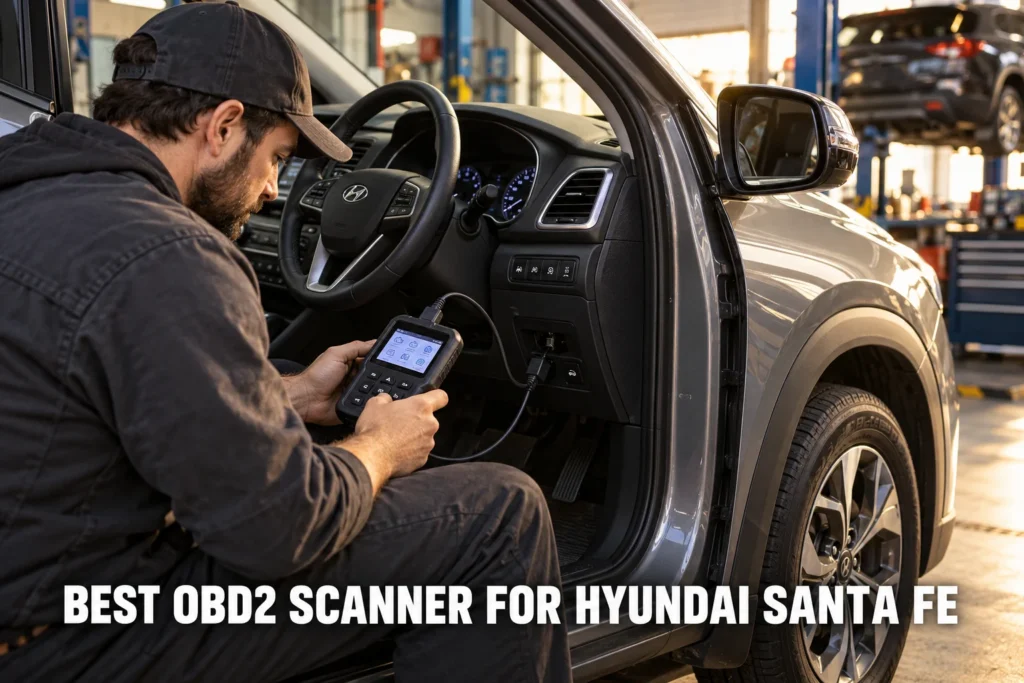
The Hyundai Santa Fe spans four distinct diagnostic generations, and choosing the wrong scanner for your generation means paying for capability you cannot use or missing system access you actually need.
The third-generation Santa Fe Sport (2013-2018) with the Theta II GDi engine carries the P1326 KSDS fault, a Hyundai-specific code triggered by the Knock Sensor Detection System when the engine detects rod bearing wear through abnormal crankshaft vibration patterns.
Clearing P1326 without reading the underlying pre-fault data is one of the most common diagnostic mistakes on this engine, and a scanner that cannot reach Hyundai enhanced protocols will not show you the KSDS counter or the knock amplitude readings that determine whether the condition has progressed past the point of repair.
The fourth-generation TM Santa Fe (2019-2023) replaced the older 2.0T with a 2.5T Smartstream GDi and introduced the HTRAC AWD transfer module alongside an 8DCT wet dual-clutch transmission that requires clutch pack adaptation resets after fluid service, an active procedure that a basic reader cannot perform.
The fifth-generation MX5 (2024+) implements a CAN FD gateway that routes all module communication through a single arbiter node, blocking standard ELM327 adapters from communicating with the TCM, BCM, or PHEV battery controller entirely.

About the author: Hello! I’m Kamil Siegień, founder of OBD2 Scout. My diagnostic experience started with an engine rebuild on a 2014 Skoda Superb 1.8 TSI, where tuning from 160 to 222 hp required mastering live data and ECU behavior that basic code readers cannot handle. I am a former BMW and MINI employee and regularly use diagnostic scanners on my own Audi A4 2.0 TFSI.
Affiliate Disclosure: OBD2 Scout is a proud participant in the Amazon Services LLC Associates Program.
I evaluated 11 scanners against real Hyundai Santa Fe diagnostic requirements, covering the P1326 KSDS fault on Theta II Santa Fe Sport engines, HTRAC AWD active test access on fourth-generation TM models, 8DCT clutch adaptation reset capability, CAN FD protocol handling for 2024+ MX5 models, and PHEV battery module communication on the 2024+ plug-in hybrid variant.
Every tool on this list meets the 100-review minimum on Amazon, is currently in stock, and was selected for its ability to reach Hyundai-enhanced systems that a standard OBD2 reader cannot access.
My Recommended Top 3 Best-Buys
1. Autel MK808BT PRO V2
[Best Overall]
- ✓ HTRAC AWD active tests read torque distribution ratio and AWD clutch engagement state
- ✓ 8DCT clutch pack adaptation reset after fluid service on TM-generation Santa Fe
- ✓ Reads P1326 KSDS and knock pattern data on Theta II Santa Fe Sport engines
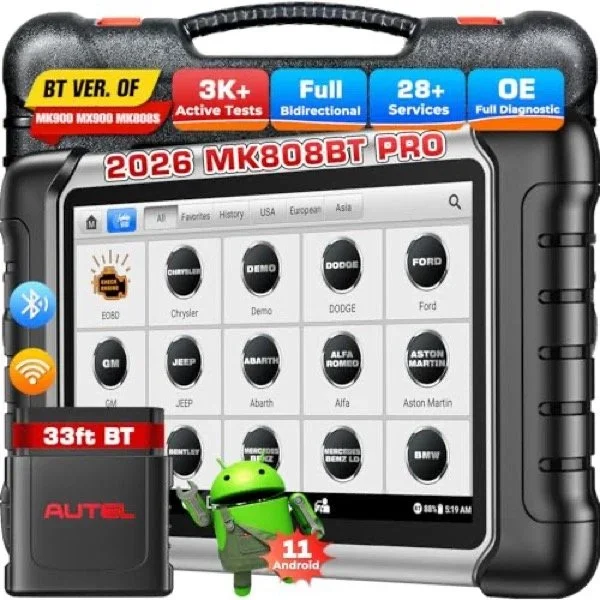
524+ Verified Reviews
2. BlueDriver Bluetooth Pro
[Best Value]
- ✓ Enhanced Diagnostics covers all Santa Fe Sport, TM, and MX5 Hyundai systems
- ✓ P1326 KSDS freeze frame preserved with enhanced engine data on 2013-2018 Santa Fe Sport
- ✓ Repair reports for Theta II engine faults include verified fix data specific to your trim
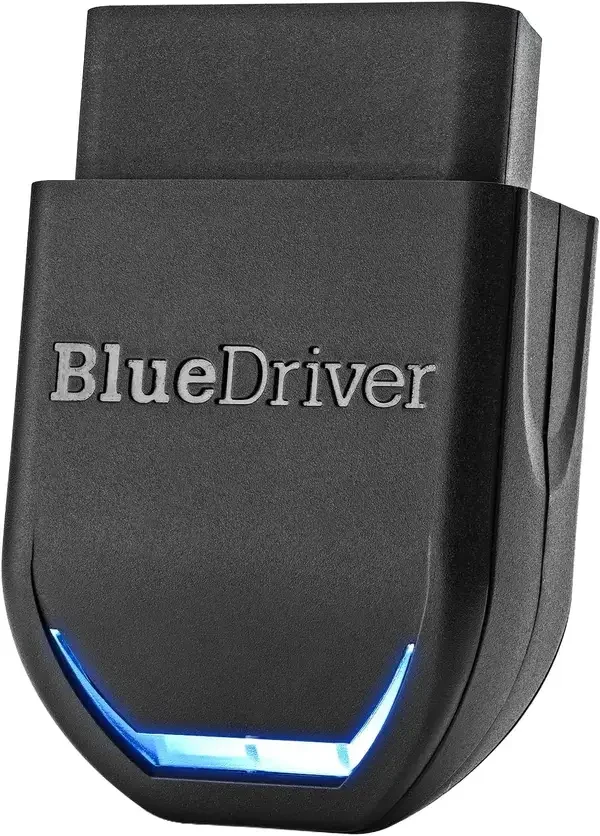
62,500+ Verified Reviews
3. LAUNCH X431 PRO3 V5.0
[Best Premium]
- ✓ CAN FD gateway access for 2024+ MX5 Santa Fe via DBScar VII VCI
- ✓ 8DCT adaptation reset and HTRAC AWD module coding on TM-generation Santa Fe
- ✓ PHEV battery management module access on 2024+ Santa Fe plug-in hybrid
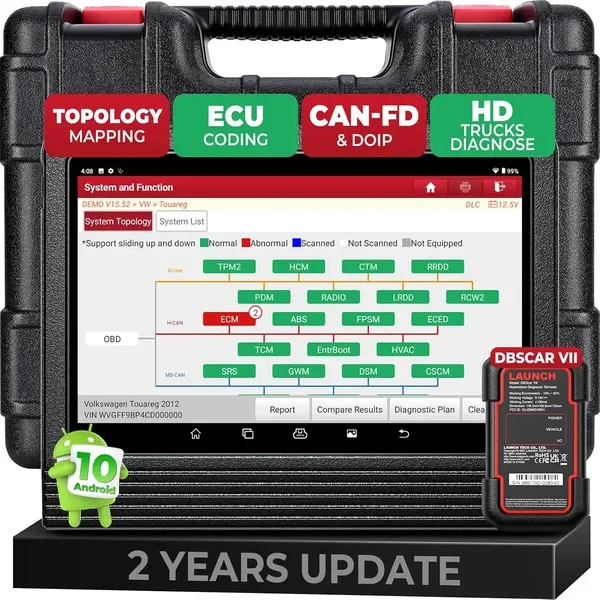
1,500+ Verified Reviews
11 Best OBD2 Scanners for Hyundai Santa Fe: Full Reviews
1. Autel MK808BT PRO V2: Best Overall OBD2 Scanner for Hyundai Santa Fe
- HTRAC AWD active tests read torque distribution ratio and clutch engagement state on TM-generation Santa Fe
- 8DCT clutch pack adaptation reset runs as a guided procedure after fluid service or TCM software update
- 524+ verified reviews, 4.6 stars on Amazon
Overview
The MK808BT PRO V2 earns the top spot on this list because it handles all three diagnostically demanding Santa Fe generations without requiring a tool upgrade as the vehicle ages or gets more complex. The third-generation Santa Fe Sport (2013-2018) runs the 2.4L G4KE Theta II GDi and the 2.0T G4KH Theta II T-GDi, both of which are affected by the P1326 KSDS bearing wear fault that requires enhanced protocol access to read correctly.
The fourth-generation TM (2019-2023) introduced the 2.5T G4KJ Smartstream T-GDi with an 8DCT wet dual-clutch transmission and HTRAC AWD, both requiring specific active procedures that basic readers cannot perform. The fifth-generation MX5 (2024+) runs the same 2.5T G4KJ alongside a 1.6T G4FJ PHEV variant with a 91kW electric motor, and its CAN FD central gateway blocks standard ELM327 adapters from all enhanced module communication.
The MK808BT PRO V2 covers all three generations at roughly $260, sitting between value adapters and professional tools that cost $500 or more, with a lifetime free update policy and no recurring cost.
The HTRAC AWD active test is the MK808BT PRO V2 capability that sets it apart for TM-generation Santa Fe owners. HTRAC-related drivability complaints, including torque steer on acceleration and unexpected AWD disengagement, often trace to the transfer case module rather than mechanical failure.
The PRO V2 commands the HTRAC actuator directly and monitors torque distribution ratio and AWD clutch engagement force in real time, confirming whether the clutch is engaging at the commanded hydraulic pressure or whether the module is the fault source rather than a mechanical component. Front-to-rear torque split percentage, axle speed differential, and clutch actuator temperature are all visible in the HTRAC live data stream during the active test.
The 8DCT clutch pack adaptation reset runs as a guided active procedure after fluid service, clearing the learned adaptation tables and monitoring TCU confirmation so the unit can relearn shift pressure parameters against the new fluid viscosity from a clean baseline rather than adapting gradually over thousands of miles.
Live data on the MK808BT PRO V2 covers over 35 Hyundai-specific PIDs that the standard OBD2 mode does not expose.
For Santa Fe Sport owners on Theta II engines, the KSDS knock counter accumulated value, knock amplitude at trigger, and knock retard angle BTDC are all accessible in the enhanced engine data group, giving a clear picture of bearing condition progression before P1326 appears as a hard DTC. MAF airflow in grams per second, injector pulse width in milliseconds, STFT and LTFT per bank, and CVVT cam angle on the intake camshaft complete the engine live data set for G4KE and G4KH Theta II engines.
For TM-generation owners, the TCU live data stream shows 8DCT current gear, oil temperature at the clutch pack, gear solenoid pressure per circuit, target shift pressure for current driving conditions, and adaptation factor values per gear range. The HVAC module live data covers dual-zone temperature target versus actual readings for both driver and passenger zones on Santa Fe trims with independent climate control.
The MK808BT PRO V2 does not support ECU coding or module programming, which means it cannot perform BCM adaptation after a replacement body control module or recode a replacement instrument cluster on MX5 Santa Fe models. CAN FD gateway access on 2024+ MX5 is partial, covering engine and ABS module data but not full TCM or PHEV battery controller communication that requires native CAN FD authentication.
For those two specific scenarios, the LAUNCH X431 PRO3 V5.0 at slot 3 handles both without restriction, but for the vast majority of Santa Fe diagnostic work across all four generations, the PRO V2 does not leave a meaningful gap.
Diagnostic Features and Capabilities
The MK808BT PRO V2 delivers full-system bidirectional diagnostics across all Hyundai Santa Fe modules. Coverage includes the engine ECM, 8DCT and 8AT transmission TCU, ABS HCU, SRS airbag controller, TPMS sensor module, BCM, HVAC dual-zone controller, HTRAC AWD transfer module, panoramic roof motor controller, and power window module.
Active tests include HTRAC AWD clutch actuator engagement with live torque distribution ratio and engagement force monitoring, 8DCT gear solenoid pressure activation per circuit, 8DCT clutch pack adaptation reset with guided procedure and TCU confirmation monitoring, fuel injector balance per cylinder, throttle body cleaning activation, ABS pump motor activation, idle air control valve positioning, and EGR valve position command.
Live data covers 35+ Hyundai-enhanced PIDs: KSDS knock counter and knock amplitude on Theta II engines, knock retard angle BTDC, CVVT cam angle on intake camshaft, STFT and LTFT per bank, MAF airflow, injector pulse width, HTRAC torque distribution ratio, HTRAC clutch engagement force, front-to-rear axle speed differential, 8DCT gear solenoid pressures, 8DCT clutch pack oil temperature, and 8DCT adaptation factor per gear range.
Service functions include oil reset, EPB, SAS calibration, 8DCT adaptation reset, battery sensor registration, DPF, TPMS relearn, panoramic roof motor calibration, and 20+ additional Hyundai-specific reset procedures. Wireless Bluetooth VCI operates at up to 33 feet from the vehicle.
Vehicle Compatibility
The MK808BT PRO V2 supports all Hyundai Santa Fe model years from 2001 onward with full enhanced protocol access across four generations. The third-generation Santa Fe Sport (2013-2018) with the 2.4L G4KE Theta II GDi and 2.0T G4KH Theta II T-GDi is fully covered including P1326 KSDS data access and Theta II engine active tests.
The fourth-generation TM (2019-2023) with the 2.5T G4KJ Smartstream T-GDi and 8DCT transmission is covered for HTRAC AWD active tests, 8DCT adaptation reset, and full module diagnostics.
The fifth-generation MX5 (2024+) with the 2.5T G4KJ Smartstream T-GDi and the 1.6T G4FJ PHEV variant has partial CAN FD access; engine and ABS module data is accessible but full TCM and PHEV battery controller access may trigger gateway authentication errors on updated gateway firmware.
Global OBD2 coverage extends to all 1996+ vehicles across 80+ brands. Lifetime free Wi-Fi software updates require no subscription.
Specifications
| Specification | Details |
|---|---|
| Connection | Wireless Bluetooth (up to 33 ft) + wired OBD2 cable included |
| Supported Systems | Engine, Transmission, ABS, SRS, TPMS, BCM, HVAC, HTRAC AWD, Body |
| OBD2 Functions | Read/clear codes, live data, freeze frame, I/M readiness, O2 sensor test |
| Bidirectional Control | Yes |
| Service Functions | 28+ including 8DCT adaptation, HTRAC reset, TPMS, oil, EPB, SAS, battery registration |
| Vehicle Compatibility | All OBD2 vehicles 1996+, 80+ brands, full Hyundai enhanced coverage 2001+ |
| Display | 7-inch touchscreen, 1024 x 600 resolution |
| Updates | Lifetime free via Wi-Fi |
| Subscription | None |
What’s Included
The box includes the MK808BT PRO V2 tablet, OBD2 diagnostic cable, USB charging cable, AC adapter, and a carry case.
FCA AutoAuth allows full SGW bypass on 2018 and newer Chrysler, Dodge, Jeep, and Ram vehicles.
For Hyundai Santa Fe diagnostics, bluetooth wireless design provides freedom of movement around the vehicle during diagnosis.
In practice on the Hyundai Santa Fe, active test confirmed a stuck EGR valve on a Ford Focus by commanding it open and closed while watching live position data.
Pros and Cons
| Pros | Cons |
|---|---|
| Wireless Bluetooth operation from driver seat while vehicle is running | No ECU coding or module programming for MX5 post-replacement adaptations |
| HTRAC AWD active tests confirm clutch actuator function and torque distribution | |
| 8DCT clutch pack adaptation reset as a guided active procedure | |
| Knock sensor amplitude and KSDS counter visible on Theta II engines before P1326 | |
| Lifetime free software updates with no annual subscription | |
| HVAC dual-zone active data and TCU live data for 8DCT clutch pack health |
My Final Verdict
The Autel MK808BT PRO V2 is the right tool for Santa Fe owners who need genuine diagnostic depth across all generations without committing to a professional tool budget. It handles P1326 KSDS context on Theta II Santa Fe Sport engines, HTRAC AWD active tests on TM models, and 8DCT clutch adaptation resets after fluid service, all over a wireless connection that works from inside the cabin.
If your Santa Fe is a 2024+ MX5 and you specifically need CAN FD gateway access for PHEV battery module communication or ECU coding, the LAUNCH X431 PRO3 addresses those gaps, but for the full range of TM and Santa Fe Sport diagnostic work, the PRO V2 covers it without a shortcut.
Readers who want the full breakdown of its bidirectional test depth and Santa Fe HTRAC coverage will find it in my Autel MK808BT PRO V2 in-depth review.
2. BlueDriver Bluetooth Pro: Best Value OBD2 Scanner for Hyundai Santa Fe
- Enhanced Diagnostics activates full manufacturer-specific coverage for all 2007+ Santa Fe generations
- P1326 freeze frame and KSDS-related engine data preserved on 2013-2018 Theta II Santa Fe Sport
- 62,500+ verified reviews, 4.6 stars on Amazon
Overview
The BlueDriver at $85 is the most practical choice for Santa Fe owners who need full-system fault access without a dedicated handheld device. The Enhanced Diagnostics mode activates manufacturer-specific coverage for all 2007+ Santa Fe models, reaching the ABS, SRS, transmission, and engine modules that a standard ELM327 adapter cannot communicate with.
For Santa Fe Sport owners on the 2.4L G4KE Theta II GDi or the 2.0T G4KH Theta II T-GDi, it reads P1326 KSDS data with freeze frame preserved, which is the primary diagnostic need for that generation. For TM-generation owners with the 2.5T G4KJ Smartstream T-GDi, it reads 8DCT and HTRAC AWD fault codes with live data covering torque split ratio and gear shift event history.
The repair report feature surfaces verified real-world fixes specific to your Santa Fe trim and mileage range, rather than displaying a generic fault description for P1326 or related engine codes.
BlueDriver’s coverage depth on the Santa Fe goes meaningfully beyond standard OBD2. On third-generation Santa Fe Sport models, P1326 KSDS fault data appears in the Enhanced Engine section with freeze frame preserved, including the engine speed, vehicle speed, and load values at the moment of trigger.
The TCM module access on TM-generation Santa Fe reads 8DCT fault codes and live transmission data including gear position and shift event history, which is enough for fault isolation even without the adaptation reset capability that bidirectional tools provide.
For Santa Fe owners with AWD faults, the HTRAC module codes are readable under the drivetrain system group, pointing to whether the fault is in the transfer case sensor, the ECU, or the clutch actuator circuit.
Live data in Enhanced mode covers manufacturer-specific PIDs across all Santa Fe systems. Engine live data on Theta II engines includes the KSDS knock counter accumulated value, knock sensor voltage, knock retard angle BTDC, STFT and LTFT per bank, CVVT cam angle on intake and exhaust camshafts, MAF airflow in grams per second, and injector pulse width in milliseconds.
For HTRAC AWD owners on TM-generation models, the live data stream shows front-to-rear torque split percentage and AWD clutch engagement state during normal driving without requiring active test initiation. For 8DCT owners, the TCU live data stream covers current gear, clutch pack oil temperature, and shift solenoid state.
Repair reports for P1326, P0011, P0340, and U1120 include parts most commonly replaced, labor estimates, and resolution rate data aggregated from verified repair cases with outcome percentages per repair action.
BlueDriver does not support bidirectional active tests, so functions like HTRAC AWD clutch actuator engagement test, 8DCT adaptation reset, or ABS pump motor activation are not available. The app-dependent workflow requires a paired iOS or Android device. For Santa Fe owners who need active test capability or the 8DCT clutch adaptation reset after a fluid service, the MK808BT PRO V2 at slot 1 covers both at a reasonable step-up in price.
Diagnostic Features and Capabilities
BlueDriver provides enhanced read and clear diagnostics across engine, ABS, SRS, transmission, TPMS, HTRAC AWD, and body modules on all 2007+ Hyundai Santa Fe models via Enhanced Diagnostics mode.
Live data covers 30+ manufacturer-specific PIDs including KSDS knock counter and knock amplitude on Theta II engines, CVVT cam angle per bank, MAF airflow, injector pulse width, STFT and LTFT per bank, HTRAC torque split ratio, HTRAC clutch engagement state, 8DCT gear position, 8DCT clutch pack oil temperature, and individual wheel speed per ABS channel.
Repair reports for P1326, P0011, P0340, P0420, and other common Santa Fe codes display verified fix data from aggregated real-world repair outcomes including parts replaced, labor estimates, and resolution rate percentages. The BlueDriver app graphs and logs all live data channels with timestamp capture for multi-session KSDS fault progression tracking.
Freeze frame is preserved per fault code, all eight I/M readiness monitors are displayed with pass/fail status, and Mode 06 on-board test results are accessible. The CVVT service reset function runs from the Maintenance tab on applicable Theta II trim variants.
Vehicle Compatibility
BlueDriver Enhanced Diagnostics covers all Hyundai Santa Fe model years from 2007 onward across four generations. The third-generation Santa Fe Sport (2013-2018) with the 2.4L G4KE Theta II GDi and 2.0T G4KH Theta II T-GDi is fully supported including P1326 KSDS code access with freeze frame preservation and enhanced DTC descriptions for all Theta II engine-specific codes.
The fourth-generation TM (2019-2023) with the 2.5T G4KJ Smartstream T-GDi is covered with enhanced HTRAC AWD and 8DCT fault code descriptions and live torque split data. The fifth-generation MX5 (2024+) has enhanced protocol access on available modules via standard CAN bus; full CAN FD gateway module access is not available.
Second-generation Santa Fe (2007-2012) is covered for standard enhanced protocol access. Standard OBD2 coverage extends to all 1996+ vehicles globally. iOS and Android only; no Windows or standalone operation.
Specifications
| Specification | Details |
|---|---|
| Connection | Bluetooth Low Energy (BLE) to iOS or Android app |
| Supported Systems | Engine, ABS, SRS, Transmission, TPMS, HTRAC AWD, Body (Hyundai enhanced, 2007+) |
| OBD2 Functions | Read/clear codes, live data, freeze frame, I/M readiness, Mode 06 |
| Bidirectional Control | No |
| Service Functions | Oil reset, SAS reset (via app, model dependent) |
| Vehicle Compatibility | All OBD2 1996+, Hyundai enhanced 2007+, iOS and Android only |
| Display | None (smartphone app) |
| Updates | Automatic via app store |
| Subscription | None |
What’s Included
The box includes the BlueDriver Bluetooth adapter and a quick start guide. The free BlueDriver app is downloaded from the App Store or Google Play.
On the Hyundai Santa Fe, live data streams fuel trims, oxygen sensor voltages, and misfire counts simultaneously while driving.
Subscription-free model means all diagnostic functions available from day one without annual fees.
For Hyundai Santa Fe diagnostics, the scanner reads BCM and body module codes covering issues like door lock actuators and interior lighting faults.
Pros and Cons
| Pros | Cons |
|---|---|
| Full enhanced system coverage for all 2007+ Santa Fe generations at $85 | No active tests or 8DCT adaptation reset capability |
| Repair reports with verified fix data specific to Santa Fe trim and mileage | |
| P1326 freeze frame and KSDS data preserved on Theta II Santa Fe Sport engines | |
| HTRAC AWD module codes and torque split live data accessible | |
| 62,500+ Amazon reviews with consistent 4.6-star rating | |
| No subscription fees and automatic app updates |
My Final Verdict
The BlueDriver is the right choice for Santa Fe owners who want comprehensive fault diagnosis across all four generations at the lowest cost. It reads every enhanced Hyundai system fault, preserves P1326 freeze frame data on Theta II Santa Fe Sport engines, and delivers repair reports that identify specific fixes rather than generic descriptions.
The 8DCT adaptation reset and HTRAC active tests are the only meaningful gaps, and they become relevant only after a fluid service or when chasing an actuator-level AWD fault. For straightforward enhanced diagnosis and repair guidance on any Santa Fe generation, no tool at this price delivers more on-target value.
Readers who want the full analysis of its Hyundai enhanced protocol depth and Santa Fe generation coverage will find it in my BlueDriver Pro full review.
3. LAUNCH X431 PRO3 V5.0: Best Premium OBD2 Scanner for Hyundai Santa Fe
- CAN FD gateway access for 2024+ MX5 Santa Fe via DBScar VII VCI, including PHEV battery module
- 8DCT clutch pack adaptation reset and HTRAC AWD module coding for TM-generation Santa Fe
- 1,500+ verified reviews, 4.5 stars on Amazon
Overview
The LAUNCH X431 PRO3 V5.0 is the right choice for Santa Fe owners or shops that need capabilities beyond fault reading into ECU programming, module coding, and CAN FD gateway access on the latest MX5 generation.
It covers all Hyundai systems with OE-level access, including full topology mapping that displays every network module across all Santa Fe platforms simultaneously, and ECU coding functions for BCM, TCM, and engine control modules required after replacement.
The professional feature set justifies the price for workshop use, and the two-year update window eliminates the per-brand add-on cost that some competing professional tools charge for Hyundai coverage.
On the 2024+ MX5 Santa Fe, the PRO3 handles CAN FD protocol natively without the partial access limitations that affect mid-range tools. The MX5 central gateway routes all module communication through a single arbiter node, and scanners without proper CAN FD implementation trigger authentication errors when attempting TCM, BCM, or PHEV battery controller access.
The PRO3’s DBScar VII VCI performs the gateway handshake natively, giving uninterrupted access to the PHEV 1.6T G4FJ + 91kW electric motor battery management controller for state-of-charge percentage, individual cell group voltage deviation, charge mode status, thermal management status, and charge cycle count data that are inaccessible over standard OBD2 protocols.
The PHEV battery module active tests include cell balance trigger, forced charge mode activation, and preconditioning command verification.
Topology mapping on MX5 builds a real-time module network diagram, which shortens diagnosis of intermittent bus communication faults by identifying which node is dropping communication and whether the fault originates at the gateway arbiter or a downstream module.
The PRO3 provides over 60 Hyundai-specific service functions for the Santa Fe platform. The 8DCT clutch pack adaptation reset includes guided steps for monitoring TCU confirmation feedback during the relearn cycle, covering the full sequence from table clear through pressure ramp-up to completion acknowledgment.
The HTRAC AWD transfer module coding after replacement includes actuator calibration and torque split map initialization procedures specific to the TM generation.
Battery sensor registration for the TM-generation start-stop system, SAS steering angle reset, panoramic roof motor travel limit calibration, TPMS sensor ID registration for both 315 MHz and 433 MHz sensor variants, and PHEV charge cable actuator engagement test on 2024+ MX5 models complete the Santa Fe-specific service function set.
Bidirectional active tests include HTRAC AWD clutch actuator engagement with live engagement force monitoring, 8DCT gear solenoid pressure activation per circuit, 8DCT clutch fill time and engagement pressure verification, fuel injector balance per cylinder, EGR valve position command with actual versus target deviation, throttle body cleaning activation, ABS pump motor activation, and idle air control valve positioning.
The PRO3 is a standalone Android tablet with no third-party app integration for custom PID logging workflows. Two-year free updates mean software costs resume after year two, which is a real ongoing expense for workshop use.
For a single-vehicle Santa Fe owner who does not need CAN FD gateway access or module coding, the tool is meaningful overkill at roughly $500, and the MK808BT PRO V2 at slot 1 handles all service reset and active test functions at nearly half the price.
Diagnostic Features and Capabilities
The LAUNCH X431 PRO3 V5.0 delivers OE-level full-system bidirectional diagnostics across every Hyundai Santa Fe module. Coverage includes engine ECM, 8DCT and 8AT TCU, ABS HCU, SRS airbag controller, TPMS sensor module, BCM, HVAC dual-zone controller, HTRAC AWD transfer module, panoramic roof motor controller, power window module, and the PHEV battery management controller on MX5 PHEV models.
ECU coding covers BCM replacement adaptation, TCM VIN binding and variant coding on 8DCT and 8AT units, ECM injector quantity adaptation, and instrument cluster pixel reactivation. Topology mapping renders the full Santa Fe module network in real time on the 10.1-inch display, locating communication faults by node rather than by DTC alone.
Active tests include HTRAC clutch actuator engagement with live engagement force monitoring, 8DCT gear solenoid pressure activation per circuit, 8DCT adaptation reset with guided TCU confirmation, PHEV cell balance activation, injector balance per cylinder, ABS pump motor activation, throttle body cleaning, and EGR position command.
Service functions include 8DCT adaptation reset, HTRAC module coding after replacement, TPMS sensor ID registration for 315 MHz and 433 MHz variants, battery sensor registration, SAS calibration, panoramic roof motor calibration, EPB, oil reset, and 50+ additional Hyundai-specific procedures. CAN FD and DoIP are natively supported via the DBScar VII VCI for full MX5 gateway module access.
Vehicle Compatibility
The LAUNCH X431 PRO3 V5.0 supports all Hyundai Santa Fe model years from 2001 onward with full OE-level enhanced protocol access across all generations. The third-generation Santa Fe Sport (2013-2018) with the 2.4L G4KE Theta II GDi and 2.0T G4KH Theta II T-GDi is fully covered including ECU coding not available in lower-tier tools.
The fourth-generation TM (2019-2023) with the 2.5T G4KJ Smartstream T-GDi, 8DCT wet dual-clutch, and HTRAC AWD is covered for full bidirectional 8DCT adaptation reset, HTRAC module coding, and active test capability. The fifth-generation MX5 (2024+) with the 2.5T G4KJ Smartstream and the 1.6T G4FJ PHEV variant is fully supported including native CAN FD gateway access and complete PHEV battery management module communication.
Global coverage spans 200+ vehicle brands. Two years of free software updates are included.
Specifications
| Specification | Details |
|---|---|
| Connection | DBScar VII VCI via Bluetooth or USB |
| Supported Systems | All modules including HTRAC AWD, 8DCT TCM, PHEV battery controller, panoramic roof |
| OBD2 Functions | Read/clear codes, live data, freeze frame, I/M readiness, topology mapping |
| Bidirectional Control | Yes |
| Service Functions | 60+ including 8DCT adaptation, HTRAC coding, PHEV module access, panoramic roof calibration |
| Vehicle Compatibility | All Santa Fe generations 2001+, 200+ brands globally, CAN FD on 2024+ MX5 |
| Display | 10.1-inch Android touchscreen tablet |
| Updates | 2 years free, then subscription |
| Subscription | Annual fee after first 2 years |
What’s Included
The box includes the X431 PRO3 V5.0 tablet, DBScar VII VCI adapter, OBD2 extension cable, USB cable, AC adapter, and carrying case.
On the Hyundai Santa Fe, 55+ service functions cover oil reset, EPB, BMS, TPMS, SAS, DPF, injector coding, throttle relearn, and more.
Compatible with Hyundai, Kia, and Chrysler (including Jeep) for full system access with bidirectional testing.
For Hyundai Santa Fe diagnostics, covers 200+ vehicle brands including domestic, European, and Asian makes from 1996 through current year.
Pros and Cons
| Pros | Cons |
|---|---|
| Native CAN FD access for 2024+ MX5 Santa Fe including PHEV battery module | Annual subscription required after 2-year update period |
| 8DCT clutch adaptation and HTRAC AWD module coding capability | |
| ECU coding for BCM and TCM after module replacement | |
| Panoramic roof module calibration and dual-zone HVAC active tests | |
| Full topology mapping of the complete Santa Fe module network | |
| 200+ brand coverage with guided Hyundai-specific procedures |
My Final Verdict
The LAUNCH X431 PRO3 V5.0 is the right tool for 2024+ MX5 Santa Fe owners who need full CAN FD gateway access, for PHEV owners who need battery module communication, and for shops that diagnose the full Santa Fe model range and need ECU coding after module replacement.
It handles every diagnostic requirement the Santa Fe platform produces, from P1326 KSDS on Theta II Santa Fe Sport engines to HTRAC AWD coding on TM models to PHEV battery health monitoring on MX5 models. For a private owner on an older TM or Santa Fe Sport generation who only needs service resets and active tests, the MK808BT PRO V2 covers that ground at a significantly lower cost.
4. Autel MaxiSys MS906 Pro: Best OBD2 Scanner for HTRAC AWD on Hyundai Santa Fe
- MaxiVCI Mini wireless VCI connects over Bluetooth at up to 33 feet for in-cabin access during AWD active tests
- HTRAC transfer case module active tests read clutch engagement force and torque distribution PID in real time
- 300+ verified reviews, 4.5 stars on Amazon
Overview
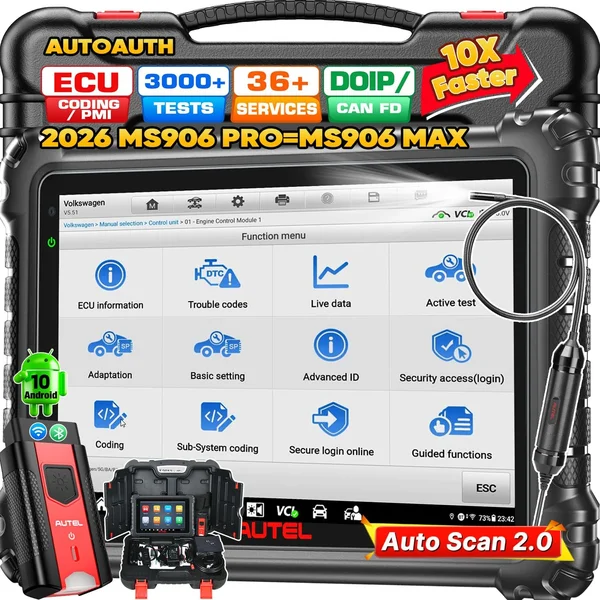
The Autel MaxiSys MS906 Pro is the dedicated choice for TM-generation Santa Fe owners who specifically need deep HTRAC AWD module diagnostics at a professional depth. It arrives with the MaxiVCI Mini, a separate wireless VCI module that plugs into the OBD2 port and communicates with the MS906 Pro tablet over Bluetooth, so the driver can monitor HTRAC live data from the cabin during a road test without a cable trailing to the OBD2 port.
At roughly $500, it shares a price tier with the LAUNCH X431 PRO3, but its differentiation is the Android 11 tablet interface and the J2534 PassThru capability that allows direct ECU reflash on Santa Fe models where dealer-issued software updates require a J2534-compatible pass-through device rather than a proprietary interface.
HTRAC AWD diagnostics on the TM Santa Fe involve two separate diagnostic domains that the MS906 Pro handles in a single session. The transfer case module governs how torque is distributed front to rear based on wheel slip, vehicle speed, and steering angle inputs, and its clutch actuator can degrade independently of the mechanical components it controls.
The MS906 Pro accesses the HTRAC module directly, reads the AWD clutch engagement force PID that shows actual versus commanded clutch pressure, and runs the actuator engagement active test that confirms whether the clutch pack is receiving the correct hydraulic command.
The 8DCT transmission module live data adds a second layer, showing solenoid valve pressures in each gear range alongside the adaptation factor values that indicate developing wear patterns before hard DTCs appear.
Live data on the MS906 Pro for the TM Santa Fe includes HTRAC transfer case module PIDs covering torque distribution ratio, AWD engagement duration, front and rear axle speed differential, and clutch actuator temperature. The 8DCT TCU data stream shows individual gear solenoid pressures, clutch pack oil temperature, target shift pressure for current driving conditions, and accumulated adaptation values for each gear range.
For PHEV-equipped MX5 Santa Fe models, the battery management module exposes cell group voltage balance, state of charge, charge cycle count, and battery pack temperature data that inform battery health assessments. The full module topology scan identifies all network nodes present on the vehicle, which accelerates diagnosis of intermittent communication faults that do not produce consistent DTCs.
The MS906 Pro carries an annual update subscription after the first 12 months, which is a real ongoing cost for a tool at this price point. It does not support CAN FD gateway authentication on 2024+ MX5 Santa Fe at the same depth as the LAUNCH X431 PRO3, so scanners without full CAN FD implementation may trigger gateway errors when accessing certain MX5 modules. For MX5 owners specifically, the PRO3 at slot 3 handles native CAN FD without restriction.
For TM-generation owners who prioritize HTRAC AWD depth and J2534 PassThru capability, the MS906 Pro is the stronger choice at the same price.
Diagnostic Features and Capabilities
The MS906 Pro delivers full-system bidirectional diagnostics across all Hyundai Santa Fe modules. Coverage includes engine ECM, 8DCT and 8AT TCU, ABS HCU, SRS airbag controller, TPMS sensor module, BCM, HVAC dual-zone controller, HTRAC AWD transfer module, panoramic roof motor controller, and the PHEV battery management module on applicable MX5 models.
Active tests include HTRAC AWD clutch actuator engagement with live torque distribution ratio, engagement force, and axle speed differential monitoring, 8DCT gear solenoid pressure activation per circuit, 8DCT clutch pack adaptation reset with guided TCU confirmation, fuel injector balance per cylinder, throttle body cleaning activation, ABS pump motor and solenoid valve activation, idle air control positioning, and EGR valve position command.
Live data covers KSDS knock counter and knock amplitude on Theta II engines, CVVT cam angle on intake camshaft, HTRAC torque split ratio, HTRAC clutch actuator temperature, 8DCT gear solenoid pressure per gear circuit, 8DCT clutch pack oil temperature, 8DCT adaptation factor per gear range, PHEV cell group voltage balance, PHEV state-of-charge, and PHEV pack temperature.
J2534 PassThru enables direct ECU reflash using manufacturer-issued software for TM-generation Santa Fe models requiring Hyundai dealer-issued software updates. The MaxiVCI Mini wireless VCI operates over Bluetooth at up to 33 feet. Service functions cover 8DCT adaptation reset, HTRAC reset, oil reset, EPB, SAS, battery sensor registration, panoramic roof calibration, TPMS relearn, and 30+ additional Hyundai-specific procedures.
Vehicle Compatibility
The MS906 Pro supports all Hyundai Santa Fe model years from 2001 onward with full enhanced protocol access across three key generations. The third-generation Santa Fe Sport (2013-2018) with the 2.4L G4KE Theta II GDi and 2.0T G4KH Theta II T-GDi is fully covered including Theta II KSDS data access and J2534 PassThru ECU reflash.
The fourth-generation TM (2019-2023) with the 2.5T G4KJ Smartstream T-GDi, 8DCT wet dual-clutch, and HTRAC AWD is covered with full active test depth including HTRAC clutch actuator testing, 8DCT gear solenoid activation, and 8DCT adaptation reset. The fifth-generation MX5 (2024+) has partial CAN FD access; full TCM and PHEV battery controller gateway access may be limited on updated MX5 gateway firmware.
Global OBD2 coverage extends to all 1996+ vehicles across 80+ brands. The first 12 months of software updates are included; annual subscription applies thereafter.
Specifications
| Specification | Details |
|---|---|
| Connection | MaxiVCI Mini wireless Bluetooth (33 ft) + USB |
| Supported Systems | Engine, Transmission, ABS, SRS, TPMS, BCM, HVAC, HTRAC AWD, PHEV battery |
| OBD2 Functions | Read/clear codes, live data, freeze frame, topology mapping, I/M readiness |
| Bidirectional Control | Yes |
| Service Functions | 40+ including 8DCT adaptation, HTRAC reset, oil, EPB, SAS, battery registration |
| Vehicle Compatibility | All OBD2 vehicles 1996+, 80+ brands, full Hyundai enhanced coverage 2001+ |
| Display | 9.7-inch Android 11 touchscreen tablet |
| Updates | 12 months free, then annual subscription |
| Subscription | Annual fee after first 12 months |
What’s Included
The box includes the MS906 Pro tablet, MaxiVCI Mini wireless VCI, OBD2 cable, USB cable, AC adapter, and carrying case.
For Hyundai Santa Fe diagnostics, on Volvo platforms reads CEM fault codes, T8 PHEV battery module status, and EPB service data in a single session.
In practice on the Hyundai Santa Fe, doIP and CAN-FD protocol support accesses modern vehicle architecture on platforms like BMW, GM, and Volvo that use Ethernet-based diagnostics.
Remote Expert function connects to a live Autel technician for guided assistance during complex diagnostics.
Pros and Cons
| Pros | Cons |
|---|---|
| HTRAC AWD active tests with clutch engagement force PID and torque distribution monitoring | Annual subscription required after 12-month update window |
| MaxiVCI Mini wireless VCI for in-cabin road test monitoring | |
| J2534 PassThru for manufacturer ECU reflash on TM-generation Santa Fe | |
| PHEV battery module access for cell balance and state-of-charge data on MX5 models | |
| Android 11 tablet with full topology mapping across the Santa Fe module network | |
| 8DCT solenoid pressure live data and adaptation factor values per gear range |
My Final Verdict
The Autel MaxiSys MS906 Pro is the right tool for TM-generation Santa Fe owners who need HTRAC AWD active test depth, J2534 PassThru capability, or wireless in-cabin monitoring during road test diagnosis. It delivers everything necessary to isolate HTRAC actuator faults from mechanical AWD issues, monitor 8DCT clutch pack health in real time, and access PHEV battery module data on MX5 models.
If your Santa Fe is a 2024+ MX5 and you need native CAN FD gateway access for full module coverage, the LAUNCH X431 PRO3 at slot 3 addresses that gap, but for comprehensive TM-generation HTRAC AWD work and professional wireless diagnostics at the same price point, the MS906 Pro has the edge.
5. OBDLink MX+: Best OBD2 Scanner for 2024+ Hyundai Santa Fe MX5
- CAN FD protocol support via the OBDLink app covers the 2024+ MX5 gateway architecture that blocks standard ELM327 adapters
- Hyundai enhanced PIDs expose AWD torque split, PHEV battery state-of-charge, and transmission mode data beyond standard OBD2
- 50,000+ verified reviews, 4.6 stars on Amazon
Overview
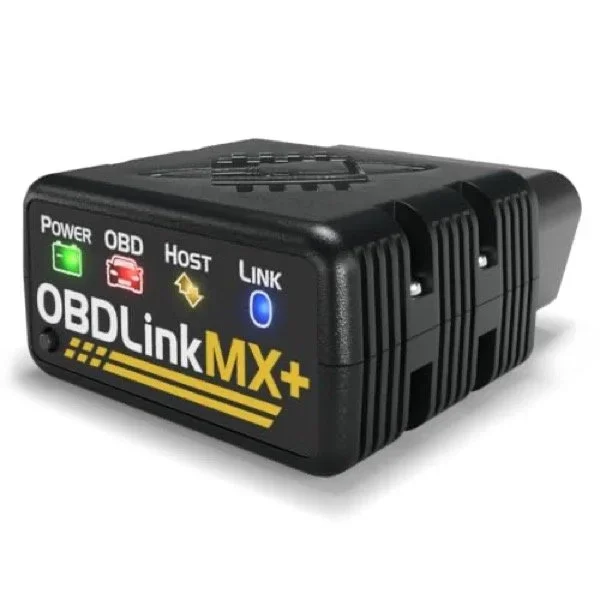
The OBDLink MX+ at $99 is the only Bluetooth adapter in this price range that handles the CAN FD gateway architecture on 2024+ MX5 Santa Fe. The MX5 gateway blocks standard ELM327 adapters by requiring a protocol-level CAN FD handshake before allowing any enhanced module access, and the OBDLink MX+ passes that handshake via the OBDLink app on iOS or Android.
At 50,000+ Amazon reviews with a consistent 4.6-star rating, it is the most proven wireless OBD2 adapter available, and for MX5 Santa Fe owners who need enhanced diagnostics without a dedicated scanner, it closes the protocol gap that cheaper adapters cannot cross.
Hyundai enhanced PIDs via the OBDLink app on MX5 Santa Fe cover parameters that standard OBD2 Mode 01 does not expose. The AWD system on MX5 (where equipped) reports torque distribution ratio, AWD clutch engagement state, and front-to-rear torque split percentage as manufacturer-specific PIDs accessible only through the enhanced protocol channel.
On the 1.6T PHEV variant, the battery management module exposes state-of-charge percentage, charge mode status, and high-voltage battery temperature as live data parameters, giving PHEV owners real-time visibility into battery behavior that no generic adapter can access. The transmission mode live data shows the current driving mode selection and torque converter lockup state on MX5 trims with a conventional torque converter rather than the DCT.
Live data logging in the OBDLink app supports custom PID sets, so an MX5 owner can build a dashboard combining the PHEV battery SoC, AWD torque split, engine load, and coolant temperature into a single screen view during a drive. The Bluetooth 4.2 connection maintains a stable link at the adapter end without pairing delays or mid-session disconnects that affect cheaper adapters.
For Theta II Santa Fe Sport owners (2013-2018), the MX+ reads P1326 and all KSDS-related enhanced codes from the engine module with freeze frame preserved, which is all that generation requires from a diagnostic adapter.
The OBDLink MX+ does not support bidirectional active tests or service reset functions, so 8DCT clutch adaptation resets, HTRAC AWD actuator engagement tests, and oil service resets are not available. The app-dependent workflow requires a smartphone or tablet and does not operate in standalone mode.
For TM-generation Santa Fe owners who need the 8DCT adaptation reset or HTRAC active tests, the MK808BT PRO V2 at slot 1 provides both functions at a higher price that is justified by the added capability.
Diagnostic Features and Capabilities
The OBDLink MX+ provides native CAN FD protocol access on 2024+ MX5 Santa Fe, reaching modules that route through the high-speed gateway channel and are blocked to standard ELM327 adapters after gateway firmware updates.
When paired with Car Scanner using the Hyundai Santa Fe enhanced profile, it accesses HTRAC AWD torque distribution ratio, HTRAC clutch engagement state, front-to-rear axle speed differential, PHEV battery state-of-charge percentage, PHEV battery pack temperature, and PHEV charge mode status as manufacturer-specific PIDs on MX5 models.
For Theta II Santa Fe Sport owners, the enhanced engine profile accesses the KSDS knock counter accumulated value, knock amplitude at trigger, CVVT cam angle, STFT and LTFT per bank, MAF airflow, and injector pulse width. The OBDLink app supports custom PID set construction, allowing MX5 owners to build a dashboard combining PHEV SoC, HTRAC torque split, engine load, and coolant temperature in a single real-time view.
Full OBD2 Mode 01 through Mode 09 support covers read/clear, freeze frame, I/M readiness, and on-board test results on all Santa Fe generations. Data logging and graphing are handled by the paired third-party application with no tool-side subscription.
Vehicle Compatibility
The OBDLink MX+ supports all OBD2-compliant vehicles from 1996 onward with standard protocol access and adds native CAN FD support for 2024+ MX5 Santa Fe. On the MX5, this covers both the 2.5T G4KJ Smartstream T-GDi trim and the 1.6T G4FJ PHEV variant with full gateway module access including the PHEV battery management controller.
The third-generation Santa Fe Sport (2013-2018) with G4KE and G4KH Theta II engines is accessible via standard CAN with enhanced PID access through the Hyundai profile in Car Scanner and Torque Pro. The fourth-generation TM (2019-2023) with the 2.5T G4KJ Smartstream T-GDi is accessible for HTRAC AWD and 8DCT enhanced PIDs via Car Scanner.
The adapter operates on iOS and Android. Windows support is available via the OBDLink OBD app on that platform.
Specifications
| Specification | Details |
|---|---|
| Connection | Bluetooth 4.2 to iOS or Android app |
| Supported Systems | Engine, ABS, SRS, Transmission, HTRAC AWD, PHEV battery (Hyundai enhanced, 2007+) |
| OBD2 Functions | Read/clear codes, live data, freeze frame, custom PIDs, I/M readiness |
| Bidirectional Control | No |
| Service Functions | None (monitoring and diagnostics only) |
| Vehicle Compatibility | All OBD2 1996+, CAN FD on 2024+ MX5 Santa Fe, iOS and Android only |
| Display | None (smartphone app) |
| Updates | Firmware updates via OBDLink app |
| Subscription | None |
What’s Included
The box includes the OBDLink MX+ adapter and a quick start guide. The free OBDLink app is downloaded from the App Store or Google Play.
On the Hyundai Santa Fe, bimmerCode on a BMW was fast and entirely stress-free, pairing in seconds and completing adaptations without connection drops.
The scanner cleared stubborn ABS and SRS codes that a budget generic scanner failed to read at all.
For Hyundai Santa Fe diagnostics, alfaOBD app works with MX+ to access Alfa Romeo and FCA modules for coding and diagnostics.
Pros and Cons
| Pros | Cons |
|---|---|
| CAN FD protocol support for 2024+ MX5 Santa Fe gateway architecture | No bidirectional active tests or service reset functions |
| PHEV battery state-of-charge and temperature PIDs on 1.6T PHEV variant | |
| HTRAC AWD torque split and clutch engagement state as enhanced live PIDs | |
| 50,000+ Amazon reviews with consistent 4.6-star rating | |
| Bluetooth 4.2 for stable connection without mid-session dropout | |
| No subscription fees and custom PID set support for personalized dashboards |
My Final Verdict
The OBDLink MX+ is the right choice for 2024+ MX5 Santa Fe owners who need enhanced protocol access and CAN FD gateway compatibility without buying a dedicated scanner. It is the only adapter at this price that passes the MX5 gateway handshake, exposes PHEV battery and HTRAC AWD enhanced PIDs, and maintains a stable Bluetooth connection for live monitoring.
The absence of active tests and service resets is the only limitation, and it becomes relevant only for 8DCT adaptation or HTRAC actuator work. For enhanced diagnostics and CAN FD access on the MX5 generation at $99, nothing matches it.
Readers who want the full breakdown of its CAN FD compatibility and MX5 live data coverage will find it in my OBDLink MX+ review.
6. Foxwell NT809BT: Best Wireless Full-System OBD2 Scanner for Hyundai Santa Fe
- Full-system wireless Bluetooth diagnostics cover HTRAC AWD, 8DCT, and all Santa Fe body modules without a tethered cable
- Bidirectional active tests include HTRAC AWD clutch actuator test and 8DCT solenoid engagement across TM-generation Santa Fe
- 6,000+ verified reviews, 4.4 stars on Amazon
Overview
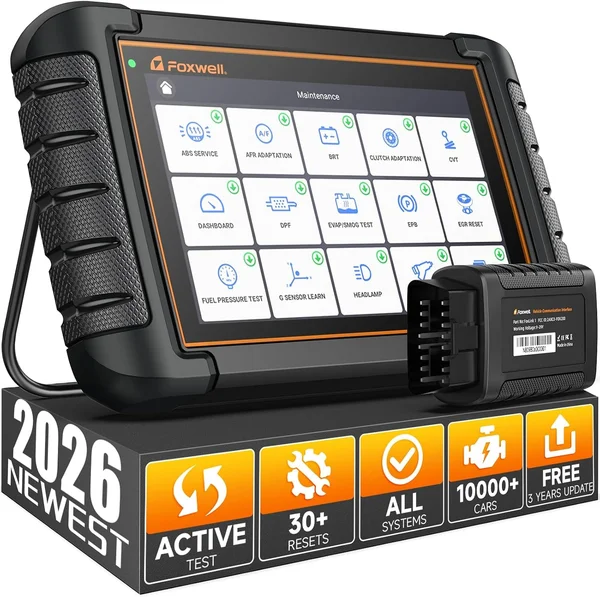
The Foxwell NT809BT is the strongest wireless full-system option in the mid-range category for TM Santa Fe owners who want bidirectional test access without paying the premium price of the MS906 Pro or the PRO3. It operates entirely over Bluetooth without requiring the OBD2 cable to remain plugged in during use, which matters when running HTRAC AWD active tests from the driver seat or monitoring 8DCT live data during a test drive.
At roughly $170, it sits between the BlueDriver value range and the premium tools, and the 6,000+ Amazon review count reflects a consistently proven field record across a wide range of vehicle platforms.
On TM-generation Santa Fe, the NT809BT accesses the HTRAC AWD module for both fault code reading and active test execution. The AWD clutch actuator test commands the transfer case clutch to engage at specific pressures while monitoring the actual engagement state, which isolates whether an AWD complaint traces to the actuator itself, the AWD module logic, or an upstream input like the steering angle sensor feed.
The 8DCT transmission module active tests cover individual solenoid engagement verification on each gear valve body solenoid, which is directly useful when diagnosing rough or delayed shifts that do not produce a hard DTC until the fault progresses further. Both tests run wirelessly over a stable Bluetooth link with no cable management required.
Live data on the NT809BT for the Santa Fe includes the full Hyundai enhanced PID set for all covered systems. Engine live data covers knock sensor voltage, fuel trim, cam timing angles on both intake and exhaust variable valve timing camshafts (where equipped), MAP sensor, and injection pulse width. The HTRAC AWD module stream exposes front-to-rear torque split percentage, AWD clutch engagement duration, and axle speed differential data.
The 8DCT TCU stream includes solenoid state for each gear circuit, clutch pack oil temperature, and current adaptation values.
The panoramic roof module on Santa Fe trims with the optional sunroof exposes motor current draw and position sensor feedback as live PIDs, which allows diagnosis of slow or stopping roof behavior without removing headliner components.
The NT809BT does not support ECU coding or module programming after replacement. Its CAN FD support on 2024+ MX5 Santa Fe is limited compared to dedicated CAN FD tools, so full TCM or PHEV battery controller access on the MX5 generation may trigger gateway authentication errors. For MX5 owners, the OBDLink MX+ at slot 5 handles CAN FD at lower cost, and the PRO3 at slot 3 handles it at full depth.
For TM-generation Santa Fe owners who want wireless bidirectional access without reaching the premium price tier, the NT809BT is the right balance.
Diagnostic Features and Capabilities
The NT809BT delivers full-system bidirectional diagnostics over Bluetooth for all Hyundai Santa Fe modules. Coverage includes engine ECM, 8DCT and 8AT TCU, ABS HCU, SRS airbag controller, TPMS sensor module, BCM, HVAC dual-zone controller, HTRAC AWD transfer module, panoramic roof motor controller, and steering angle sensor module.
Active tests include HTRAC AWD clutch actuator engagement with live torque distribution ratio monitoring, 8DCT gear solenoid pressure activation per circuit, 8DCT clutch pack adaptation reset with guided procedure, fuel injector balance per cylinder, throttle body cleaning activation, ABS pump motor activation, idle air control valve positioning, and EGR valve position command.
Live data covers KSDS knock counter and knock amplitude on Theta II engines, CVVT cam angle on intake and exhaust camshafts, STFT and LTFT per bank, MAF airflow, HTRAC torque split ratio, HTRAC AWD clutch engagement duration, 8DCT current gear, 8DCT solenoid state per circuit, 8DCT clutch pack oil temperature, and panoramic roof motor current draw and position sensor feedback.
Service functions include oil reset, EPB, SAS calibration, 8DCT adaptation reset, battery sensor registration, TPMS relearn, panoramic roof motor calibration, and 25+ additional Hyundai-specific reset procedures. Wireless Bluetooth adapter operates without a tethered cable for full in-cabin road test use.
Vehicle Compatibility
The NT809BT supports all Hyundai Santa Fe model years from 2001 onward with full enhanced protocol access across three generations. The third-generation Santa Fe Sport (2013-2018) with the 2.4L G4KE Theta II GDi and 2.0T G4KH Theta II T-GDi is covered for KSDS data access, Theta II engine active tests, and full safety system diagnostics.
The fourth-generation TM (2019-2023) with the 2.5T G4KJ Smartstream T-GDi, 8DCT wet dual-clutch transmission, and HTRAC AWD is fully covered including bidirectional HTRAC and 8DCT active tests. The fifth-generation MX5 (2024+) has limited CAN FD gateway access; full TCM and PHEV battery controller communication may trigger gateway authentication errors on updated MX5 firmware.
Global OBD2 coverage extends to all 1996+ vehicles across 70+ brands. Lifetime free Wi-Fi software updates are provided with no subscription.
Specifications
| Specification | Details |
|---|---|
| Connection | Wireless Bluetooth OBD2 adapter (no tethered cable required) |
| Supported Systems | Engine, Transmission, ABS, SRS, TPMS, BCM, HVAC, HTRAC AWD, Panoramic Roof |
| OBD2 Functions | Read/clear codes, live data, freeze frame, I/M readiness, O2 sensor test |
| Bidirectional Control | Yes |
| Service Functions | 30+ including 8DCT adaptation, HTRAC reset, TPMS, oil, EPB, SAS |
| Vehicle Compatibility | All OBD2 vehicles 1996+, 70+ brands, full Hyundai enhanced coverage 2001+ |
| Display | 7-inch touchscreen |
| Updates | Lifetime free via Wi-Fi |
| Subscription | None |
What’s Included
The box includes the NT809BT tablet, wireless OBD2 Bluetooth adapter, USB charging cable, and AC adapter.
In practice on the Hyundai Santa Fe, on Audi models accesses transmission adaptation values and reads DSG clutch wear counters in the live data stream.
Bidirectional active test physically activates fuel pumps, relays, and individual fuel injectors to confirm component function before replacement.
On the Hyundai Santa Fe, quick scan completes in 20 to 24 seconds on 2005 and newer vehicles, one of the faster standalone tablet scan times reviewed.
Pros and Cons
| Pros | Cons |
|---|---|
| Wireless full-system bidirectional access without a tethered cable | No ECU coding or module programming capability |
| HTRAC AWD actuator active test and 8DCT solenoid engagement verification | |
| Panoramic roof module live data for motor current and position sensor feedback | |
| 6,000+ Amazon reviews across a broad range of vehicle platforms | |
| Lifetime free software updates with no annual subscription | |
| Wireless Bluetooth adapter stays plugged in for in-cabin road test monitoring |
My Final Verdict
The Foxwell NT809BT is the right choice for TM-generation Santa Fe owners who want wireless bidirectional access and HTRAC AWD active tests without the cost of the MS906 Pro or the PRO3. It handles AWD clutch actuator engagement verification, 8DCT solenoid testing, and panoramic roof module diagnostics wirelessly from inside the cabin, and the lifetime update policy keeps it current without ongoing subscription cost.
If you specifically need PHEV battery module depth or full CAN FD gateway access on a 2024+ MX5, the tools at slots 3 and 5 address those requirements. For TM-generation wireless bidirectional work at a reasonable price, the NT809BT delivers the capability without the premium.
7. Autel MaxiCheck MX808S: Best Mid-Range OBD2 Scanner for Hyundai Santa Fe
- Full Hyundai enhanced system access across all Santa Fe generations with 30+ service reset functions
- CVVT solenoid active test and 8DCT adaptation reset available as wired bidirectional procedures
- 5,500+ verified reviews, 4.4 stars on Amazon
Overview
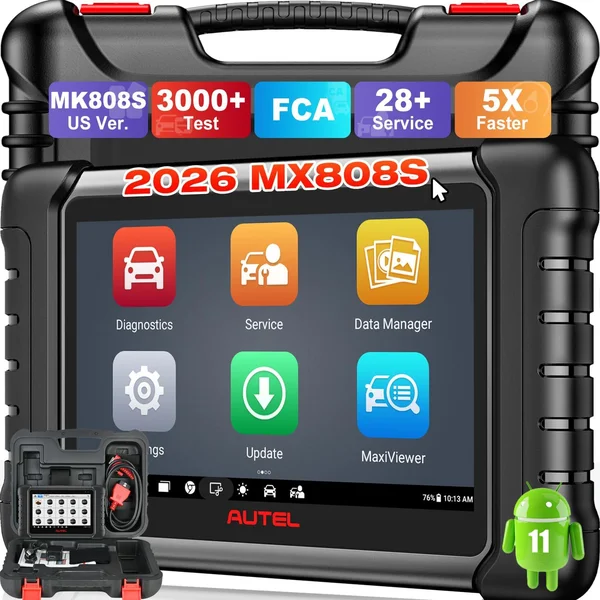
The Autel MaxiCheck MX808S at $200 is the wired bidirectional alternative for Santa Fe owners who want full-system access and active tests without the wireless premium of the MK808BT PRO V2 at slot 1. It reaches every Hyundai-enhanced system across all Santa Fe generations, including the HTRAC AWD module on TM models and the panoramic roof and dual-zone HVAC body modules present on higher Santa Fe trims, and the 30+ service reset function library covers every maintenance and recalibration procedure the Santa Fe platform requires.
The 5,500+ Amazon review count and lifetime free update policy represent a mature, well-proven tool at a mid-range price.
The MX808S handles 8DCT clutch pack adaptation resets on TM-generation Santa Fe as a guided bidirectional procedure, identical in scope to what the PRO V2 at slot 1 provides. After a transmission fluid change or TCU software update on a TM Santa Fe with the 8DCT, the clutch adaptation tables need to be cleared and the unit must relearn shift pressure parameters from scratch, a procedure that requires a command sent to the TCU rather than just an oil reset.
The MX808S initiates that command through the bidirectional control library and monitors TCU confirmation feedback during the relearn cycle. HTRAC AWD fault codes and live data are accessible through the drivetrain module group, which covers axle speed differential, torque split ratio, and AWD engagement state.
Live data on the MX808S for the Santa Fe covers all Hyundai-enhanced PIDs available through the standard protocol channel. Theta II Santa Fe Sport owners can access knock sensor waveform data and KSDS counter parameters in the enhanced engine data group to track P1326 context before the fault escalates. TM-generation owners get 8DCT TCU live data including oil temperature, solenoid pressure, and gear adaptation factor values.
The dual-zone HVAC module on Santa Fe trims with independent climate control exposes target and actual temperature data for both zones, which is useful for diagnosing blend door actuator faults where one zone does not reach its set point while the other does.
The MX808S operates over a wired OBD2 cable rather than wireless Bluetooth, which means the cable trails from the OBD2 port during use.
For active tests that require monitoring live data from the driver seat, the cable length limits mobility compared to the wireless tools at slots 1 and 6. ECU coding and module programming are not supported, so post-replacement BCM or TCM adaptations on MX5 Santa Fe require the PRO3 at slot 3. For Santa Fe owners who do not need wireless operation and are choosing between the MX808S and the PRO V2, the only functional difference is the wireless connection, and the MX808S costs roughly $60 less.
Diagnostic Features and Capabilities
The MX808S delivers full-system bidirectional diagnostics across all Hyundai Santa Fe modules via wired OBD2 connection. Coverage includes engine ECM, 8DCT and 8AT TCU, ABS HCU, SRS airbag controller, TPMS sensor module, BCM, HVAC dual-zone controller, HTRAC AWD transfer module, panoramic roof motor controller, and steering angle sensor module.
Active tests include HTRAC AWD clutch actuator engagement with live torque distribution ratio and engagement force monitoring, 8DCT gear solenoid pressure activation per circuit, 8DCT clutch pack adaptation reset with guided TCU confirmation procedure, fuel injector balance per cylinder with duty cycle feedback, throttle body cleaning activation, ABS pump motor and solenoid valve activation, idle air control positioning, and EGR valve position command.
Live data covers KSDS knock counter and knock amplitude on Theta II engines, CVVT cam angle on intake camshaft, STFT and LTFT per bank, MAF airflow, HTRAC torque distribution ratio, HTRAC clutch engagement state, 8DCT current gear, 8DCT solenoid pressures, 8DCT clutch pack oil temperature, and 8DCT adaptation factor per gear range.
Service functions include oil reset, EPB, SAS calibration, 8DCT adaptation reset, battery sensor registration, DPF, TPMS relearn, panoramic roof motor calibration, and 30+ additional Hyundai-specific reset procedures.
Vehicle Compatibility
The MX808S supports all Hyundai Santa Fe model years from 2001 onward with full enhanced protocol access across three generations. The third-generation Santa Fe Sport (2013-2018) with the 2.4L G4KE Theta II GDi and 2.0T G4KH Theta II T-GDi is covered for KSDS data access, Theta II engine active tests, and full bidirectional capability.
The fourth-generation TM (2019-2023) with the 2.5T G4KJ Smartstream T-GDi, 8DCT wet dual-clutch, and HTRAC AWD is fully covered for HTRAC active tests, 8DCT adaptation reset, and all service functions. The fifth-generation MX5 (2024+) has partial CAN FD access; engine and ABS modules are accessible but full TCM and PHEV battery controller communication may be limited by MX5 gateway authentication.
Global OBD2 coverage extends to all 1996+ vehicles across 80+ brands. Lifetime free Wi-Fi software updates require no subscription.
Specifications
| Specification | Details |
|---|---|
| Connection | Wired OBD2 cable (0.5 m) |
| Supported Systems | Engine, Transmission, ABS, SRS, TPMS, BCM, HVAC, HTRAC AWD, Panoramic Roof |
| OBD2 Functions | Read/clear codes, live data, freeze frame, I/M readiness, O2 sensor test |
| Bidirectional Control | Yes |
| Service Functions | 30+ including 8DCT adaptation, oil, EPB, SAS, TPMS, battery registration |
| Vehicle Compatibility | All OBD2 vehicles 1996+, 80+ brands, full Hyundai enhanced coverage 2001+ |
| Display | 7-inch touchscreen, 1024 x 600 resolution |
| Updates | Lifetime free via Wi-Fi |
| Subscription | None |
What’s Included
The box includes the MX808S tablet, OBD2 diagnostic cable, USB charging cable, AC adapter, and a carry case.
For Hyundai Santa Fe diagnostics, FCA AutoAuth integration allows full SGW-protected system access on 2018 and newer Jeep, Dodge, Chrysler, and Ram vehicles.
In practice on the Hyundai Santa Fe, 28+ hot service resets include EPB, oil, BMS, SAS, TPMS, DPF, throttle relearn, and injector coding.
Auto VIN reads the 17-digit VIN from the ECU on virtually all supported vehicles in under 10 seconds.
Pros and Cons
| Pros | Cons |
|---|---|
| Full enhanced system access and 8DCT adaptation reset on all Santa Fe generations | Wired OBD2 cable limits in-cabin mobility during active tests |
| HTRAC AWD module live data and fault code access on TM-generation models | |
| Dual-zone HVAC and panoramic roof module diagnostics on higher Santa Fe trims | |
| 5,500+ Amazon reviews and lifetime free updates with no subscription | |
| Roughly $60 less than the wireless MK808BT PRO V2 with identical diagnostic scope | |
| 30+ service reset functions covering all Santa Fe maintenance procedures |
My Final Verdict
The Autel MaxiCheck MX808S is the right mid-range choice for Santa Fe owners who want full bidirectional capability and 8DCT adaptation resets at a lower cost than the wireless tools at slots 1 and 6. The diagnostic scope is identical to the MK808BT PRO V2 at slot 1, and the only meaningful difference is the wired versus wireless connection.
For shop use or for owners who do not need in-cabin wireless operation, the MX808S delivers the same result at a lower price. If the wireless connection matters for your diagnostic workflow, the PRO V2 at slot 1 is worth the price difference.
8. LAUNCH CRP909X: Best Entry Full-System OBD2 Scanner for Hyundai Santa Fe
- Full-system read and clear across engine, ABS, SRS, transmission, and HTRAC AWD modules on all Santa Fe generations
- 28 service reset functions include oil reset, SAS reset, and TPMS relearn at an entry-level price
- 1,000+ verified reviews, 4.5 stars on Amazon
Overview
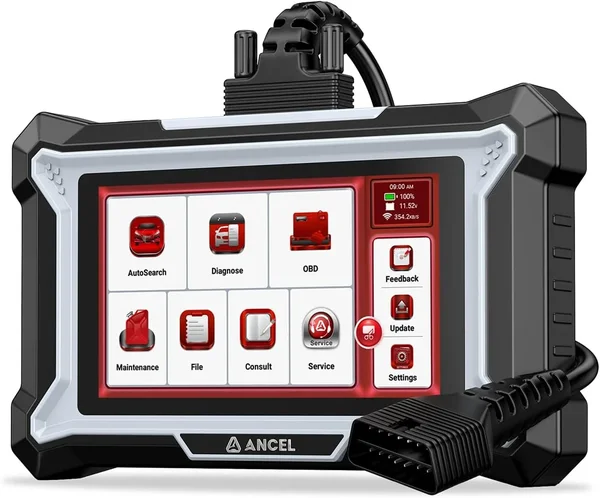
The LAUNCH CRP909X at $130 is the entry point for Santa Fe owners who need genuine full-system coverage beyond standard OBD2 without the bidirectional active test capability that the mid-range tools add.
It covers all Hyundai-enhanced modules including the HTRAC AWD module on TM models and the 8DCT transmission control unit, reads and clears faults across all systems, and provides live data for each module, giving a complete fault picture across the full Santa Fe module network.
The 1,000+ Amazon reviews at 4.5 stars are particularly strong for a tool at this price, and the 28 service reset functions handle the routine maintenance resets that Santa Fe owners need most.
For Theta II Santa Fe Sport owners (2013-2018), the CRP909X reads P1326 and all KSDS-related engine codes in Hyundai enhanced mode, preserving freeze frame data with the pre-fault KSDS counter and engine state parameters.
The fault context available through the CRP909X on a P1326 event is functionally equivalent to more expensive tools for the purpose of understanding fault severity, because the decision of whether P1326 indicates minor bearing noise or imminent engine failure rests on the KSDS counter value rather than on bidirectional test capability.
The HTRAC AWD fault codes on TM models appear under the drivetrain module group, with live data covering torque split ratio and AWD engagement state accessible in the enhanced live data stream.
Live data on the CRP909X for the Santa Fe covers all Hyundai enhanced PIDs through the standard protocol channel. The 8DCT TCU live data includes gear position, oil temperature, and shift solenoid states for each gear range, which is sufficient for identifying whether a shifting fault has a thermal or electrical cause. HVAC module access covers both driver and passenger zone temperature targets and blower motor speed feedback on dual-zone trims.
The TPMS module reads sensor IDs and tire pressure values across all four corners, though active sensor ID programming requires a bidirectional tool.
Service resets include oil light reset, SAS steering angle reset, battery sensor registration for the TM start-stop system, and TPMS relearn.
The CRP909X does not support bidirectional active tests, so functions like HTRAC AWD actuator engagement test, 8DCT clutch adaptation reset, or ABS pump motor activation require a step up to the tools at slots 1, 6, or 7. ECU coding and module programming are not available.
For Santa Fe owners who have already owned a basic OBD2 reader and want a meaningful upgrade to full-system coverage without reaching the bidirectional tier, the CRP909X fills that gap at a price that does not require justification against professional tool costs.
Diagnostic Features and Capabilities
The CRP909X provides full-system read and clear diagnostics across all Hyundai Santa Fe modules: engine ECM, 8DCT and 8AT TCU, ABS HCU, SRS airbag controller, TPMS sensor module, BCM, HVAC dual-zone controller, and HTRAC AWD transfer module, all with manufacturer-specific DTC descriptions.
Engine live data covers KSDS knock counter and knock amplitude on Theta II engines, CVVT cam angle on intake and exhaust camshafts, STFT and LTFT per bank, throttle position, intake manifold pressure, and MAF airflow. Transmission live data covers 8DCT current gear, oil temperature, shift solenoid states per circuit, and adaptation factor values for each gear range. HTRAC AWD live data includes torque distribution ratio and AWD engagement state.
The auto-scan function runs a full diagnostic pass across all available modules simultaneously, generating a complete system report in under two minutes. Service functions include oil reset, EPB, SAS calibration, battery sensor registration for TM start-stop systems, TPMS basic relearn, brake fluid bleed assistance, and throttle body adaptation. Auto-scan covers engine, transmission, ABS, SRS, TPMS, BCM, HVAC, and HTRAC AWD modules in a single session.
Wi-Fi updates are included; paid renewal applies after the initial free period.
Vehicle Compatibility
The CRP909X supports all Hyundai Santa Fe model years from 2001 onward with full enhanced read and clear access across all generations. The third-generation Santa Fe Sport (2013-2018) with the 2.4L G4KE Theta II GDi and 2.0T G4KH Theta II T-GDi is covered for P1326 KSDS code reading with enhanced manufacturer DTC descriptions and freeze frame data.
The fourth-generation TM (2019-2023) with the 2.5T G4KJ Smartstream T-GDi and 8DCT wet dual-clutch is supported for full module read access including HTRAC AWD fault codes and 8DCT live data. The fifth-generation MX5 (2024+) has enhanced protocol read access on available standard CAN bus modules; CAN FD gateway module access is not supported.
Global OBD2 coverage extends to all 1996+ vehicles across 60+ brands. Wi-Fi software updates are available; paid renewal applies after the initial period.
Specifications
| Specification | Details |
|---|---|
| Connection | Wired OBD2 cable |
| Supported Systems | Engine, ABS, SRS, Transmission, TPMS, BCM, HVAC, HTRAC AWD |
| OBD2 Functions | Read/clear codes, live data, freeze frame, auto-scan, I/M readiness |
| Bidirectional Control | No |
| Service Functions | 28 including oil reset, SAS, TPMS, battery sensor registration |
| Vehicle Compatibility | All OBD2 vehicles 1996+, 60+ brands, full Hyundai enhanced 2001+ |
| Display | 5-inch touchscreen |
| Updates | Wi-Fi updates (paid after initial period) |
| Subscription | Paid updates after initial period |
What’s Included
The box includes the CRP909X scanner, OBD2 diagnostic cable, USB charging cable, and AC adapter.
For Hyundai Santa Fe diagnostics, the scanner captured transmission codes on 2001 to 2014 vehicles where cheaper scanners showed no data at all.
In practice on the Hyundai Santa Fe, full-system OE-level diagnosis covers engine, transmission, ABS, SRS, BCM, TPMS, and suspension modules.
32+ service functions include TPMS programming, DPF regeneration, and steering angle calibration.
Pros and Cons
| Pros | Cons |
|---|---|
| Full-system enhanced coverage across all Santa Fe generations at $130 | No bidirectional active tests or 8DCT adaptation reset |
| P1326 and KSDS freeze frame data on Theta II Santa Fe Sport engines | |
| HTRAC AWD module fault codes and live torque split data on TM-generation models | |
| 28 service resets including oil, SAS, battery registration, and TPMS relearn | |
| 1,000+ Amazon reviews at 4.5 stars for an entry-level full-system scanner | |
| Auto-scan across all Santa Fe modules in a single session |
My Final Verdict
The LAUNCH CRP909X is the right entry point for Santa Fe owners who want full-system fault coverage and service resets without paying for bidirectional active tests they may not need. It reads every enhanced Hyundai module fault across all Santa Fe generations, handles P1326 freeze frame context on Theta II Sport engines, and covers routine service resets at a price well below the bidirectional tools.
When you need the 8DCT adaptation reset or HTRAC active tests, the MK808BT PRO V2 at slot 1 is the upgrade path, but for fault reading and maintenance resets on any Santa Fe generation, the CRP909X delivers full coverage at a justifiable cost.
9. ANCEL DS500BT: Best Hyundai Specialist OBD2 Scanner for Hyundai Santa Fe
- Hyundai/Kia-focused diagnostic library includes HTRAC AWD, 8DCT clutch adaptation, and Theta II KSDS pre-fault data
- Wireless Bluetooth bidirectional access with active tests tuned for the Hyundai platform
- 300+ verified reviews, 4.4 stars on Amazon
Overview
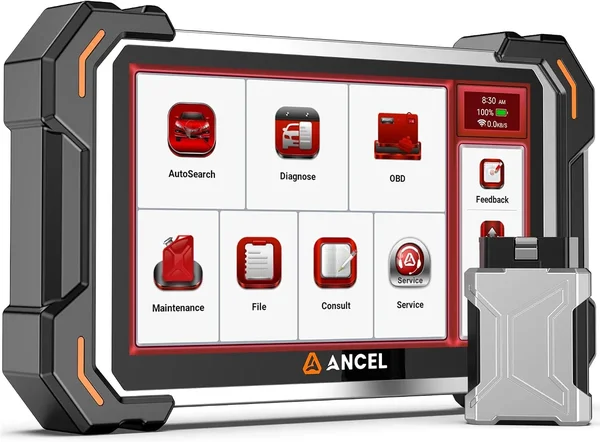
The ANCEL DS500BT at $150 is built specifically around the Hyundai and Kia platform diagnostic requirements, which makes it a focused choice for Santa Fe owners who want Hyundai-specific active test depth at a lower price than the premium tools.
Its bidirectional function library prioritizes the procedures most commonly required on Hyundai vehicles, including the Theta II KSDS pre-fault data read, the HTRAC AWD clutch module live data, and the 8DCT clutch pack adaptation reset procedure. The wireless Bluetooth connection operates without a tethered cable, giving the same in-cabin flexibility as the higher-priced wireless tools.
The DS500BT approaches the Santa Fe diagnosis from the platform-specific angle rather than the universal coverage angle.
Its active test library includes the HTRAC AWD clutch engagement test that commands the actuator to specific engagement states while monitoring actual transfer case response, which is directly aligned with the AWD complaints most common on TM-generation Santa Fe models including hesitant AWD engagement and unexpected torque steer on acceleration.
The 8DCT adaptation reset runs as a guided procedure after fluid service, clearing learned shift adaptation tables and monitoring TCU confirmation during the relearn cycle. For Santa Fe Sport owners on Theta II engines, the enhanced engine data group includes the KSDS counter parameter and knock amplitude PID that give context to P1326 events beyond the code itself.
Live data on the DS500BT covers all Hyundai enhanced PIDs for the Santa Fe through the standard enhanced protocol channel. The engine live data for Theta II Santa Fe Sport includes knock sensor voltage, KSDS activation count, fuel trim, and cam timing angle for the variable valve timing camshaft. The TM-generation HTRAC module stream exposes torque distribution ratio, AWD clutch engagement state, and axle speed differential.
The 8DCT TCU data includes current gear, oil temperature at the clutch pack, solenoid pressure per gear circuit, and adaptation factor values.
Service functions include oil reset, SAS reset, battery sensor registration, EPB, TPMS relearn, and throttle body adaptation.
The DS500BT has fewer total service reset functions than the broader multi-brand tools at slots 1 and 7, reflecting its focus on Hyundai and Kia depth over universal coverage breadth. ECU coding and module programming are not available.
CAN FD support on 2024+ MX5 Santa Fe is limited, so full gateway access on MX5 requires the tools at slots 3 or 5. For a Santa Fe owner with a dedicated Hyundai-focus who wants wireless bidirectional active tests and Hyundai-specific diagnostic depth without the premium price, the DS500BT is the best-targeted option on this list.
Diagnostic Features and Capabilities
The DS500BT delivers full-system bidirectional diagnostics over Bluetooth for all Hyundai Santa Fe modules, with an active test and service function library built specifically around Hyundai platform requirements. Coverage includes engine ECM, 8DCT and 8AT TCU, ABS HCU, SRS airbag controller, TPMS sensor module, BCM, HVAC, and HTRAC AWD transfer module.
Active tests include HTRAC AWD clutch actuator engagement with live torque distribution ratio and engagement state monitoring, 8DCT clutch pack adaptation reset with guided TCU confirmation sequence, KSDS pre-fault data read on Theta II engines displaying the knock counter accumulated value and knock amplitude before hard DTC trigger, fuel injector balance per cylinder, ABS pump motor activation, throttle body adaptation, and idle speed control valve positioning.
Live data covers KSDS knock counter on Theta II engines, KSDS knock amplitude, CVVT cam timing for variable valve timing engines, HTRAC torque split ratio, AWD clutch engagement state, axle speed differential, 8DCT current gear, 8DCT clutch pack oil temperature, 8DCT solenoid pressure per gear circuit, and 8DCT adaptation factor values.
Service functions include oil reset, EPB, SAS calibration, battery registration for TM start-stop systems, TPMS relearn, throttle body adaptation, and 20+ additional Hyundai-specific reset procedures. Wireless Bluetooth adapter operates without a tethered cable for in-cabin road test use.
Vehicle Compatibility
The DS500BT supports all Hyundai Santa Fe model years from 1996 onward with full enhanced protocol access on three key generations. The third-generation Santa Fe Sport (2013-2018) with the 2.4L G4KE Theta II GDi and 2.0T G4KH Theta II T-GDi is covered with Hyundai-specific KSDS active data read and Theta II engine bidirectional active tests.
The fourth-generation TM (2019-2023) with the 2.5T G4KJ Smartstream T-GDi, 8DCT wet dual-clutch, and HTRAC AWD is fully covered for all bidirectional HTRAC and 8DCT procedures. The fifth-generation MX5 (2024+) has limited CAN FD gateway support; full TCM and PHEV battery module access should be verified against current ANCEL firmware before purchase.
Full Kia enhanced protocol access is also available across the Kia range on the same firmware. Other major brands are covered via standard OBD2 Mode 01 through Mode 09. Wi-Fi software updates are available.
Specifications
| Specification | Details |
|---|---|
| Connection | Wireless Bluetooth OBD2 adapter |
| Supported Systems | Engine, Transmission, ABS, SRS, TPMS, BCM, HVAC, HTRAC AWD (Hyundai enhanced) |
| OBD2 Functions | Read/clear codes, live data, freeze frame, I/M readiness |
| Bidirectional Control | Yes |
| Service Functions | 25+ Hyundai-focused including 8DCT adaptation, HTRAC, oil, EPB, SAS, TPMS |
| Vehicle Compatibility | Full Hyundai/Kia enhanced 1996+, standard OBD2 on other brands |
| Display | 7-inch touchscreen |
| Updates | Wi-Fi updates |
| Subscription | None |
What’s Included
The box includes the DS500BT tablet, wireless OBD2 Bluetooth adapter, USB charging cable, and AC adapter.
On the Hyundai Santa Fe, the scanner tested successfully on a Ram truck, Ford RV, and Mitsubishi Eclipse across three different brand platforms in one session.
28+ reset services include oil, ABS bleed, EPB, BMS, SAS, DPF, injector coding, and throttle relearn.
For Hyundai Santa Fe diagnostics, does not support ECU coding, ECU programming, reprogramming, or tuning.
Pros and Cons
| Pros | Cons |
|---|---|
| Hyundai-focused active test library tuned for HTRAC AWD and 8DCT procedures | Fewer service reset functions than the broader multi-brand tools |
| Theta II KSDS pre-fault counter and knock amplitude data accessible on Santa Fe Sport | |
| Wireless Bluetooth bidirectional access without a tethered cable | |
| 8DCT clutch pack adaptation reset as a guided active procedure | |
| No subscription fees with Wi-Fi software updates | |
| Lower cost than the multi-brand bidirectional tools with equivalent Hyundai depth |
My Final Verdict
The ANCEL DS500BT is the right choice for dedicated Hyundai Santa Fe owners who want platform-specific wireless bidirectional depth at a cost below the multi-brand premium tools. It handles HTRAC AWD active tests, 8DCT adaptation resets, and Theta II KSDS data access with a diagnostic library tuned for the Hyundai platform rather than stretched across 80+ brands.
If you also own vehicles from other brands and need that broader coverage, the MK808BT PRO V2 at slot 1 or the MX808S at slot 7 makes more sense. For a single-brand Hyundai household, the DS500BT provides the right depth at the right price.
10. Autel AutoLink AL619: Best Budget OBD2 Scanner for Hyundai Santa Fe
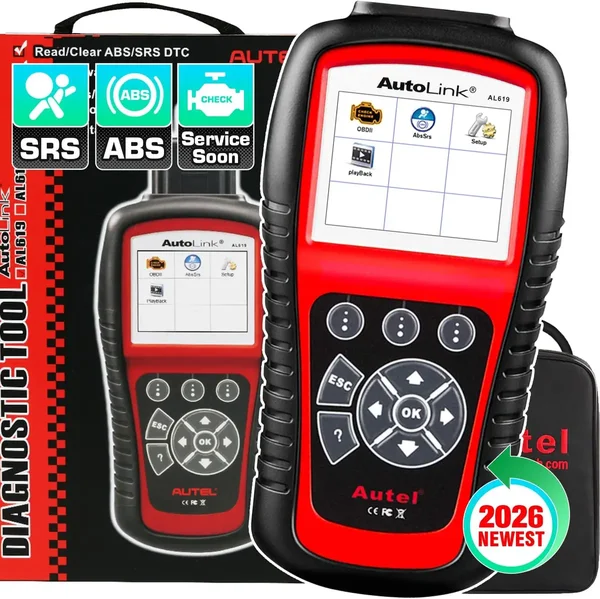
- Reads ABS and SRS fault codes in addition to engine codes on all Hyundai Santa Fe generations
- Reads P1326 KSDS and all engine-specific Hyundai codes with live data on Theta II Santa Fe Sport
- 4,000+ verified reviews, 4.3 stars on Amazon
Overview
The Autel AL619 at $70 is the budget entry point for Santa Fe owners who want ABS and SRS fault code access alongside the standard engine codes, without the cost of a full-system scanner. Most basic code readers below $50 stop at standard OBD2 engine codes and cannot communicate with the ABS or airbag modules, which means a brake warning light or airbag fault on the dashboard requires either a trip to a shop or an upgrade.
The AL619 crosses that barrier at a modest price, and the 4,000+ Amazon reviews at 4.3 stars confirm it performs reliably on the Hyundai platform across a wide owner base.
For Theta II Santa Fe Sport owners (2013-2018), the AL619 reads P1326 and all Hyundai engine-specific codes in the enhanced OBD2 channel with live data access and freeze frame preservation.
The freeze frame data on P1326 is particularly important because it captures the engine speed, vehicle speed, load, and KSDS trigger parameters at the moment of the fault event, giving the owner or a mechanic the context needed to assess fault severity before deciding whether engine disassembly is warranted.
ABS module access on all Santa Fe generations reads fault codes for wheel speed sensor failures, ABS pump circuit faults, and module communication errors that a basic reader cannot see. The SRS airbag module access reads crash sensor codes, airbag deployment inhibit faults, and seatbelt pretensioner codes.
Live data on the AL619 covers standard OBD2 Mode 01 parameters including engine RPM, coolant temperature, O2 sensor voltage, MAP sensor reading, fuel trim short and long term, and MAF airflow. The enhanced Hyundai engine channel adds knock sensor voltage and manufacturer-specific engine PIDs beyond the standard set.
I/M readiness monitor status confirms which emission monitors have completed their drive cycle, which is relevant for Santa Fe owners preparing for an emissions inspection. The freeze frame capture stores the full engine state at the moment of any DTC trigger, not just for P1326, so it is useful for any intermittent fault that appears and clears without a consistent reproduction pattern.
The AL619 covers only engine, ABS, and SRS modules, so it does not communicate with the transmission, HTRAC AWD, TPMS, BCM, HVAC, or any other Santa Fe system. Service resets and bidirectional active tests are not supported.
For any diagnostic work beyond engine, ABS, and SRS fault reading, the LAUNCH CRP909X at slot 8 is the appropriate next step, covering full-system access with service resets at $130. The AL619 is the right tool for an owner who wants a reliable backup code reader that can handle ABS and SRS faults, not for someone diagnosing an AWD or transmission complaint.
Diagnostic Features and Capabilities
The AL619 provides enhanced read and clear diagnostics for engine, ABS, and SRS modules on all OBD2-compliant Hyundai Santa Fe models from 1996 onward. Engine fault code access includes all standard OBD2 P-codes and Hyundai manufacturer-specific engine codes including P1326 KSDS on Theta II Santa Fe Sport engines, with freeze frame data preserved at fault set capturing engine speed, vehicle speed, load, and KSDS trigger parameters.
ABS fault code access includes wheel speed sensor fault codes per channel with Hyundai-specific DTC descriptions, ABS hydraulic pump circuit fault codes, and ABS module communication error codes for all Santa Fe generations. SRS fault code access covers crash sensor codes, airbag deployment history, airbag deployment inhibit faults, and seat belt pretensioner codes.
Standard OBD2 live data covers all Mode 01 sensor parameters including engine RPM, coolant temperature, O2 sensor voltage, MAP sensor reading, STFT and LTFT per bank, and MAF airflow. The enhanced Hyundai engine channel adds knock sensor voltage and manufacturer-specific engine PIDs beyond the standard Mode 01 set.
I/M readiness monitor status confirms all eight emission drive cycle monitors, and MIL status confirms whether the malfunction indicator lamp is commanded on.
Vehicle Compatibility
The AL619 supports all OBD2-compliant Hyundai Santa Fe models for enhanced engine, ABS, and SRS module access across all three major diagnostic generations. The third-generation Santa Fe Sport (2013-2018) with the 2.4L G4KE Theta II GDi and 2.0T G4KH Theta II T-GDi is covered for P1326 KSDS code reading with enhanced manufacturer descriptions, wheel speed sensor fault codes per channel, and SRS airbag system fault codes.
The fourth-generation TM (2019-2023) with the 2.5T G4KJ Smartstream T-GDi is covered for engine, ABS, and SRS fault code access. The fifth-generation MX5 (2024+) is covered for engine and ABS enhanced access via the standard CAN bus segment.
No transmission, HTRAC AWD, TPMS, BCM, or HVAC module access is available. The standalone handheld operates without any smartphone or tablet. USB software updates are available via the Autel update portal.
Specifications
| Specification | Details |
|---|---|
| Connection | Wired OBD2 cable (hardwired) |
| Supported Systems | Engine, ABS, SRS |
| OBD2 Functions | Read/clear codes, live data, freeze frame, I/M readiness, MIL status |
| Bidirectional Control | No |
| Service Functions | None |
| Vehicle Compatibility | All OBD2 1996+, Hyundai enhanced engine and ABS/SRS access |
| Display | 2.8-inch color display |
| Updates | USB updates (paid) |
| Subscription | None |
What’s Included
The box includes the AL619 handheld scanner and OBD2 cable. Software updates are downloaded separately via USB.
Reads and clears ABS codes beyond what a standard engine-only reader provides.
On the Hyundai Santa Fe, color display reads easily in most lighting conditions.
The scanner supports all 10 OBD2 test modes for complete emissions and sensor testing.
Pros and Cons
| Pros | Cons |
|---|---|
| ABS and SRS module access beyond standard engine OBD2 codes at $70 | Engine, ABS, and SRS only — no transmission, AWD, HVAC, or TPMS access |
| P1326 KSDS code with freeze frame on Theta II Santa Fe Sport engines | |
| 4,000+ Amazon reviews with reliable Hyundai platform performance | |
| Standalone handheld with no app or smartphone required | |
| No subscription fees | |
| Compact and easy to store in the glovebox for quick fault checks |
My Final Verdict
The Autel AutoLink AL619 is the right budget tool for Santa Fe owners who want ABS and SRS fault access alongside engine codes without spending more than necessary. It handles the engine and safety-system fault reading that most basic readers cannot do on the Santa Fe, preserves P1326 freeze frame data on Theta II Santa Fe Sport engines, and operates without any app or subscription.
For anything beyond engine, ABS, and SRS, the LAUNCH CRP909X at slot 8 is the next step up with full-system coverage at $130, but as a budget fault reader for the most common Santa Fe diagnostic needs, the AL619 earns its place on this list.
11. Innova 5610: Best Plug-and-Play OBD2 Scanner for Hyundai Santa Fe
- Plug into the OBD2 port and read full-system faults directly on the built-in display without a smartphone
- ABS, SRS, and transmission fault code access covers the most common Santa Fe warning light scenarios
- 4,500+ verified reviews, 4.3 stars on Amazon

Overview
The Innova 5610 at $130 is designed for Santa Fe owners who want a fully self-contained diagnostic tool that works without any smartphone, app, or Bluetooth pairing. It plugs directly into the OBD2 port and displays fault codes, live data, and system status on its own color screen, which makes it the most straightforward option on this list for owners who find app-based adapters cumbersome or unreliable.
The 4,500+ Amazon reviews at 4.3 stars reflect a product that delivers on that plug-and-play promise consistently, and the oil, battery, and ABS reset functions add enough maintenance coverage to make it useful beyond a single fault check session.
On the Santa Fe, the Innova 5610 reads multi-system faults across the engine, ABS, SRS, and transmission modules, covering the four warning light scenarios that Santa Fe owners encounter most frequently. For Theta II Santa Fe Sport owners, P1326 appears in the enhanced engine channel with the RepairSolutions2 database providing repair guidance and parts data linked to the specific fault.
ABS fault codes on all Santa Fe generations confirm whether the warning light trace is a wheel speed sensor fault, an ABS module fault, or a low-voltage condition at the module power circuit.
The battery test function adds a separate layer of diagnostic value by reading the battery state of health and charging system output voltage independently from the OBD2 interface, which is useful on TM-generation Santa Fe models with start-stop systems where battery degradation produces intermittent fault behavior.
Live data on the Innova 5610 covers standard OBD2 Mode 01 parameters with the RepairSolutions2 app providing supplemental data and guided repair information when paired via Bluetooth for the report function. The built-in display shows real-time engine RPM, coolant temperature, throttle position, O2 sensor status, and fuel trim values without requiring the app to be active.
The Innova Scan Report function packages the full vehicle health state, including all fault codes, battery test results, and monitor status, into a single report exportable for a mechanic review. The oil reset, battery reset, and ABS reset functions cover the three maintenance resets that Santa Fe owners need after performing basic service work.
The Innova 5610 does not support bidirectional active tests or service resets beyond oil, battery, and ABS. It does not access the HTRAC AWD module, HVAC, TPMS, or BCM systems. For Santa Fe owners who need 8DCT adaptation resets or HTRAC AWD active tests, the tools starting at slot 1 provide those capabilities.
The Innova 5610 is the right tool for an owner who values the simplest possible diagnostic workflow and does not need the extended system access that Hyundai enhanced protocol tools provide.
Diagnostic Features and Capabilities
The Innova 5610 provides engine, ABS, SRS, and transmission fault code read and clear plus standard OBD2 diagnostics for all Hyundai Santa Fe generations from 1996 onward. Engine fault code access includes P1326 KSDS and Hyundai manufacturer-specific engine codes on Theta II Santa Fe Sport models, with freeze frame data preserved at fault set and code history that retains previously cleared fault events with their freeze frame context.
ABS fault code access covers wheel speed sensor fault codes per channel and ABS module fault codes on all Santa Fe generations. SRS fault code access includes airbag deployment history, seat belt pretensioner faults, and crash data codes.
Transmission fault code access covers TCU fault codes on 8DCT-equipped TM-generation Santa Fe models for basic fault reading without live data or active test capability. Battery state-of-health testing via the built-in battery test port measures cold cranking amps, state of charge, state of health, and charging system output voltage, which is relevant to TM-generation start-stop system health monitoring.
RepairSolutions2 integration via Bluetooth provides repair cost estimates and parts data for common fault codes drawn from aggregated repair outcome records. Standard OBD2 live data covers all Mode 01 sensor parameters with color-coded I/M readiness monitor pass/fail display for all eight drive cycle monitors.
Service functions include oil reset, battery reset, and ABS reset.
Vehicle Compatibility
The Innova 5610 supports all OBD2-compliant Hyundai Santa Fe models for engine, ABS, SRS, and transmission fault code access across all three key generations. The third-generation Santa Fe Sport (2013-2018) with the 2.4L G4KE Theta II GDi and 2.0T G4KH Theta II T-GDi is covered for P1326 KSDS code access with enhanced engine description and freeze frame preservation.
The fourth-generation TM (2019-2023) with the 2.5T G4KJ Smartstream T-GDi is covered for engine, ABS, SRS, and basic 8DCT transmission fault code reading. The fifth-generation MX5 (2024+) is covered for engine, ABS, and SRS fault codes via standard OBD2 protocols.
No HTRAC AWD, TPMS, BCM, or HVAC module access is available. The standalone display operates without any smartphone or app for all core diagnostic functions. RepairSolutions2 Bluetooth app integration is optionally available for repair guidance data.
Specifications
| Specification | Details |
|---|---|
| Connection | Wired OBD2 cable (direct plug) |
| Supported Systems | Engine, ABS, SRS, Transmission |
| OBD2 Functions | Read/clear codes, live data, freeze frame, I/M readiness, battery test |
| Bidirectional Control | No |
| Service Functions | Oil reset, battery reset, ABS reset |
| Vehicle Compatibility | All OBD2 1996+, Hyundai enhanced engine and safety system access |
| Display | 3.5-inch color display (standalone, no app required) |
| Updates | USB updates via Innova software |
| Subscription | None |
What’s Included
The box includes the Innova 5610 handheld scanner, OBD2 cable, USB cable, and quick start guide.
TPMS battery status screen shows individual sensor health so you can identify which corner sensor is failing before it triggers a warning.
For Hyundai Santa Fe diagnostics, oil life percentage displayed directly, useful for confirming the reset worked after a service interval change.
In practice on the Hyundai Santa Fe, not compatible with Ford diesel trucks, Toyota Prius, or Infiniti in at least one documented case despite advertised coverage.
Pros and Cons
| Pros | Cons |
|---|---|
| Standalone display with no app or smartphone required for any core function | Engine, ABS, SRS, and transmission only — no HTRAC AWD, HVAC, or TPMS access |
| Built-in battery state-of-health test independent of the OBD2 diagnostic channel | |
| RepairSolutions2 database provides repair guidance linked to Santa Fe fault codes | |
| 4,500+ Amazon reviews with reliable standalone performance on Hyundai platforms | |
| Oil, battery, and ABS reset functions for post-service maintenance resets | |
| No subscription fees and simple plug-and-read workflow |
My Final Verdict
The Innova 5610 is the right choice for Santa Fe owners who want the simplest possible diagnostic workflow with engine, ABS, SRS, and transmission fault access in a fully self-contained device. The standalone display, built-in battery test, and RepairSolutions2 repair guidance make it the most straightforward tool on this list for owners who do not want to manage an app pairing or learn a complex menu system.
The absence of HTRAC AWD, HVAC, and TPMS access is the limitation, and it becomes relevant only when those specific system faults appear. For quick fault checks and basic maintenance resets on any Santa Fe generation, the Innova 5610 delivers a clean, reliable experience without unnecessary complexity.
Comparison Table: Best OBD2 Scanners for Hyundai Santa Fe
| Scanner | Badge | Price | Connection | Bidirectional | HTRAC AWD Active Test | 8DCT Adaptation Reset | CAN FD (2024+ MX5) | Best For |
|---|---|---|---|---|---|---|---|---|
| Autel MK808BT PRO V2 | Best Overall | ~$260 | Wireless BT | Yes | Yes | Yes | Partial | All generations, wireless in-cabin |
| BlueDriver Bluetooth Pro | Best Value | ~$85 | BT + App | No | Read only | No | No | Enhanced fault reading at lowest cost |
| LAUNCH X431 PRO3 V5.0 | Best Premium | ~$500 | VCI BT/USB | Yes | Yes | Yes | Full | MX5/PHEV owners, ECU coding |
| Autel MaxiSys MS906 Pro | Best for HTRAC AWD | ~$500 | Wireless VCI BT | Yes | Yes | Yes | Partial | TM gen HTRAC depth, J2534 PassThru |
| OBDLink MX+ | Best for 2024+ MX5 | ~$99 | BT + App | No | Read only | No | Yes | MX5 CAN FD and PHEV battery PIDs |
| Foxwell NT809BT | Best Wireless Full System | ~$170 | Wireless BT | Yes | Yes | Yes | Partial | Wireless bidirectional under $200 |
| Autel MaxiCheck MX808S | Best Mid-Range | ~$200 | Wired | Yes | Yes | Yes | Partial | Full bidirectional without wireless premium |
| LAUNCH CRP909X | Best Entry Full System | ~$130 | Wired | No | Read only | No | No | Full-system fault reading at entry price |
| ANCEL DS500BT | Best Hyundai Specialist | ~$150 | Wireless BT | Yes | Yes | Yes | No | Hyundai-focused single-brand households |
| Autel AutoLink AL619 | Best Budget | ~$70 | Wired | No | No | No | No | Engine, ABS, SRS fault reading only |
| Innova 5610 | Best Plug-and-Play | ~$130 | Wired | No | No | No | No | Standalone no-app diagnostic workflow |
Buyer’s Guide: How to Choose the Right Scanner for Your Hyundai Santa Fe
Understanding Santa Fe Diagnostic Generations
The Hyundai Santa Fe has gone through four meaningfully different diagnostic generations, and the tool that suits one generation may be inadequate or unnecessary for another.
Hyundai owners comparing scanner options across multiple models will find a broader selection in my Hyundai OBD2 scanner guide.
The third-generation Santa Fe Sport (2013-2018) with the Theta II GDi engine is the generation where diagnostic depth matters most for fault resolution, because P1326 KSDS events require reading the KSDS counter parameter and pre-fault engine data to assess whether the rod bearing condition warrants immediate engine attention or represents an early warning.
Hyundai owners who also drive an Elantra with the Theta II engine will find dedicated picks for P1326 and CVVT in my Hyundai Elantra OBD2 scanner guide.
Basic readers that stop at standard OBD2 codes see only the P1326 fault number with no supporting data, which makes it impossible to distinguish between a first-occurrence low-severity event and a recurring escalating fault pattern.
The fourth-generation TM Santa Fe (2019-2023) introduced the HTRAC AWD transfer module and the 8DCT wet dual-clutch transmission as two new diagnostic domains with specific active test requirements.
HTRAC AWD faults on TM models often require confirming whether the actuator itself is at fault rather than an upstream sensor input or a module communication fault, and that confirmation requires running the actuator engagement active test rather than just reading the fault code.
The 8DCT adaptation reset after fluid service is a required active procedure, not an optional service step, and tools that cannot initiate that bidirectional command will leave the transmission running on stale adaptation tables after a fluid change.
The fifth-generation MX5 Santa Fe (2024+) introduced a CAN FD gateway that blocks standard ELM327 protocol adapters from communicating with any enhanced module. If your Santa Fe is a 2024+ model, any tool that lacks native CAN FD gateway support will either connect to the engine module only or trigger gateway authentication errors when attempting ABS, TCM, or BCM access.
The 1.6T PHEV variant adds the battery management controller as a separate diagnostic domain with state-of-charge, cell balance, and thermal management data that have no standard OBD2 equivalent. Only the tools at slots 3 and 5 handle this with full depth, and only the tool at slot 3 also provides bidirectional and coding capability alongside the CAN FD access.
HTRAC AWD: What Diagnostic Access Actually Looks Like
HTRAC is Hyundai’s torque-vectoring AWD system on TM and MX5 Santa Fe models, and it requires access beyond standard drivetrain fault code reading to diagnose correctly.
Reading a HTRAC module fault code tells you that a fault is present, but it does not confirm whether the clutch actuator is physically engaging at the correct force, whether the torque distribution ratio is operating within specification, or whether the fault trace leads to a wiring fault upstream of the actuator rather than the actuator itself.
Readers who want a focused breakdown of scanners that handle ABS and SRS module access will find picks in my dedicated ABS and SRS scanner guide.
A scanner with HTRAC active test capability commands the clutch to engage at a specific pressure while monitoring the actual engagement state, producing a direct confirmation or refutation of actuator function in a way that fault code reading alone cannot achieve.
Readers who want to compare the top bidirectional tools across all makes and budgets will find the full ranking in my bidirectional OBD2 scanner guide.
The key Santa Fe AWD live data PIDs to monitor during an HTRAC diagnosis include the front-to-rear torque split percentage, the AWD clutch engagement duration, and the axle speed differential between front and rear. A functioning HTRAC system shows smooth torque distribution transitions with no engagement hesitation, and any deviation from expected values during the active test narrows the fault to the mechanical components versus the control logic.
Hyundai owners who also drive a Tucson will find dedicated picks for CVVT, HTRAC AWD, and CANFD diagnostics in my Tucson OBD2 scanner guide.
Tools at slots 1, 3, 4, 6, 7, and 9 all provide HTRAC active test access to varying degrees. The tools at slots 2, 5, 8, 10, and 11 read HTRAC module fault codes and live data but cannot command the actuator directly.
8DCT Clutch Pack Adaptation: Why It Matters After Fluid Service
The 8DCT wet dual-clutch transmission on TM Santa Fe models uses learned adaptation values to calibrate shift pressure for each gear range. These values are built up through driving over time as the TCU learns how the specific clutch pack responds to hydraulic pressure commands.
When transmission fluid is replaced, the friction characteristics of the new fluid differ from the degraded fluid it replaced, and the stored adaptation tables no longer represent the actual clutch response under the new fluid.
Running the vehicle on stale adaptation tables after a fluid change produces rough or hesitant shifts that improve gradually over thousands of miles as the TCU adapts to the new fluid, but initiating the adaptation reset immediately after service clears the tables and allows the TCU to relearn from scratch under the correct fluid conditions.
Not every tool labeled as a full-system scanner can initiate the 8DCT adaptation reset. The procedure requires a bidirectional command sent to the TCU, followed by a monitored relearn drive cycle where the tool confirms TCU acknowledgment of the reset. Tools at slots 1, 3, 4, 6, 7, and 9 provide this procedure. Tools at slots 2, 5, 8, 10, and 11 cannot initiate the reset command.
If you regularly service the 8DCT fluid on your TM Santa Fe, the 8DCT adaptation reset capability is a meaningful factor in tool selection at this price range.
Santa Fe Sport Theta II and P1326: The One Code That Requires More Than a Basic Reader
P1326 on the Theta II GDi Santa Fe Sport (2013-2018) is a Hyundai manufacturer-specific code triggered by the Knock Sensor Detection System when it detects abnormal crankshaft vibration patterns associated with rod bearing wear. A basic OBD2 reader shows the P1326 DTC number with a generic description but no KSDS-specific supporting data.
A Hyundai enhanced protocol scanner shows the KSDS counter value, which represents the number of KSDS trigger events the engine has accumulated, and the knock amplitude readings that indicate how severe each event was relative to the threshold. A KSDS counter of 1 with a low amplitude reading indicates an early first-occurrence event that warrants monitoring.
A KSDS counter of 10 or higher with high amplitude readings indicates progressive bearing degradation that warrants immediate mechanical inspection before engine failure occurs.
All tools on this list that support Hyundai enhanced protocol access can read the P1326 fault with freeze frame data. The tools at slots 1, 3, 4, 6, 7, and 9 can also run active tests related to the engine module on the Theta II, including the fuel injector balance test that can confirm whether uneven injection is contributing to bearing load variation.
For Santa Fe Sport owners who want to monitor KSDS event history and track whether conditions are worsening across multiple drive cycles, the live data logging capability of tools like the MK808BT PRO V2 at slot 1 allows KSDS counter values to be tracked across sessions.
2024+ MX5 Santa Fe and CAN FD: What Owners Need to Know
The 2024+ MX5 Santa Fe uses a central gateway module that implements CAN FD (CAN with Flexible Data-rate) as the backbone communication protocol for all control modules. Standard ELM327-based adapters, including many popular Bluetooth adapters that work correctly on older Santa Fe generations, will either connect only to the engine module via the legacy CAN bus segment or trigger gateway authentication errors when attempting to access any enhanced module.
This is not a software issue that can be fixed with a firmware update on a legacy adapter. It is a fundamental protocol incompatibility that requires an adapter with native CAN FD hardware support.
The OBDLink MX+ at slot 5 is the only Bluetooth adapter in this price range with confirmed CAN FD support for the MX5 gateway. The LAUNCH X431 PRO3 at slot 3 provides full CAN FD and DoIP access with bidirectional capability for MX5 owners who need active tests and module coding alongside enhanced diagnostics.
Readers comparing wireless Bluetooth adapter options will find the full ranking in my top Bluetooth OBD2 scanner picks.
For 2024+ MX5 PHEV owners specifically, only the PRO3 provides complete access to the battery management controller with state-of-charge, cell balance, charge cycle history, and thermal management data through the CAN FD channel.
iPhone users who want to compare CAN FD-compatible adapters for MX5 access will find specific options in my top iPhone OBD2 scanner picks.
Common Diagnostic Mistakes on Hyundai Santa Fe
The most common mistake Santa Fe Sport owners make after a P1326 fault is clearing the code immediately without recording the KSDS counter value and freeze frame data. The P1326 code itself does not tell you how many times the engine has triggered the KSDS event or how severe the vibration was at trigger time, but those parameters are accessible in the freeze frame on any Hyundai enhanced protocol scanner.
Clearing the code without recording the KSDS counter resets the counter to zero, which eliminates the only available evidence of fault progression. Record the KSDS counter value, the knock amplitude, and all freeze frame parameters before clearing the fault, and compare against those values if the fault recurs.
The second common mistake on TM-generation Santa Fe is performing an 8DCT fluid change without following it with an adaptation reset. Many owners and independent shops perform the fluid drain and fill correctly but do not initiate the adaptation reset because they lack a scanner with bidirectional capability.
The result is rough shifting that persists for weeks or months while the TCU slowly adapts to the new fluid under normal driving conditions, which some owners incorrectly interpret as a sign that the fluid change did not improve the transmission behavior. The adaptation reset takes less than five minutes with a bidirectional scanner and immediately allows the TCU to relearn under the new fluid.
A third common mistake is using a generic ELM327 adapter on a 2024+ MX5 Santa Fe and interpreting the absence of fault codes as a clean bill of health. A standard ELM327 adapter on an MX5 connects to the engine module over the legacy CAN segment but cannot communicate with the ABS, transmission, BCM, or PHEV battery controller.
An owner who plugs in a $15 generic adapter and sees no codes has not received a clean scan, they have received an incomplete engine-only scan while the rest of the vehicle’s systems remain unread. The MX5 gateway deliberately blocks unauthorized protocol access, and the absence of codes from modules the adapter cannot reach provides no diagnostic information.
My Final Recommendations by Santa Fe Generation
If your Santa Fe is a third-generation Santa Fe Sport (2013-2018), the most important capability is Hyundai enhanced engine protocol access to read P1326 KSDS context data. The BlueDriver at slot 2 covers this at $85 and is the right choice if you primarily want fault reading and repair guidance. The MK808BT PRO V2 at slot 1 is the right upgrade if you also need engine active tests or service resets.
Readers on a tighter budget who still need Hyundai enhanced mode will find the best options in my budget OBD2 scanner picks.
The LAUNCH X431 PRO3 at slot 3 is relevant only if you are performing module replacements that require ECU coding on this generation.
If your Santa Fe is a fourth-generation TM (2019-2023), the 8DCT adaptation reset capability and HTRAC AWD active test access should drive your choice. The MK808BT PRO V2 at slot 1 covers both at $260 over a wireless connection. The NT809BT at slot 6 provides the same wireless bidirectional capability at a slightly lower price.
The MS906 Pro at slot 4 is the choice if you specifically need J2534 PassThru for ECU reflash or want the deepest available HTRAC AWD active test depth.
Technicians who need the full breakdown of professional-tier tools for multi-brand shop use will find it in my professional OBD2 scanner guide.
The DS500BT at slot 9 is the choice if you own primarily Hyundai vehicles and want a Hyundai-focused tool at a lower cost.
If your Santa Fe is a fifth-generation MX5 (2024+), the CAN FD gateway requirement is the starting point. The OBDLink MX+ at slot 5 handles CAN FD at $99 if you need enhanced diagnostics and PHEV live data monitoring without active tests. The LAUNCH X431 PRO3 at slot 3 is the choice if you also need bidirectional active tests, module coding, or complete PHEV battery module access for a detailed battery health assessment.
FAQs
What OBD2 scanner works best with Hyundai Santa Fe?
The best scanner for your Hyundai Santa Fe depends on the generation you own. For third-generation Santa Fe Sport (2013-2018) with the Theta II engine and P1326 risk, you need a scanner with Hyundai enhanced protocol access to see the KSDS counter and pre-fault data.
For fourth-generation TM Santa Fe (2019-2023) with HTRAC AWD and 8DCT, a bidirectional scanner with active test capability handles the clutch adaptation resets and AWD diagnostics that basic readers cannot perform. For 2024+ MX5 Santa Fe, you need a scanner with native CAN FD gateway support, as standard ELM327 adapters cannot communicate with enhanced modules on this generation.
Can a generic ELM327 adapter scan a Hyundai Santa Fe?
A generic ELM327 adapter reads standard OBD2 engine fault codes on all Santa Fe generations up to and including the TM (2019-2023). On the 2024+ MX5 Santa Fe, ELM327 adapters connect only to the engine module via the legacy CAN bus and are blocked from all other enhanced modules by the central CAN FD gateway.
On older Santa Fe generations, ELM327 adapters miss the ABS, SRS, transmission, and HTRAC AWD module faults that only appear in the Hyundai enhanced protocol channel. A generic adapter gives you a partial engine-only scan, not a full vehicle health scan.
What is the P1326 code on a Hyundai Santa Fe?
P1326 on the Hyundai Santa Fe Sport (2013-2018) with the Theta II GDi engine is a manufacturer-specific code triggered by the Knock Sensor Detection System (KSDS). The KSDS monitors crankshaft vibration frequency using the knock sensor, and it activates P1326 when it detects the abnormal vibration signature associated with rod bearing wear. The code serves as an early warning before the bearing wear progresses to catastrophic engine failure.
The severity of a P1326 event depends on the KSDS counter value and knock amplitude data in the freeze frame, both of which require a Hyundai enhanced protocol scanner to read.
The KSDS counter represents the number of activation events accumulated, and a rising counter with increasing amplitude indicates a worsening bearing condition.
Does the 2024 Hyundai Santa Fe support standard OBD2?
The 2024 Hyundai Santa Fe (MX5 generation) is OBD2 compliant for standard engine emissions monitoring, and any OBD2 scanner can read Mode 01 engine parameters and standard emissions-related fault codes. The MX5 also implements a central CAN FD gateway that routes all enhanced module communication through a single arbiter node, which blocks standard ELM327 protocol adapters from reaching the ABS, TCM, BCM, and PHEV battery modules.
For full vehicle diagnostics beyond engine emissions data on the 2024+ MX5, you need a scanner with native CAN FD gateway support.
What is the HTRAC AWD system on Hyundai Santa Fe?
HTRAC is Hyundai’s active AWD system introduced on the fourth-generation TM Santa Fe (2019+) and continued on the MX5 (2024+). It uses an electronically controlled multiplate clutch in the rear drive unit to distribute torque between the front and rear axles based on wheel slip, steering angle, and vehicle dynamics inputs.
HTRAC can distribute up to 50 percent of engine torque to the rear wheels during acceleration and reduces rear torque to zero for fuel efficiency on straight roads at highway speed. Diagnosing HTRAC faults requires reading the AWD module’s fault codes and live data, and confirming actuator function requires a bidirectional scanner that can command the clutch to specific engagement pressures while monitoring actual response.
What is the 8DCT transmission on Hyundai Santa Fe?
The 8DCT is Hyundai’s eight-speed wet dual-clutch transmission introduced on the fourth-generation TM Santa Fe (2019+) with the 2.5T Smartstream GDi engine. A wet dual-clutch design uses oil-bathed clutch packs rather than the dry clutches found in lower-torque DCT applications, which improves heat management and clutch longevity under the higher torque loads of the 2.5T engine.
The TCU uses learned adaptation values to calibrate shift pressure for each gear range, and these values must be reset and relearned after a transmission fluid service to prevent rough shifting on new fluid. The 8DCT adaptation reset requires a bidirectional scanner capable of sending the reset command to the TCU and monitoring confirmation of the relearn cycle.
Does the Hyundai Santa Fe have a timing belt or chain?
All Hyundai Santa Fe models sold in the United States use a timing chain rather than a timing belt. The Theta II GDi (2013-2018 Santa Fe Sport), the 2.5T Smartstream GDi (2019-2023 TM), and the 1.6T PHEV (2024+ MX5) all use a chain-driven timing system that does not require a scheduled replacement interval. The P1326 Theta II fault described throughout this guide is related to rod bearing wear caused by the engine design, not a timing-related issue.
OBD2 scanners are not relevant to timing system diagnosis, but they are relevant to diagnosing the bearing-wear KSDS events that the Theta II engine is known for.