

The OBD2 system monitors what its sensors measure. If a component has no sensor connected to the ECU, no fault code for it can exist. If a fault is present but below the ECU’s detection threshold, no code is set even though the ECU is tracking the events occurring. These two blind spots mean a vehicle can have severely compromised brakes, degraded fluid, failing mechanical components, or structural damage and return a completely clean scan. Understanding the scanner’s limits is as important as knowing what it catches. My guide on OBD2 readiness monitor coverage covers what each monitor actually tests within those sensor-based limits, what the status labels mean, and how to use monitor status to identify whether a system has a genuine problem or simply needs more drive time.

About the author: Hello! I’m Kamil Siegień, founder of OBD2 Scout. My diagnostic experience started with an engine rebuild on a 2014 Skoda Superb 1.8 TSI, where tuning from 160 to 222 hp required mastering live data and ECU behavior that basic code readers cannot handle. I am a former BMW and MINI employee and regularly use diagnostic scanners on my own Audi A4 2.0 TFSI.
This guide covers why OBD2 misses certain faults by design, which mechanical and fluid conditions are completely outside the scan’s reach, how detection thresholds create a grey zone where faults are occurring without codes, and what physical tests deliver information a scanner cannot. My guide on what OBD2 is designed to monitor covers which systems the ECU tracks and why — the specific compliance requirements that determined what gets monitored and what does not — which explains directly why so many common faults are outside the scanner’s reach.
The Two Reasons OBD2 Misses Faults
There are exactly two reasons a fault can exist in a vehicle while producing no code on an OBD2 scanner. My reference guide on the OBD2 code system and what triggers a stored fault covers exactly which system conditions produce a DTC and why the two reasons a fault exists without a code connect directly to the boundaries built into the diagnostic standard itself.
Reason 1: no sensor. The ECU cannot detect what it cannot measure. Brake pad thickness, clutch wear, suspension component play, belt and hose condition, fluid quality, and structural integrity are not measured by any sensor connected to the ECU. These systems have no representation in the ECU’s data. No fault code for them can ever be generated by a scan, because there is no signal to trigger one.
For Audi Q5 owners, the SFD protection layer creates a comparable boundary: the scanner reaches the module but certain write commands are silently blocked without an active token, and my Audi Q5 scanner guide covers which tools navigate as close to that boundary as a non-dealer tool can.
Forester owners who want to understand what their scanner can and cannot access on the Forester will find my Forester OBD2 scanner picks covers those boundaries, including EyeSight limits.
Reason 2: below the detection threshold. The ECU monitors parameters and records events, but it only sets a fault code when a defined rate or value is crossed. A fault can be actively occurring, and the ECU may be tracking the events, while the threshold that triggers a code has not been reached. The car is experiencing the fault. The scanner reports nothing.
This behavior appears on the 4M Q7’s EAS system, where a compressor running longer than calibrated on cold starts can indicate developing height sensor drift before any code appears, and my Q7 scanner picks cover the tools that surface EAS live data for this kind of pre-code monitoring.
Both reasons produce an identical result on the scanner: no codes found. The distinction matters because the response is different. A fault with no sensor cannot be diagnosed by any scanner at any price. A fault below threshold requires knowing what the ECM is monitoring and what threshold it uses, so the actual vehicle behavior can be evaluated against that boundary. A professional-grade scanner exposes the parameters the ECM is tracking but not flagging: my guide to the advanced OBD2 scanner options covers tools with this level of live parameter depth.
Mechanical Components with No Sensor
Brake pad wear and rotor condition have no sensor that reports to the ECU. The ABS module monitors wheel speed; it does not monitor pad thickness or rotor surface condition. A vehicle with brake pads at 1 mm of remaining material, warped rotors, and no braking safety margin returns no brake-related fault code on any scanner. Some vehicles have a dedicated wear sensor that grounds when a metal tab contacts the rotor, triggering a dashboard warning. That is a standalone circuit unrelated to OBD2. Most vehicles do not have even that. For a scanner that reads ABS and SRS module codes alongside standard engine diagnostics, my guide to the top scanner for ABS and SRS covers the options.
Clutch wear on a manual transmission has no sensor. The ECU monitors input shaft speed and throttle position but has no visibility into clutch disc material, pressure plate condition, or slippage under normal driving loads. A clutch at 20% remaining life scans clean. The first OBD2 indication of clutch failure is typically a misfire or input speed sensor discrepancy, which appears after significant damage has already occurred.
Crosstrek owners who rely on live CVT data for health monitoring will find my Crosstrek OBD2 scanner breakdown covers which tools provide the deepest Crosstrek data access.
Suspension component wear generates no codes until failure is severe enough to affect a sensor indirectly. Ball joints, wheel bearings, and control arm bushings all wear progressively without ever appearing in a scan. A worn wheel bearing may eventually affect ABS wheel speed sensor consistency and produce a C-code, but this happens late in the wear progression, not at the point where replacement is advisable. My guide on what ABS and SRS codes a multi-system scanner can flag in the braking and suspension systems covers where that reach ends.
Timing belt and chain stretch have no dedicated sensor. A timing chain that has elongated and is at the edge of the tensioner’s adjustment range produces no code until cam timing variance crosses the ECM’s detection threshold. By then, meaningful internal wear has already occurred and the chain is close to a catastrophic failure condition.
Exhaust leaks upstream of the first oxygen sensor represent a specific case where OBD2 can mislead. A pre-catalyst exhaust leak allows outside air to enter the exhaust stream and contaminate the oxygen sensor’s reading. The O2 sensor reports a lean condition that is not caused by fuel delivery or air induction at all. The resulting P0171 or P0174 lean code is real data about a real sensor reading, but it points to the wrong cause entirely. The scanner returns a code; the code does not identify the actual fault.
This mismatch is common on the RS Q8 biturbo system, where a P0299 underboost code can point to the turbocharger, diverter valve, or intercooler circuit depending on live data context, and my Q8 diagnostic guide covers which tools provide the depth to isolate the cause correctly.
Fluid Condition: Completely Invisible to OBD2
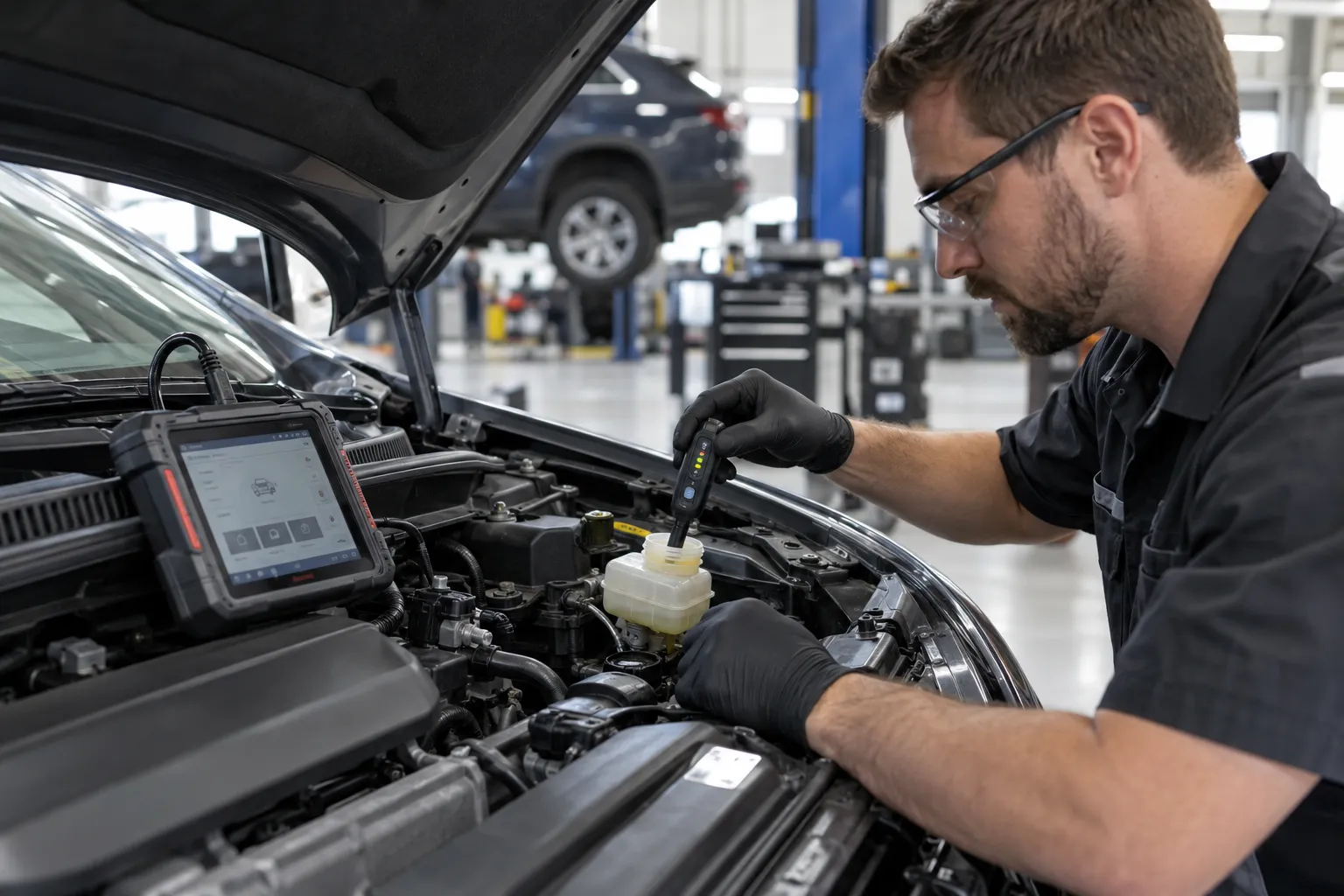
Engine oil is the most consequential example. The ECU monitors oil pressure and, on vehicles with the appropriate sensor, oil level and temperature. It does not monitor oil quality, viscosity breakdown, contamination, or the presence of coolant or fuel dilution at low concentrations. A vehicle running on engine oil that is far past its service life, with degraded viscosity and depleted additives, scans clean as long as oil pressure remains above the minimum threshold. The first OBD2 indication of severe oil degradation may be a bearing knock that has already caused internal damage.
My why does check engine light come on after oil change covers this step by step.
Coolant condition follows the same pattern. Coolant temperature is monitored precisely. Coolant pH, silicate depletion, and whether the coolant is still providing corrosion protection are not. Coolant that has degraded chemically to the point of causing internal corrosion in coolant passages produces no fault code. The first sign of a problem may be a coolant loss or thermostat fault years after internal corrosion has been underway.
Brake fluid moisture content is one of the most safety-relevant blind spots in OBD2 diagnostics. Brake fluid is hygroscopic: it absorbs moisture from the atmosphere through seals and hoses over time. At 3 to 4% water content by volume, the fluid’s boiling point drops by roughly 40 to 50% compared to fresh fluid. Wet brake fluid with this level of moisture contamination can vaporize under repeated hard braking and cause brake fade. No sensor measures brake fluid moisture. No OBD2 code exists for degraded brake fluid regardless of moisture level. The only way to assess brake fluid condition is a moisture content test strip or a refractometer reading.
Transmission fluid condition creates the same gap. The TCM monitors fluid temperature and slip ratios but has no way to detect whether the fluid is burnt, oxidized, or mechanically contaminated. Burnt transmission fluid causes progressively worse shift behavior and accelerated internal wear without generating any code until the slip exceeds the threshold that triggers a P-code or U-code. By that point, the fluid condition has been a problem for some time.
My how to reset transmission adaptations with obd2 scanner covers this step by step.
My guide on the check engine light on but no codes stored covers all seven causes of this exact scenario and the diagnostic sequence for finding the hidden fault.
Outback owners who combine scanner readouts with scheduled CVT fluid changes rather than waiting for warning lights will find my Subaru Outback scanner picks covers which tools provide CVT module access.
The Detection Threshold: Faults That Are Happening with No Code
The ECU’s monitoring system is built around thresholds, not continuous fault flagging. Events below the threshold are tracked but not reported as faults. For a breakdown of how fault codes are structured and what each category covers, my guide to OBD2 codes explained covers the full classification from P-codes through U-codes.
Misfire detection is the clearest example. The ECM counts misfire events per 200 and per 1,000 engine revolutions. Fault codes P0300 through P0308 are set when the misfire rate crosses a specific programmed threshold, typically in the range of 1 to 2% of combustion events depending on the engine and its calibration. A cylinder misfiring at a rate of 1% is producing incomplete combustion events that the ECM is counting, while no code is set and the driver has no indication. The engine is running rough below the threshold. The scan returns nothing. When the misfire rate does cross the threshold, it first appears as a pending code before progressing to an active, confirmed fault.
Catalyst efficiency monitoring works the same way. The catalyst monitor compares upstream and downstream oxygen sensor activity. A P0420 code is set when catalyst efficiency falls below approximately 80%. A catalyst at 82% efficiency is degrading toward that threshold and producing no code. Emission output at 82% efficiency is elevated above what a healthy catalyst produces. The scan is clean. A professional scanner like the Autel MaxiSYS Elite II Pro can access raw catalyst monitor data and compare efficiency trends that a standard code reader cannot reach.
Transmission slip operates under a similar threshold. The TCM compares input and output shaft speeds. Minor slipping below the speed variance threshold that would trigger a code is occurring and wearing clutch pack material without generating any fault. A transmission that slips noticeably under heavy load, but not enough to exceed the TCM’s threshold, produces no code during a routine scan. The driver may feel the behavior. The scanner reports nothing.
Oil pressure monitoring has a minimum threshold below which a code and warning are generated. Oil pressure slightly above that threshold, which may indicate bearing wear or pump degradation, produces no code. The ECU’s oil pressure monitoring is designed to warn of impending failure, not to track the gradual decline toward it.
Physical and Structural Faults OBD2 Cannot See
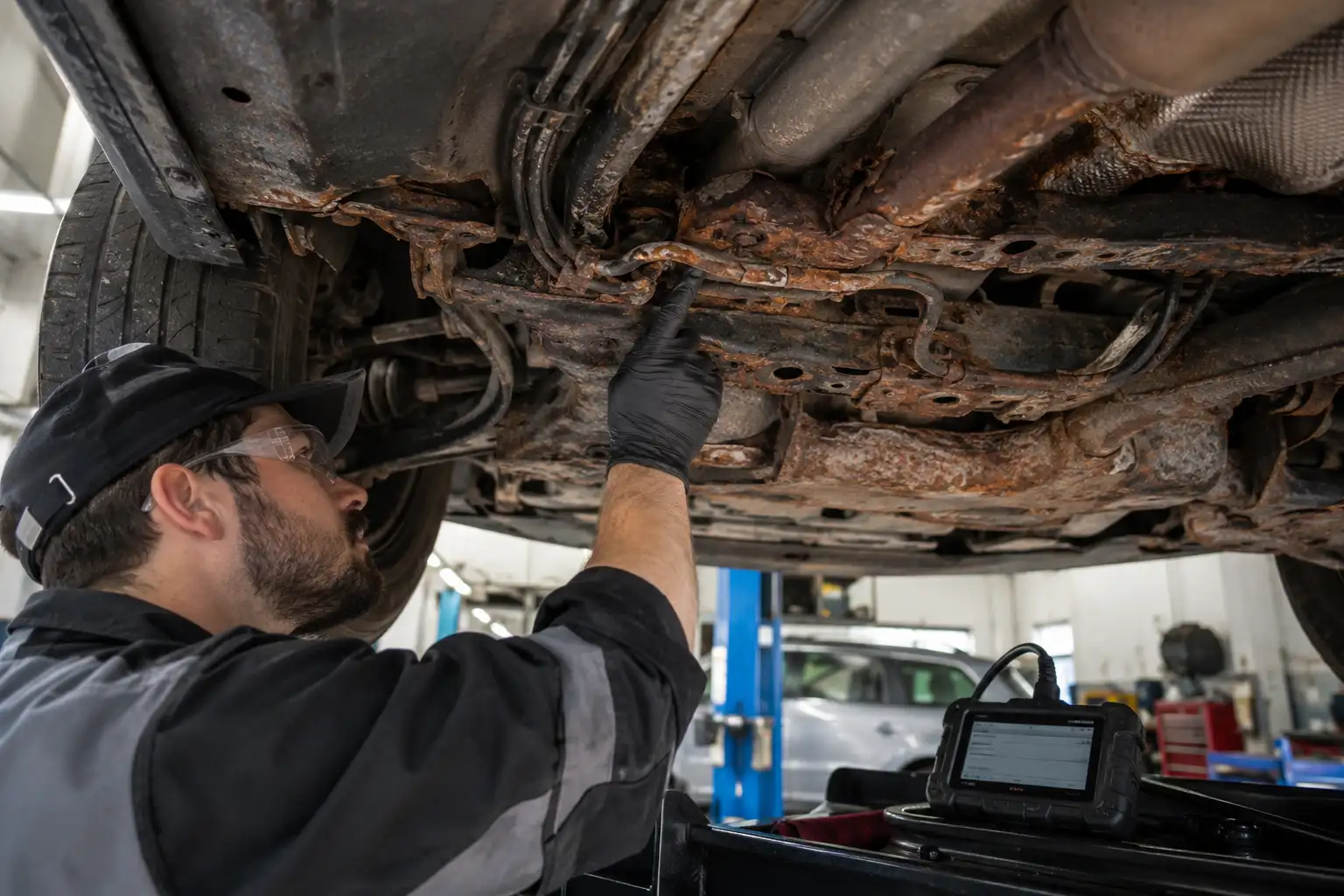
Frame and structural damage from a prior collision are completely outside OBD2’s scope. A vehicle with a bent frame, compromised structural welds, or structural components that were repaired but misaligned scans identically to an undamaged vehicle. No sensor measures frame geometry. No code is generated for structural compromise.
My obd2 codes after car accident covers this step by step.
Underbody rust affecting brake lines, fuel lines, and subframe integrity has no sensor representation. Brake line corrosion that has reduced wall thickness significantly produces no code. The first OBD2 indication of a compromised brake line is typically after failure, when the pressure loss triggers an ABS or stability control fault.
Tire condition is monitored only for pressure on vehicles with TPMS. Tread depth, sidewall damage from curb contact, separation between tread layers, and uneven wear patterns that indicate alignment or suspension problems are completely invisible to any OBD2 scanner. TPMS measures air pressure and reports low pressure. It does not measure structural integrity or tread depth.
The Clean Scan Trap: Concrete Examples
Several specific vehicle conditions consistently produce a clean OBD2 scan despite representing a real mechanical problem:
A transmission with burnt fluid and worn clutch packs that has not yet crossed the TCM’s slip detection threshold: clean scan. A vehicle that was in a prior collision, had structural work done, but was not properly aligned afterward: clean scan. A car with 3.5% moisture content in the brake fluid: clean scan. A timing chain stretched to near the edge of its tensioner adjustment, producing 1.8 degrees of cam timing variance when the ECM threshold for a cam position code is 2 to 3 degrees: clean scan. A cylinder misfiring at 1.2% of combustion events: clean scan.
These are not hypothetical scenarios. They describe the exact gap between what the scanner reports and what a physical inspection, fluid analysis, or compression test would reveal. A clean scan result combined with driver-reported symptoms is a signal to look harder, not a reason to dismiss the concern. For how to combine a scanner check with a mechanic’s physical inspection during a vehicle purchase, see my guide on OBD2 scanner check on a used car.
What OBD2 Actually Does Well
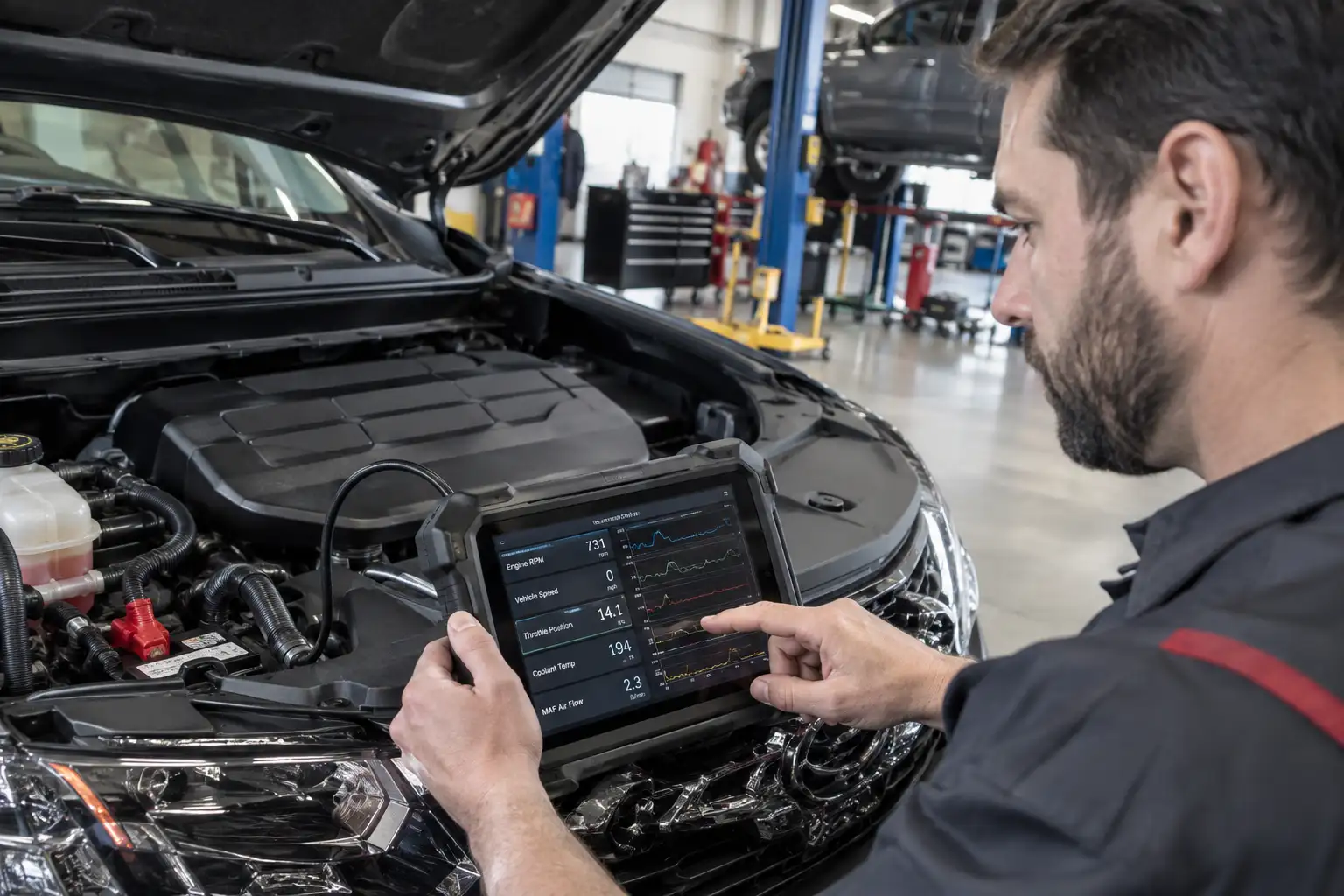
The limitations above are not failures of the OBD2 standard. The standard was designed to monitor emissions-related systems, electrical circuit integrity, and sensor network health. Within that scope, it performs reliably. Oxygen sensor circuit faults and response performance issues, fuel system trim corrections outside the normal operating range, catalyst efficiency below the detection threshold, misfire rates above the calibrated detection rate, evaporative emission system leaks, EGR circuit faults, MAF sensor performance deviations, throttle position circuit issues, module communication failures (U-codes), and ABS wheel speed sensor circuit faults are all caught accurately when present. Beyond fault codes, OBD2 live data adds another layer: fuel trim trends, oxygen sensor switching behavior, and misfire counts per cylinder can reveal developing problems before they cross the code threshold.
The appropriate frame is not that OBD2 is a limited diagnostic tool. It is that OBD2 is a sensor-based monitoring system that reports what its sensors measure. The mechanical, fluid, and structural world that exists beyond those sensors is not its domain by design. For a scanner that extends into ABS and SRS systems beyond the standard OBD2 scope, my full review of the Foxwell NT630 Plus covers its diagnostic reach across both systems.
The Bottom Line
A clean OBD2 scan means no sensor-based fault codes are currently stored above detection thresholds. It does not mean the vehicle has no problems. Brake wear, fluid condition, structural integrity, and below-threshold mechanical faults are all outside the scan’s reach. For a used vehicle purchase or a car with unexplained symptoms and no codes, a physical inspection, a compression test if engine symptoms are present, a brake fluid moisture test, and a visual assessment of fluid conditions deliver information the scanner cannot. The scan is one piece of the diagnostic picture. It is not the whole picture. For the scan portion of this assessment, my guide on how to use an OBD2 scanner covers the complete process including which parameters to read beyond fault codes.
FAQs
Can an OBD2 scanner detect worn brake pads?
No. Brake pad thickness has no sensor that reports to the ECU. No scanner, regardless of capability or price, can read brake pad wear from the OBD2 port. The ABS module monitors wheel speed behavior but does not have access to pad wear measurements. Some vehicles have a dedicated wear sensor that triggers a dashboard warning when the metal wear indicator contacts the rotor, but that is a standalone circuit unrelated to OBD2 diagnostics. The only reliable way to assess brake pad condition is a physical inspection by removing the wheel or looking through the wheel opening with a light.
Will a scanner show if my transmission is failing?
It depends on how far the failure has progressed. Early-stage clutch pack wear, burnt transmission fluid, and minor slip below the TCM’s detection threshold produce no codes. If the transmission has degraded to the point where slip exceeds the TCM’s speed variance threshold, P-codes or U-codes may appear. A scanner can confirm that the transmission has crossed the ECU’s detection threshold. It cannot tell you the transmission is approaching that threshold from below. Symptoms such as delayed engagement, shuddering under load, hesitation between gears, or fluid that smells burnt are more reliable early indicators than a clean scan result.
Can OBD2 detect engine oil problems?
Partially. The ECU monitors oil pressure and, on vehicles with the sensor, oil level. If oil pressure drops below the minimum threshold, a warning and code are generated. What the ECU cannot detect is oil quality, viscosity breakdown, or contamination at concentrations below what affects pressure readings. A vehicle running on severely degraded oil that still maintains minimum oil pressure scans clean. Oil analysis from a lab is the only method that reveals oil condition before pressure-based failure occurs.
My scanner shows no codes. Does that mean my car is fine?
Not necessarily. A clean scan means no sensor-based fault codes are currently stored above detection thresholds. It does not rule out brake wear, fluid degradation, below-threshold mechanical faults, or structural issues. If the vehicle has symptoms such as unusual noises, vibration, delayed shifting, a pulling sensation when braking, or behavior that feels different than it did previously, a clean scan is one piece of information. It rules out ECU-detected faults above threshold. It does not complete the picture on its own.
Can an OBD2 scanner detect a coolant leak?
Only indirectly, and only once the leak has progressed far enough to affect cooling system performance. If a coolant leak causes the level to drop enough to affect temperature regulation, a coolant temperature fault or thermostat efficiency code may eventually appear. Small external leaks that lose coolant slowly, early-stage internal leaks such as a head gasket seeping at low pressure, and leaks that are compensated by refilling produce no code. A cooling system pressure test is the correct diagnostic method for detecting leaks at any stage.
Will a scanner catch suspension problems?
Not directly. Ball joints, control arm bushings, wheel bearings, and shock absorbers have no sensor that reports to the ECU. A severely worn wheel bearing may eventually produce inconsistent ABS wheel speed sensor readings and generate a C-code, but this occurs late in the wear progression, after the bearing has become a safety concern. A physical inspection with the vehicle raised on a lift, checking for play in suspension components by hand, is the only reliable method for identifying suspension wear before it reaches failure.
What does OBD2 actually detect reliably?
OBD2 reliably detects faults in any system that has a sensor connected to the ECU and that has exceeded a programmed threshold. This includes oxygen sensor circuit faults and response performance, fuel system trim corrections outside the normal operating range, catalyst efficiency below the detection threshold, misfire rates above the calibrated detection rate, evaporative emission system leaks, EGR and intake system circuit faults, MAF sensor performance deviations, throttle position circuit issues, module communication failures between ECUs (U-codes), and ABS wheel speed sensor circuit faults on ABS-equipped vehicles. These are well-defined, sensor-reported faults that the scan returns accurately when present.