
The best OBD2 scanner for Hyundai does more than read a check engine light. Hyundai vehicles carry separate control modules for the IVT Intelligent Variable Transmission, the MDPS Motor-Driven Power Steering system, the ABS unit, and the SRS airbag system, and each of those modules can throw fault codes that an engine-only scanner will never reach. A Sonata with a transmission warning, a Tucson with a steering fault, or an Elantra with the ABS light on will all pass silently through a basic code reader with no codes found.

About the author: Hello! I’m Kamil Siegień, founder of OBD2 Scout. My diagnostic experience started with an engine rebuild on a 2014 Skoda Superb 1.8 TSI, where tuning from 160 to 222 hp required mastering live data and ECU behavior that basic code readers cannot handle. I am a former BMW and MINI employee and regularly use diagnostic scanners on my own Audi A4 2.0 TFSI.
Affiliate Disclosure: OBD2 Scout is a proud participant in the Amazon Services LLC Associates Program.
Every tool in this list was chosen because it reaches Hyundai’s full control module architecture: IVT and DCT transmission codes, MDPS fault access, ABS and SRS diagnostics, and where relevant, the service resets that let you complete maintenance without a dealer visit. Eleven tools. Eleven different use cases. One correct answer for each Hyundai owner depending on their model, their warning light, and how deep they need to go.
My Recommended Top 3 Best-Buys
1. BlueDriver Bluetooth Pro
[Best Overall]
- ✓ Reads Hyundai IVT, MDPS, ABS, and SRS codes via app
- ✓ Hyundai repair reports with confirmed fixes from other owners
- ✓ Mode 06 misfire data for P1326 bearing wear detection on Theta II GDI engines before catastrophic failure

62,500+ Verified Reviews
2. ANCEL FX2000
[Best Budget]
- ✓ Engine, IVT transmission, ABS, and SRS in a standalone handheld
- ✓ Reads IVT fault codes engine-only scanners cannot reach
- ✓ Standalone 4.0-inch color screen with no app or annual subscription required after purchase
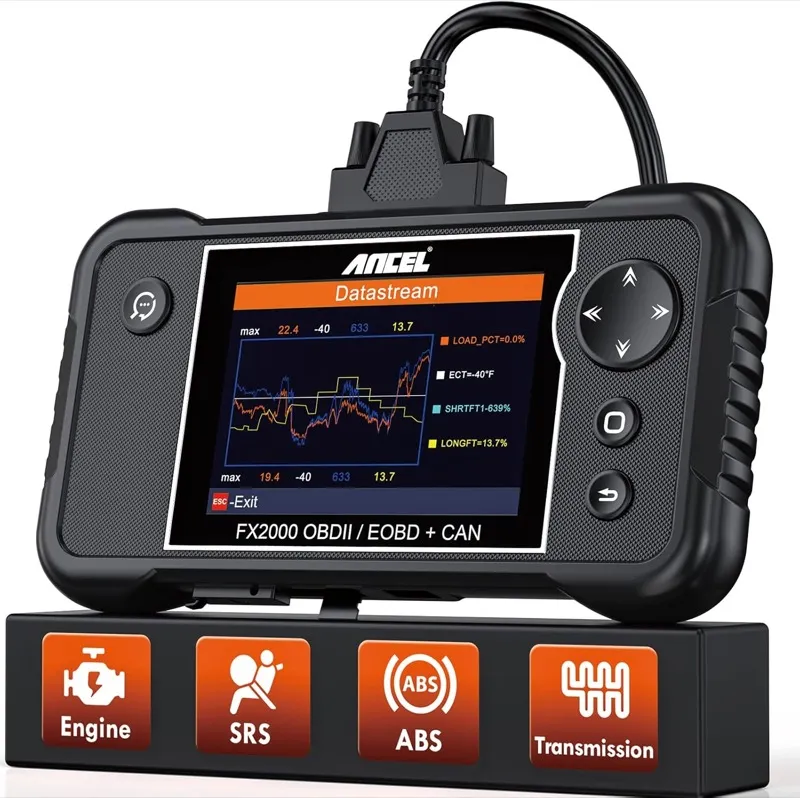
4,500+ Verified Reviews
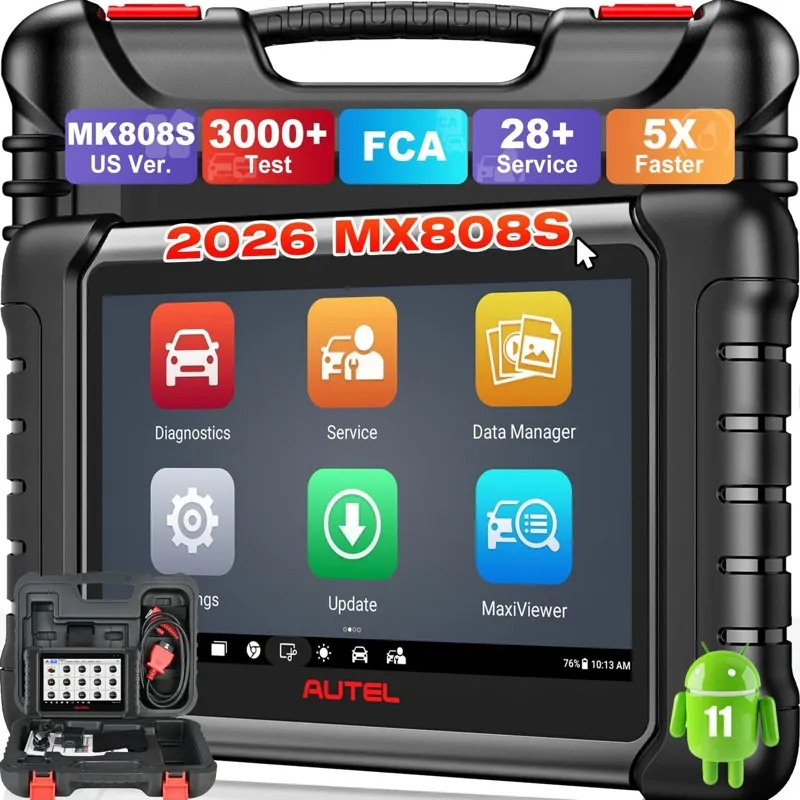
3. Autel MaxiCheck MX808S
[Best Premium]
- ✓ 36+ Hyundai resets: SAS calibration, EPB, BMS, TPMS, throttle
- ✓ Full bidirectional active tests across all Hyundai modules
- ✓ Closest aftermarket equivalent to Hyundai GDS dealer tool
900+ Verified Reviews
11 Best OBD2 Scanners for Hyundai in 2026
1. BlueDriver Bluetooth Pro: Best Overall OBD2 Scanner for Hyundai
- Reads Hyundai IVT transmission, MDPS power steering, ABS, and SRS fault codes through the BlueDriver app, including manufacturer-specific codes the standard OBD2 protocol does not expose
- Hyundai-specific repair reports pull confirmed fixes from other BlueDriver owners who had the same code on the same model year, ranked by how often each fix resolved the fault
- 62,500+ verified Amazon reviews at 4.6 stars, the largest field-proven track record of any Hyundai diagnostic adapter on this list
Overview
BlueDriver earns the top spot on this best OBD2 scanner for Hyundai list because the app is built around your specific vehicle, not generic OBD2 protocol access. When you plug BlueDriver into a Hyundai Sonata, Elantra, Tucson, or Santa Fe and run a scan, the app returns codes from every module the car will share, including the IVT transmission control module, the MDPS power steering module, and the ABS and SRS systems, all interpreted against Hyundai’s own diagnostic database.
The repair report function separates BlueDriver from a standard code reader on Hyundai vehicles. After reading a code, the app pulls a database of actual repairs performed on that code, on that make and model, by other BlueDriver users. A P0700 TCM fault on a Hyundai Tucson gives you a ranked list of what other Tucson owners with the same code actually repaired, starting with the most frequent fix. That narrows the diagnostic path significantly before any parts are touched.
Live data on BlueDriver covers all standard OBD2 PIDs and extends into Hyundai-enhanced parameters beyond the OBD2 standard. You can monitor IVT fluid temperature, individual fuel injector pulse width, knock sensor activity on Theta II engines, and real-time fuel trim data for both short-term and long-term corrections. The graphing function lets you chart multiple parameters simultaneously, which matters for diagnosing intermittent Hyundai Theta II engine symptoms that only appear under specific load conditions.
The trade-off is that BlueDriver has no standalone function. The adapter is a Bluetooth dongle with no screen. Everything runs through the iOS or Android app on your phone. For Hyundai owners comfortable using their phone for diagnostics, this is the most field-tested option in the list by a significant margin.
Diagnostic Features and Capabilities
BlueDriver reads and clears codes from all Hyundai OBD2-accessible modules including engine, IVT transmission, MDPS, ABS, and SRS. Mode 6 data is available for misfire count analysis and catalyst monitor readings. Enhanced live data stream includes Hyundai-specific parameters not available on generic scanners. Freeze frame capture stores sensor values at the moment a fault triggers. I/M readiness monitors show which Hyundai systems are ready for an emissions inspection.
Vehicle Compatibility
Compatible with all Hyundai models from 1996 onward using the standard OBD2 port: Sonata, Elantra, Tucson, Santa Fe, Kona, Ioniq, Accent, Veloster, Azera, Genesis (pre-separation), and Nexo. Depth of enhanced diagnostics varies by model year, with 2005 and newer models returning more complete manufacturer-specific data. Also covers Kia where relevant.
Specifications
| Specification | Details |
|---|---|
| Connection | Bluetooth LE (iOS and Android) |
| Supported Systems | Engine, IVT Transmission, MDPS, ABS, SRS via app |
| OBD2 Functions | Read/clear codes, live data with graphing, freeze frame, I/M readiness, Mode 6 |
| Bidirectional Control | No |
| Service Functions | Oil reset, battery reset via app |
| Vehicle Compatibility | All Hyundai OBD2 models 1996+ |
| Display | App screen (no built-in display) |
| Updates | Free via BlueDriver app |
| Subscription | None |
What’s Included
BlueDriver Bluetooth Pro adapter, quick start guide. The BlueDriver app is a free download on iOS and Android with no subscription fee for core diagnostic functions.
Pros and Cons
| Pros | Cons |
|---|---|
| Reads Hyundai IVT, MDPS, ABS, and SRS codes through the app | Requires a phone for all functions; no standalone operation |
| Hyundai repair reports with ranked confirmed fixes from other owners | |
| 62,500+ verified reviews, the largest track record of any Hyundai adapter in this list | |
| Enhanced Hyundai live data including Theta II knock sensor and IVT fluid temperature | |
| No subscription fee for core diagnostics |
My Final Verdict
BlueDriver Bluetooth Pro is the best OBD2 scanner for Hyundai owners who want full system access, Hyundai-specific code guidance, and a proven track record. The repair report function alone justifies the cost for anyone who has replaced parts based on a generic code description. If you own a Hyundai and want one tool that tells you what is wrong and what other Hyundai owners did to fix it, this is the right choice.
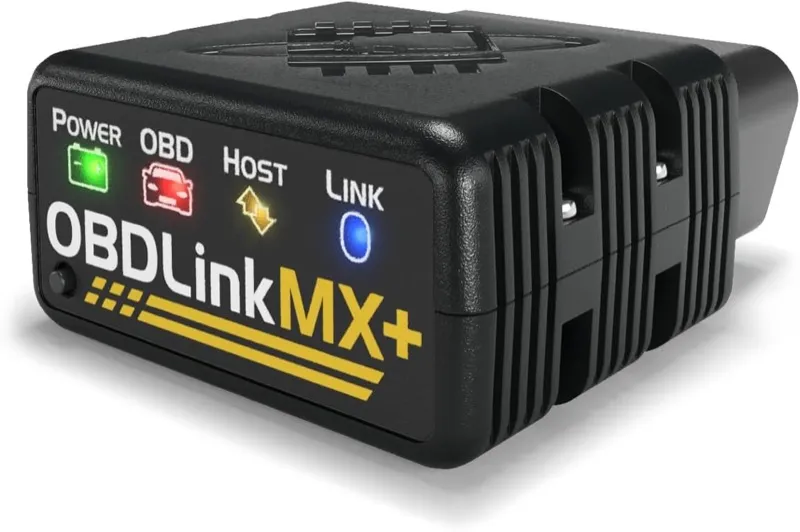
2. OBDLink MX+: Best OBD2 Adapter for Hyundai Live Data Logging
- Fastest Bluetooth data throughput for real-time Hyundai multi-parameter monitoring, roughly ten times faster than generic ELM327 adapters
- Works with extended-PID Hyundai software on iOS, Android, and Windows for manufacturer-specific parameter access beyond standard OBD2
- 50,000+ verified Amazon reviews at 4.6 stars with a three-year warranty
Overview
OBDLink MX+ is the top choice for Hyundai owners who want the deepest live data access through third-party software. Where BlueDriver is a closed system interpreting Hyundai data through its own app, OBDLink MX+ is an open platform that works with any compatible application. For Hyundai enthusiasts who log data on track days, monitor Theta II engine health over time, or use Windows-based diagnostic programs that expose Hyundai’s extended parameter set, the MX+ is the preferred wireless bridge to the OBD2 port.
The speed advantage over other Bluetooth adapters is meaningful for Hyundai live data work. When monitoring IVT fluid temperature, individual injector data, short and long-term fuel trims, and knock sensor activity at the same time, the faster polling rate produces smoother graphs and more accurate time-correlated data. This matters on Theta II engines where understanding the relationship between knock events and fuel trim corrections requires high-frequency simultaneous logging.
For standard diagnostics the OBDLink app handles all OBD2 functions on Hyundai including read/clear codes and live data. For extended Hyundai parameter access beyond the OBD2 standard, the MX+ works with third-party applications that implement Hyundai’s manufacturer-specific protocol. Hyundai IVT control module PIDs and MDPS system data are accessible through compatible software on a Windows laptop paired with the MX+ adapter.
Diagnostic Features and Capabilities
Full OBD2 protocol support including CAN, ISO, VPW, and PWM. Bluetooth 4.0 BLE and Classic Bluetooth plus Wi-Fi for broad device compatibility. OBDLink app provides standard OBD2 diagnostics. Third-party app compatibility exposes extended Hyundai parameter access. Compatible with iOS, Android, and Windows.
Vehicle Compatibility
Compatible with all OBD2 Hyundai vehicles from 1996 onward. Extended Hyundai PID access depends on the third-party application used. Multi-brand compatibility across all OBD2 vehicles.
Specifications
| Specification | Details |
|---|---|
| Connection | Bluetooth 4.0 BLE, Classic BT, Wi-Fi |
| Supported Systems | OBD2 standard + extended via third-party apps |
| OBD2 Functions | Read/clear codes, live data, freeze frame, I/M readiness |
| Bidirectional Control | App-dependent |
| Service Functions | Via third-party apps |
| Vehicle Compatibility | All Hyundai OBD2 models 1996+; multi-brand |
| Display | App screen (no built-in display) |
| Updates | Free firmware updates via OBDLink app |
| Subscription | None |
What’s Included
OBDLink MX+ adapter, quick start guide. OBDLink app is free on iOS and Android. Compatible with a wide range of third-party OBD2 applications.
Pros and Cons
| Pros | Cons |
|---|---|
| Fastest Bluetooth live data for Hyundai multi-parameter logging | Advanced Hyundai PID access requires third-party app knowledge |
| Works with extended Hyundai PID software on iOS, Android, and Windows | |
| 50,000+ verified reviews confirm real-world reliability | |
| Three-year warranty, the longest coverage in this list | |
| No subscription fee |
My Final Verdict
OBDLink MX+ is the right Hyundai Bluetooth adapter for owners who log data and want the fastest, most compatible wireless connection. The speed advantage matters when monitoring multiple Hyundai parameters at once. For a Hyundai owner who just needs to read and clear codes, BlueDriver or the ANCEL FX2000 are more immediately useful.
3. ANCEL FX2000: Best Budget OBD2 Scanner for Hyundai
- Covers engine, IVT Intelligent Variable Transmission, ABS, and SRS in a standalone handheld with no phone required
- Reads IVT fault codes including P0700, P0868, and transmission fluid pressure codes that engine-only scanners cannot reach on Hyundai
- 4,500+ verified Amazon reviews at 4.3 stars confirm compatibility across Korean import vehicles including all Hyundai models
Overview
The ANCEL FX2000 earns the budget pick for Hyundai because it covers the four systems that matter most at the lowest price in this list. Hyundai owners with a transmission warning light need IVT code access, not just engine diagnostics. The FX2000 includes the transmission module as one of its four covered systems, which means a Hyundai Sonata with a P0700 TCM fault or a Tucson with an IVT fluid pressure code returns an actual code rather than a blank result. That single capability separates the FX2000 from basic code readers that only see the engine.
The tool operates standalone with no phone required. Plug it into the OBD2 port, select your Hyundai’s make and model, and run a full 4-system scan. The color screen displays codes with descriptions, live data, and freeze frame data without any additional setup. For a Hyundai owner who wants a dedicated tool that lives in the glove box and works immediately, the FX2000 is the straightforward choice at the lowest price in the list.
Live data covers all standard OBD2 parameters on Hyundai including engine load, coolant temperature, fuel trims, O2 sensor data, and transmission fluid temperature. Theta II engine owners can monitor knock sensor status and short-term fuel corrections in real time. Oil life reset handles the maintenance interval after an oil change on Hyundai models that store this indicator.
Diagnostic Features and Capabilities
Reads and clears codes from engine, IVT transmission, ABS, and SRS on Hyundai. Full live data stream with graphing capability. Freeze frame capture. OBD2 readiness monitor for emissions testing. Oil life reset. AutoVIN vehicle identification.
Vehicle Compatibility
Compatible with all OBD2-compliant Hyundai vehicles from 1996 onward: Sonata, Elantra, Tucson, Santa Fe, Kona, Ioniq, Veloster, Accent, Azera, and Nexo. Multi-brand compatibility covers domestic and import vehicles.
Specifications
| Specification | Details |
|---|---|
| Connection | Wired OBD2 |
| Supported Systems | Engine, IVT Transmission, ABS, SRS |
| OBD2 Functions | Read/clear codes, live data with graphing, freeze frame, I/M readiness |
| Bidirectional Control | No |
| Service Functions | Oil life reset |
| Vehicle Compatibility | All Hyundai OBD2 models 1996+; multi-brand |
| Display | Color screen |
| Updates | Free via ANCEL website |
| Subscription | None |
What’s Included
ANCEL FX2000 scanner, OBD2 cable, user manual. Free software updates via the ANCEL website.
Pros and Cons
| Pros | Cons |
|---|---|
| Reads Hyundai IVT fault codes; the function a basic code reader misses | No bidirectional active tests or advanced resets beyond oil life |
| Standalone handheld with no phone required | |
| 4,500+ verified reviews confirm compatibility on Korean import vehicles | |
| Color screen with live data graphing and freeze frame | |
| Lowest price in this list for genuine 4-system Hyundai coverage |
My Final Verdict
The ANCEL FX2000 is the right starting point for Hyundai owners who need a reliable standalone scanner that reads IVT fault codes without spending on features they will not use. The 4-system coverage handles the check engine, transmission warning, ABS, and airbag lights that cover the majority of Hyundai dashboard events.
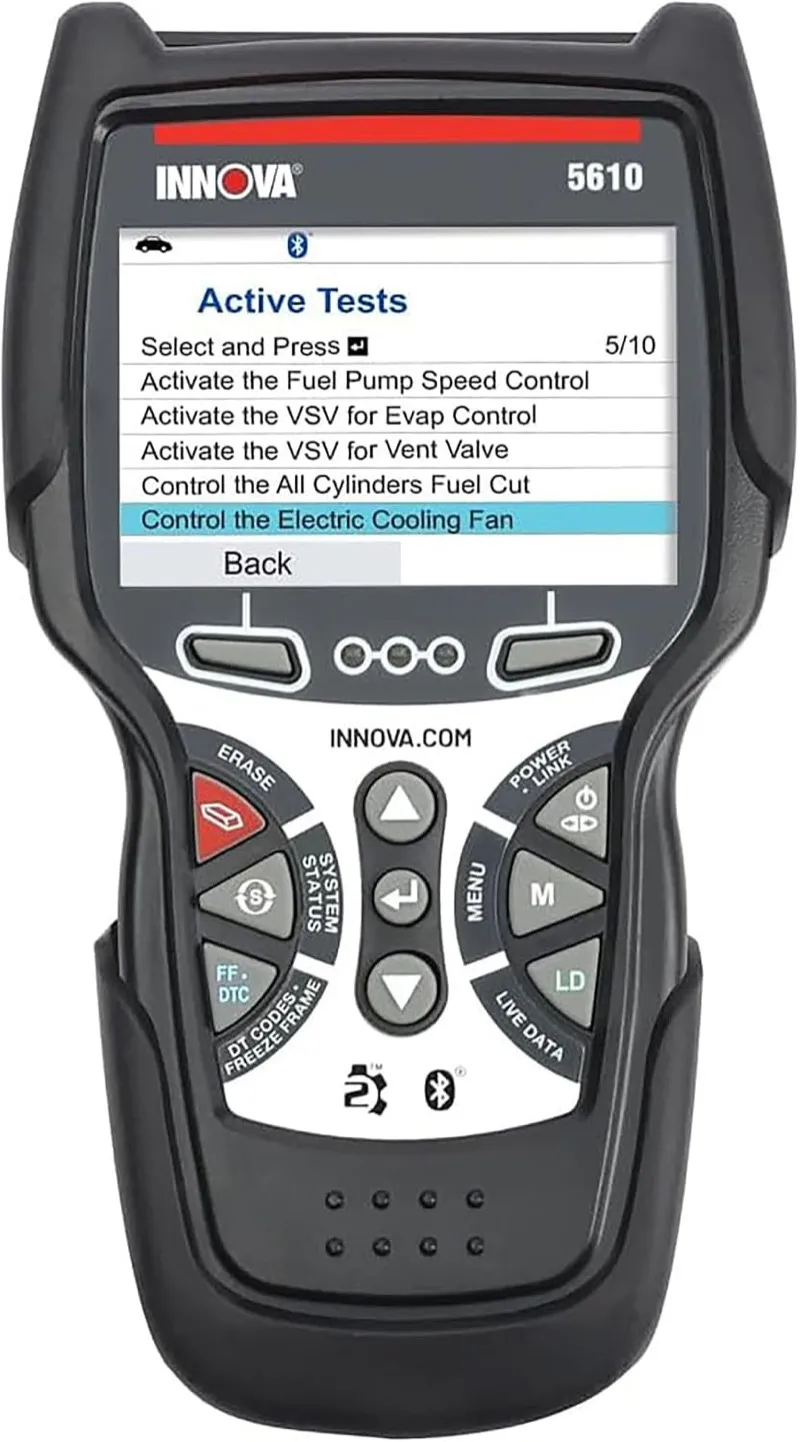
4. Innova 5610: Best Standalone Bidirectional OBD2 Scanner for Hyundai
- Full bidirectional active tests on Hyundai components without a phone or app, commanding actuators directly from the handheld unit
- US-based technical support and RepairSolutions2 app integration for Hyundai-verified repair guidance after reading codes
- 3,600+ verified Amazon reviews at 4.4 stars with no annual subscription fee for any function
Overview
The Innova 5610 occupies a distinct position on this list: it is the only scanner here that combines full bidirectional active testing with a standalone wired interface, US-based technical support, and no subscription fee. For a Hyundai owner who wants to perform active component tests without depending on an app, and who prefers to call a US support line when they have a question about a specific Hyundai code, the 5610 provides that combination at a mid-range price.
Bidirectional control on the 5610 means you can command Hyundai components directly during diagnosis. The cooling fan can be activated to confirm it responds before chasing an overheating fault. Fuel injectors can be cycled individually to test contribution. The ABS pump can be activated to verify pressure before attributing an ABS fault to a sensor. These active tests confirm whether a component actually responds before deciding to replace it, which matters on Hyundai vehicles where parts are not always the cheapest.
The RepairSolutions2 app integration is optional but useful. After reading codes on the 5610, the app cross-references the code against Innova’s repair database and returns verified fixes for that code on that Hyundai model. The 5610 works fully without the app, but connecting it adds another layer of Hyundai-specific guidance that rivals BlueDriver’s repair report function.
Diagnostic Features and Capabilities
Full system diagnostics on Hyundai including engine, transmission, ABS, and SRS. Bidirectional active tests for Hyundai component verification. Oil reset, EPB retraction, battery registration, TPMS relearn, and SAS calibration service functions. Live data with multi-channel graphing. Freeze frame capture. I/M readiness status. AutoVIN. US-based technical support. Lifetime free updates included.
Vehicle Compatibility
Compatible with all OBD2 Hyundai vehicles from 1996 onward. Bidirectional and service function coverage is strongest on 2006 and newer models. Multi-brand compatibility across domestic, Asian, and European vehicles.
Specifications
| Specification | Details |
|---|---|
| Connection | Wired OBD2 |
| Supported Systems | Engine, Transmission, ABS, SRS |
| OBD2 Functions | Read/clear codes, live data with graphing, freeze frame, I/M readiness |
| Bidirectional Control | Yes |
| Service Functions | Oil reset, EPB retraction, BMS, TPMS, SAS calibration |
| Vehicle Compatibility | All Hyundai OBD2 models 1996+; multi-brand |
| Display | Color screen |
| Updates | Free lifetime updates included |
| Subscription | None |
What’s Included
Innova 5610 scanner, OBD2 cable, user manual, USB cable. Lifetime free updates. RepairSolutions2 app available on iOS and Android as optional companion.
Pros and Cons
| Pros | Cons |
|---|---|
| Bidirectional active tests on Hyundai components without a phone or app | Smaller review base than BlueDriver or ANCEL FX2000 at a higher price point |
| US-based technical support for Hyundai diagnostic questions | |
| No subscription fee for any function including bidirectional and service resets | |
| SAS calibration, EPB retraction, and BMS reset cover the most common Hyundai service needs | |
| RepairSolutions2 app adds Hyundai repair guidance after code reading |
My Final Verdict
The Innova 5610 is the right tool for Hyundai owners who want bidirectional capability and key service resets without a subscription, and who value accessible US support when a Hyundai code is unclear. It covers more ground than the ANCEL FX2000 at a higher price, and it avoids the update subscription that Autel requires after year one.
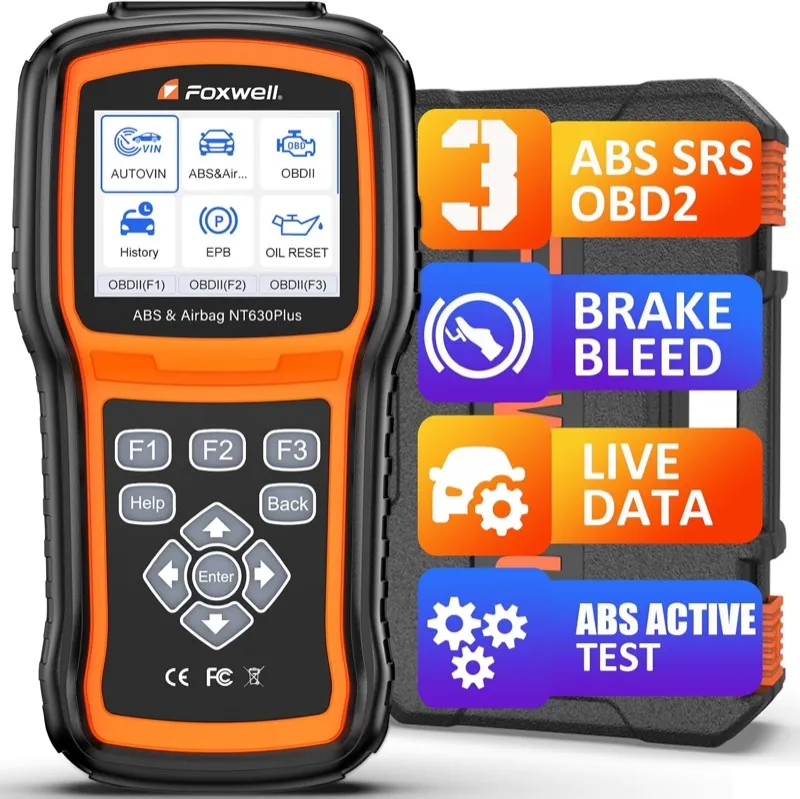
5. Foxwell NT630 Plus: Best OBD2 Scanner for Hyundai ABS Brake Service
- ABS auto-bleed function for Hyundai brake service, electronically activating the ABS pump to purge trapped air from the Mando and Bosch ABS modulators on Sonata, Tucson, and Elantra
- Reads and clears ABS and SRS fault codes across all Hyundai models from 1996 onward
- 4,000+ verified Amazon reviews at 4.4 stars with confirmed Hyundai ABS module compatibility
Overview
The Foxwell NT630 Plus is the most focused Hyundai ABS service tool in this list. Its core function is ABS auto-bleed: the electronic activation of the ABS pump motor required to properly bleed the ABS modulator on Hyundai Sonata, Tucson, and Elantra brake systems. Hyundai’s ABS modulators trap air in the hydraulic circuit during a brake fluid flush or caliper replacement, and standard manual bleed procedures often fail to clear the modulator completely. The NT630 Plus cycles the modulator through the OBD2 port, purging trapped air in a controlled sequence.
Beyond ABS service, the NT630 Plus reads and clears fault codes from the ABS and SRS modules across all Hyundai models, identifying which sensor or circuit triggered the warning light. ABS wheel speed sensor faults, hydraulic unit faults, and airbag module communication errors return specific codes rather than a generic warning. Engine OBD2 diagnostics are also included for check engine light diagnosis alongside the safety system coverage.
Diagnostic Features and Capabilities
ABS auto-bleed for Hyundai. ABS and SRS full code read and clear. Engine OBD2 diagnostics including read/clear codes, live data, and freeze frame. ABS wheel speed sensor live data. Oil life reset. I/M readiness monitor.
Vehicle Compatibility
Compatible with all Hyundai OBD2 vehicles from 1996 onward. ABS auto-bleed confirmed on Mando and Bosch ABS module variants fitted to Sonata, Elantra, Tucson, Santa Fe, and Kona. Multi-brand compatibility for households with multiple vehicle makes.
Specifications
| Specification | Details |
|---|---|
| Connection | Wired OBD2 |
| Supported Systems | Engine, ABS, SRS |
| OBD2 Functions | Read/clear codes, live data, freeze frame, I/M readiness |
| Bidirectional Control | ABS bleed only |
| Service Functions | Oil life reset, ABS auto-bleed |
| Vehicle Compatibility | All Hyundai OBD2 models 1996+; multi-brand |
| Display | Color screen |
| Updates | Free via Foxwell website |
| Subscription | None |
What’s Included
Foxwell NT630 Plus scanner, OBD2 cable, USB update cable, user manual. Free software updates from Foxwell website.
Pros and Cons
| Pros | Cons |
|---|---|
| ABS auto-bleed for Hyundai brake service on Mando and Bosch ABS modulators | No IVT transmission module access; not suitable for transmission warning lights |
| Reads and clears ABS and SRS fault codes across all Hyundai models | |
| 4,000+ verified reviews with confirmed Hyundai ABS compatibility | |
| Oil life reset included for post-service maintenance clearing | |
| Free lifetime software updates via Foxwell website |
My Final Verdict
The Foxwell NT630 Plus is the right tool for Hyundai owners who service their own brakes and need the ABS bleed function, or for owners diagnosing ABS and SRS warning lights specifically. If the IVT transmission module also matters, step up to the ANCEL FX2000 or above.
6. Autel MaxiCheck MX808S: Best Premium OBD2 Scanner for Hyundai
- 36+ Hyundai service resets including SAS steering angle calibration, EPB retraction, BMS battery registration, TPMS relearn, and throttle adaptation
- Full bidirectional active tests and ECU coding across all Hyundai control modules
- Closest aftermarket equivalent to the Hyundai GDS dealer diagnostic tool for routine service and maintenance
Overview
The Autel MX808S is the most capable aftermarket Hyundai diagnostic tool in this list. Hyundai’s dealer tool, the GDS (Global Diagnostic System), provides access to every module, runs bidirectional active tests, performs ADAS calibration, and programs replacement control units. The MX808S covers the majority of what the GDS does for everyday maintenance and diagnostics, at a fraction of the dealer tool cost, without the subscription the GDS requires.
The SAS steering angle sensor calibration is one of the most frequently needed Hyundai resets that basic scanners cannot perform. After any alignment work, suspension component replacement, or steering rack service on a Hyundai, the SAS must be recalibrated or the stability control system operates incorrectly. The MX808S executes this calibration directly through the OBD2 port. No separate calibration tool, no dealer visit, no labor charge for a ten-minute procedure.
BMS battery registration is the other Hyundai reset that matters most. When replacing a battery on a newer Hyundai, the battery management module must register the new battery’s specifications for the alternator charging strategy to function correctly. Skipping registration results in chronic undercharging or overcharging. The MX808S handles this reset alongside EPB retraction for rear caliper service, TPMS sensor registration, throttle adaptation, and IVT fluid life reset where applicable.
Diagnostic Features and Capabilities
Full system diagnostics across all Hyundai modules. Bidirectional active tests and ECU coding. 36+ service resets: SAS calibration, EPB retraction, BMS battery registration, oil service, TPMS relearn, throttle adaptation, IVT fluid reset, brake deceleration sensor, and more. Live data graphing with record and playback. Fusion topology mapping shows all modules and communication status. Full OBD2 coverage.
Vehicle Compatibility
Compatible with all Hyundai models from 1996 onward. Expanded Hyundai-specific coverage is strongest on 2005 and newer models. Supports over 80 vehicle makes globally.
Specifications
| Specification | Details |
|---|---|
| Connection | Wired OBD2 (Wi-Fi for updates) |
| Supported Systems | All Hyundai systems including IVT, MDPS, ABS, SRS, body |
| OBD2 Functions | Read/clear codes, live data with graphing and playback, freeze frame, I/M readiness |
| Bidirectional Control | Yes, plus ECU coding |
| Service Functions | 36+ including SAS, EPB, BMS, TPMS, oil, throttle adaptation, IVT fluid reset |
| Vehicle Compatibility | All Hyundai OBD2 models 1996+; 80+ brands |
| Display | 7-inch Android touchscreen |
| Updates | 1 year included; annual subscription after year one |
| Subscription | Required after year one for continued updates |
What’s Included
Autel MX808S tablet, OBD2 cable, USB charging cable, user manual. Wi-Fi software updates via Autel MaxiUpdate Pro (first year included).
Pros and Cons
| Pros | Cons |
|---|---|
| SAS calibration, EPB retraction, and BMS registration cover the most critical Hyundai service resets | Annual software update fee applies after the first year |
| Full bidirectional active tests across all Hyundai modules | |
| Closest aftermarket equivalent to the Hyundai GDS dealer tool | |
| 36+ service resets handle maintenance procedures dealers charge labor for | |
| ECU coding capability for Hyundai module configuration | |
| 7-inch Android touchscreen with Hyundai-specific module navigation |
My Final Verdict
The Autel MX808S is the correct choice for Hyundai owners who want to service their vehicle at home at a level that approaches dealer capability. The SAS calibration, BMS registration, and EPB retraction alone save more than the scanner’s cost the first time they are needed. If you maintain a Hyundai long-term and want to avoid dealership labor costs for routine resets, the MX808S pays for itself quickly.
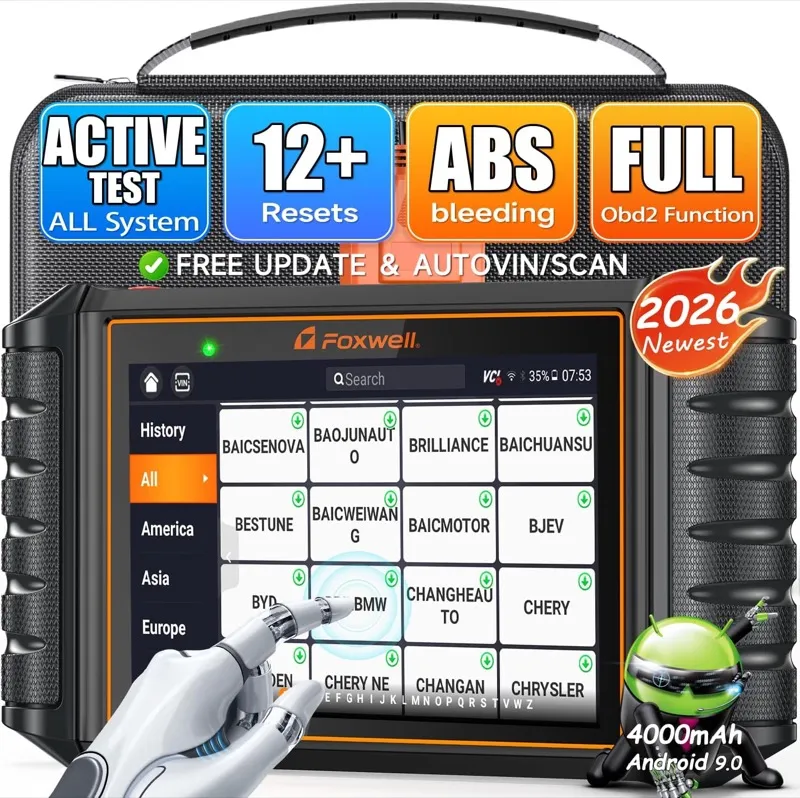
7. Foxwell NT726: Best Mid-Range Bidirectional OBD2 Scanner for Hyundai
- Full bidirectional active tests on Hyundai modules at a mid-range price, with component verification before replacement across IVT, MDPS, ABS, and body systems
- ABS auto-bleed and EPB retraction for Hyundai brake service without reaching premium tier pricing
- Full Hyundai system coverage with 2026 firmware and free lifetime software updates
Overview
The Foxwell NT726 fills the gap between a basic multi-system reader and the full professional capability of the Autel MX808S. It covers all Hyundai systems, runs bidirectional active tests, and includes the service resets Hyundai owners most commonly need, at a price well below the premium tier. For a Hyundai owner who needs more than code reading but does not need SAS calibration or BMS registration specifically, the NT726 is the practical middle ground.
Bidirectional active testing on the NT726 lets you command Hyundai components directly. Individual injectors can be toggled for cylinder contribution testing on Theta II engines. The ABS pump can be activated to verify pressure. Cooling fans can be commanded to confirm operation. These active tests confirm whether a component responds before a replacement decision is made, which is the key capability that separates the NT726 from the scanners below it in price.
The ABS auto-bleed function handles the brake service procedure on Hyundai Sonata and Tucson models where the ABS modulator traps air during a fluid flush. The EPB retraction function compresses rear caliper pistons for pad replacement on Hyundais with electronic parking brake actuators, which is the correct procedure for those models rather than manually winding the pistons.
Diagnostic Features and Capabilities
Full all-system diagnostics on Hyundai including IVT, MDPS, ABS, SRS, and body modules. Bidirectional active tests. Service resets: oil interval, EPB retraction, TPMS relearn, ABS auto-bleed. Live data with multi-channel graphing. Freeze frame capture. AutoVIN. I/M readiness status.
Vehicle Compatibility
Compatible with all Hyundai OBD2 vehicles from 1996 onward. Updated 2026 firmware covers recent Hyundai model years. Multi-brand coverage across domestic and import vehicles.
Specifications
| Specification | Details |
|---|---|
| Connection | Wired OBD2 |
| Supported Systems | All systems including IVT, MDPS, ABS, SRS, body |
| OBD2 Functions | Read/clear codes, live data with graphing, freeze frame, I/M readiness |
| Bidirectional Control | Yes |
| Service Functions | Oil reset, EPB retraction, TPMS relearn, ABS auto-bleed |
| Vehicle Compatibility | All Hyundai OBD2 models 1996+; multi-brand |
| Display | Color screen |
| Updates | Free lifetime via Foxwell website |
| Subscription | None |
What’s Included
Foxwell NT726 scanner, OBD2 cable, USB update cable, user manual. Free software updates via Foxwell website.
Pros and Cons
| Pros | Cons |
|---|---|
| Bidirectional active tests at mid-range price with Hyundai component verification | Newer 2026 model with a shorter field track record than established alternatives |
| ABS auto-bleed and EPB retraction for Hyundai brake service | |
| Full system coverage: IVT, MDPS, ABS, SRS, and body modules | |
| Free lifetime software updates with 2026 Hyundai model year coverage | |
| No subscription fee |
My Final Verdict
The Foxwell NT726 is the best-value bidirectional scanner for Hyundai owners who need active testing and ABS brake service capability without paying the premium tier price. The combination of full-system Hyundai coverage, bidirectional controls, and ABS auto-bleed makes it a capable everyday tool. The 2026 firmware and free lifetime updates add long-term value.
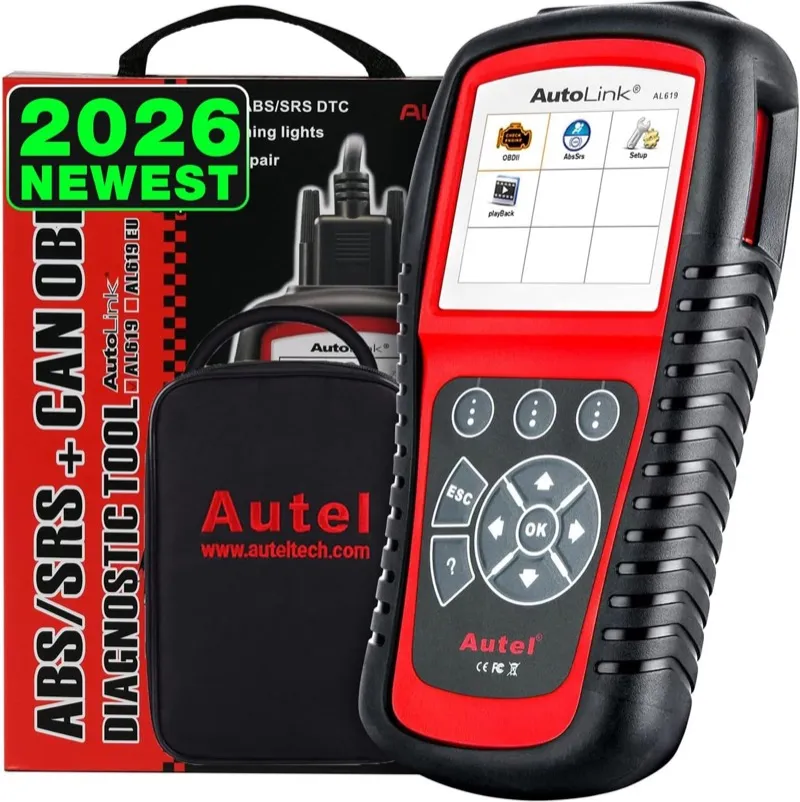
8. Autel AutoLink AL619: Best OBD2 Scanner for Hyundai ABS and SRS Warning Lights
- Reads and clears ABS and SRS fault codes on all Hyundai models from 1996 onward, covering wheel speed sensor faults, airbag module errors, and seat belt pretensioner codes
- Engine OBD2 code access alongside ABS and SRS coverage for complete warning light diagnosis in one tool
- AutoVIN automatically identifies your Hyundai at startup without manual make, model, and year entry
Overview
The Autel AL619 is the most direct ABS and SRS scanner in this list for Hyundai. Its purpose is narrow: read and clear ABS warning lights and airbag lights on Hyundai vehicles, plus handle standard engine OBD2 codes. For a Hyundai owner whose only concern is a lit ABS or SRS light, the AL619 provides exactly the coverage needed without the cost of a more capable scanner.
Hyundai ABS warning lights commonly result from wheel speed sensor faults, ABS module communication errors, or brake fluid level triggering the pressure sensor. The AL619 identifies the specific fault code from the ABS module and clears it once the underlying cause is repaired. SRS airbag faults, seat belt pretensioner codes, and airbag control module communication errors are also covered. Live data is available for ABS wheel speed sensors to confirm a replaced sensor is functioning correctly before the fault code is cleared.
Diagnostic Features and Capabilities
Engine OBD2 read and clear. ABS module code read and clear. SRS airbag module code read and clear. Live data for engine and ABS parameters. Freeze frame capture. I/M readiness status. AutoVIN automatic vehicle identification.
Vehicle Compatibility
Compatible with all Hyundai OBD2 vehicles from 1996 onward. ABS and SRS module access confirmed across all Hyundai models. Multi-brand compatibility for domestic and import vehicles.
Specifications
| Specification | Details |
|---|---|
| Connection | Wired OBD2 |
| Supported Systems | Engine, ABS, SRS |
| OBD2 Functions | Read/clear codes, live data, freeze frame, I/M readiness |
| Bidirectional Control | No |
| Service Functions | None |
| Vehicle Compatibility | All Hyundai OBD2 models 1996+; multi-brand |
| Display | Color screen |
| Updates | Free via Autel MaxiUpdate |
| Subscription | None |
What’s Included
Autel AL619 scanner, OBD2 cable, user manual. Free software updates via Autel MaxiUpdate.
Pros and Cons
| Pros | Cons |
|---|---|
| Direct ABS and SRS fault code access at the lowest 3-system price in this list | No IVT or MDPS module access; not suitable for transmission or steering warning lights |
| AutoVIN loads the correct Hyundai diagnostic profile automatically at startup | |
| Autel brand reliability on a focused Hyundai safety system tool | |
| Live ABS wheel speed data confirms sensor replacement before code clear | |
| Engine OBD2 coverage handles check engine light alongside ABS and SRS |
My Final Verdict
The Autel AL619 is the right tool for a Hyundai owner who needs to read and clear an ABS or SRS warning light without spending on capabilities they will not use. If you also need IVT access, the ANCEL FX2000 delivers that at a similar price.
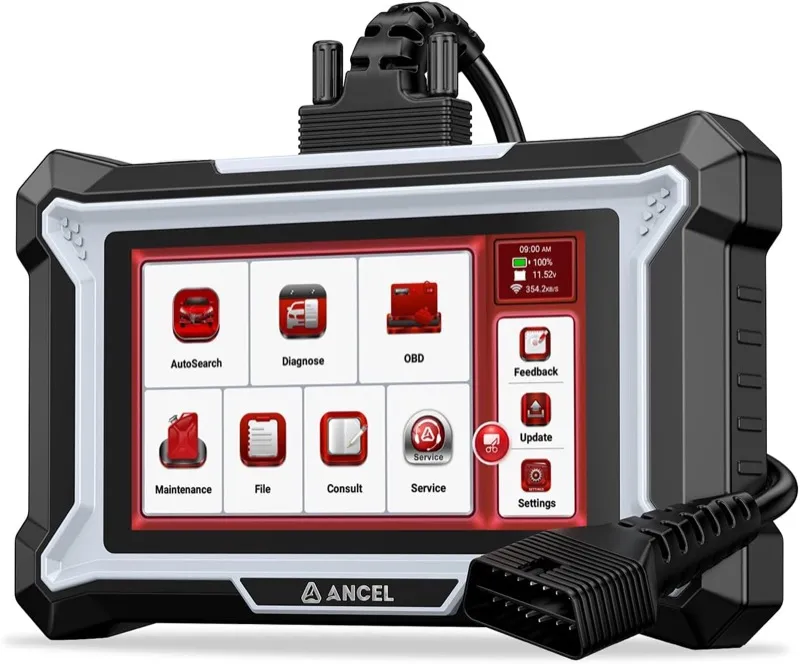
9. ANCEL DS100: Best Touchscreen OBD2 Scanner for Hyundai
- Touchscreen 4-system scanner that reads IVT fault codes alongside engine, ABS, and SRS on all Hyundai models
- AutoVIN pulls the Hyundai VIN directly from the OBD2 port and loads the correct diagnostic profile without manual entry
- 5,150+ verified Amazon reviews at 4.3 stars confirm reliability across Korean and Japanese import vehicles
Overview
The ANCEL DS100 offers the same 4-system Hyundai diagnostic coverage as the ANCEL FX2000 in a touchscreen format. For Hyundai owners who prefer a touch interface over physical buttons for navigating between system menus, the DS100 provides engine, IVT transmission, ABS, and SRS code access with a faster and more modern display experience. Scrolling through Hyundai live data parameters and switching between IVT and engine modules is faster via touchscreen than button-based navigation on traditional handhelds.
AutoVIN identifies your Hyundai automatically when you connect and power on the scanner, pulling the VIN directly from the OBD2 port and loading the correct Hyundai diagnostic profile. Having the correct vehicle profile loaded before scanning ensures the DS100 polls the right module addresses, which matters on Hyundai vehicles where the IVT and MDPS modules sit at specific addresses that generic scanning can miss.
The DS100 has a meaningfully larger review base than the FX2000 alternative at 5,150+ reviews, confirming consistent compatibility across Hyundai’s lineup. The IVT module access is the same as the FX2000, making the DS100 the better choice for owners who value the larger review count and prefer the touch interface. Neither tool performs bidirectional tests or advanced service resets; for those functions, the Foxwell NT726 or Autel MX808S are the correct step up.
Diagnostic Features and Capabilities
4-system diagnostics: engine, IVT transmission, ABS, SRS. AutoVIN for automatic Hyundai identification. Touchscreen interface for system navigation. Live data with graphing. Freeze frame capture. Oil life reset. I/M readiness status. Full OBD2 function coverage.
Vehicle Compatibility
Compatible with all Hyundai OBD2 vehicles from 1996 onward. 4-system coverage confirmed across Sonata, Elantra, Tucson, Santa Fe, Kona, Ioniq, Veloster, and Accent. Multi-brand support.
Specifications
| Specification | Details |
|---|---|
| Connection | Wired OBD2 |
| Supported Systems | Engine, IVT Transmission, ABS, SRS |
| OBD2 Functions | Read/clear codes, live data with graphing, freeze frame, I/M readiness |
| Bidirectional Control | No |
| Service Functions | Oil life reset |
| Vehicle Compatibility | All Hyundai OBD2 models 1996+; multi-brand |
| Display | Touchscreen |
| Updates | Free via ANCEL website |
| Subscription | None |
What’s Included
ANCEL DS100 scanner, OBD2 cable, user manual. Free software updates via ANCEL website.
Pros and Cons
| Pros | Cons |
|---|---|
| Touchscreen interface for faster Hyundai system navigation | No bidirectional tests or advanced resets; same capability ceiling as ANCEL FX2000 |
| IVT transmission module access at 4-system budget pricing | |
| 5,150+ verified reviews, the largest review count for a budget 4-system tool in this list | |
| AutoVIN loads correct Hyundai profile without manual entry | |
| Live data graphing for intermittent Hyundai fault diagnosis |
My Final Verdict
The ANCEL DS100 is the right choice for a Hyundai owner who wants 4-system IVT-capable diagnostics in a touchscreen format. It delivers the same core coverage as the ANCEL FX2000 with a different interface and a larger review base. If the touchscreen matters to you, the DS100 is the way to get it without giving up IVT access.
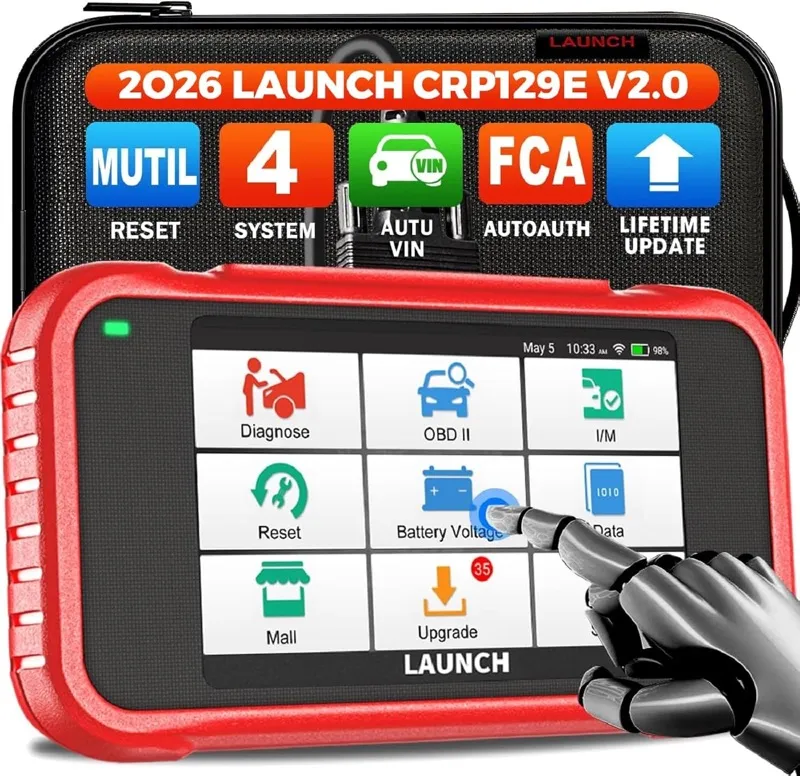
10. Launch CRP129E: Best OBD2 Scanner for Hyundai Service Resets
- 12 service resets including SAS steering angle calibration, EPB retraction, BMS battery registration, TPMS, throttle adaptation, and injector coding at a mid-range price
- 4-system code access covering engine, IVT transmission, ABS, and SRS on all Hyundai models
- 3,595+ verified Amazon reviews at 4.7 stars, the highest star rating of any scanner in this list
Overview
The Launch CRP129E occupies a unique position on this list: it offers more Hyundai service resets than any other scanner in this price range, but it does not perform bidirectional active tests. For a Hyundai owner whose primary need is performing the resets that normally require a dealer visit, but who does not need to command actuators or run component output tests, the CRP129E provides the right combination of capabilities at a mid-range price.
The SAS steering angle calibration on the CRP129E covers the most frequently needed Hyundai reset after alignment work. The BMS battery registration handles battery replacement correctly. EPB retraction enables rear caliper service. Throttle adaptation resets the throttle body after cleaning or replacement on Theta II engines. Injector coding handles replacement injector calibration. These twelve resets cover the full scope of routine Hyundai maintenance that most dealers charge separately for each service.
The 4.7-star rating across 3,595 reviews is the highest customer satisfaction score in this list, which reflects the CRP129E’s reputation for doing exactly what it claims without unnecessary complexity. It is not the deepest Hyundai diagnostic tool; it does not run active tests or provide Hyundai-specific repair guidance. For reset capability at a non-premium price, it has no equivalent in this list.
Diagnostic Features and Capabilities
4-system code read and clear: engine, IVT transmission, ABS, SRS. 12 service resets: SAS calibration, EPB retraction, BMS battery registration, oil reset, TPMS relearn, throttle adaptation, injector coding, DPF regeneration, brake deceleration, steering angle, ABS bleeding, and more. Live data with graphing. Freeze frame capture. AutoVIN. Lifetime free updates included.
Vehicle Compatibility
Compatible with all Hyundai OBD2 vehicles from 1996 onward across 100+ vehicle brands. Service reset coverage is strongest on 2006 and newer Hyundai models.
Specifications
| Specification | Details |
|---|---|
| Connection | Wired OBD2 |
| Supported Systems | Engine, IVT Transmission, ABS, SRS |
| OBD2 Functions | Read/clear codes, live data with graphing, freeze frame, I/M readiness |
| Bidirectional Control | No |
| Service Functions | 12 resets including SAS, EPB, BMS, TPMS, throttle adaptation, injector coding |
| Vehicle Compatibility | All Hyundai OBD2 models 1996+; 100+ brands |
| Display | Color screen |
| Updates | Free lifetime updates included |
| Subscription | None |
What’s Included
Launch CRP129E scanner, OBD2 cable, user manual. Lifetime free software updates included.
Pros and Cons
| Pros | Cons |
|---|---|
| 12 service resets including SAS, EPB, BMS, TPMS, and injector coding at mid-range price | No bidirectional active tests; cannot command Hyundai actuators for component verification |
| 4.7-star rating across 3,595 reviews, highest customer satisfaction in this list | |
| IVT transmission code access alongside 4-system engine, ABS, and SRS coverage | |
| Lifetime free updates included with no annual fee | |
| Throttle adaptation and injector coding cover Theta II engine service needs |
My Final Verdict
The Launch CRP129E is the right choice for Hyundai owners who need service resets at a mid-range price and do not need bidirectional active tests. The 12 resets cover every routine Hyundai maintenance procedure that requires more than a basic code reader, at a price significantly below the Autel MX808S. If active component testing is also needed, step up to the Foxwell NT726 or Innova 5610.
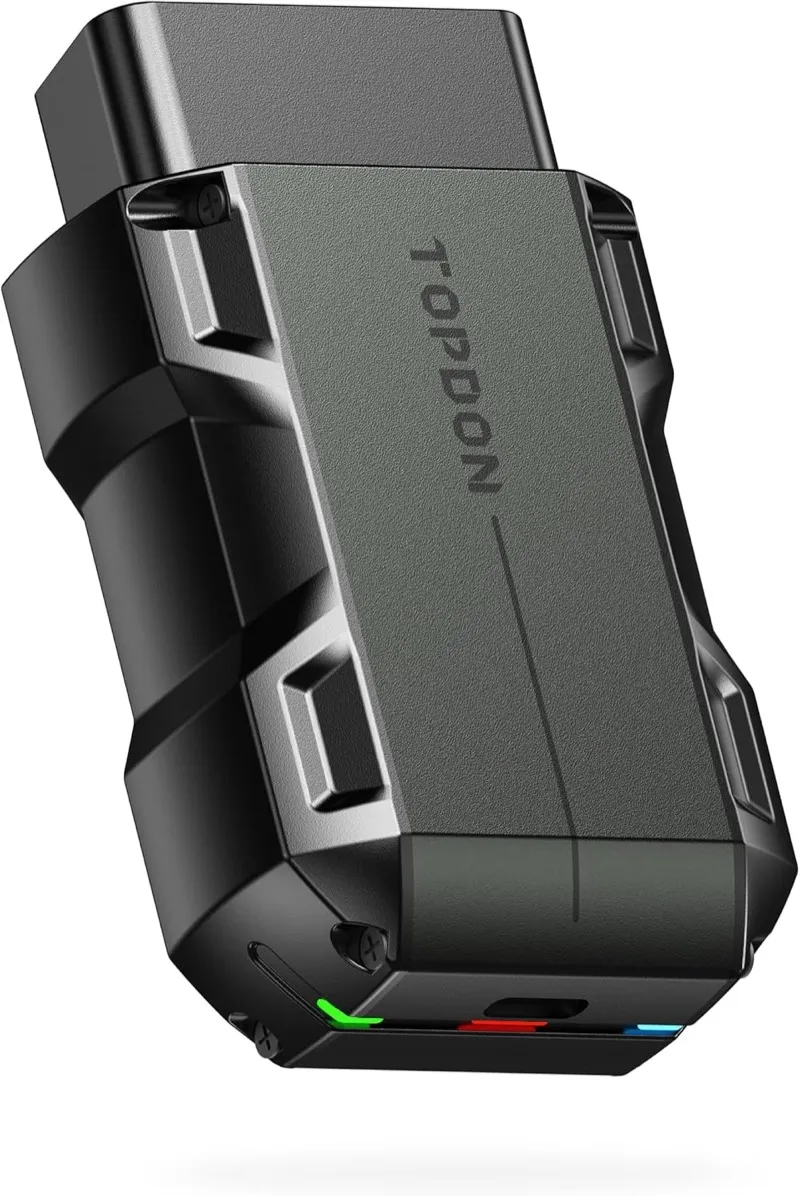
11. Topdon TopScan Lite: Best Bluetooth Bidirectional OBD2 Scanner for Hyundai
- Bluetooth bidirectional scanner with 8 service resets and an AI diagnostic assistant that explains Hyundai codes and suggests next steps in plain language
- Full system wireless diagnostics on Hyundai including engine, transmission, ABS, and SRS with FCA AutoAuth compatibility
- 418+ verified Amazon reviews at 4.4 stars on a compact Bluetooth adapter with active test capability
Overview
The Topdon TopScan Lite is the only Bluetooth bidirectional scanner in this list, combining wireless convenience with active test capability and an AI diagnostic assistant. For Hyundai owners who are newer to DIY diagnostics and want a tool that not only reads codes but also explains what they mean and what to check next, the TopScan Lite provides a guided diagnostic experience that no other scanner in this list offers.
The AI assistant function reads the code from your Hyundai, provides a plain-language explanation of what the fault indicates, and suggests the most likely causes and checks in order of probability. For a Hyundai owner who reads P0420 and does not know whether it points to the oxygen sensor, the catalytic converter, or an exhaust leak, the AI function narrows the diagnostic path before any parts are ordered. This is different from BlueDriver’s repair report function, which shows what other owners fixed; the Topdon AI explains the fault itself.
The bidirectional capability on the TopScan Lite enables component output tests on Hyundai via the companion app. The 8 service resets cover oil interval, TPMS, EPB, SAS, BMS, throttle adaptation, ABS bleeding, and injector coding. CAN FD protocol support covers newer Hyundai models that have transitioned to the faster bus architecture. FCA AutoAuth is included for compatibility across the full range of OBD2-accessible vehicles.
Diagnostic Features and Capabilities
Full system Bluetooth diagnostics on Hyundai. Bidirectional active tests via companion app. AI diagnostic assistant with plain-language code explanations. 8 service resets: oil, TPMS, EPB, SAS, BMS, throttle, ABS bleed, injector coding. CAN FD support. FCA AutoAuth. Live data with performance testing. Freeze frame. I/M readiness.
Vehicle Compatibility
Compatible with all Hyundai OBD2 vehicles from 1996 onward. CAN FD protocol support covers newer Hyundai model years. Compatible with iOS and Android. 120+ vehicle brands.
Specifications
| Specification | Details |
|---|---|
| Connection | Bluetooth (iOS and Android) |
| Supported Systems | Engine, Transmission, ABS, SRS via app |
| OBD2 Functions | Read/clear codes, live data, freeze frame, I/M readiness, performance test |
| Bidirectional Control | Yes (via app) |
| Service Functions | 8 resets: oil, TPMS, EPB, SAS, BMS, throttle, ABS bleed, injector coding |
| Vehicle Compatibility | All Hyundai OBD2 models 1996+; 120+ brands; CAN FD |
| Display | App screen (no built-in display) |
| Updates | Core diagnostics free; advanced features free first year |
| Subscription | Advanced features require subscription after year one |
What’s Included
Topdon TopScan Lite adapter, quick start guide. Topdon app free on iOS and Android. Core diagnostic functions free permanently; advanced bidirectional features and AI assistant free for first year, subscription required after.
Pros and Cons
| Pros | Cons |
|---|---|
| AI diagnostic assistant explains Hyundai codes in plain language and suggests next steps | Advanced features including bidirectional and AI require subscription after year one |
| Bluetooth bidirectional active tests without a wired connection | |
| 8 service resets including SAS, EPB, BMS, and throttle adaptation on Hyundai | |
| CAN FD support covers newer Hyundai model years | |
| Compact wireless adapter that travels easily |
My Final Verdict
The Topdon TopScan Lite is the right choice for Hyundai owners who are newer to DIY diagnostics and want a wireless tool that guides them through the repair process rather than just displaying a code number. The AI assistant and bidirectional capability in a Bluetooth adapter format is a unique combination in this list. The subscription requirement after year one is a real cost to factor in if you plan to use the advanced features long-term.
Comparison Table: All 11 OBD2 Scanners for Hyundai
| Scanner | Award | IVT/DCT Access | Bidirectional | SAS Reset | Other Key Resets | Subscription |
|---|---|---|---|---|---|---|
| BlueDriver Bluetooth Pro | Best Overall | Yes (via app) | No | No | Oil, battery via app | None |
| OBDLink MX+ | Best for Data Logging | Via third-party apps | App-dependent | Via third-party apps | Via third-party apps | None |
| ANCEL FX2000 | Best Budget | Yes | No | No | Oil reset | None |
| Innova 5610 | Best Standalone Bidirectional | Yes | Yes | Yes | Oil, EPB, BMS, TPMS | None |
| Foxwell NT630 Plus | Best for ABS Brake Service | No | ABS bleed only | No | Oil, ABS auto-bleed | None |
| Autel MaxiCheck MX808S | Best Premium | Yes + IVT fluid reset | Yes + ECU coding | Yes | 36+ including EPB, BMS, TPMS, throttle | After yr 1 |
| Foxwell NT726 | Best Mid-Range Bidir. | Yes | Yes | No | Oil, EPB, TPMS, ABS bleed | None |
| Autel AL619 | Best for ABS/SRS Only | No | No | No | None | None |
| ANCEL DS100 | Best Touchscreen Budget | Yes | No | No | Oil reset | None |
| Launch CRP129E | Best for Service Resets | Yes | No | Yes | 12 resets: EPB, BMS, TPMS, throttle, injector | None |
| Topdon TopScan Lite | Best Bluetooth Bidir. | Yes | Yes (via app) | Yes | 8 resets: EPB, BMS, TPMS, throttle, injector | After yr 1 |
Buyer’s Guide: How to Choose an OBD2 Scanner for Hyundai
Hyundai Theta II Engine: What Live Data Reveals That a Code Reader Cannot
The Theta II engine, Hyundai’s 2.0L and 2.4L GDI four-cylinder fitted to the Sonata, Elantra, Tucson, and Santa Fe across multiple model years, has a documented history of excessive oil consumption and in more severe cases, engine bearing failure. A fault code alone does not capture what is happening inside a Theta II engine under load. A P0300 random misfire code on a Theta II could indicate a fouled injector, a worn piston ring, low compression, or early bearing wear, and the code is the same regardless of which cause is present.
Live data is where the diagnostic picture becomes clear. Monitoring short-term and long-term fuel trim values at idle versus cruise reveals whether the engine is running lean due to an intake leak or rich due to injector fouling. Watching knock sensor activity at different RPM bands shows whether the engine is managing combustion normally or compensating for an underlying mechanical issue. Checking misfire counts per cylinder identifies whether the fault is isolated to one cylinder, which points toward that cylinder’s injector, coil, or compression specifically. None of this diagnostic depth is available from a fault code alone. Any scanner that streams live Hyundai data provides this information; BlueDriver and OBDLink MX+ provide the most complete Hyundai-specific parameter sets.
My OBDLink MX+ review covers the Hyundai-specific extended PID library and live data logging depth in detail.
Hyundai MDPS and EPS: Why These Modules Need a Full-System Scanner
MDPS, Hyundai’s Motor-Driven Power Steering system, stores fault codes in its own electronic control unit, separate from the engine ECU and the ABS module. An MDPS warning light on a Hyundai Tucson, Elantra, or Sonata means the MDPS module has stored a fault, and that fault is not accessible through an engine-only scanner. Common MDPS fault codes include C1203 (MDPS motor fault), C1235 (wheel speed sensor signal error affecting EPS), and B1603 (steering torque sensor fault). A scanner that only reads engine codes returns nothing on an MDPS warning light.
Full-system scanners that poll all Hyundai modules reach the MDPS unit and return the specific fault code. BlueDriver, the Autel MX808S, the Foxwell NT726, and the Innova 5610 all access the MDPS module. The 4-system tools in this list cover engine and transmission but generally do not extend to the MDPS unit specifically. For a Hyundai owner with a steering warning light, a full-system scanner is the minimum tool required to identify the fault.
My Foxwell NT726 review covers its Hyundai MDPS module access in detail, including the bidirectional active tests available on Tucson and Elantra platforms.
Hyundai GDS vs. Aftermarket Scanners: What You Actually Lose
Hyundai’s GDS (Global Diagnostic System) is the dealer diagnostic tool. It provides access to every module on every Hyundai model, executes full bidirectional active tests, performs ADAS camera calibration after windshield replacement, programs replacement control modules, and reads live data at the full native bus speed. The GDS is what a Hyundai service technician uses for any diagnosis that goes beyond a straightforward code read and reset.
Aftermarket scanners cover approximately 90 to 95 percent of what the GDS does for common maintenance and diagnostic work. Reading and clearing fault codes from all modules, performing service resets, running bidirectional output tests, and logging live data are all available on consumer tools. What is not available on any aftermarket scanner at any consumer price point: ADAS camera recalibration after a windshield replacement, ECU programming for replacement modules (such as a new TCM or BCM), and immobilizer key programming. The Autel MX808S comes closest to GDS capability for everyday use; it handles every routine Hyundai service function that does not require module programming or ADAS calibration.
My guide to the best professional OBD2 scanners covers the tools that step closer to GDS-level capability, including the top-tier options above the MX808S for shops and advanced DIYers.
Hyundai Service Resets Every Owner Should Know
SAS (Steering Angle Sensor) calibration: Required after any alignment work, suspension component replacement, or steering rack service on Hyundai. The stability control system uses the SAS to determine vehicle heading. An uncalibrated SAS after a wheel alignment causes the stability control to intervene incorrectly during normal cornering. The Autel MX808S, Innova 5610, Launch CRP129E, and Topdon TopScan Lite all perform this calibration. Basic 4-system scanners do not.
BMS (Battery Management System) registration: Required when replacing the battery on 2010 and newer Hyundai models. The BMS module tracks battery state of charge history and adapts the alternator charging rate accordingly. Installing a new battery without registration causes the module to apply the old battery’s charging profile to the new battery, resulting in chronic undercharging or overcharging. The Autel MX808S, Innova 5610, Launch CRP129E, and Topdon TopScan Lite perform this reset.
EPB (Electronic Parking Brake) retraction: Required on Hyundai Santa Fe, Tucson, and other models with a motor-driven rear caliper actuator before rear brake pad replacement. Attempting to compress the rear piston without EPB retraction mode damages the actuator motor. The Autel MX808S, Innova 5610, Foxwell NT726, Launch CRP129E, and Topdon TopScan Lite support EPB retraction on compatible Hyundai models.
My guide to the best OBD2 scanners for ABS and SRS covers the full category of tools that access Hyundai brake and safety modules, including ABS bleed and EPB retraction support.
Throttle adaptation: Required after throttle body cleaning or replacement on Theta II engines. The ECU learns the throttle’s closed position and range of motion during adaptation. Without it, idle quality is unstable after throttle service. Available on the Autel MX808S, Innova 5610, Launch CRP129E, and Topdon TopScan Lite.
Oil service reset: Available on every wired scanner in this list except the Autel AL619.
Wired vs. Wireless for Hyundai Diagnostics
Wireless Hyundai scanners, specifically BlueDriver and OBDLink MX+, provide access to Hyundai-specific repair databases and extended parameter sets that no standalone handheld in this list matches. BlueDriver’s repair reports and OBDLink’s compatibility with extended Hyundai PID software give wireless adapters a diagnostic depth advantage for code interpretation and live data logging. The Topdon TopScan Lite adds Bluetooth bidirectional capability and an AI assistant, making it the most capable wireless option for Hyundai owners who prefer app-based diagnostics.
My guide to the best Bluetooth OBD2 scanners covers all three across the full wireless category, with head-to-head comparisons on Hyundai-specific parameter coverage and app experience.
Wired scanners maintain a stable connection during active service procedures that require sustained communication. ABS bleed, EPB retraction, SAS calibration, and BMS registration all involve command-response sequences that benefit from a wired connection’s reliability over Bluetooth in an engine bay environment. For Hyundai owners performing service procedures rather than just reading codes, a wired tool is the safer choice for those specific functions.
My guide to the best bidirectional OBD2 scanners covers the wired tools that go furthest in active test depth, including full comparisons of service procedure support across Hyundai platforms.
Common Hyundai OBD2 Scanner Buying Mistakes
Buying an engine-only scanner for a Hyundai with a transmission or steering warning light. A scanner that only reaches the engine module returns zero codes when the IVT warning light or MDPS light is active. Those codes live in separate modules the engine-only scanner cannot reach. Confirm that any scanner you consider explicitly covers the transmission and steering systems on Hyundai before purchasing.
Skipping SAS calibration after alignment work and just clearing the warning code. Clearing the SAS-related stability control fault without performing the calibration procedure leaves the stability control system operating with an incorrect reference point. The warning light returns immediately, and the vehicle’s stability behavior remains incorrect until the calibration is completed. Only scanners with the SAS service reset function can complete this procedure.
Replacing a Hyundai battery without performing BMS registration. A new battery on a 2010 or newer Hyundai requires BMS registration for the charging system to function correctly. Skipping this step is not immediately obvious but causes battery performance problems over time. If your scanner cannot perform BMS registration, have the dealer complete it after a battery replacement.
Assuming “Hyundai compatible” means all-module access. A scanner that claims Hyundai compatibility typically means it reads engine OBD2 codes on Hyundai. That does not mean it reaches the IVT module, the MDPS module, or the SRS system. Read the system coverage list in the specifications, not the make compatibility list on the product page.
Buying a wireless adapter without understanding the app requirements. BlueDriver, OBDLink MX+, and Topdon TopScan Lite require a smartphone to function. If you want a plug-in-and-go handheld experience, choose one of the wired scanners in this list.
My Final Recommendations
For most Hyundai owners who want complete system coverage with Hyundai-specific diagnostic guidance, the BlueDriver Bluetooth Pro is my top pick. It reads IVT, MDPS, ABS, and SRS codes through the app, provides Hyundai repair reports with confirmed fixes from other owners, and has over 62,500 verified reviews confirming it works correctly across Hyundai’s full lineup.
My full BlueDriver Pro review covers the Hyundai IVT, MDPS, and SRS module access, the repair report database, and how live data logging performs on Theta II engines specifically.
For a Hyundai owner on a budget who needs IVT code access without spending on bidirectional features, the ANCEL FX2000 is the right starting point. It covers engine, IVT, ABS, and SRS at the lowest price in this list for genuine 4-system Hyundai coverage.
Hyundai owners comparing budget options across all OBD2 categories will find more alternatives in my guide to the top budget OBD2 scanners.
For a Hyundai owner who services their own vehicle and needs SAS calibration, EPB retraction, BMS registration, and bidirectional active tests, the Autel MaxiCheck MX808S is the closest aftermarket equivalent to the Hyundai GDS dealer tool available at consumer pricing.
Honda owners who need the same depth of module coverage for their platform will find the right picks in my Honda OBD2 scanner guide.
Hyundai owners dealing with CVVT faults, P1326 knock codes, or CANFD gateway access on the Tucson will find dedicated picks for that platform in my best OBD2 scanner for Hyundai Tucson guide.
For a Hyundai owner who needs service resets including SAS, EPB, BMS, and throttle adaptation without paying the premium tier price and without needing bidirectional tests, the Launch CRP129E offers the most resets of any scanner in the mid-range tier, with the highest customer satisfaction rating in this list.
Hyundai owners dealing with IVT faults, CVVT solenoid codes, or P1326 on the Elantra will find dedicated picks for that platform in my best OBD2 scanner for Hyundai Elantra guide.
For a Hyundai owner who performs their own brake service and needs the ABS bleed function specifically, the Foxwell NT630 Plus handles ABS modulator bleeding on Hyundai Mando and Bosch ABS unit variants with 4,000+ verified reviews confirming compatibility.
My Foxwell NT630 Plus review breaks down its Hyundai ABS and Mando brake unit compatibility in detail, including the EPB retraction sequence and ABS bleed procedure.
For a Hyundai owner new to DIY diagnostics who wants wireless convenience, bidirectional capability, and an AI assistant that explains codes in plain language, the Topdon TopScan Lite is the only tool in this list that provides guided diagnostic assistance alongside active test capability in a Bluetooth adapter format.
Subaru owners looking for the same wireless bidirectional coverage on their platform will find the right options in my top Subaru OBD2 scanner picks.
Hyundai owners dealing with HTRAC AWD faults, 8DCT diagnostics, or EPB service on the Santa Fe will find dedicated picks for that platform in my best OBD2 scanner for Hyundai Santa Fe guide.
FAQs
Can I use any OBD2 scanner on a Hyundai?
Any OBD2 scanner connects to the Hyundai OBD2 port and reads engine fault codes from 1996 onward. Accessing the IVT transmission module, MDPS power steering module, ABS system, and SRS airbag system requires a scanner with full-system or Hyundai-enhanced coverage. A basic engine-only code reader returns no codes when the transmission warning light or MDPS light is active, because those codes live in separate modules the scanner cannot reach.
What is Hyundai GDS and what aftermarket tool comes closest?
Hyundai GDS (Global Diagnostic System) is the official dealer diagnostic tool. It provides access to every Hyundai module, performs full bidirectional active tests, executes ADAS calibration, and programs replacement control units. Of the aftermarket tools in this list, the Autel MX808S comes closest in coverage depth, offering bidirectional active tests, 36+ service resets, ECU coding, and full module access that handles approximately 90 to 95 percent of what the GDS does for routine maintenance and diagnostics. Module programming and ADAS calibration remain dealer-only regardless of which aftermarket scanner you own.
Can a consumer OBD2 scanner read Hyundai MDPS fault codes?
Yes, but only scanners that access all Hyundai control modules, not just the engine ECU. The MDPS module stores fault codes at its own module address separate from the powertrain. BlueDriver reads MDPS codes through the app. The Autel MX808S, Foxwell NT726, and Innova 5610 access MDPS through their full-system diagnostic coverage. The 4-system scanners in this list cover engine and transmission but do not extend to MDPS. If your Hyundai has a steering warning light, a full-system scanner is the minimum tool required.
What is the Hyundai Theta II engine issue and how does an OBD2 scanner help?
The Theta II is Hyundai’s 2.0L and 2.4L GDI four-cylinder engine, fitted to multiple Sonata, Elantra, Tucson, and Santa Fe generations. A portion of these engines have a documented tendency toward excessive oil consumption and in more severe cases, premature bearing wear or seizure. An OBD2 scanner helps by providing live data monitoring of knock sensor activity, fuel trim corrections, misfire counts per cylinder, and oil temperature, which together reveal whether the engine is running correctly or compensating for an underlying mechanical issue before it reaches the point of failure. Any scanner that streams Hyundai live data provides this monitoring capability.
What Hyundai service resets require an OBD2 scanner?
The resets that require a scanner with Hyundai service function support are: SAS steering angle calibration after alignment work, BMS battery registration after a battery replacement on 2010 and newer models, EPB retraction before rear brake pad service on models with electronic parking brakes, throttle adaptation after throttle body cleaning or replacement, TPMS sensor relearn after rotating tires or replacing sensors, and the oil service interval reset. Basic code readers cannot execute any of these; each requires two-way communication between the scanner and the relevant Hyundai module.
What Hyundai warning lights can these scanners diagnose?
The scanners in this list cover the following Hyundai warning lights depending on which tool: check engine light (all scanners), transmission warning light (BlueDriver, ANCEL FX2000, ANCEL DS100, Innova 5610, Foxwell NT726, Autel MX808S, Launch CRP129E, Topdon TopScan Lite), ABS warning light (all except OBDLink MX+ standalone), SRS airbag light (all except OBDLink MX+ standalone), MDPS steering light (BlueDriver, Innova 5610, Foxwell NT726, Autel MX808S, Topdon TopScan Lite). Match the warning light on your Hyundai to the correct tool tier before purchasing.
Does Hyundai use CAN FD and do I need a scanner that supports it?
Hyundai has been implementing CAN FD (Controller Area Network Flexible Data-Rate) on newer model year vehicles, with broader adoption starting on 2022 and later platforms. Most Hyundai models currently on the road use standard CAN protocol, which all scanners in this list support. If you own a very recent Hyundai model and a scanner fails to connect to certain modules, confirm whether that specific model year uses CAN FD on those modules. The Topdon TopScan Lite includes explicit CAN FD support in its specification, which provides the most reliable coverage for the newest Hyundai platforms.