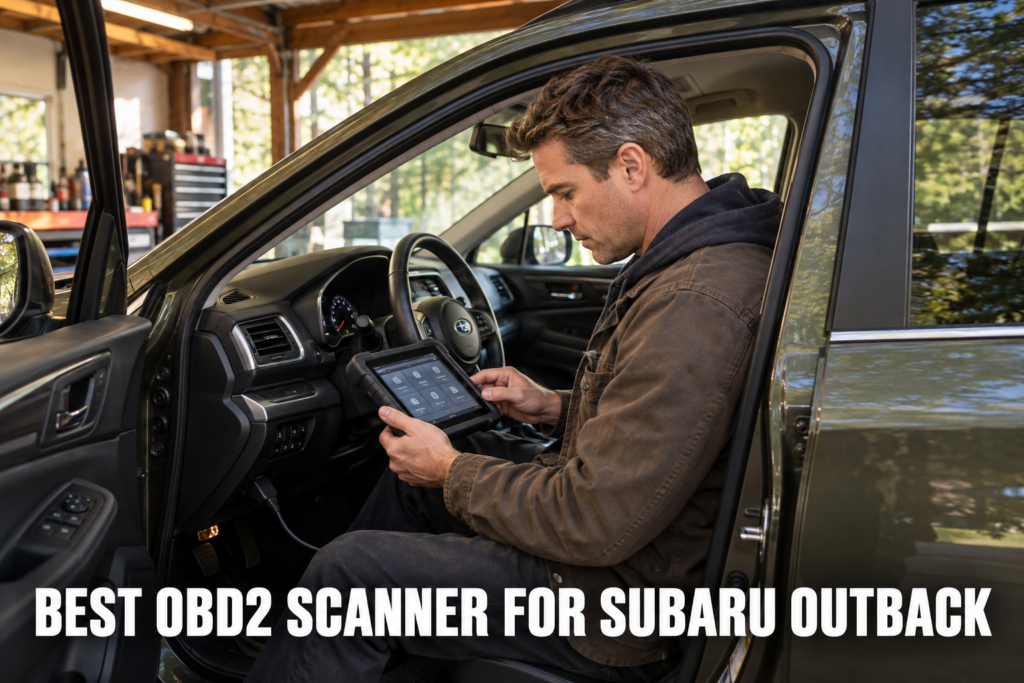
The Subaru Outback spans six generations and three engine configurations that each create different diagnostic demands. The EZ36 H6 3.6R (2010-2019) runs a Dual Active Valve Control System with cam phasers on both intake and exhaust camshafts per bank. This produces four AVCS-related fault channels instead of two. The FA24F Turbocharged XT (2020-present) adds high-pressure fuel pump monitoring and wastegate solenoid testing to the list. Every Outback from 2013 also carries EyeSight, and every 2015-and-later model with the 2.5L engine pairs it with the Lineartronic CVT.

About the author: Hello! I’m Kamil Siegień, founder of OBD2 Scout. My diagnostic experience started with an engine rebuild on a 2014 Skoda Superb 1.8 TSI, where tuning from 160 to 222 hp required mastering live data and ECU behavior that basic code readers cannot handle. I am a former BMW and MINI employee and regularly use diagnostic scanners on my own Audi A4 2.0 TFSI.
Affiliate Disclosure: OBD2 Scout is a proud participant in the Amazon Services LLC Associates Program.
A standard OBD2 code reader connects to the Outback’s diagnostic port and reads only the powertrain codes that Subaru shares with all OBD2 scanners. The AVCS cam timing faults in the EZ36 H6, the Lineartronic CVT hydraulic pressure codes, and the EyeSight camera fault codes are all stored in enhanced manufacturer-specific registers. Standard OBD2 mode cannot access any of them.
Scanners with Subaru enhanced protocol open those registers. Only bi-directional tools with active test menus can command the oil control valves, CVT solenoids, or EyeSight camera assembly directly. This confirms whether a fault is electrical or mechanical before any parts are replaced.
Every scanner on this list was verified against the Outback’s diagnostic requirements across all six generations. For 4-cylinder models, this covers AVCS cam timing codes, Lineartronic CVT module access from 2015, and EyeSight camera DTC reading from 2013. For Outback XT models from 2020, it also covers FA24F boost pressure monitoring and HPFP diagnostics.
Nine tools made the cut. Each one covers a different combination of budget, features, and use case for Outback owners.
My Recommended Top 3 Best-Buys
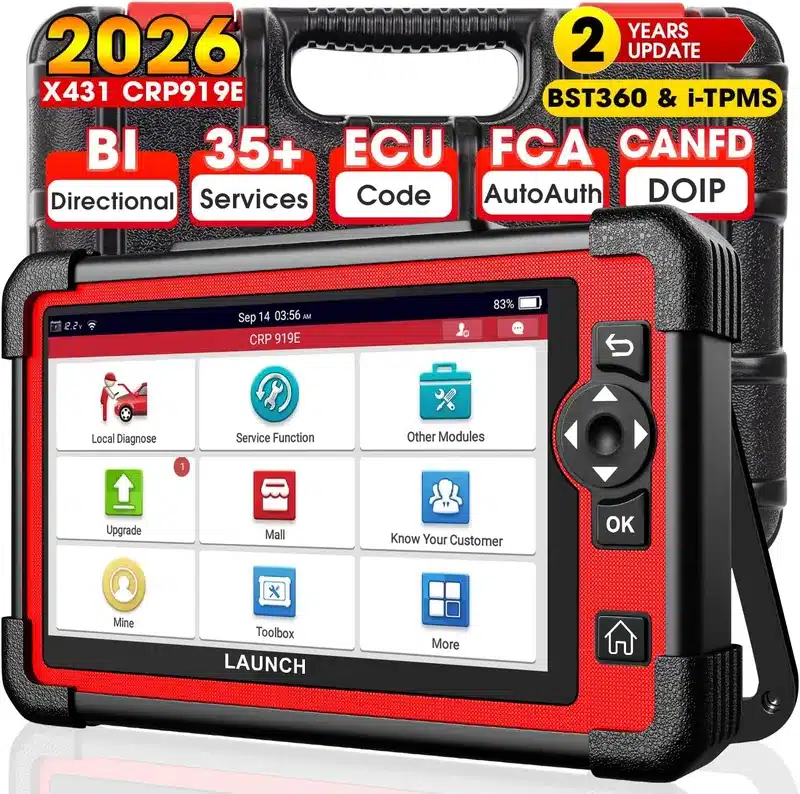
1. Launch CRP919E
[Best Overall]
- ✓ Bi-directional AVCS solenoid test on EZ36 H6 and FB25
- ✓ CVT adaptation reset for Lineartronic 2015+
- ✓ DoIP support for 2022-2025 Outback CAN FD
3,500+ Verified Reviews
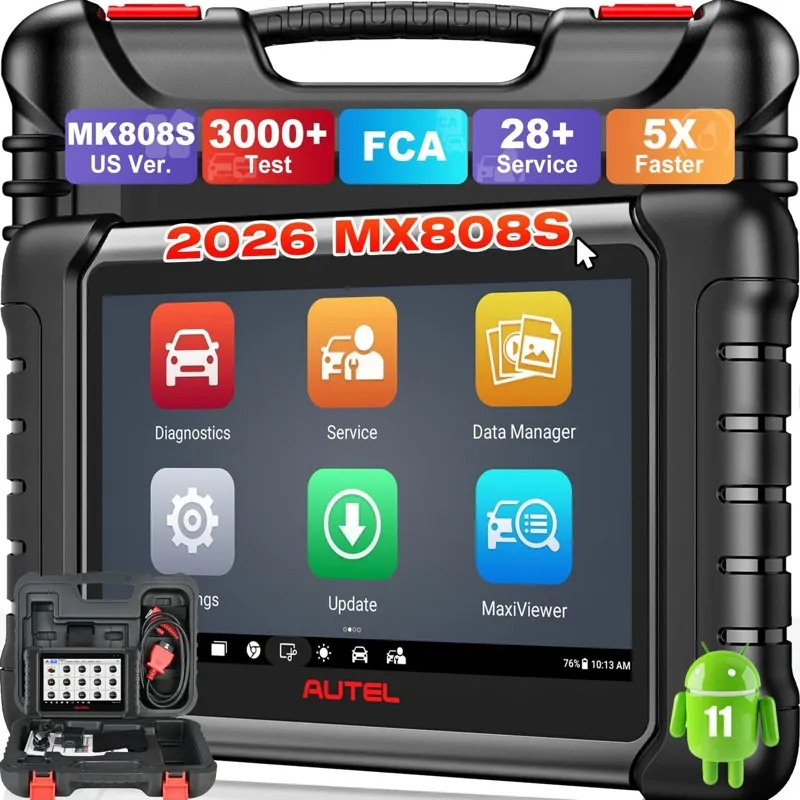
2. Autel MK808S
[Best Value]
- ✓ Full-system access across all Outback generations including EZ36 H6
- ✓ CVT adaptation reset for Lineartronic 2015+ plus SAS, EPB, TPMS
- ✓ EyeSight DTC read and clear on Gen 1 through Gen 4
3,800+ Verified Reviews
3. BlueDriver Pro
[Best Bluetooth]
- ✓ Full Subaru enhanced protocol on all Outback models from 2003-2023
- ✓ AVCS cam advance angle and OCV duty cycle live PIDs for EZ36 H6 DAVCS
- ✓ EyeSight module DTC access on all EyeSight-equipped Outback models

30,000+ Verified Reviews
9 Best OBD2 Scanners for Subaru Outback: Full Reviews
1. Launch CRP919E: Best Overall OBD2 Scanner for Subaru Outback
- Active AVCS oil control valve test on all four EZ36 H6 DAVCS channels plus FB25 and FA24F
- CVT Lineartronic adaptation reset, EPB, SAS, TPMS, and 33 additional Subaru service resets
- 3,500+ Amazon reviews, 4.2 stars
Overview
The Launch CRP919E is a DoIP and CAN FD capable tablet scanner that covers every Outback generation from 2003 through 2025. It reads enhanced Subaru manufacturer-specific fault codes that a standard OBD2 reader misses, including AVCS cam timing codes on the EZ36 H6 and Lineartronic CVT hydraulic pressure codes. It also supports the DoIP protocol stack on 2022-and-later Outbacks built on the new global platform, where older CAN-based scanners may fail to communicate with body and chassis modules.
The most important capability for EZ36 3.6R owners is the AVCS bi-directional test. The CRP919E can command each of the four oil control valves independently and observe the cam advance angle response in real time. This distinguishes a mechanically stuck phaser from one that is electrically functional but slow to respond, without removing any components.
For Outback XT owners with the FA24F engine, the CRP919E reads boost pressure as a live PID and can command the wastegate solenoid to open and close. This test is the fastest way to confirm whether a boost fault is an actuator problem or a pressure sensor problem. The CRP919E also reads the high-pressure fuel pump duty cycle live data, which is relevant for diagnosing the P0087 HPFP fault that affects 2020-2024 Outback XT models.
The CVT coverage includes the adaptation reset function for Lineartronic-equipped Outbacks from 2015 onward. After a fluid change, the Lineartronic TCM needs to relearn friction coefficients for the new fluid. Skipping this reset often causes harsh shifting for the first few hundred miles. The CRP919E guides the process with on-screen prompts and confirms completion with a pass status before the scanner disconnects.
EyeSight coverage on the CRP919E spans all four generations of the system installed on Outback models from 2013 through 2025. The gen 1 grayscale twin-camera units on 2013-2014 Outbacks, the gen 2 color-camera system on 2015-2017 models, the gen 3 wide-angle update on 2018-2021 Outbacks, and the gen 4 architecture on the 2022 and newer platform all operate on separate CAN node addresses from the engine ECU. The CRP919E reads and clears DTCs from the EyeSight camera control module on every generation, including calibration deviation codes logged after windshield replacement, camera contamination alerts, and communication errors between the EyeSight module and the steering angle sensor controller.
What the CRP919E cannot do for EyeSight is run the full optical recalibration sequence that Subaru uses after windshield replacement. That procedure requires the SSMIII factory scan tool with a specific target board positioned at a measured distance from the front bumper. The CRP919E’s role on EyeSight is read-and-clear: confirming which codes are stored, clearing them after a verified repair, and checking whether the module is communicating on the CAN bus. For owners who need to clear an EyeSight warning light after a windshield shop visit, the CRP919E handles that in under two minutes without needing a dealer appointment.
The CRP919E’s freeze frame capability on Lineartronic CVT faults provides data that changes how a diagnosis proceeds. When P0868 for hydraulic line pressure below threshold stores on an Outback, the freeze frame captured at the fault moment includes belt slip ratio as a percentage, primary and secondary pulley shaft speed readings, CVT fluid temperature at fault time, and the line pressure value in kPa. These four figures together distinguish a fault caused by low fluid level from one caused by a worn pressure control solenoid from one caused by cold-start viscosity before the CVT reaches operating temperature. A cold-weather P0868 with normal belt slip and low fluid temperature is a very different diagnosis from a hot-weather P0868 with elevated belt slip at normal operating temperature.
For 2022-and-later Outbacks on the new global platform, the practical implication of DoIP support is that the CRP919E reaches modules that sit behind the OBD2 gateway. The new platform uses a gateway architecture where modules communicate over an internal Ethernet network rather than a single CAN bus. A scanner that connects via legacy CAN-only protocol establishes communication with the gateway module only. All AVCS, CVT, and EyeSight modules are on the far side of the gateway and are invisible to that scanner. The CRP919E’s DoIP stack opens full module access through the gateway to every ECU on the 2022-2025 Outback, which is the only way to read AVCS cam timing codes, CVT line pressure codes, or EyeSight DTCs on those model years.
Diagnostic Features and Capabilities
The CRP919E reads and clears DTCs across all OBD2 systems plus Subaru enhanced modules including engine, CVT, ABS, SRS, EyeSight, body control, and TPMS. Bi-directional active tests include AVCS solenoid command on all four EZ36 H6 DAVCS channels, FA24F wastegate solenoid actuation, and CVT solenoid actuator test. Additional active tests cover cooling fan relay and fuel injector pulse on applicable model years. Live data streams up to 30 parameters per second with graph view for dual-trace overlay comparisons.
DoIP and CAN FD communication protocols are supported for 2022 and newer Outback variants on the new global platform. Service reset functions cover CVT adaptation, oil service interval, EPB, SAS zero-point calibration, TPMS sensor relearn, BMS battery registration, throttle body adaptation, and 29 additional Subaru-supported procedures.
Vehicle Compatibility
The CRP919E covers the Subaru Outback from 2003 through 2025. Engine families covered include EJ25 in gen 3 and gen 4, EZ36 H6 3.6R in gen 4 and gen 5, and FB25 in gen 5 NA variants. FA24F covers the 2020-and-later XT trim, and FA25 covers 2022-2025 models. EyeSight coverage applies to all trim levels where the system was factory equipped. The scanner covers most OBD2-compliant vehicles from 1996 onward through the same cable and software.
Specifications
| Specification | Details |
|---|---|
| Connection | Wired OBD2, WiFi for updates |
| Supported Systems | Engine, CVT/transmission, ABS, SRS, EyeSight, BCM, TPMS, and all enhanced Subaru modules |
| OBD2 Functions | Read/clear DTC, live data, freeze frame, I/M readiness, O2 sensor, EVAP, Mode 6 |
| Bidirectional Control | Yes |
| Service Functions | 37+ including CVT adaptation, SAS, EPB, TPMS, oil reset, BMS, throttle adaptation |
| Vehicle Compatibility | Subaru 2003-2025; OBD2 universal 1996+ |
| Display | 7-inch touchscreen |
| Updates | 2 years free via WiFi |
| Subscription | None required; optional paid renewal after year 2 |
What’s Included
The package includes the CRP919E scanner unit, a main OBD2 cable, a DC power cable, a USB data cable, a protective carry case, and a printed quick start guide.
31+ service reset functions include oil, EPB, BMS, SAS, TPMS, DPF, and throttle relearn.
For Subaru Outback diagnostics, FCA function covers 2018 and newer Chrysler, Dodge, Jeep, and Ram SGW-protected systems.
In practice on the Subaru Outback, the scanner displayed transmission data on 2001 to 2014 vehicles that less capable scanners showed as empty or unsupported.
Pros and Cons
| Pros | Cons |
|---|---|
| Active AVCS solenoid test on all four EZ36 H6 DAVCS channels confirms P0011/P0021 root cause | 2-year update window; paid renewal required after that period |
| CVT adaptation reset executes as a guided service procedure for Lineartronic models | |
| EyeSight DTC access across all four EyeSight generations on Outback | |
| DoIP and CAN FD support confirmed for 2022-2025 Outback new global platform | |
| FA24F Turbo XT wastegate solenoid test and boost pressure live data | |
| Full-system bi-directional coverage from a single tool |
My Final Verdict
The Launch CRP919E is the right choice for Outback owners who need full diagnostic coverage across all Subaru systems. It is the only scanner on this list that covers EZ36 H6 DAVCS bi-directional testing, FA24F Turbo XT wastegate actuation, and DoIP for 2022-and-later models in a single tool.
2. Autel MK808S: Best Value OBD2 Scanner for Subaru Outback
- Full-system DTC read and clear from engine, CVT, ABS, SRS, and EyeSight across all Outback generations
- CVT Lineartronic adaptation reset, SAS calibration, EPB, TPMS, and 24 additional Subaru service resets
- 3,800+ Amazon reviews, 4.4 stars
Overview
The Autel MK808S is a 7-inch Android tablet scanner that reads and clears fault codes across every module on the Subaru Outback. This includes enhanced Subaru-specific codes that a standard OBD2 reader cannot see. It covers the engine ECU, Lineartronic CVT TCM, ABS/VDC module, EyeSight camera control unit, SRS airbag, and body systems. This multi-module access is the core capability that justifies choosing the MK808S over a cheaper code reader.
The CVT service coverage on the MK808S addresses the three Lineartronic maintenance needs that follow a fluid change. The adaptation reset guides the TCM through the relearn cycle. The fluid temperature PID lets an owner confirm that the CVT reached full operating temperature before performing a static shift adaptation. The TCM live data stream also shows hydraulic line pressure and slip ratio during a test drive, which helps identify intermittent CVT faults that only appear under load.
For AVCS diagnosis, the MK808S provides cam advance angle live data for both banks on the EZ36 H6 and the single-cam-per-bank layout of the FB25 and FA24F. This is read-only data, not a bi-directional command. An owner can see whether P0011 or P0021 correlates with a cam angle that is consistently over-advanced and unresponsive to ECU correction. This narrows the diagnosis to a solenoid or oil supply issue.
EyeSight DTC access covers all four generations of the EyeSight system installed on Outback models from 2013 through 2025. The MK808S reads and clears camera module fault codes including sensor contamination faults, CAN communication errors, and calibration deviation codes that appear after windshield replacement. It does not perform the full optical recalibration sequence, but it handles all read-and-clear EyeSight work a home mechanic needs.
For EZ36 3.6R Outback owners specifically, the MK808S AVCS live data is particularly useful during a cold-start monitoring session. The EZ36’s four cam phasers take longer to build oil pressure on a cold morning than the four-cylinder FB25, which means P0011 and P0021 deviations often appear within the first two minutes of engine run time when the viscosity of the oil is still high. Watching the cam advance angle PID during a cold start on the MK808S’s live data screen shows whether the deviation is a sustained fault, a temperature-dependent lag, or a momentary cold-start event that corrects once oil pressure stabilizes. This information shapes whether the next step is a solenoid replacement or an oil viscosity change.
The 28 service reset functions on the MK808S cover the full maintenance cycle of the Outback beyond just the CVT adaptation reset. For Outback owners with the electronic parking brake on 2019-and-later models, the EPB retract function is required before rear caliper replacement or brake pad service. Without it, the piston cannot be compressed manually without damaging the electric motor in the caliper. The SAS zero-point calibration is also required after any wheel alignment service or steering column component replacement on VDC-equipped Outbacks, which is every trim from 2010 onward. The TPMS relearn function covers sensor ID registration after tire rotation or sensor replacement.
The boundary where the MK808S stops and the CRP919E begins is defined by a single capability: the active solenoid command. Watching cam timing data on the MK808S tells an owner that the cam is not following the ECU’s commanded angle. What it cannot do is send a direct command to the solenoid to activate while monitoring the response. That distinction matters because a solenoid that is electrically responsive to a command test but mechanically slow is indistinguishable from a solenoid that is simply receiving a correction signal that it is executing too slowly. The bi-directional test resolves that ambiguity in thirty seconds. For owners who want to make that determination without a bi-directional scanner, the MK808S narrows the diagnosis but leaves the final confirmation to a mechanic.
Diagnostic Features and Capabilities
The MK808S reads and clears DTCs across all systems on Subaru Outback models from 2003 through 2025, covering engine, CVT transmission, ABS, SRS, EyeSight, body control module, and TPMS. Live data display supports up to 30 parameters in graph or list mode with freeze frame record and playback. Standard OBD2 functions are all present: I/M readiness, Mode 6, O2 sensor test, EVAP system test, and VIN read.
Service reset functions number 28 for Subaru applications. These include CVT adaptation reset, SAS zero-point calibration, EPB brake service, TPMS relearn, oil service interval, BMS, and throttle body adaptation. There is no bi-directional actuator command capability on the MK808S.
Vehicle Compatibility
The MK808S covers the Subaru Outback from 2003 through 2025 across EJ25, EZ36 H6, FB25, FA24F, and FA25 engine families. EyeSight coverage applies to all trim levels equipped with the system from 2013 onward. The scanner covers most OBD2-compliant vehicles from 1996 onward.
Specifications
| Specification | Details |
|---|---|
| Connection | Wired OBD2, USB for updates |
| Supported Systems | Engine, CVT/transmission, ABS, SRS, EyeSight, BCM, TPMS |
| OBD2 Functions | Read/clear DTC, live data, freeze frame, I/M readiness, O2 sensor, EVAP, Mode 6 |
| Bidirectional Control | No |
| Service Functions | 28 Subaru-applicable including CVT adaptation, SAS, EPB, TPMS, oil interval, BMS |
| Vehicle Compatibility | Subaru 2003-2025; OBD2 universal 1996+ |
| Display | 7-inch touchscreen |
| Updates | 1 year free via USB |
| Subscription | None required |
What’s Included
The package includes the MK808S tablet scanner, OBD2 diagnostic cable, USB charging cable, and printed user guide.
On the Subaru Outback, the scanner works on 80+ car makes from 1996 through current model year on gasoline and diesel 12V vehicles.
The scanner reads and clears codes across Engine, Transmission, ABS, SRS, BCM, and additional body module systems.
For Subaru Outback diagnostics, 3,000+ bidirectional active tests across 80+ vehicle makes, covering actuators from window motors to fuel injection solenoids.
Pros and Cons
| Pros | Cons |
|---|---|
| Full-system coverage across all Outback generations at a value price point | No bi-directional actuator capability; cannot command AVCS solenoids or CVT solenoids individually |
| 28 Subaru service resets including CVT adaptation, SAS, EPB, and TPMS | |
| EyeSight module DTC read and clear on all four EyeSight generations | |
| AVCS cam advance angle live data for P0011/P0021 preliminary diagnosis | |
| 7-inch touchscreen with compact form factor for under-dash use |
My Final Verdict
The Autel MK808S is the right choice for Outback owners who want full-system diagnostic access at a value price. It covers all service intervals and module-level fault codes without the bi-directional active test capability that most owners rarely need.
3. BlueDriver Pro: Best Bluetooth OBD2 Scanner for Subaru Outback
- Full-system Subaru enhanced protocol including engine, CVT, ABS, SRS, and EyeSight on all Outback generations
- AVCS cam advance angle and OCV duty cycle live PIDs on EZ36 H6 and all 4-cylinder variants
- 30,000+ Amazon reviews, 4.5 stars
Overview
The BlueDriver Pro is a Bluetooth OBD2 adapter that plugs into the Outback’s diagnostic port and communicates with the free BlueDriver app on iOS or Android. It covers the full Subaru enhanced protocol stack, giving it access to the same manufacturer-specific fault code registers that a dealer service tool reads. This puts it in a different category from generic Bluetooth adapters that communicate only through standard OBD2 mode.
For EZ36 3.6R owners, the BlueDriver Pro reads all four DAVCS-related fault channels through Subaru enhanced protocol. It provides cam advance angle as a live PID for both banks, showing whether the cam timing is responding to the ECU’s commanded advance target. The oil control valve duty cycle PID shows whether the ECU is sending a correction signal that the cam is not following. A non-responsive cam points to a mechanical fault rather than an electrical one.
The CVT coverage on the BlueDriver Pro reads and clears Lineartronic-specific fault codes on 2015-and-later Outbacks. This includes the belt slip ratio codes (P17F0, P17E1) that a standard OBD2 transmission scan misses. The BlueDriver Pro does not perform the CVT adaptation reset function, so owners who need that procedure after a fluid change will need a scanner with a full service menu.
The BlueDriver Pro reads and clears EyeSight DTC codes on all EyeSight-equipped Outback models it supports. It cannot run the active camera self-test or the calibration validation sequence. Owners who need to confirm EyeSight camera function after windshield replacement will need a scanner with an active test menu for that specific step.
The BlueDriver repair report feature provides a list of confirmed fixes sourced from BlueDriver users who reported the same code on the same vehicle. For Outback-specific codes, these reports reflect real repair outcomes from other Outback owners. A P0011 on a 2017 Outback FB25 generates a repair report showing the most common confirmed fixes for that code on that model year, including oil viscosity changes, AVCS solenoid replacement, and timing chain stretch, ranked by frequency of confirmed resolution. This is more actionable than a raw code description alone, particularly for owners who are deciding whether to tackle the repair themselves or take it to a shop.
For EZ36 H6 3.6R owners, the BlueDriver Pro accesses all four DAVCS-related fault channels through Subaru enhanced protocol. The cam advance angle live data PID is available for both bank 1 and bank 2, and the oil control valve duty cycle PID updates continuously while the engine runs. The EZ36’s four-channel AVCS architecture means that P0026 and P0028, which indicate exhaust cam oil control valve performance faults rather than the more common P0011/P0021 intake cam codes, are also readable through the BlueDriver app. Owners of high-mileage 3.6R Outbacks who see an unfamiliar exhaust-cam AVCS code can read it and look up the repair report without a dedicated scanner.
The practical advantage of the BlueDriver Pro’s form factor for Outback diagnosis is its always-on capability. The adapter draws minimal current from the OBD2 port and stays connected between drives without draining the battery. For an Outback used for daily commuting, this means a quick app check after the morning drive can show whether any fault codes stored during the commute, including intermittent AVCS deviations during cold start that might not trigger a persistent check engine light. This passive monitoring function is something that a dedicated tablet scanner cannot match, since no owner leaves a tablet scanner plugged in between every drive.
Diagnostic Features and Capabilities
Reads and clears manufacturer-specific Subaru enhanced protocol codes from engine, CVT, ABS, SRS, and EyeSight modules via the BlueDriver app. Live data mode covers enhanced Subaru PIDs including AVCS cam advance angle, OCV duty cycle, CVT slip ratio, line pressure, and per-bank long-term fuel trims. Subaru-specific repair reports are included in the purchase price: community-sourced fix guides listing confirmed repairs for each specific fault code.
My complete BlueDriver Pro review covers its full Subaru enhanced report set and how it handles the Outback’s CVT and EyeSight module access.
No service reset functions are available beyond oil service interval reset on supported models. No bi-directional actuator capability. The adapter communicates over Bluetooth 4.0 BLE and connects to the BlueDriver app on iOS 12 and above, and Android 5.0 and above.
Vehicle Compatibility
The BlueDriver Pro covers the Subaru Outback from 2003 through 2023 with full enhanced Subaru protocol coverage for all modules. For 2024-2025 Outback models on the new global platform with CAN FD, compatibility should be confirmed via the BlueDriver vehicle checker on their website before purchase.
Specifications
| Specification | Details |
|---|---|
| Connection | Bluetooth 4.0 (BLE) |
| Supported Systems | Engine, CVT, ABS, SRS, EyeSight via BlueDriver app |
| OBD2 Functions | Read/clear DTC, live data, freeze frame, I/M readiness, Mode 6 |
| Bidirectional Control | No |
| Service Functions | Limited; oil service interval reset on supported vehicles |
| App | BlueDriver (iOS and Android, free download) |
| Vehicle Compatibility | Subaru 2003-2023; OBD2 universal 1996+ |
| Updates | Over-the-air via BlueDriver app |
What’s Included
The package includes the BlueDriver Pro Bluetooth adapter and a printed quick start guide.
In practice on the Subaru Outback, the scanner pinpointed the exact tire with a dying internal battery by showing individual TPMS sensor health for each corner.
Detected exactly which ABS wheel speed sensor was malfunctioning and explained why (a foreign object was sitting on top of the sensor).
On the Subaru Outback, the scanner reads transmission codes, BCM codes, and other non-engine modules beyond the standard engine ECU.
Pros and Cons
| Pros | Cons |
|---|---|
| Full Subaru enhanced protocol from a compact wireless adapter with no tablet required | CAN FD compatibility for 2024-2025 Outback on the new global platform requires verification before purchase |
| AVCS cam angle and OCV duty cycle as live PIDs on EZ36 H6 and FB25 | |
| EyeSight module DTC read and clear on all EyeSight-equipped Outback models | |
| Subaru-specific repair reports included at no additional cost | |
| Stays plugged into the OBD2 port between drives for always-available monitoring | |
| 30,000+ verified Amazon reviews with consistent Subaru coverage reports |
My Final Verdict
The BlueDriver Pro is the right choice for Outback owners who want full-system Subaru diagnostic coverage in a compact wireless adapter. It suits those whose service needs stop at fault code reading, live data monitoring, and DTC clearing rather than active actuator testing.
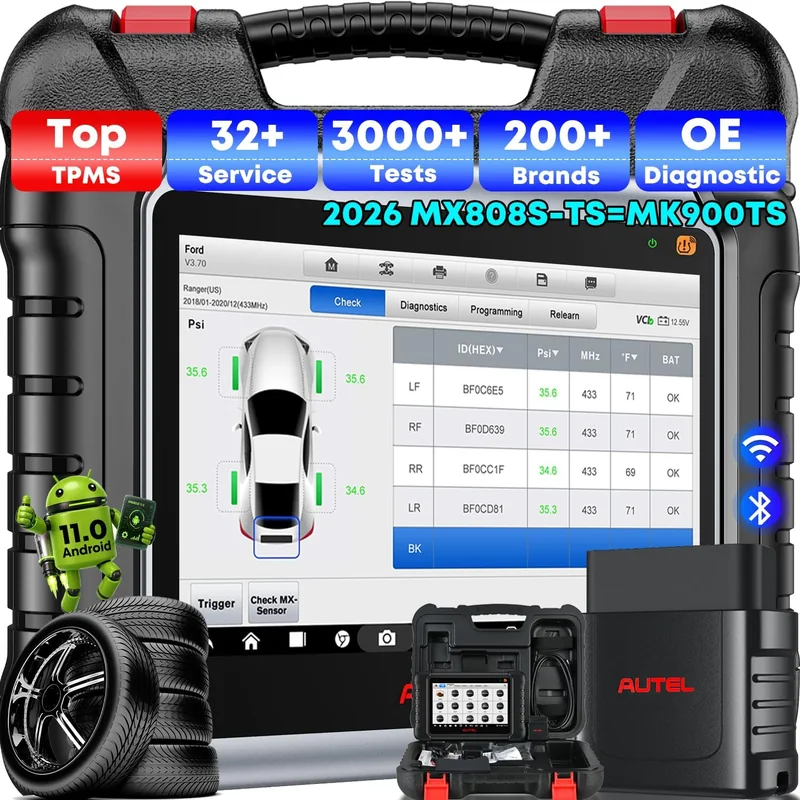
4. Autel MaxiCheck MX900: Best Premium OBD2 Scanner for Subaru Outback
- Bi-directional test on all four EZ36 H6 DAVCS phasers independently plus EyeSight camera self-test
- FA24F Turbo XT HPFP duty cycle live data and wastegate solenoid actuation for Outback XT diagnosis
- 500+ Amazon reviews, 4.3 stars
Overview
The Autel MaxiCheck MX900 is a 10-inch bi-directional tablet scanner with the deepest Subaru diagnostic coverage on this list short of a dealer service tool. Its position at number four comes from two capabilities no other scanner here can match. The first is independent active testing of all four DAVCS phasers on the EZ36 H6, and the second is the EyeSight camera self-test that verifies camera electronics after windshield replacement.
For EZ36 3.6R owners, the AVCS bi-directional menu on the MX900 presents all four cam phasers as individually addressable channels. The test commands the oil control valve on each phaser to activate and hold while the cam position sensor reading updates in real time. This means an owner can confirm which specific phaser is mechanically stuck versus which one has an intermittent electrical fault, without removing components. The EZ36 has four oil control valves across both banks, and the MX900 tests each one in sequence.
For Outback XT FA24F owners, the MX900 monitors boost pressure as a live PID and can command the wastegate solenoid to open and close during a test run. It also reads the HPFP duty cycle live data alongside the actual fuel rail pressure from the sensor. Comparing commanded duty cycle against measured rail pressure while the HPFP issue TSB is active helps confirm whether the fault is a sensor calibration drift or a mechanical pump failure.
The EyeSight self-test is a functional verification that queries the camera module for internal diagnostic readiness flags and confirms whether the camera assembly is operating within specification. This is not a full optical recalibration, but it confirms that the camera electronics are functional before an owner drives away after a windshield replacement. The MX900 is the only scanner on this list that includes this specific test sequence for the Outback.
The 10-inch screen on the MX900 changes how complex Outback diagnoses are conducted. Running a CVT diagnosis on the Outback correctly requires monitoring hydraulic line pressure, belt slip ratio, and CVT fluid temperature simultaneously during a test drive. The MX900 can display all three on a split-screen graph view while the tablet sits on the passenger seat. Watching belt slip ratio tick upward as fluid temperature crosses 80 degrees while line pressure holds steady tells a different story than watching slip ratio increase while line pressure drops. The 10-inch format makes that side-by-side comparison readable at a glance during a drive.
The FA24F Turbo XT HPFP diagnosis on the MX900 addresses a specific technical service bulletin that affects 2020-2024 Outback XT models. The P0087 code for fuel rail pressure below specification can be generated by either a failing high-pressure fuel pump or by an ECM calibration issue that causes the system to misread normal fuel pressure as a fault. Subaru issued a TSB with an ECM update that corrects the false positive on affected vehicles. The MX900 reads both the HPFP duty cycle command and the actual measured fuel rail pressure simultaneously. An owner who sees P0087 with commanded HPFP duty cycle already at maximum but measured rail pressure at or above specification is looking at a sensor or ECM calibration fault, not a failed pump.
The Lineartronic CVT adaptation reset on the MX900 includes a guided drive cycle instruction that the CRP919E does not have. After executing the reset command, the MX900’s service menu displays a step-by-step drive cycle guide that walks the owner through the vehicle speed targets, gear selection, and deceleration events the TCM needs to complete its relearn. Following this sequence after the reset ensures the TCM builds a complete friction map before the owner returns to normal driving. Owners who perform only the software reset without the drive cycle may notice that the transmission still shifts oddly for several hundred miles, because the TCM is relearning from scratch during each subsequent drive rather than from a confirmed baseline.
Diagnostic Features and Capabilities
Bi-directional active test coverage is the deepest on this list for Outback-specific diagnosis. The MX900 tests each of the four EZ36 H6 DAVCS oil control valves as individually addressable channels. It includes the EyeSight functional self-test that confirms camera electronics are operational without requiring a dealer calibration board. Full DoIP and CAN FD support for 2022-2025 Outback is confirmed. Service reset menu covers 40+ Subaru-applicable procedures including CVT adaptation, EPB, SAS, TPMS, oil interval, BMS, and throttle adaptation.
The 10-inch screen allows side-by-side live data and DTC view for complex multi-system diagnosis. FA24F Turbo XT coverage includes boost pressure actuation test, HPFP duty cycle and fuel rail pressure live data, and wastegate solenoid command. The MX900 reads and clears DTCs from all Subaru Outback modules from 2003 through 2025.
Vehicle Compatibility
The MX900 covers the Subaru Outback from 2003 through 2025 including EZ36 H6, FB25, FA24F, and FA25 engines. DoIP support is confirmed for 2022-2025 models on the new global platform. The scanner covers most OBD2-compliant vehicles from 1996 onward.
Specifications
| Specification | Details |
|---|---|
| Connection | Wired OBD2, WiFi for updates |
| Supported Systems | All modules including EyeSight ADAS, CVT, ABS, SRS, BCM, TPMS |
| OBD2 Functions | Read/clear DTC, live data, freeze frame, I/M readiness, O2 sensor, EVAP, Mode 6 |
| Bidirectional Control | Yes |
| Service Functions | 40+ including CVT adaptation, SAS, EPB, TPMS, oil reset, BMS, EyeSight self-test |
| Vehicle Compatibility | Subaru 2003-2025; OBD2 universal 1996+ |
| Display | 10-inch touchscreen |
| DoIP/CAN FD | Yes, confirmed for 2022-2025 Outback |
| Updates | 2 years free via WiFi |
What’s Included
The package includes the MX900 scanner tablet, OBD2 diagnostic cable, DC power adapter, USB data cable, carry case, and printed guide.
Vehicle identification completes in 20 to 40 seconds via AutoVIN, then launches a full system scan automatically.
For Subaru Outback diagnostics, full system scan runs in 3 to 6 minutes on a complete vehicle, accessing all available ECU modules.
In practice on the Subaru Outback, CAN-FD protocol support reaches 2019 and newer GM platforms that require the faster data rate.
Pros and Cons
| Pros | Cons |
|---|---|
| Independent bi-directional test on all four EZ36 H6 DAVCS phasers | 10-inch form factor is larger than necessary for simple code reads and less practical for quick under-dash inspections |
| EyeSight camera self-test confirms camera electronics after windshield replacement | |
| DoIP and CAN FD support confirmed for 2022-2025 Outback | |
| FA24F Turbo XT HPFP live data and wastegate solenoid command | |
| 10-inch screen for side-by-side live data and DTC viewing |
My Final Verdict
The Autel MaxiCheck MX900 is the right choice for EZ36 3.6R owners who need independent bi-directional testing of all four DAVCS phasers. Outback XT owners who need HPFP live data, wastegate actuation testing, and EyeSight functional verification will also get the most from it.
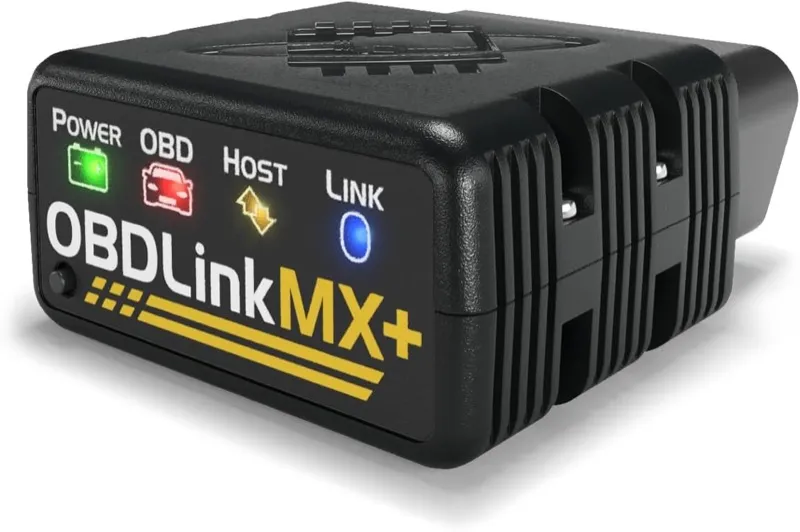
5. OBDLink MX+: Best for Live Data on Subaru Outback
- SSM2 protocol via OBD Fusion delivers AVCS cam angle live data at 10-15 Hz for EZ36 H6 6-cylinder
- CVT Lineartronic belt slip ratio and fluid temperature as native SSM2 sensor PIDs
- 1,500+ Amazon reviews, 4.4 stars
Overview
The OBDLink MX+ is a Bluetooth adapter that uses the Subaru Select Monitor 2 (SSM2) proprietary protocol through OBD Fusion or a compatible app. This protocol gives it access to live data at a refresh rate and depth that most dedicated scanners cannot match from a handheld or tablet. The OBDLink MX+ occupies a specific position on this list. It is the best tool for data logging diagnostic test drives and for monitoring multiple live channels simultaneously on a phone or tablet screen.
My OBDLink MX+ in-depth review covers the Subaru-compatible apps that access SSM2 data on the Outback and the specific CVT and AVCS parameters it reads.
For EZ36 H6 owners, the SSM2 PID set through OBD Fusion covers all six cylinders. The AVCS cam advance angle PID updates at approximately 10 to 15 times per second. This rate is fast enough to capture transient cam timing deviations during cold start and during sudden throttle inputs. The oil control valve duty cycle PID updates at the same rate. Watching both PIDs simultaneously during a test drive shows whether P0011 or P0021 is a consistent deviation or an intermittent event tied to a specific engine load or temperature range.
For iPhone users capturing that data on iOS, my top iPhone OBD2 scanner picks covers the OBDLink MX+ alongside other adapters that support Subaru SSM2-compatible apps.
The Lineartronic CVT live data through SSM2 includes the belt slip ratio as a calculated percentage. This PID is not available through standard OBD2 mode, which reports only transmission-level SAE codes. The slip ratio PID shows whether the CVT belt is slipping under load before P17F0 is stored. This is useful for monitoring a CVT after a fluid change or at high mileage.
The EyeSight camera module does not appear in the SSM2 PID list through OBD Fusion or Torque Pro. Reading EyeSight fault codes requires a scanner with a dedicated Subaru enhanced protocol module rather than the SSM2 data channel. Owners who need EyeSight DTC access alongside the SSM2 live data depth of the OBDLink MX+ will need to pair it with a secondary scanner for EyeSight-specific work.
Setting up the OBDLink MX+ for Subaru SSM2 access through OBD Fusion requires a one-time configuration that takes about five minutes. After pairing the adapter to the phone over Bluetooth, the OBD Fusion app needs the Subaru SSM2 connection mode selected under vehicle profile, and the Subaru-specific PID set loaded from the app’s custom PID library. Once configured, the profile saves and reconnects automatically on subsequent uses. The setup cost is higher than plugging in a dedicated scanner with built-in Subaru profiles, but the resulting data stream is more granular than any dedicated scanner on this list can produce.
For EZ36 H6 6-cylinder Outback owners, the SSM2 PID set through OBD Fusion includes per-bank misfire counters, per-bank LTFT values, the oil control valve duty cycle for each of the four AVCS channels, and individual cam advance angle readings for bank 1 intake, bank 1 exhaust, bank 2 intake, and bank 2 exhaust. Monitoring all four cam advance angle channels simultaneously during a cold start shows whether a deviation is isolated to a single phaser or is common to all phasers on one bank, which separates an oil supply issue affecting one side of the engine from a solenoid problem affecting a single cam. No other scanner on this list provides four-channel simultaneous AVCS live data on the EZ36 H6.
Data logging is the OBDLink MX+’s strongest capability for intermittent Outback faults that do not store a persistent code. An Outback owner who suspects a CVT slipping under load but has no stored P17F0 code can run OBD Fusion’s data logger during a highway merge or a steep uphill pull. The log captures belt slip ratio, line pressure, CVT fluid temperature, and engine load at every moment of the drive. Playing back the log on the app’s timeline view after the drive shows whether slip ratio exceeded normal thresholds at any point, even briefly, during the portion of the drive that felt rough. This evidence helps a transmission shop confirm whether a CVT fluid change and adaptation reset addresses the issue or whether internal wear is present.
Diagnostic Features and Capabilities
SSM2 protocol access through OBD Fusion provides the highest live data refresh rate of any scanner on this list for Subaru Outback diagnostics. The AVCS cam advance angle PID updates at 10-15 Hz compared to 1-2 Hz on most dedicated tablet scanners. For EZ36 H6 owners, the full 6-cylinder SSM2 PID set is accessible, including per-cylinder data channels not available through standard OBD2 mode.
The Lineartronic CVT belt slip ratio is available as a calculated SSM2 PID through OBD Fusion and is not present in the standard OBD2 SAE data set. EyeSight fault codes are not accessible through the SSM2 data channel. No service reset functions are built in; those depend entirely on the third-party app used.
Vehicle Compatibility
The OBDLink MX+ covers the Subaru Outback from 2003 through 2023 through SSM2 protocol in the OBD Fusion app. Standard OBD2 compatibility applies to all vehicles from 1996 onward through compatible third-party apps. For 2024-2025 Outback on the new global platform, CAN FD compatibility should be confirmed before purchase.
Specifications
| Specification | Details |
|---|---|
| Connection | Bluetooth 4.0 (BLE) and USB |
| Supported Systems | Engine, CVT, ABS, SRS via SSM2 (EyeSight not available through SSM2) |
| OBD2 Functions | Read/clear DTC, live data, freeze frame, I/M readiness, Mode 6 |
| Bidirectional Control | No |
| Service Functions | None built-in; depends on third-party app |
| App | OBD Fusion (recommended), Torque Pro, DashCommand (iOS and Android) |
| Vehicle Compatibility | Subaru 2003-2023 via SSM2; OBD2 universal 1996+ |
| Updates | Firmware updates via OBDLink app |
What’s Included
The package includes the OBDLink MX+ Bluetooth adapter and a printed user guide.
For Subaru Outback diagnostics, compatible with Torque, FORScan Lite, DashCommand, RealDash, and AlfaOBD, making it useful with nearly every third-party diagnostic app.
In practice on the Subaru Outback, 2mA sleep mode means leaving it plugged in between uses does not drain the car battery over days.
Verified 2mA sleep current confirmed by third-party measurement, unlike some competitors that claim low current but do not achieve it.
Pros and Cons
| Pros | Cons |
|---|---|
| SSM2 protocol delivers the fastest AVCS cam angle refresh rate on this list | EyeSight module DTC access is not available through SSM2; a separate scanner is needed for EyeSight fault codes |
| EZ36 H6 6-cylinder full data access through the complete Subaru SSM2 PID set | |
| CVT belt slip ratio as a live calculated PID before fault codes store | |
| Per-bank long-term fuel trim monitoring for EZ36 or FB25 combustion issues | |
| Compatible with multiple apps on both iOS and Android |
My Final Verdict
The OBDLink MX+ is the right choice for Outback owners who want the deepest live data access. It covers AVCS cam timing diagnosis, EZ36 H6 6-cylinder monitoring, and CVT slip ratio logging. Setting up a third-party app with a Subaru SSM2 PID configuration adds a brief step compared to a dedicated scanner.
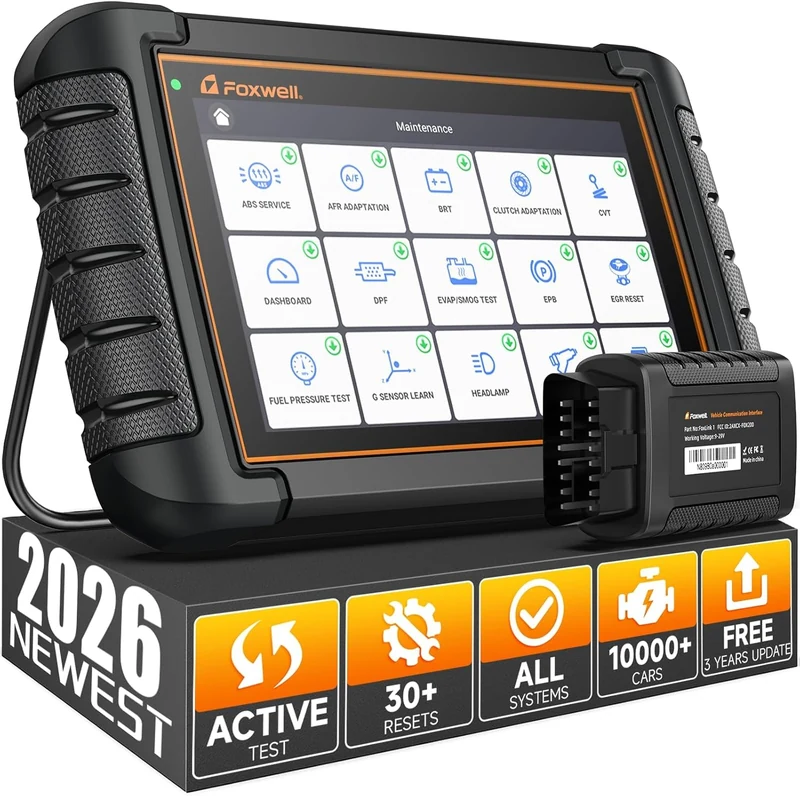
6. Foxwell NT809BT: Best Wireless Bi-Directional OBD2 Scanner for Subaru Outback
- AVCS oil control valve bi-directional test on both FB25 4-cylinder and EZ36 H6 6-cylinder
- CVT Lineartronic adaptation reset plus 26 additional Subaru service resets including SAS and EPB
- 300+ Amazon reviews, 4.1 stars
Overview
The Foxwell NT809BT is a wireless bi-directional scanner that separates into two components. A compact VCI module plugs into the OBD2 port, and a 7-inch Android tablet communicates with it over Bluetooth. This cord-free setup lets an owner walk around the vehicle during a test drive while monitoring live data on the tablet screen. It is a meaningfully different experience from wired bi-directional scanners that require the tablet to stay near the OBD2 port.
For Outback owners who prefer wireless test drive monitoring, my top Bluetooth OBD2 scanner picks covers the NT809BT and the other wireless Subaru-compatible tools.
The AVCS solenoid actuation test on the NT809BT covers both the FB25 4-cylinder and the EZ36 H6 6-cylinder. For EZ36 3.6R owners, the test commands the oil control valve on each AVCS channel and monitors the cam advance angle response. This is the same fundamental test as the CRP919E, though the NT809BT’s Subaru profile does not access all four EZ36 DAVCS channels with the same granularity as the Autel MX900.
Subaru Crosstrek owners evaluating the same scanner set will find my Crosstrek OBD2 scanner guide covers how each tool handles the Crosstrek’s CVT and EyeSight diagnostics.
The service reset menu on the NT809BT includes 27 Subaru-applicable functions. The CVT adaptation reset for Lineartronic models is listed explicitly and guides the procedure with status feedback. The steering angle sensor zero-point calibration is also present, which is needed after any alignment or steering component replacement on an Outback with VDC active stability control.
The NT809BT reads and clears EyeSight fault codes from the camera control module on all four EyeSight generations fitted to Outback models from 2013 through 2025. This does not include active camera self-test commands; the scanner reads whatever DTCs the camera module has stored. For owners who need to monitor EyeSight warning lights without paying for an MX900, the NT809BT handles read-and-clear EyeSight work reliably.
The wireless test drive scenario is where the NT809BT’s split form factor adds real value for Outback diagnosis. Running a CVT diagnostic test drive with a wired scanner means either a passenger holds the tablet or the driver glances down at a screen near the shifter. With the NT809BT, the 7-inch Android tablet can be mounted on the dashboard using a windshield mount, positioned at eye level, while the VCI module stays in the OBD2 port without a cable running across the cabin floor. During a Lineartronic CVT slipping event at highway speed, having the tablet visible at dashboard height makes the difference between seeing the belt slip ratio at the moment of the event and reconstructing it afterward from memory.
The NT809BT’s AVCS solenoid test on the EZ36 H6 addresses the two intake cam phasers on each bank directly. P0011 and P0021 are the fault codes the test is designed to resolve. The procedure commands the oil control valve on each intake cam channel to activate while the cam position sensor output updates in the live data window. What the NT809BT’s Subaru profile does not provide is independent addressability of the exhaust cam channels (P0026 and P0028 territory) with the same depth as the MX900. For 3.6R owners whose AVCS faults involve only the intake cam codes, the NT809BT’s bi-directional test covers the diagnosis completely. For owners with exhaust cam AVCS codes on a high-mileage 3.6R, the MX900 provides the more thorough four-channel test.
EyeSight coverage on the NT809BT extends to reading and clearing the three categories of EyeSight DTC that Outback owners encounter most often: camera module communication faults (U-codes generated when the EyeSight camera loses its CAN connection), calibration deviation codes (generated when camera alignment moves outside specification), and sensor contamination codes (generated when the camera’s automatic lens cleaning system detects persistent obstruction). All three categories appear in the EyeSight module DTC list on the NT809BT across the four EyeSight generations on 2013-2025 Outback models. Clearing these codes after a confirmed repair takes under one minute from the EyeSight module selection screen.
Diagnostic Features and Capabilities
Bi-directional active tests cover the AVCS oil control valve command on both the FB25 and EZ36 H6. The cordless VCI module stays plugged in during the test while the tablet receives live cam angle data wirelessly. Full-system DTC read and clear covers engine, CVT, ABS, SRS, EyeSight, and body control module on Outback models from 2003-2025. Live data mode supports up to 28 PID parameters with graph view.
Service reset menu includes 27 Subaru-applicable functions, with CVT adaptation reset and SAS zero-point calibration explicitly supported. DoIP protocol support for 2024-2025 Outback is not confirmed at time of writing.
Vehicle Compatibility
The NT809BT covers the Subaru Outback from 2003 through 2023 with confirmed full-system coverage. For 2024-2025 Outback models on the new global platform, DoIP compatibility should be verified with Foxwell before purchase.
Specifications
| Specification | Details |
|---|---|
| Connection | Wireless VCI Bluetooth to 7-inch Android tablet |
| Supported Systems | Engine, CVT, ABS, SRS, EyeSight, BCM |
| OBD2 Functions | Read/clear DTC, live data, freeze frame, I/M readiness, O2 sensor, EVAP |
| Bidirectional Control | Yes |
| Service Functions | 27 Subaru-applicable including CVT adaptation, SAS, EPB, TPMS, oil interval |
| Vehicle Compatibility | Subaru 2003-2023; OBD2 universal 1996+ |
| Display | 7-inch Android tablet (cordless) |
| DoIP | Unconfirmed for 2024-2025 Outback |
| Updates | Via WiFi |
What’s Included
The package includes the NT809BT Android tablet, VCI wireless module, OBD2 cable, protective carry case, and printed guide.
Plain-language fault code explanations let non-technicians understand the issue without looking up the code separately.
For Subaru Outback diagnostics, minimal lag during ABS and engine RPM live data streaming, with smooth graph updates during a road test.
In practice on the Subaru Outback, 99% of 3,000+ actuation tests available across 22 vehicle systems according to verified capability testing.
Pros and Cons
| Pros | Cons |
|---|---|
| Wireless bi-directional testing allows walking around the vehicle during active AVCS tests | DoIP support for 2024-2025 Outback on the new global platform is unconfirmed; verify before purchasing for those model years |
| AVCS solenoid actuation covers both FB25 and EZ36 H6 | |
| CVT adaptation reset and SAS calibration included in service menu | |
| EyeSight DTC read and clear on all four EyeSight generations | |
| 27 Subaru-applicable service resets in a cordless format |
My Final Verdict
The Foxwell NT809BT is the right choice for 2013-2023 Outback owners who want wireless bi-directional testing without the cost of the CRP919E or MX900. It covers AVCS solenoid testing, CVT adaptation reset, and EyeSight DTC access in a cord-free tablet format.
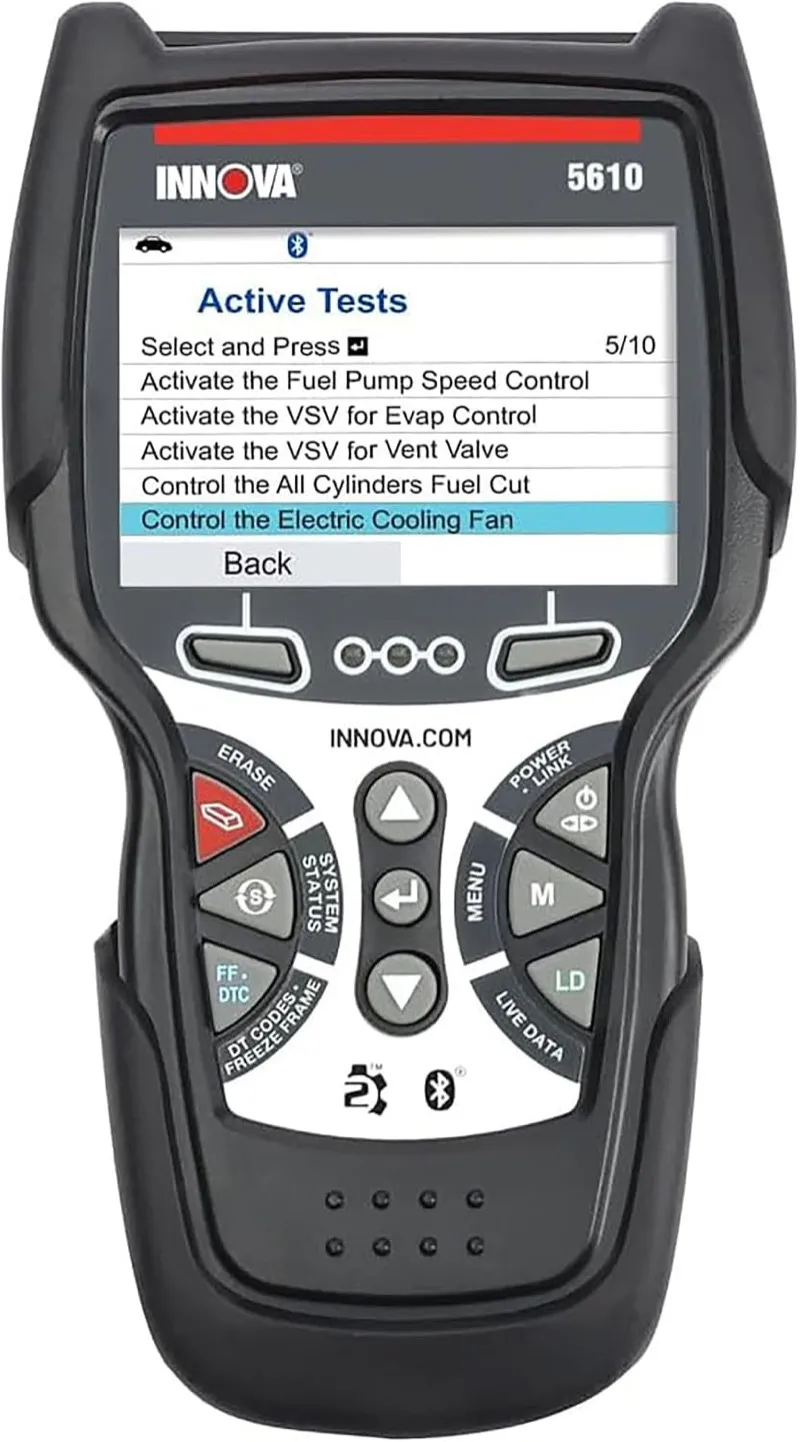
7. Innova 5610: Best Wired OBD2 Scanner for Subaru Outback
- ABS and SRS module DTC read and clear alongside engine codes in a self-contained handheld
- Battery voltage and alternator charging system test integrated with standard OBD2 diagnostics
- 800+ Amazon reviews, 4.3 stars
Overview
The Innova 5610 is a wired handheld scanner with a built-in color display that reads and clears fault codes from the engine, ABS, and SRS modules. It does not require a phone, tablet, or laptop. For Outback owners whose diagnostic needs stop at warning light identification and ABS fault isolation, it covers those cases in a self-contained tool that fits in a glovebox.
For Outback owners who want a full breakdown of ABS and SRS scanner options, my ABS and SRS scanner guide covers what separates full-system tools from engine-only readers.
The ABS coverage on the 5610 reads wheel speed sensor fault codes, pump motor fault codes, and module communication errors across all Outback trims from 2003 onward. The C-series ABS codes that appear on Outback models with the standard ABS controller are readable and clearable through the 5610. This is the main diagnostic step that separates the 5610 from a basic OBD2 engine-only code reader.
The live data capability on the 5610 covers the standard OBD2 PID set. This includes engine RPM, coolant temperature, throttle position, MAF, short-term and long-term fuel trims, and O2 sensor data from the standard OBD2 registers. The FB25 and EZ36 H6 Subaru-specific PIDs, including AVCS cam advance angle and CVT slip ratio, are not accessible through the 5610.
The 5610 is the right tool for Outback owners who need to identify a check engine light code and check whether ABS or airbag warning lights correspond to stored faults. An owner tracking a slow coolant loss can use the 5610 to monitor long-term fuel trims per bank and cylinder misfire counts from the OBD2 registers. This gives useful preliminary data for older FB25 or EZ36 Outbacks without CVT or EyeSight.
The battery voltage and charging system test on the 5610 is specifically useful for Outback owners of models from 2003 through 2014, where the alternator belt drive system is more accessible for visual inspection and where alternator-related diagnostic codes sometimes appear alongside other check engine faults. Running a charging system test while the 5610 is connected shows battery voltage, alternator output voltage, and ripple voltage from the alternator’s rectifier. A high-mileage EZ36 3.6R Outback that develops a B1200 battery condition fault or a dimming headlight symptom alongside a check engine light can have both issues assessed in one connection without swapping tools.
The ABS and SRS module access on the 5610 addresses a gap that many Outback owners discover at shops that use basic OBD2-only readers. The ABS warning light on an Outback with a failed rear wheel speed sensor generates no codes in the engine ECU. A shop using a basic engine-only code reader will tell the owner that no fault codes are present, which is accurate for the engine module but misleading for the car’s actual condition. The 5610 reads C0035 through C0038 for wheel speed sensor circuit malfunctions and C0040 for ABS pump motor fault on affected Outback models. This distinction between “no engine codes” and “ABS fault stored” is the practical value of the 5610 over a cheaper engine-only reader.
For owners looking for lower-cost multi-system options, my budget OBD2 scanner picks covers the most cost-effective tools that still include multi-module access.
The 5610 does not access the Lineartronic CVT module, EyeSight camera module, TPMS module, or body control module on any Outback model. For owners of 2015-and-later Outbacks with the CVT, the 5610 reads only the SAE-standardized OBD2 transmission codes that the CVT module exports to the gateway. P0700 (transmission control system malfunction indicating stored codes in the TCM) will appear on the 5610, but the specific Lineartronic codes behind it, such as P0868 or P17F0, require a scanner with enhanced Subaru protocol. Owners who see P0700 on the 5610 need a more capable scanner to find the root fault.
Diagnostic Features and Capabilities
The 5610 reads and clears fault codes from engine, ABS, and SRS modules. ABS coverage includes wheel speed sensor codes, pump motor codes, and module communication errors across all Outback models from 2003 onward. The built-in color display shows DTC descriptions and freeze frame data without requiring a phone or tablet. The integrated battery voltage and charging system test checks alternator output alongside standard OBD2 data.
Standard OBD2 live data covers engine RPM, coolant temperature, MAF, throttle position, short-term and long-term fuel trims, and O2 sensor output. Subaru-specific enhanced PIDs including AVCS cam advance and CVT slip ratio are not accessible. EyeSight and CVT module codes are not accessible.
Vehicle Compatibility
All Subaru Outback models from 2003-2025 for standard OBD2 engine and ABS/SRS codes. Enhanced Subaru manufacturer-specific codes, CVT module codes, and EyeSight codes are not accessible through the 5610.
Specifications
| Specification | Details |
|---|---|
| Connection | Wired OBD2 cable (built-in) |
| Supported Systems | Engine, ABS, SRS (standard OBD2 and basic enhanced) |
| OBD2 Functions | Read/clear DTC, live data, freeze frame, I/M readiness, O2 sensor |
| Bidirectional Control | No |
| Service Functions | Oil service interval reset |
| Additional Tests | Battery voltage and charging system test |
| Vehicle Compatibility | OBD2 universal 1996+; Subaru engine and ABS/SRS 2003+ |
| Display | Built-in color LCD |
| Updates | None required |
What’s Included
The package includes the Innova 5610 handheld scanner with built-in OBD2 cable and a quick reference guide.
In practice on the Subaru Outback, the scanner reads and clears transmission codes in addition to engine codes, catching gearbox faults most basic readers miss.
Reads freeze frame data captured at the moment a fault triggered, showing RPM, load, speed, and coolant temperature at the time of the event.
On the Subaru Outback, live data graphing lets you overlay up to four parameters simultaneously for side-by-side comparison while the engine runs.
Pros and Cons
| Pros | Cons |
|---|---|
| ABS and SRS module DTC access in a self-contained handheld with no app required | No CVT module access, no AVCS live data, no EyeSight DTC access, and no service resets beyond oil interval light |
| Built-in battery voltage and charging system test for alternator diagnostics | |
| Color display with DTC descriptions and freeze frame data on-screen | |
| No software subscription, no phone, and no charging required | |
| Compact glovebox size for quick fault code identification |
My Final Verdict
The Innova 5610 is the right choice for owners of older Outback models without CVT or EyeSight. It provides a simple standalone tool for check engine lights and ABS fault codes. It does not access the Subaru-specific systems that define the Outback’s diagnostic complexity.
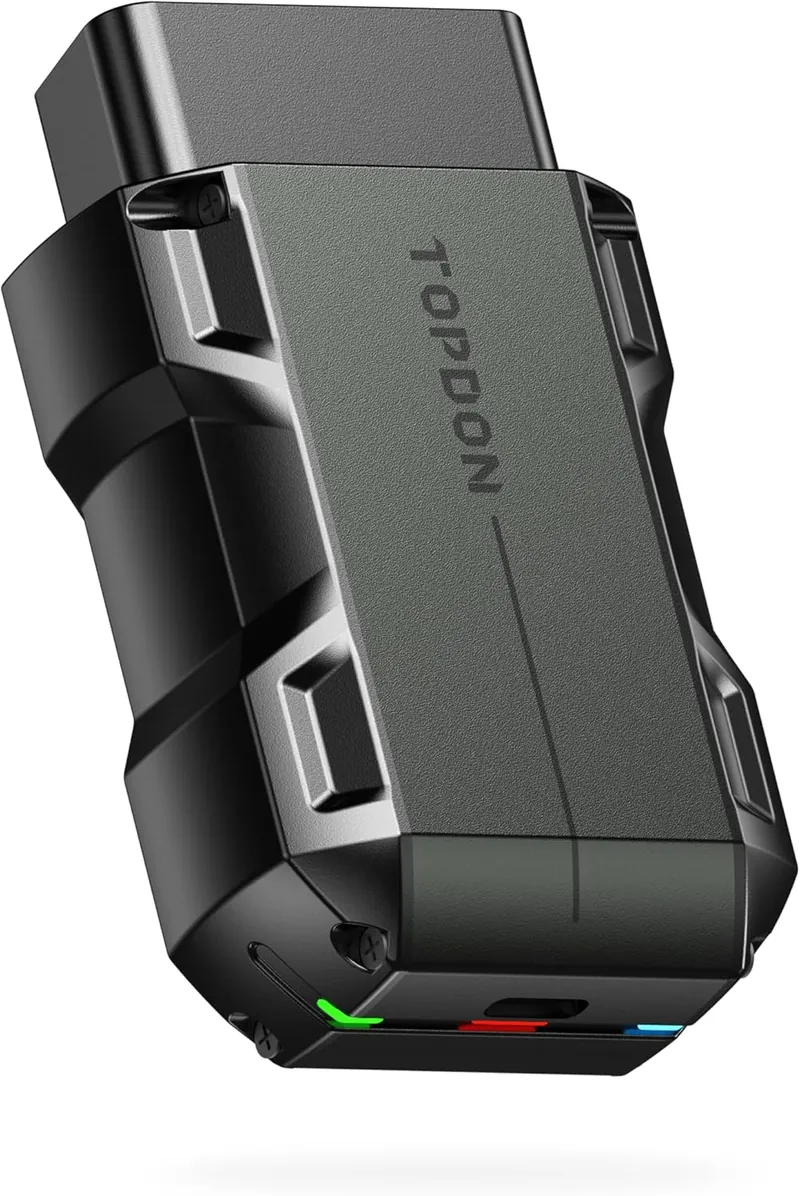
8. Topdon TopScan Lite: Best Compact Wireless OBD2 Scanner for Subaru Outback
- Full-system Subaru enhanced protocol from a compact Bluetooth adapter that stays plugged between drives
- AI-assisted fault code explanations and repair suggestions in the TopScan app for each stored code
- 400+ Amazon reviews, 4.2 stars
Overview
The Topdon TopScan Lite is a Bluetooth OBD2 adapter that pairs with the TopScan app on iOS or Android and provides full-system enhanced Subaru protocol access. It reads manufacturer-specific fault codes from the engine, transmission, ABS, SRS, and body modules that a standard OBD2 reader misses. The compact form factor and wireless connection make it practical to leave plugged in and check codes on a phone without pulling a dedicated scanner out of storage.
For Outback owners monitoring AVCS fault codes, the TopScan Lite reads P0011 and P0021 along with the full set of EZ36 H6 DAVCS codes from the enhanced Subaru protocol registers. The live data mode covers the standard OBD2 PID set plus the enhanced Subaru parameters available through the app’s Subaru-specific data stream. The cam advance angle PID is available as a live reading, though the TopScan app’s refresh rate for this PID is lower than what the OBDLink MX+ achieves through SSM2.
The TopScan app includes eight service reset functions. These cover oil service interval reset, EPB retract, battery registration, throttle body matching, TPMS relearn, steering angle sensor reset, DPF regeneration, and brake bleed. The function that Outback owners most frequently need after a fluid change is the CVT adaptation reset, and it is not in this menu. The TopScan Lite is the right compact wireless tool for Outback owners who do not need CVT service resets but want full-system fault monitoring.
The AI explanation layer in the TopScan app provides plain-language fault code descriptions and prioritized repair suggestions for each stored code.
For EZ36 H6 3.6R Outback owners specifically, the TopScan Lite reads P0011 and P0021 from the enhanced Subaru protocol registers alongside P0026 and P0028 for exhaust cam oil control valve performance. These four codes appear in the TopScan app’s DTC list with individual AI-generated explanations that describe the AVCS phaser circuit, the typical oil viscosity relationship, and the standard diagnostic chain for each code. The explanations are generic rather than EZ36-specific, but they correctly identify the solenoid, oil supply, and cam sprocket as the three component categories to investigate before assuming a single fault.
The always-connected monitoring capability of the TopScan Lite is particularly useful for Outback owners who drive in regions with large temperature swings between seasons. Cold-start AVCS deviations on the EZ36 H6 are temperature-dependent events that may not appear during a warm-weather shop visit. Leaving the TopScan Lite plugged in through the transition from summer to fall allows the app to capture any codes that store during early cold-morning starts. An owner who notices the EyeSight warning light illuminate briefly during a cold-start drive can check the app on the phone immediately to see whether a DTC stored during that event. This passive monitoring function bridges the gap between infrequent shop visits.
The TopScan app’s EyeSight module access reads DTC categories that Outback owners encounter after road debris impacts and after windshield replacements. Camera contamination codes and calibration deviation codes are the most common EyeSight DTCs on Outback models from 2013 through 2025, and the TopScan Lite reads all of them through the enhanced Subaru protocol. It cannot perform the active camera self-test that the MX900 provides, but it handles the standard read-and-clear EyeSight workflow that most owners need. The AI explanation for an EyeSight calibration deviation code includes instructions to verify camera aim and to have the alignment confirmed at a windshield service center.
For Outback owners who are not experienced with Subaru diagnostics, this feature helps translate a P0011 or a CVT belt slip code into a concrete next diagnostic step.
Diagnostic Features and Capabilities
Enhanced Subaru protocol access through the TopScan app covers engine, transmission, ABS, SRS, and body modules on all Outback models. AVCS cam advance angle is available as a live PID through the enhanced Subaru data stream. For EZ36 H6 owners, it reads all four DAVCS fault channels. EyeSight module DTC read and clear is available on EyeSight-equipped Outback models through the TopScan app.
The TopScan app includes 8 service reset functions. CVT adaptation reset is not included. The AI explanation layer provides plain-language DTC descriptions and suggested repair steps for each stored code. No bi-directional actuator capability is available.
Vehicle Compatibility
The TopScan Lite covers the Subaru Outback from 2003 through 2025 through the TopScan app’s enhanced Subaru protocol. Standard OBD2 compatibility applies to all vehicles from 1996 onward.
Specifications
| Specification | Details |
|---|---|
| Connection | Bluetooth |
| Supported Systems | Engine, transmission, ABS, SRS, BCM via TopScan app |
| OBD2 Functions | Read/clear DTC, live data, freeze frame, I/M readiness |
| Bidirectional Control | No |
| Service Functions | 8: oil interval, EPB, battery reset, throttle matching, TPMS, SAS, DPF, brake bleed |
| App | TopScan (iOS and Android, free) |
| Vehicle Compatibility | Subaru 2003-2025; OBD2 universal 1996+ |
| Updates | Over-the-air via TopScan app |
What’s Included
The package includes the TopScan Lite Bluetooth adapter and a printed quick start card.
In practice on the Subaru Outback, subscription fee required after the first year to retain advanced functions beyond I/M readiness and performance tests.
Connection inconsistent on some phone and app combinations, pairing easily for some users and failing repeatedly for others.
On the Subaru Outback, bi-directional controls available through the app allow basic active tests on supported vehicles.
Pros and Cons
| Pros | Cons |
|---|---|
| Full-system Subaru enhanced protocol in a compact always-connected adapter | No CVT adaptation reset function, which is the most critical service procedure for 2015-and-later Outbacks after a fluid change |
| AI-assisted fault code explanations with repair suggestions per stored code | |
| AVCS cam advance angle live PID for EZ36 H6 DAVCS monitoring | |
| EyeSight module DTC read and clear on EyeSight-equipped Outback models | |
| Stays plugged between drives for continuous fault monitoring without carrying a tablet |
My Final Verdict
The Topdon TopScan Lite is the right choice for Outback owners who want a compact always-connected wireless adapter for fault monitoring and standard service resets. Owners who need the CVT adaptation reset after a fluid change on a 2015-and-later Outback will need a scanner with a dedicated Lineartronic service menu.
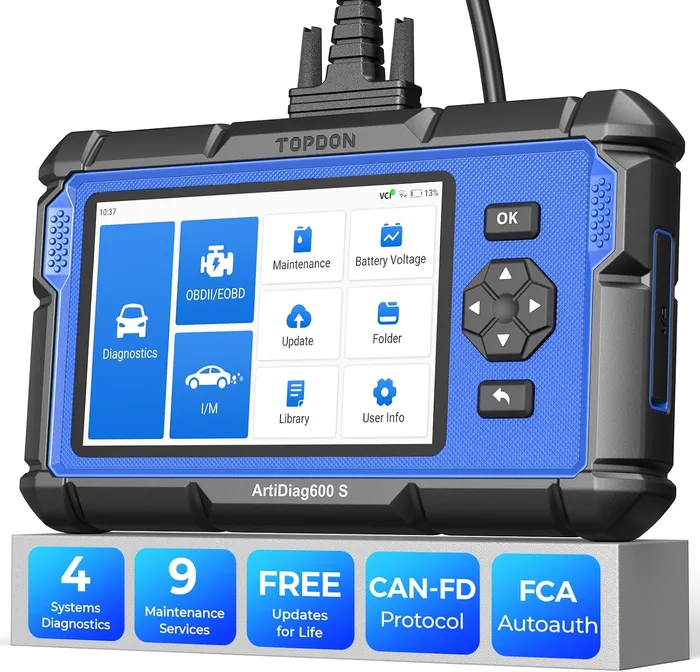
9. Autel AL629S: Best Entry-Level OBD2 Scanner for Subaru Outback
- DTC read and clear from engine, transmission, ABS, and SRS modules through Subaru enhanced protocol
- Compact handheld with built-in color screen and no app or phone required
- 600+ Amazon reviews, 4.3 stars
Overview
The Autel AL629S reads and clears DTCs across four systems on the Subaru Outback: engine, transmission, ABS, and SRS airbag. It does this through Subaru enhanced protocol, which gives it access to manufacturer-specific fault codes that a basic OBD2 engine-only reader misses. For Outback owners who need a tool that reaches beyond engine codes into the ABS and SRS modules, the AL629S does it without requiring an app or a phone.
For Lineartronic CVT owners, the AL629S reads SAE-standardized transmission codes that Subaru maps to the enhanced protocol registers it shares with the TCM. P0868 for hydraulic line pressure below threshold and P0746 for pressure control solenoid performance are readable through this protocol layer. The AL629S does not read the Lineartronic-specific codes stored only in the TCM’s proprietary fault register, such as the P17xx belt slip codes.
The ABS coverage matters for Outback owners because several common fault scenarios generate both an ABS warning light and a VDC warning simultaneously. The AL629S reads the wheel speed sensor codes and ABS pump motor codes that explain those warning lights. Owners who bring an Outback to a shop with warning lights on and are told there are no codes have likely gone to a shop with a basic engine-only scanner. The AL629S accesses the ABS module directly.
What the AL629S cannot do defines its audience. It has no AVCS live data, no CVT adaptation reset, no EyeSight module access, and no bi-directional capability. It is for Outback owners whose diagnostic needs are basic and whose cars are older models without those systems. It also suits any owner who needs to read and clear a specific code quickly.
The VDC warning light scenario is one of the most common situations where the AL629S provides value for Outback owners. The Outback’s Vehicle Dynamics Control system and ABS share the same warning light circuit. When a wheel speed sensor fails on any Outback with VDC active from 2010 onward, both the ABS light and the VDC light illuminate simultaneously. An owner who takes this Outback to a shop with a basic engine-only code reader is told there are no codes because the engine ECU stores nothing related to a wheel speed sensor fault. The AL629S accesses the ABS/VDC module directly and reads the C-series codes that explain both warning lights in one scan.
For owners of 2003-2009 EJ25 Outbacks without the Lineartronic CVT and without EyeSight, the AL629S covers the complete fault code landscape. The EJ25’s enhanced Subaru engine codes, including the AVCS deviation codes for the single-cam-per-bank AVCS system on early models, the ABS module, and the SRS airbag module, are all readable through the AL629S. An owner maintaining a third-generation Outback as a daily driver does not need CVT service reset functions or EyeSight DTC access. The AL629S serves that vehicle’s diagnostic requirements without spending money on capabilities it will never use.
The I/M readiness function on the AL629S is relevant for Outback owners in emissions testing states who need to confirm that all OBD2 monitors have completed before an inspection. After a battery disconnect or a fault code clear, the Outback’s monitors including the catalytic converter monitor, the EVAP monitor, and the oxygen sensor monitor must each complete a drive cycle before the vehicle will pass an OBD2 readiness check. The AL629S displays each monitor’s ready or not-ready status without requiring any specialized knowledge. An owner who sees a not-ready monitor can use the AL629S to confirm which specific monitor is incomplete and plan the appropriate drive cycle to complete it before going to an inspection station.
Diagnostic Features and Capabilities
The AL629S reads and clears fault codes from four systems: engine, transmission, ABS, and SRS. Enhanced Subaru protocol access gives it reach into manufacturer-specific code registers that a basic OBD2-only scanner misses, including SAE-mapped Subaru transmission codes from the CVT TCM. ABS coverage reads wheel speed sensor and pump motor codes that explain ABS and VDC warning light combinations.
Standard OBD2 live data covers engine RPM, coolant temperature, MAF, throttle position, fuel trims, and O2 sensor output. Subaru-specific live data parameters including AVCS cam advance angle and CVT slip ratio are not accessible. EyeSight fault codes are also not accessible. I/M readiness mode confirms which monitors have completed their drive cycle for emissions testing.
Vehicle Compatibility
All OBD2-compliant Subaru Outback models from 1996 onward for standard engine codes. Enhanced Subaru multi-module coverage for engine, transmission, ABS, and SRS applies from 2003 onward.
Specifications
| Specification | Details |
|---|---|
| Connection | Wired OBD2 cable (built-in) |
| Supported Systems | Engine, transmission, ABS, SRS (enhanced Subaru protocol) |
| OBD2 Functions | Read/clear DTC, live data, freeze frame, I/M readiness, O2 sensor, EVAP |
| Bidirectional Control | No |
| Service Functions | None |
| Vehicle Compatibility | Subaru 2003-2025; OBD2 universal 1996+ |
| Display | Built-in color LCD |
| Updates | None required |
What’s Included
The package includes the Autel AL629S handheld scanner with built-in OBD2 cable and a printed quick start guide.
The scanner supports all 10 OBD2 test modes for complete engine diagnostic testing including O2 sensor and evap tests.
For Subaru Outback diagnostics, graphs live PCM data stream across multiple parameters for trend monitoring during a drive cycle.
In practice on the Subaru Outback, the scanner reads and clears ABS, SRS, Engine, and Transmission codes across four systems on most 1996 and newer vehicles.
Pros and Cons
| Pros | Cons |
|---|---|
| Engine, transmission, ABS, and SRS module DTC access through enhanced Subaru protocol | No AVCS live data, no CVT adaptation reset, no EyeSight access, and no bi-directional capability |
| No app or phone required; built-in color display with DTC descriptions on-screen | |
| I/M readiness status for emissions testing preparation | |
| Compact handheld that fits in a glovebox for quick code checks | |
| Full OBD2 function coverage including freeze frame and live data |
My Final Verdict
The Autel AL629S covers the minimum diagnostic requirement for any Outback owner: read and clear fault codes from the four main systems. It is the right entry-level choice for owners of older pre-CVT, pre-EyeSight Outback models who need more than an engine-only code reader.
Comparison Table
| Scanner | Badge | AVCS Live Data | CVT Reset | EyeSight Access | Bi-Directional | DoIP (2022+) |
|---|---|---|---|---|---|---|
| Launch CRP919E | Best Overall | Yes | Yes | Yes | Yes | Yes |
| Autel MK808S | Best Value | Yes | Yes | Yes | No | No |
| BlueDriver Pro | Best Bluetooth | Yes | No | Yes | No | No |
| Autel MX900 | Best Premium | Yes | Yes | Yes | Yes | Yes |
| OBDLink MX+ | Best Live Data | Yes (SSM2) | No | No | No | No |
| Foxwell NT809BT | Best Wireless | Yes | Yes | Yes | Yes | Unconfirmed |
| Innova 5610 | Best Wired | No | No | No | No | No |
| Topdon TopScan Lite | Best Compact | Yes | No | Yes | No | No |
| Autel AL629S | Best Entry | No | No | No | No | No |
Buyer’s Guide: How to Choose the Best OBD2 Scanner for Subaru Outback
Which Outback Engine and Generation You Have Matters Most
The Subaru Outback has used several distinct engine architectures across its generations, and the right scanner depends on which one is under the hood. The EJ25 2.5L flat-four from 2003 through 2009 uses a simpler AVCS system with a single cam phaser per bank. The FB25 2.5L (2010-2019) and the FA25 2.5L (2020-present) add AVCS on both intake and exhaust cams per bank, which requires a scanner that reads four separate cam advance channels.
The EZ36 H6 3.6R (2010-2019) is the most demanding in terms of diagnostic coverage. It uses Dual Active Valve Control System with phasers on both intake and exhaust cams of all three cylinder pairs, creating four independent AVCS channels. P0011 and P0021 are the common intake cam over-advance codes. P0026 and P0028 flag oil control valve performance on the exhaust side, and these require the full DAVCS coverage that only the top-tier scanners on this list provide. The FA24F 2.4L turbo in the XT trim from 2020 onward adds boost pressure monitoring and HPFP fault access.
CVT Adaptation Reset Is Not Optional for 2015 and Later Models
The Lineartronic CVT on 2015-and-later Outbacks stores adaptation data in the TCM that calibrates the belt clamping pressure and pulley ratio to the specific wear pattern of that unit. When the CVT fluid is changed, that adaptation data no longer matches the new fluid’s friction characteristics. Subaru’s service procedure requires an adaptation reset after every CVT fluid change so the TCM learns the new fluid’s behavior.
A scanner without the CVT adaptation reset function cannot complete this procedure. The BlueDriver Pro and OBDLink MX+ lack it. The Topdon TopScan Lite lacks it. The Innova 5610 and AL629S lack it. If the Outback has the Lineartronic CVT and has had or will have a fluid change, the scanner must include the reset. The CRP919E, MK808S, MX900, and NT809BT all support it.
A full comparison of what each Subaru-compatible tool covers across all platforms is in my dedicated Subaru OBD2 scanner guide.
EyeSight Access Determines Whether Warning Lights Can Be Diagnosed
EyeSight became available on the Outback in 2013 and has gone through four generations of hardware. All four store fault codes in a dedicated camera control module that is separate from the engine ECU. A scanner that reads only engine codes will never see an EyeSight DTC. When the EyeSight warning light comes on, the only way to find out why without a dealer scan is a scanner with EyeSight module access through enhanced Subaru protocol.
The cameras themselves cannot be recalibrated by any aftermarket scanner. After a windshield replacement, calibration requires Subaru’s SSMIII or an authorized calibration tool. What the scanners in this list do is read and clear the stored EyeSight DTCs that indicate hardware faults, camera communication errors, and radar module issues. For 2013-and-later Outback owners, EyeSight DTC access is a required feature, not an optional one.
DoIP Protocol Is Required for 2022 and Later Models
The 2022 Outback moved to a new global platform that uses DoIP (Diagnostics over Internet Protocol) and CAN FD for ECU communication. These replace the older CAN protocol used on all previous Outbacks. A scanner that does not support DoIP either fails to connect to the 2022-2025 Outback entirely. Or it connects only to the OBD2 gateway and cannot reach the AVCS, CVT, or EyeSight ECUs behind it.
Only the CRP919E and MX900 on this list confirm DoIP support for the Outback. The NT809BT’s DoIP support for the 2024-2025 Outback is unconfirmed at the time of writing. All other scanners on this list are suitable for 2003-2021 Outback models. Owners of 2022-and-later Outbacks should verify DoIP compatibility with the scanner manufacturer before purchasing any tool not listed as DoIP-capable.
My professional OBD2 scanner guide covers the CRP919E and MX900 in depth, including their DoIP support for the 2022-and-later Outback platform.
Bi-Directional Testing Changes What a Diagnosis Means
A scanner that only reads fault codes tells an owner what the car thinks is wrong. A bi-directional scanner tells an owner whether the component flagged in the code is actually faulty or whether the fault is being triggered by something upstream. The AVCS oil control valve is a common example on the Outback. A P0011 intake cam over-advance code can come from a worn solenoid, blocked oil passage, low oil pressure, or a stretched timing chain.
A bi-directional scanner commands the solenoid to activate and monitors the cam angle response. If the angle moves correctly, the solenoid is functional and the problem is elsewhere. If the angle does not move, the solenoid is confirmed faulty. This test takes about thirty seconds and eliminates the two-hour labor cost of a mechanic doing the same test. The CRP919E, MX900, and NT809BT all support this test on the FB25, FA25, and EZ36 H6.
My bidirectional OBD2 scanner guide covers the full active test comparison for AVCS and DAVCS solenoid diagnosis across all Subaru platforms.
Common Mistakes When Buying an OBD2 Scanner for Subaru Outback
Buying a generic OBD2 reader and expecting Subaru-specific system access.
Generic OBD2 readers read SAE J1979 standardized fault codes from the engine ECU only. The Outback’s AVCS cam timing faults, Lineartronic CVT codes, EyeSight DTCs, and ABS module codes are all stored in manufacturer-specific registers that generic readers cannot reach. A scanner described as OBD2-compatible with no mention of enhanced Subaru protocol will miss every fault that matters on the Outback.
Assuming any bi-directional scanner supports the CVT adaptation reset on all Outback models.
The CVT adaptation reset is a separate service function from bi-directional actuation tests. Several bi-directional scanners include AVCS solenoid testing but do not include Lineartronic-specific service functions. Before purchasing, confirm that the scanner’s service reset menu explicitly lists the CVT adaptation reset for Subaru Lineartronic, not just a generic transmission reset. These are different procedures targeting different control modules.
Not checking DoIP compatibility before buying for a 2022 or later Outback.
The 2022 Outback platform change was significant enough that several scanners that work perfectly on 2021 models fail to reach the main ECUs on 2022 models. A scanner that shows as Subaru-compatible on the manufacturer’s website may have been tested on pre-2022 Outbacks only. The DoIP update requires a hardware change in the VCI module, not just a software update. Contact the scanner manufacturer directly and ask specifically about DoIP support for 2022-2025 Subaru Outback before purchasing.
Using a Bluetooth adapter without verifying EyeSight module access.
Many Bluetooth OBD2 adapters advertise full-system Subaru access without specifying whether EyeSight is included. The EyeSight module uses a different communication address than the engine and transmission ECUs. Adapters that support the standard Subaru enhanced protocol data stream may not send the specific module identifier that the EyeSight controller responds to. The BlueDriver Pro and OBDLink MX+ confirm EyeSight DTC access; most generic Bluetooth adapters do not.
Forester owners with the same Bluetooth compatibility concern will find my Subaru Forester OBD2 scanner guide covers how EyeSight module access varies across the available tools.
FAQs
What OBD2 scanner works best with the Subaru Outback?
The Launch CRP919E works best across all Outback generations and trim levels. It supports DoIP for 2022-2025 models, AVCS solenoid testing on the FB25 and EZ36 H6, CVT adaptation reset for Lineartronic models, EyeSight DTC access, and full bi-directional capability. Owners of 2013-2021 models who do not need DoIP will find the Autel MK808S covers the same core functions at a lower price.
Can an OBD2 scanner reset the Subaru Outback CVT transmission?
Yes, but only scanners that include the Lineartronic CVT adaptation reset function. The CRP919E, MK808S, MX900, and NT809BT all support this procedure. The adaptation reset is required after every CVT fluid change on 2015-and-later Outbacks and must target the Lineartronic TCM specifically. Generic transmission reset functions on basic scanners do not perform the same procedure.
Will a cheap OBD2 scanner work on a Subaru Outback?
A basic OBD2 scanner reads engine fault codes but misses the systems that matter most on the Outback. AVCS cam timing faults, Lineartronic CVT codes, EyeSight DTCs, and ABS module faults are all stored in manufacturer-specific registers. The Autel AL629S is the minimum recommended scanner because it reads across all four main modules through enhanced Subaru protocol.
Does the Subaru Outback have a Security Gateway that blocks scanners?
No. The Subaru Outback does not use a Security Gateway module. Chrysler/Stellantis vehicles introduced this system, but Subaru has not implemented it on any Outback model through 2025. Any scanner with enhanced Subaru protocol access connects directly to the ECUs without requiring a bypass subscription.
What is the AVCS fault code on a Subaru Outback and can a scanner fix it?
P0011 and P0021 are the most common AVCS codes on the Outback, indicating intake cam over-advance on bank 1 and bank 2. EZ36 H6 models also generate P0026 and P0028 for oil control valve performance on the exhaust side. A scanner with bi-directional capability tests the oil control valve directly to confirm whether it is the source of the fault. The scanner identifies the problem; the repair still requires mechanical work or a solenoid replacement.