
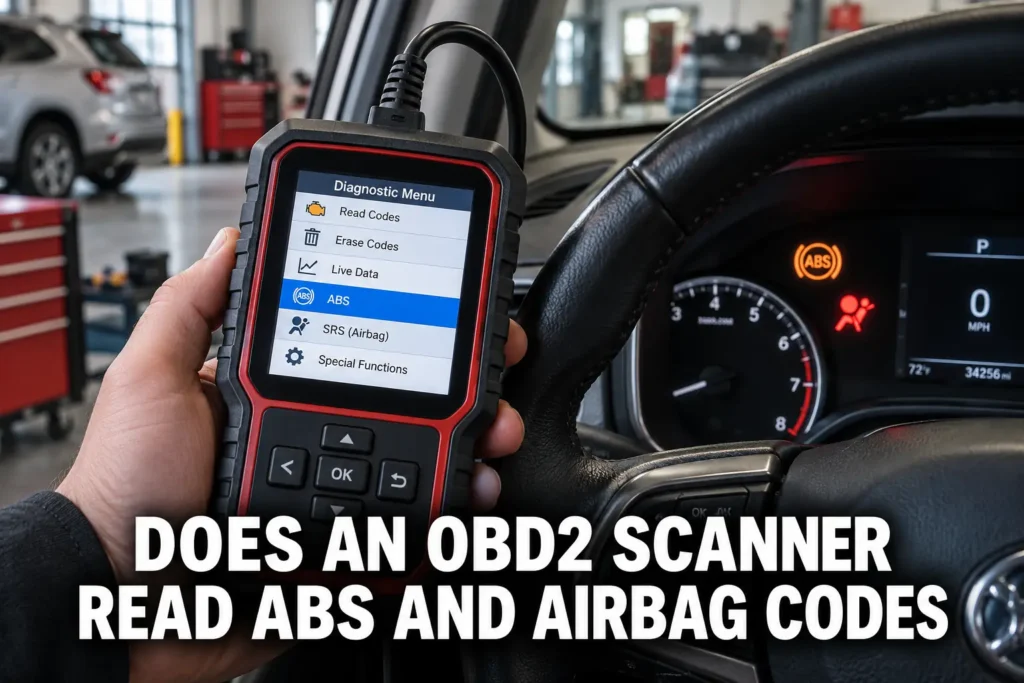
The short answer is: it depends on the scanner. A standard OBD2 code reader that reads engine codes cannot read ABS or airbag codes. A scanner with multi-system capability can. Most drivers find this out the hard way: they scan the vehicle when the ABS light or SRS airbag warning comes on, get a “no codes found” result, and assume the scanner is broken or the light is a false alarm. Neither is true. The ABS module and the SRS module are separate computers from the engine control module, and reaching them requires a scanner that has the software to communicate with those specific modules. Silverado owners who need ABS and SRS coverage for their truck can find compatible tools compared in my Chevy Silverado OBD2 scanner guide.

About the author: Hello! I’m Kamil Siegień, founder of OBD2 Scout. My diagnostic experience started with an engine rebuild on a 2014 Skoda Superb 1.8 TSI, where tuning from 160 to 222 hp required mastering live data and ECU behavior that basic code readers cannot handle. I am a former BMW and MINI employee and regularly use diagnostic scanners on my own Audi A4 2.0 TFSI.
This guide covers why standard scanners miss ABS and airbag codes, what type of scanner is needed, why clearing an airbag code without repairing the fault is a safety risk, and what to know before buying a multi-system scanner for these specific jobs.
My airbag srs codes explained covers this step by step.
My wired vs bluetooth obd2 scanner covers this step by step.
My a full system scan obd2 scanner explained covers this step by step.
For Audi Q5 owners who need ABS module access for EPB service and full SRS coverage in the same tool, my Q5 scanner comparison covers which tools confirm both alongside the VAG-specific functions the Q5 requires.
Why Standard OBD2 Scanners Cannot Read ABS or Airbag Codes
The OBD2 port in the vehicle is shared by all control modules. Every module (the engine control module, the ABS module, the SRS module, the transmission control module) communicates through the same physical connector. What is not shared is the software address for each module. On the CAN bus, each control unit has a unique identifier. A scanner initiates communication with a module by sending a request to that specific address. My guide on how to connect and use a standard OBD2 scanner for powertrain codes covers the exact capability set that standard tools access, making clear where the standard powertrain scan ends and multi-system coverage begins.
A basic code reader is programmed to address only the engine control module. It sends requests to the ECM address and reads what the ECM responds with. It has no software instructions for the ABS module address or the SRS module address. It cannot initiate a conversation with those modules at all, regardless of physical connection. This is module isolation, and it is why a scan that returns “no codes found” does not mean the ABS module has no codes stored. It means the scanner never asked. My guide to what an OBD2 scanner cannot detect covers the full scope of systems and fault types that fall outside the standard scan, including why a clean emissions scan and a clean safety system scan are two completely different things.
A multi-system scanner is programmed with the software to address multiple modules by their individual identifiers. When it scans, it queries each module in sequence: engine, then transmission, then ABS, then SRS, and so on. The result is a complete picture of what every module in the vehicle has stored. My guide on matching the right scanner tier to the diagnostic task covers the full capability spectrum so the coverage check has context before the purchase.
ABS and SRS Are Different Systems with Different Code Types
ABS and SRS are not the same system. They have separate control modules, separate warning lights on the dashboard, and separate diagnostic code ranges. My reference guide on the full OBD2 code system covers B-codes and C-codes alongside powertrain DTCs, what each category covers, and why reading ABS or SRS codes requires the same understanding of code structure but different scanner hardware. A scanner that reads ABS codes does not automatically read SRS codes. Both require explicit software support, and both must be confirmed independently for a specific vehicle before purchasing.
The code prefix identifies which module and system the fault belongs to:
- P-codes (Powertrain): Engine and transmission faults. P0300 is a random misfire. P0420 is catalyst efficiency. These are what a basic code reader reads.
- C-codes (Chassis): ABS and traction control faults. C0035 is a wheel speed sensor circuit fault. C1201 and C1235 are common ABS faults on Toyota and Ford respectively.
- B-codes (Body): SRS, airbag, and body control faults. B0001 and B1100 are typical SRS module codes. These require SRS-specific scanner software.
- U-codes (Network): Communication faults between modules. A U-code on the ABS module often means the ABS module is not receiving data from another module it depends on.
When an ABS warning light is on, the fault code will have a C prefix. When the airbag or SRS light is on, the code will have a B prefix. A scanner that only reads P-codes will return nothing for either warning light. My guide to OBD2 codes explained covers the full P-code structure in detail for anyone who also needs to work through the powertrain codes alongside ABS and SRS diagnosis.
My guide on what OBD2 trouble codes tell you covers the full code structure beyond the letter prefix, how the four-digit number identifies the specific fault within that system, and how the generic versus manufacturer-specific distinction changes where you look for the correct definition.
Why Clearing an Airbag Code Without Repairing the Fault Is Dangerous
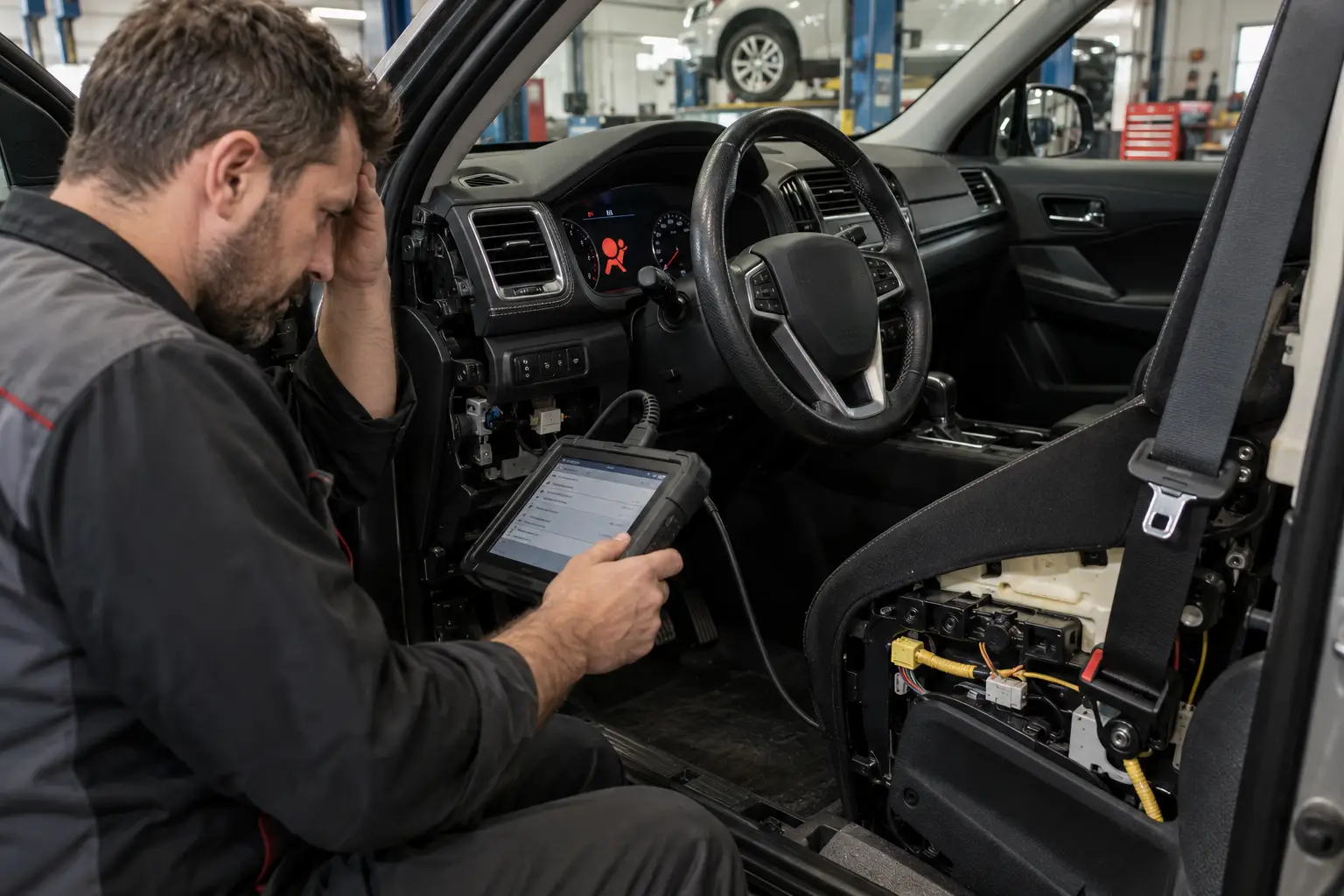
The SRS warning light is not a cosmetic annoyance. It is an active alert that the system may not be in a deployment-ready state. If an impact sensor is damaged, a connector has a fault, a pretensioner circuit has failed, or the airbag control module has an electrical issue, the airbag system may not deploy correctly in a crash.
My obd2 codes after car accident covers this step by step.
Crosstrek owners who need to clear SRS codes after a sensor fault will find my Crosstrek ABS and SRS scanner guide covers which tools reach the Crosstrek’s full module set.
Clearing the stored B-code with a scanner turns off the SRS warning light. It does not repair the fault. It does not restore the system to a deployment-ready state. After the code is cleared, the vehicle looks like the airbag system is functional. In a collision, it may not be.
This is categorically different from clearing an engine code. Clearing a check engine light code without repairing the fault is poor practice, but the immediate consequence is the light returning. Clearing an SRS code without repairing the fault carries a direct safety consequence: the system may fail to protect the occupant when it is needed.
My why does check engine light come on after oil change covers this step by step.
The correct sequence for any SRS fault is: connect a scanner with SRS capability, read the specific B-code, identify the exact fault, repair it, verify the repair, and then clear the code. Never clear first and investigate later on any SRS system.
Forester owners who need ABS and SRS coverage alongside engine diagnostics will find my Subaru Forester scanner picks covers the compatible tools for the Forester’s full module set.
The Seatbelt Pretensioner: The Most Common SRS Scenario
After a minor collision, even a low-speed impact that did not deploy the airbags, the SRS warning light frequently comes on and stays on. The most common reason is a triggered seatbelt pretensioner.
Pretensioners are pyrotechnic devices built into the seatbelt retractor. In an impact above a certain threshold, they fire and lock the belt tight around the occupant. This happens in many collisions that do not deploy the airbags. Once a pretensioner has fired, it is a single-use component and must be replaced. It cannot be reset or reloaded.
After replacing the pretensioner, the SRS warning light stays on. Many drivers assume the repair was incomplete or that another fault exists. In most cases, the repair is correct and complete. The problem is the stored B-code in the SRS module, which will not clear on its own. A scanner with SRS capability must access the module and clear the code before the light goes off. The airbag system is functional after the pretensioner replacement; the stored fault code is the only reason the light remains on.
The Airbag Warning Light Will Not Self-Clear

Most dashboard warning lights go off when the condition that triggered them is resolved. The SRS warning light does not. Once a fault code is stored in the SRS module, the warning light stays on until that code is manually cleared by a scanner with SRS access.
For Audi Q7 owners with SRS faults appearing alongside EAS or transmission codes, my Q7 scanner guide covers which tools clear multi-module faults across ABS, SRS, and the Q7’s air suspension system in a single diagnostic session.
This latching behavior is intentional. The SRS system is safety-critical and the warning light is designed to remain visible until a technician or scanner confirms the system has been serviced. A vehicle that was in a minor crash two years ago and never had its pretensioner codes cleared will still show the SRS light today, even if the underlying parts were replaced correctly at the time.
This is why SRS-capable scanner access is required both to diagnose the fault and to complete the repair. Replacing the part resolves the physical problem. Clearing the code with an SRS-capable scanner completes the repair and closes the warning light. My guide to clearing OBD2 codes covers the full clearing process and why monitors and pending codes behave differently after a clear compared to a confirmed fault that has been repaired.
What “4-System Scanner” Means and When It Falls Short
Scanners marketed as “4-system” tools claim to read codes from the engine, transmission, ABS, and SRS modules. This coverage claim needs to be verified for each specific vehicle, not taken at face value from the product label. My guide to the top budget OBD2 scanner covers the entry-level options and includes coverage verification notes for each.
In practice, many “4-system” scanners provide engine and transmission coverage across a broad range of vehicles, while ABS and SRS coverage is limited to specific makes and model years. A scanner that reads ABS codes on a Toyota may not read ABS codes on a BMW from the same production year. The physical connection succeeds; the software coverage does not exist for that specific module. My detailed BlueDriver Pro review covers a Bluetooth scanner in the mid-tier that publishes its vehicle coverage database publicly, removing the guesswork before purchase.
“Full-system” claims carry the same caveat. Before purchasing any scanner specifically to read ABS or SRS codes on a vehicle, check the tool’s published vehicle coverage database for that exact make, model, and year under both ABS and SRS access. That check takes five minutes and prevents the frustration of a purchase that does not do the job it was bought for.
Outback owners should verify ABS and SRS compatibility for the Outback’s specific modulator variants; my Subaru Outback OBD2 scanner guide covers which tools pass that check.
Active ABS Tests: The Diagnostic Capability Most Guides Skip

Reading and clearing ABS codes is the minimum diagnostic function. Advanced scanners with bidirectional ABS capability can do significantly more. My guide to the professional OBD2 scanner guide covers the tier where full bidirectional ABS control, solenoid cycling, and active pump tests are standard.
Bidirectional ABS control means the scanner can command the ABS pump and individual solenoids to activate and observe their response. When a wheel speed sensor code points to the ABS modulator, the definitive test is to command the modulator solenoids and confirm they respond. This verifies the modulator is functional without removing it from the vehicle. A component that reads a fault code may be the sensor, the wiring, or the modulator itself. Bidirectional testing narrows the cause before parts are ordered. For scanners that also support live data streaming during active ABS tests, my guide to OBD2 live data covers the wheel speed sensor PIDs and voltage readings that surface during a brake system test.
ABS bleeding via scanner is required on many vehicles after ABS modulator replacement. The ABS modulator has internal hydraulic passages that contain air after removal. Conventional brake bleeding methods (gravity, pressure, or vacuum) cannot purge this internal air because it is trapped behind solenoid valves. A scanner-initiated ABS bleeding sequence cycles the solenoids in a programmed pattern that opens each internal passage and allows the air to purge through the system. Without this step, the ABS system does not function correctly after modulator replacement, even if the component is installed correctly and all brake lines are properly bled. My full review of the Autel MaxiSYS Elite II Pro covers the professional scanner tier where ABS bleeding sequences, solenoid actuation, and module-level bidirectional control are available across a broad vehicle range.
The Bottom Line
A standard OBD2 code reader reads engine codes and nothing else. ABS codes and airbag codes are stored in separate modules that a basic scanner is not programmed to communicate with. A multi-system scanner with explicit ABS and SRS software coverage for the specific vehicle is needed for both. My guide to the top scanner for ABS and SRS codes covers the options at each price tier with verified vehicle coverage databases for both systems.
ABS and SRS require separate capability confirmation: they are different systems with different code types. Never clear an SRS code as a cosmetic fix. The airbag warning light signals a possible deployment-readiness issue, not a minor annoyance. The light will not go off after a repair without a scanner clearing the stored code. Verify vehicle coverage before purchasing any scanner marketed as supporting ABS or SRS diagnostics. My full review of the Foxwell NT630 Plus covers a dedicated ABS and SRS scanner with a coverage database that can be verified against a specific vehicle before purchase.
FAQs
Can any OBD2 scanner read ABS codes?
No. Standard code readers that communicate only with the engine control module cannot read ABS codes. ABS codes are stored in the ABS module, which is a separate computer on the vehicle’s network. A scanner must have software programmed to communicate with the ABS module by its specific identifier on the CAN bus. Scanners sold as 4-system or multi-system tools typically include ABS access, but coverage varies by vehicle make and model. Verify that the specific scanner lists the exact vehicle in its ABS coverage database before purchasing.
What type of scanner reads airbag codes?
A scanner with SRS (Supplemental Restraint System) diagnostic capability. SRS codes are stored in the airbag control module, which is separate from the engine module. The scanner must have software that addresses the SRS module by its specific CAN bus identifier. Most mid-range and professional scanners include SRS access, often bundled with ABS capability in a 4-system or full-system configuration. As with ABS, SRS coverage is vehicle-specific. Confirm the tool covers the specific make, model, and year for SRS access before buying.
Will clearing an airbag code make my SRS light go off?
Yes, but only after the underlying fault is repaired. Clearing the stored B-code from the SRS module removes the warning light. If the underlying fault is not repaired, the code returns the next time the SRS module runs its self-check, and the light comes back on. More importantly, clearing an SRS code without repairing the fault leaves the airbag system in an unknown state; it may not deploy correctly in a crash. Always identify and repair the fault before clearing any SRS code.
What do C-codes and B-codes mean on a scanner?
The letter prefix on a diagnostic trouble code identifies which vehicle system stored it. C-codes (Chassis) come from the ABS, traction control, and stability control systems. B-codes (Body) come from the SRS airbag system, body control module, and related systems. P-codes (Powertrain) come from the engine and transmission. U-codes (Network) indicate communication faults between modules. When an ABS warning light is on, the fault code stored in the ABS module will have a C prefix. When the SRS airbag light is on, the stored code will have a B prefix.
Does a 4-system scanner work on all vehicles?
Not always. A 4-system scanner is designed to access the engine, transmission, ABS, and SRS modules, but actual coverage depends on the scanner’s software database. Most 4-system tools cover a broad range of common makes for engine and transmission access. ABS and SRS coverage is often more limited and varies significantly by make, model, and year. A scanner that reads ABS codes on most Toyota and Honda vehicles may not support ABS on a European make from the same year. Always check the specific vehicle coverage list for ABS and SRS access before purchasing a scanner for those systems.
For Audi Q8 owners verifying ABS and SRS coverage alongside RS Q8 engine diagnostics, my Audi Q8 scanner breakdown covers which tools confirm verified coverage across all of the Q8’s safety and powertrain modules.
My ABS light is on but my scanner shows no codes. Why?
The most likely reason is that the scanner does not support ABS module communication for that vehicle. When a basic code reader connects and shows “no codes,” it is reporting that the engine control module has no stored P-codes. It is not reporting that the ABS module has no codes; it never queried the ABS module. A scanner with ABS capability for that specific vehicle will show the stored C-code that the basic reader could not see. If an ABS-capable scanner also returns no codes, the fault may be intermittent and not currently stored, or the ABS module itself may have a communication fault requiring further diagnosis.
Do I need to reset the SRS system after replacing a seatbelt pretensioner?
Yes. After replacing a triggered seatbelt pretensioner, the SRS warning light stays on because the fault code stored in the SRS module when the pretensioner fired is still present. Replacing the part resolves the physical fault but does not clear the stored code. An SRS-capable scanner must access the SRS module and clear the B-code for the warning light to go off. This is one of the most common post-collision SRS jobs: the repair is complete, the system is restored to a functional state, and the final step is clearing the latched code with a scanner.