
The common framing is that OBD2 added features to OBD1. The more accurate framing is that OBD1 was never standardized in the first place. Before 1996, each manufacturer built their own diagnostic system: their own connector, their own fault codes, their own communication method. A scan tool that worked on a GM vehicle would not work on a Ford. A Ford tool would not work on a Toyota. There was no shared standard at all. OBD2 was not an upgrade to something that existed. It was a federal mandate that replaced manufacturer chaos with a single system that any compliant scanner could read.

About the author: Hello! I’m Kamil Siegień, founder of OBD2 Scout. My diagnostic experience started with an engine rebuild on a 2014 Skoda Superb 1.8 TSI, where tuning from 160 to 222 hp required mastering live data and ECU behavior that basic code readers cannot handle. I am a former BMW and MINI employee and regularly use diagnostic scanners on my own Audi A4 2.0 TFSI.
This guide covers what OBD1 actually was, what the OBD2 mandate standardized, the five communication protocols OBD2 used before CAN became mandatory, how to identify which system a specific vehicle has, and what scanner to use on each.
What OBD1 Actually Was: Each Manufacturer Went Its Own Way
OBD1 was not a standard. It was a collection of manufacturer-specific diagnostic implementations that happened to share a name. The California Air Resources Board required vehicles sold in California from 1988 onward to have some form of onboard diagnostics, but it left the implementation details entirely to each manufacturer. The result was fragmentation. My guide on how to use a modern OBD2 scanner covers the standardized connection and menu flow that works across all post-1996 makes — the exact opposite of the manufacturer-specific process each OBD1 system required.
General Motors used a 12-pin ALDL (Assembly Line Diagnostic Link) connector, typically located under the dashboard near the steering column. Ford used a single-wire EEC-IV system with its own trapezoidal connector. Chrysler had a different connector and a different protocol. Toyota used a 17-pin connector on many models. Honda had its own two-pin system. Some manufacturers placed the connector in the engine bay. Others put it under the dash on the passenger side. No two systems were in the same location or used the same interface. Honda has used standard OBD2 since 1996; my best OBD2 scanners for Honda guide covers current scanner options for Civic, CR-V, Accord, and Acura platforms.
Fault codes were also proprietary. A code that meant “oxygen sensor circuit malfunction” on a GM vehicle used a completely different number than the same fault on a Ford. A technician moving between makes needed brand-specific scan tools and brand-specific code lists. There was no cross-referencing and no shared language between systems.
Diagnostic depth was limited by modern standards. Most OBD1 systems reported codes for emissions-related faults and not much else. Live data was available only through expensive dealer-level equipment. Consumer-grade OBD1 scanners were rare, brand-specific, and largely limited to reading and clearing codes.
What the OBD2 Mandate Standardized
The OBD2 standard, developed through SAE and adopted by the EPA, replaced the OBD1 patchwork with a defined set of requirements that every compliant vehicle had to meet. My guide on what is OBD2 covers the exact federal mandate that created that universal system, what the 1996 compliance date required of every vehicle sold in the US, and how the standard eliminated the fragmentation that made OBD1 unworkable as a diagnostic platform. Three standardization areas drove the practical change.
The connector became universal. SAE J1962 defined a 16-pin trapezoidal connector and required it to be within 3 feet of the steering wheel on the driver’s side, accessible without tools. Every OBD2 vehicle from every manufacturer uses this same connector in this same location. A single cable connects any OBD2 scanner to any OBD2 vehicle. My guide to OBD2 port location covers where the 16-pin connector sits across common makes and what to do when it is not where the manual says it should be.
Fault codes became standardized. DTCs shifted to a 5-character format: one letter identifying the system (P for powertrain, C for chassis, B for body, U for network) followed by four digits. Generic codes shared across all manufacturers start with P0. Manufacturer-specific enhanced codes start with P1, P2, or P3. The same P0420 code means catalyst efficiency below threshold on every OBD2 vehicle from every brand. My guide to OBD2 codes explained covers the full P-code taxonomy, what the digits in a DTC actually communicate, and how to look up any code across the standardized range.
Service modes became required. SAE J1979 defined nine standardized service modes covering confirmed codes, freeze frame data, live data PIDs, I/M readiness monitor status, oxygen sensor testing, and more. Every OBD2 vehicle must support the mandatory modes. This is why any OBD2 scanner can pull codes and check I/M readiness on any OBD2 vehicle regardless of make. My guide to OBD2 readiness monitors covers what each monitor tracks, why monitors reset after a battery disconnect, and how to run a drive cycle that sets them before an emissions test.
The U.S. implementation timeline: gasoline passenger cars sold in California were required to comply from model year 1994. Federal OBD2 compliance for gasoline passenger cars and light trucks became mandatory for model year 1996. Diesel light-duty vehicles were phased in by 1997.
My j1939 heavy duty truck diagnostics obd2 covers this step by step.
The Five OBD2 Protocols Before CAN: The Detail Most Guides Miss

Every guide that covers OBD2 says it uses CAN (Controller Area Network). This is accurate for vehicles from model year 2008 onward. For 1996 through 2007 OBD2 vehicles, it is not accurate. CAN was not a mandatory OBD2 protocol until model year 2008. From 1996 to 2007, OBD2 vehicles used one of five different communication protocols depending on the manufacturer.
My can bus obd2 diagnostics explained covers this step by step.
The five protocols and which vehicles used them:
- J1850 PWM (Pulse Width Modulation): Used primarily by Ford vehicles from 1996 through the mid-2000s. Runs at 41.6 kbps. Pins 2 and 10 on the OBD2 connector carry this signal.
- J1850 VPW (Variable Pulse Width): Used primarily by General Motors vehicles from 1996 through the early 2000s. Runs at 10.4 kbps. Communicates over pin 2 only.
- ISO 9141-2: Used by most European and Asian imports (including Toyota, Honda, BMW, Mercedes, Volkswagen, and others) during the same period. Runs at 10.4 kbps over pins 7 and 15.
- KWP2000 (ISO 14230-4): Used by some European vehicles as an alternative to ISO 9141-2, particularly from the early 2000s onward. Shares the same physical pins as ISO 9141-2.
- CAN (ISO 15765-4): Mandatory for all OBD2 vehicles from model year 2008. Some manufacturers adopted it earlier, but it was not required before 2008.
The practical implication is that “OBD2 compatible” on a scanner does not automatically mean it communicates correctly with every OBD2 vehicle. A scanner built primarily for CAN-based vehicles may have incomplete or absent support for ISO 9141-2, which means it may fail to communicate with a 2003 Toyota Land Cruiser or a 2001 BMW 3 Series even though those vehicles are OBD2 compliant. Most modern scanners support all five protocols, but for older or budget tools, confirming protocol support for the specific vehicle is worth doing before purchasing. My guide to OBD2 live data covers the standard PID set that delivers the real-time parameter stream across all five protocols and what changes when moving from ISO to CAN.
The 1994 to 1996 Gray Zone: How to Identify Which System Your Vehicle Has
The 1996 federal cutoff is not the complete picture. California required OBD2 compliance starting with model year 1994 for gasoline passenger cars. Vehicles built for the California market in 1994 and 1995 may have the 16-pin OBD2 connector even though the federal mandate did not apply yet. Additionally, a “1996 model year” vehicle may have been manufactured and sold in calendar year 1995, because model years typically begin production in the prior calendar year.
Early OBD2 (1994 and 1995 California-market vehicles) was not fully equivalent to later implementations. Not all readiness monitors were required. Some manufacturers implemented the minimum to comply. A scanner connecting to one of these early vehicles may find that certain monitors show “Not Applicable” even though the system appears to be OBD2.
The most reliable field identification method requires no lookup: check under the dashboard on the driver’s side for the 16-pin trapezoidal connector. If it is present and accessible without tools, the vehicle is OBD2. If the connector has a different shape or is not in the driver’s area under the dash, the vehicle is OBD1. The connector shape is distinctive and consistent across all OBD2 vehicles.
For 1994 and 1995 vehicles where the system is uncertain: a Carfax or dealer lookup using the VIN will confirm the original specification. The VIN also encodes the model year, which resolves the calendar-year vs. model-year ambiguity.
How OBD1 Codes Were Read: and Still Can Be Without a Scanner
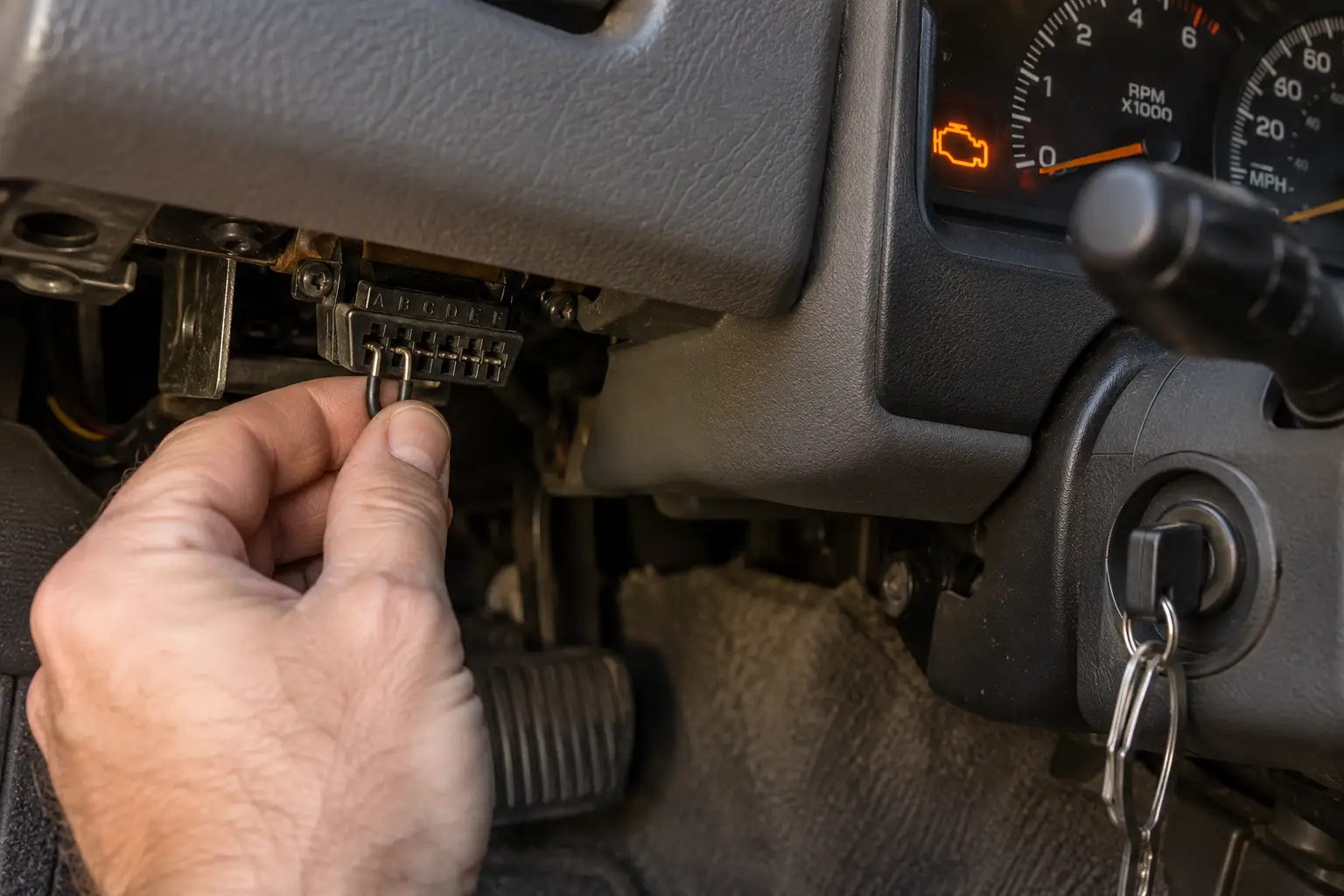
One of the most useful and least-documented features of OBD1 systems is that many of them support blink code reading. Without any scanner at all, a driver can retrieve fault codes by counting check engine light flashes. The method varies by manufacturer but the principle is the same: place the system in diagnostic mode, and the ECU flashes the stored fault codes in a pattern the driver counts and decodes.
My why does check engine light come on after oil change covers this step by step.
GM (ALDL connector): Locate the 12-pin ALDL connector under the dash. Insert a jumper wire between pin A (ground) and pin B (diagnostic request terminal). Turn the ignition to the on position without starting the engine. The check engine light begins flashing. Code 12 always appears first (one flash, pause, two flashes) and repeats three times to confirm the system is in diagnostic mode and functioning. Stored fault codes follow, each flashed three times before moving to the next. A longer pause separates individual codes. Modern Chevy vehicles use standardized OBD2 and support a much wider range of diagnostic tools than the ALDL era allowed; my top Chevy OBD2 scanner picks covers GM-dedicated tools with full bidirectional access and GM-specific service functions.
Ford EEC-IV: Locate the self-test output (STO) connector, typically a single-wire pigtail near the EEC-IV module or fuse box. Connect a test lamp between battery positive and the STO wire, or a jumper from the self-test input (STI) to ground. Turn the ignition to the run position. Count the test lamp flashes or check engine light pulses. Ford uses a two-digit format with a 4-second pause between code sets. Modern Ford vehicles moved to standardized OBD2 in 1996; my top Ford OBD2 scanner options guide covers what works best across the current Ford lineup, from F-150 and Mustang to Explorer and Transit.
Chrysler: No jumper wire required. Cycle the ignition key: on, off, on, off, on, completing the three-step cycle within 5 seconds, ending with the ignition on. The check engine light begins flashing codes immediately. Chrysler uses a format where the number of flashes before the first pause is the first digit and the number of flashes after is the second.
No OBD2 vehicle supports any equivalent method. The ability to read codes without a scanner ended with OBD1. For owners of pre-1996 vehicles who want a quick diagnosis without purchasing equipment, the blink code method is free and requires only a jumper wire or paper clip.
What Scanner to Use on an OBD1 Vehicle
An OBD2 scanner will not communicate with an OBD1 vehicle. The physical connectors are different and the protocols share nothing. Plugging an OBD2 scanner into a GM ALDL connector is not possible without an adapter, and even with an adapter, the scanner has no software to interpret OBD1 responses. Modern Chevy Silverado owners use the standardized OBD2 port, and my Chevy Silverado scanner comparison covers the tools that work best on that platform.
For owners who need a scanner rather than the blink code method, the options are limited. Brand-specific OBD1 scan tools and cables exist for GM, Ford, and Chrysler vehicles. Some multi-brand OBD1 scanners cover all three domestic manufacturers: the Innova 3170RS is one example that handles GM, Ford, and Chrysler OBD1 systems using manufacturer-specific cable adapters included with the unit. For vehicles confirmed to be OBD2, my guide to the entry-level OBD2 scanner guide covers the options at this price tier that handle all five legacy protocols as well as CAN.
Live data was not a realistic consumer-grade capability in the OBD1 era. The Actron CP9690 was the only mass-market OBD1 scanner that provided live data, and it has been discontinued. Professional technicians diagnosing OBD1 vehicles today typically use a combination of blink codes for initial fault identification and oscilloscopes or breakout boxes for circuit-level diagnosis of the specific sensor or actuator in question. For technicians who need deep bidirectional access alongside oscilloscope-level waveform capture from a single device, my guide to the top professional OBD2 scanner covers the tools at that tier.
For most owners of pre-1996 vehicles, the practical diagnostic sequence is: use the blink code method to identify stored fault codes at no cost, cross-reference the manufacturer-specific code list to identify the affected system, and proceed with component-level testing from there. My my full review of the Innova 3100RS covers a budget-tier OBD2 scanner from the same manufacturer that pairs with the OBD1 adapter lineup for shops and DIYers working across both generations.
My guide on how code readers and OBD2 scanners differ covers the full spectrum, including which code categories each tier can and cannot reach and when a step up in tool capability is actually needed.
EOBD: The European Equivalent
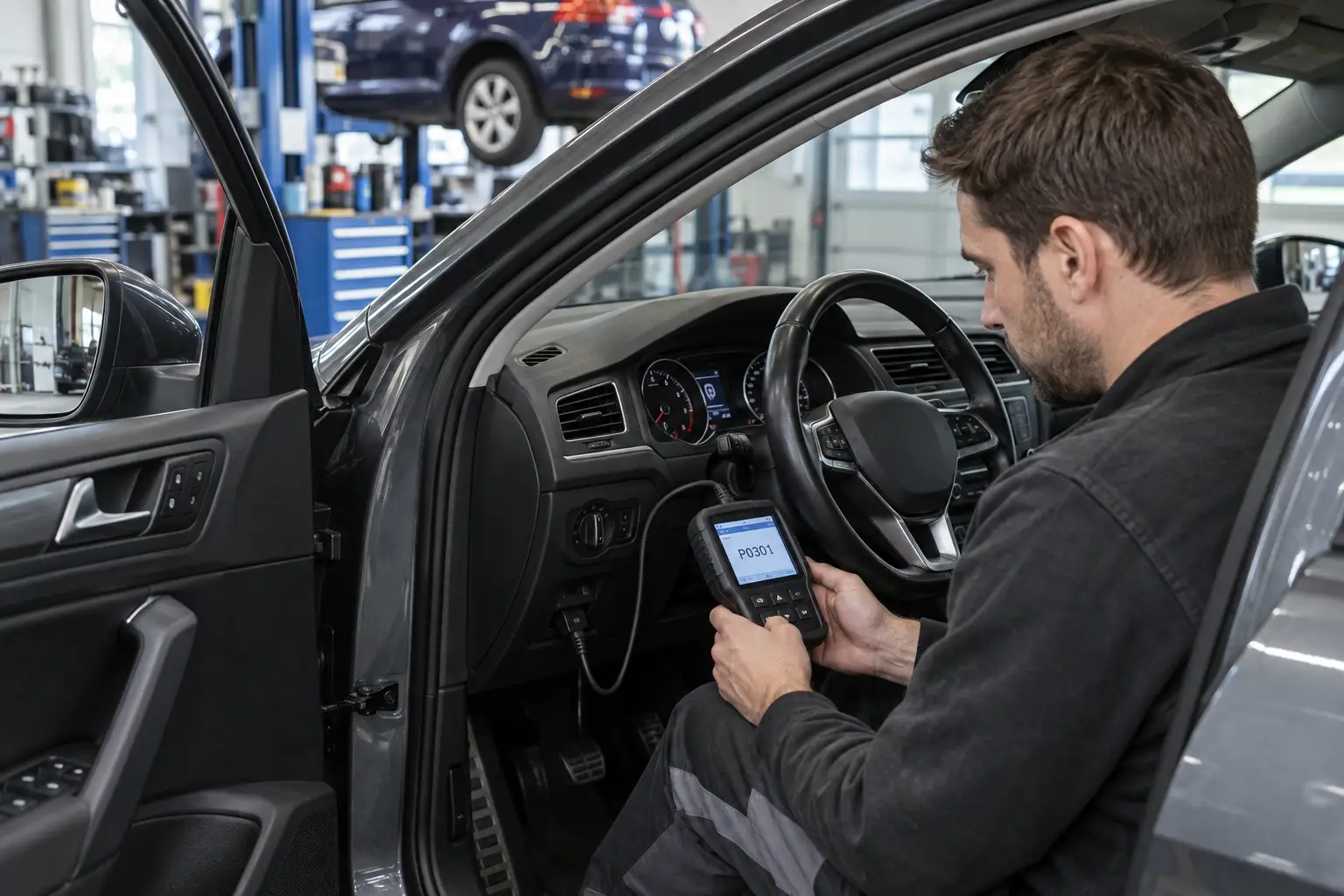
EOBD (European On-Board Diagnostics) is the European implementation of the OBD2 standard. It uses the same 16-pin SAE J1962 connector, the same 5-character DTC format, and the same standardized service modes. An OBD2 scanner works on an EOBD vehicle without modification. For diagnostic purposes, the two systems are functionally identical. That compatibility extends to ABS and SRS diagnostics: my guide to the scanner guide for ABS and SRS covers the multi-system scanners that work on both OBD2 and EOBD vehicles without modification.
The European implementation timeline differs from the U.S. one. EOBD became mandatory for new gasoline passenger cars sold in Europe from January 1, 2001. Diesel passenger cars followed from January 1, 2004. Light commercial vehicles (gasoline) required EOBD from 2002, diesel from 2007.
EOBD2 is a stricter revision mandated for new vehicles in Europe from 2014. It extends monitoring requirements to cover faults that are not engine or emissions-system specific, broadening the scope of what the onboard system must detect and report. For the purposes of scanner compatibility, EOBD2 vehicles use the same connector and protocols as OBD2/EOBD. My my detailed Foxwell NT630 Plus review covers a mid-range scanner that reads ABS and SRS modules on both OBD2 and EOBD vehicles using the same connection.
The Bottom Line
OBD1 was not a unified system. It was a collection of proprietary implementations that required brand-specific tools and produced codes no other brand’s scanner could read. OBD2 replaced it entirely with a federal standard: one connector, one DTC format, required service modes. My reference guide on OBD2 codes and the standardized diagnostic system they represent covers what the OBD2 mandate standardized, how the five-character DTC format works, and why the same code number can have a different meaning depending on the manufacturer.
The two practical details most guides skip: OBD2 used five different communication protocols from 1996 to 2007 before CAN became mandatory in 2008, which matters for scanner compatibility on older OBD2 vehicles; and OBD1 vehicles from GM, Ford, and Chrysler can be diagnosed without any scanner at all using the blink code method. For any pre-1996 vehicle or early OBD2 vehicle, confirming which system it actually has using the connector check is faster and more reliable than relying on model year alone. My my experience with the Autel MaxiSYS Elite II Pro covers the professional scanner tier where full OBD1 legacy protocol support, bidirectional control, and OBD2 coverage across all CAN-era vehicles come as standard.
FAQs
Can I use an OBD2 scanner on an OBD1 car?
No. OBD2 scanners and OBD1 systems use different physical connectors and completely different communication protocols. An OBD2 scanner cannot plug into a GM ALDL connector, a Ford EEC-IV connector, or any other OBD1 interface without a physical adapter, and even with an adapter the scanner has no software to interpret OBD1 protocol responses. To read codes on an OBD1 vehicle, use a manufacturer-specific OBD1 scan tool, a multi-brand OBD1 scanner such as the Innova 3170RS, or the blink code method if the vehicle and manufacturer support it.
How do I know if my car is OBD1 or OBD2?
The simplest field check is to look under the dashboard on the driver’s side for a 16-pin trapezoidal connector that is accessible without tools. If it is there, the vehicle is OBD2. If the connector has a different shape or is not in that location, the vehicle is OBD1. As a general rule, all gasoline passenger cars sold in the U.S. from model year 1996 onward are OBD2. Some 1994 and 1995 California-market vehicles are also OBD2. Vehicles from 1995 and earlier outside California are OBD1. For any borderline case, a VIN lookup or dealer check confirms the original specification.
Can I read OBD1 codes without a scanner?
Yes, on many OBD1 vehicles. GM, Ford, and Chrysler all support a blink code method where the ECU flashes stored fault codes through the check engine light. For GM: insert a jumper between pin A and pin B on the ALDL connector, turn the ignition on without starting the engine, and count the check engine light flashes. For Chrysler: cycle the ignition key on-off-on-off-on within 5 seconds and count the flashes. For Ford: bridge the self-test input and output terminals, turn the ignition to run, and count the pulses. Each manufacturer uses a different code list. The blink code method is free and requires only a jumper wire or paper clip.
What is the OBD2 cutoff year for trucks and SUVs?
For light-duty gasoline trucks and SUVs (gross vehicle weight rating under 8,500 pounds), the federal OBD2 mandate applied from model year 1996, the same as passenger cars. Some heavy-duty gasoline trucks (over 8,500 pounds GVWR) were phased in through 2002. Diesel light-duty vehicles were required to comply with OBD2 from model year 1997 in the U.S. California-specific requirements followed a similar but sometimes earlier schedule. If a truck or SUV was manufactured and sold in the U.S. from 1996 onward and has a GVWR under 8,500 pounds, it is OBD2.
Do all OBD2 scanners work on all OBD2 vehicles?
For the standardized generic functions (reading P-codes, clearing codes, I/M readiness, basic live data PIDs) yes, any OBD2 scanner works on any OBD2 vehicle. For vehicles from 1996 through 2007, protocol support becomes relevant: those vehicles use one of five communication protocols (J1850 PWM, J1850 VPW, ISO 9141-2, KWP2000, or CAN) depending on the manufacturer. Most modern scanners support all five. Older or budget tools may lack support for some protocols. CAN became the mandatory single protocol for all OBD2 vehicles from model year 2008, so any scanner sold after that date reliably supports CAN-era vehicles by default.
What is EOBD and how does it differ from OBD2?
EOBD is the European implementation of the OBD2 standard. It uses the same 16-pin connector, the same DTC format, and the same standardized service modes as OBD2. An OBD2 scanner works on any EOBD vehicle without modification. The difference is the regional mandate timeline: EOBD became mandatory for new gasoline passenger cars in Europe from 2001 and for diesel vehicles from 2004. EOBD2, required from 2014, adds stricter emissions monitoring requirements but remains compatible with standard OBD2 scanners at the connector and protocol level.
Are OBD2 fault codes the same across all vehicle brands?
Generic OBD2 codes (those starting with P0, C0, B0, U0) are standardized and mean the same thing on every OBD2 vehicle from every manufacturer. P0420 is always catalyst efficiency below threshold, regardless of brand. Manufacturer-specific codes (starting with P1, P2, P3 and equivalent prefixes for other systems) are not standardized and vary by manufacturer. A P1000 on a Ford is a different fault than a P1000 on a Toyota. Reading manufacturer-specific codes requires a scanner with software calibrated to that specific make. Generic code readers only report the standardized P0 range.