
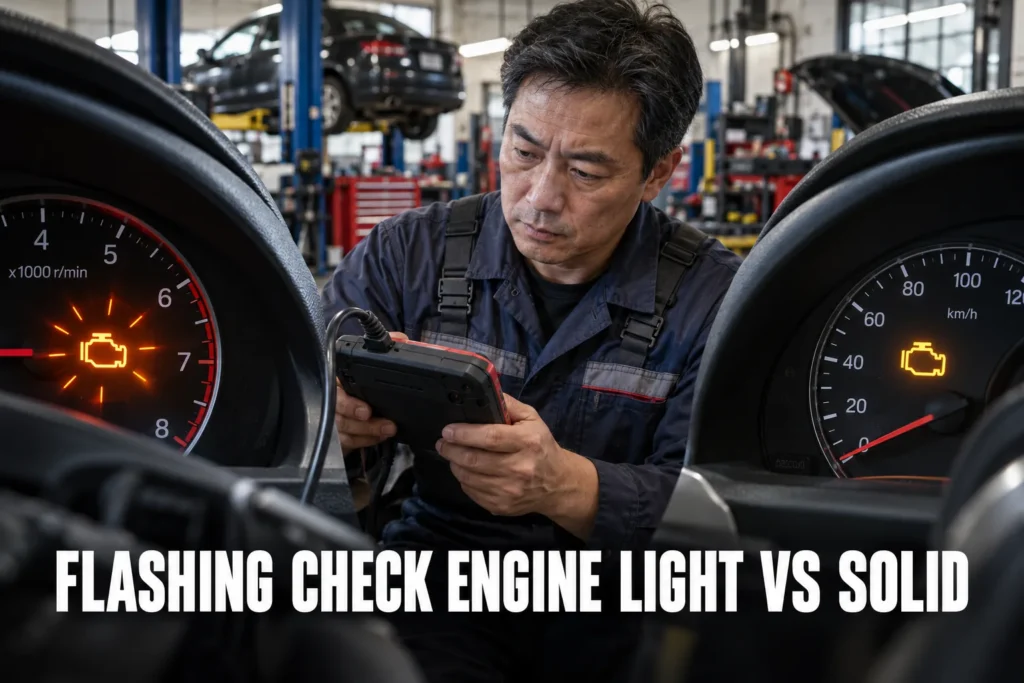
The check engine light has two states, and they do not mean the same thing. A solid light means the ECU has confirmed a fault that needs diagnosis. A flashing light means an active engine misfire is happening right now, at a rate severe enough to damage the catalytic converter within minutes. Treating both states the same way (scanning the code, looking it up, scheduling a repair for next week), is the correct response to one and the wrong response to the other.
My why does check engine light come on after oil change covers this step by step.

About the author: Hello! I’m Kamil Siegień, founder of OBD2 Scout. My diagnostic experience started with an engine rebuild on a 2014 Skoda Superb 1.8 TSI, where tuning from 160 to 222 hp required mastering live data and ECU behavior that basic code readers cannot handle. I am a former BMW and MINI employee and regularly use diagnostic scanners on my own Audi A4 2.0 TFSI.
This guide covers what each state signals at the ECU level, the specific mechanism behind the flashing light, what happens to the catalytic converter if you keep driving, and how to read the code behind either state with an OBD2 scanner.
What the Check Engine Light Is Built to Do
The Malfunction Indicator Lamp is a federally mandated warning light required on every OBD2-compliant vehicle sold in the United States since 1996. Its legal purpose is emissions: it is required to illuminate whenever the vehicle detects a fault that causes emissions to exceed 1.5 times the federal standard. That mandate is why it triggers for a loose gas cap or a failing oxygen sensor, both cause measurable emissions increases even if they do not affect how the car drives.
Some manufacturers replaced the standard ‘Check Engine’ text with ‘Service Engine Soon’ on this same mandatory light; my guide to the service engine soon light vs check engine light covers which brands use each name and what the naming difference means for diagnosis.
The ECU controls the MIL through two distinct signaling modes. It can hold the light steady, which it does for confirmed non-emergency faults. It can flash the light at a rate of approximately once per second, which it does specifically when a misfire rate crosses the threshold defined by SAE J1979 for catalyst damage risk. No other fault type causes the MIL to flash on a properly functioning OBD2 system. If the light is flashing, the ECU has identified an active misfire. That is the only explanation. The guide on what OBD2 is and how it works covers the structure of the MIL control system and what the ECU is monitoring continuously to decide which state to use.
A third state exists on some vehicles: the MIL illuminates briefly at key-on as part of the bulb check, then turns off. This is normal and not diagnostic. What matters is what the light does after the engine starts and the bulb check sequence ends.
What a Solid Check Engine Light Means

A solid check engine light means the ECU has stored a confirmed Diagnostic Trouble Code. The fault met the confirmation threshold (typically detection across two consecutive drive cycles), and the ECU logged it in non-volatile memory. The light stays on, at steady brightness, until the fault is resolved and enough clean drive cycles pass for the ECU to self-clear, or until a scanner sends an explicit clear command.
My my guide on reset check engine light without a scanner covers this step by step.
My guide on how long it takes the check engine light to turn off after a repair covers the exact drive cycle count the ECU uses for each fault type and what prevents that count from reaching the threshold.
My guide to the best Bluetooth OBD2 scanners covers the wireless tools that can read confirmed codes, stream freeze frame data, and clear the light from a phone.
A solid light does not indicate that the car is undriveable right now. It means a fault is present and confirmed. The urgency depends entirely on which code is stored. A P0442 small EVAP leak is a confirmed fault that can wait for a scheduled appointment. A P0128 low coolant temperature indicating a stuck-open thermostat should be addressed within days because it hurts fuel economy and causes continuous rich running. A P0011 cam timing fault that is causing rough idle at cold start needs attention soon because ignoring it can lead to timing chain wear.
The correct response to a solid check engine light is to scan the code, identify the system, assess the severity, and schedule a repair based on that assessment. Most solid check engine light codes do not require pulling over immediately. The guide on how to read OBD2 trouble codes covers the scanning process from connection to code interpretation, including how to identify which system the code belongs to before deciding on urgency.
Most Common Causes of a Solid Check Engine Light
The five most frequent causes of a solid check engine light, in order of frequency reported across OBD2 diagnostic data, are: a loose, damaged, or missing fuel cap triggering an EVAP leak code; a failing downstream oxygen sensor (P0141, P0161); a degraded catalytic converter (P0420, P0430); a failing mass airflow sensor (P0101, P0102); and worn spark plugs causing a low-level misfire that does not reach the catalyst damage threshold (P0301-P0308 at low severity).
My my guide on test catalytic converter covers this step by step.
A loose gas cap accounts for approximately one in five solid check engine lights on vehicles under 150,000 miles. The EVAP system is sealed, and the fuel cap is the only serviceable seal point. A cap that is not fully tightened (three audible clicks on most vehicles), allows fuel vapor to escape, which the ECU detects as an EVAP leak via the purge valve and vent valve test. Retightening the cap and completing one or two drive cycles is often enough to clear the code without any other intervention.
My my guide on perform evap system test covers this step by step.
My the malfunction indicator light mil explained covers this step by step.
Oxygen sensor codes split between upstream and downstream sensors, and the urgency differs significantly. An upstream oxygen sensor fault (B1S1 or B2S1, P0131-P0138) affects the ECU’s fuel control loop directly. The ECU may run in open loop, defaulting to a fixed fuel map rather than correcting based on exhaust feedback. This causes persistent rich or lean running, accelerated fuel consumption, and secondary damage to the catalytic converter if left for months. A downstream sensor fault (B1S2 or B2S2, P0141, P0161) affects emissions monitoring accuracy but does not disrupt closed-loop fuel control, making it lower urgency for drivability even though it still requires repair.
My my guide on test o2 sensor covers this step by step.
What a Flashing Check Engine Light Means
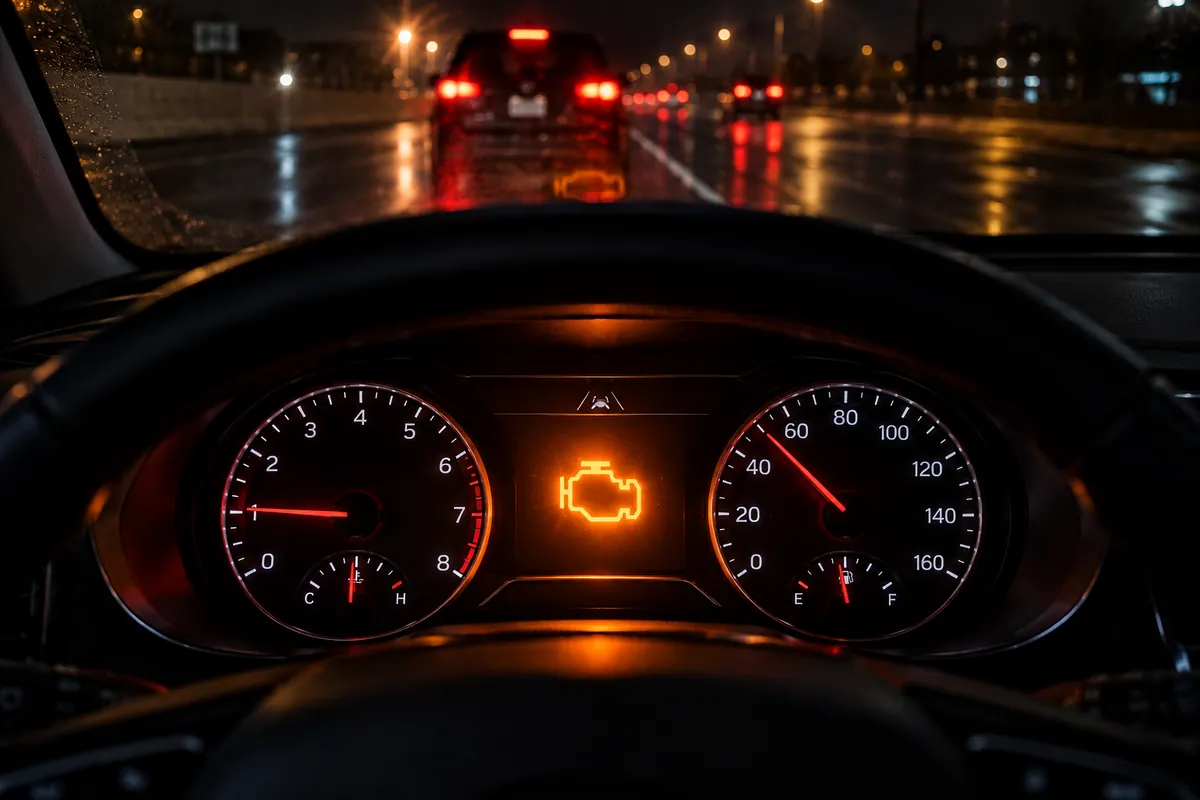
A flashing check engine light means the ECU has detected an active misfire at a rate that the onboard diagnostic system classifies as a catalyst damage risk. SAE J1979 defines two misfire severity categories. Type A misfires are severe enough that the ECU calculates catalyst damage could occur within 200 revolutions of the crankshaft at the detected misfire rate. The ECU responds to a Type A misfire by flashing the MIL immediately, in the same drive cycle, without waiting for a second confirmation cycle. Type B misfires affect emissions beyond the legal threshold but are not expected to cause immediate catalyst damage. The ECU logs a P0300-P0308 code for a Type B misfire but holds the MIL solid rather than flashing.
The flashing rate is approximately once per second and is consistent. It does not speed up, slow down, or change pattern based on severity. Any steady flashing at that cadence is the ECU communicating the same message: active catalyst damage misfire, stop driving. The guide on OBD2 codes explained covers the P0300 series code structure, how the ECU identifies which cylinder is misfiring, and what the suffix on a cylinder-specific code tells you about the location of the fault.
Misfire codes that accompany a flashing light are almost always P0300 (random or multiple cylinder misfire) or a cylinder-specific code P0301 through P0312. The cylinder number in the code suffix identifies the specific cylinder. P0301 is cylinder 1. P0304 is cylinder 4. On engines where the cylinder numbering is not obvious (V6, V8, flat-4 engines with non-sequential physical numbering), the vehicle’s service manual cylinder map is required to locate the physical cylinder from the code number.
Once the cylinder is identified, my roundup of the best bidirectional OBD2 scanners covers the tools that can disable individual cylinders or activate ignition coils to confirm the misfire source.
Type A vs Type B Misfires: How OBD2 Classifies Them
The distinction between Type A and Type B misfires determines whether the MIL flashes or stays solid, and it is set by the misfire rate calculation built into the ECU. The ECU monitors crankshaft rotation speed through the crankshaft position sensor. A cylinder that misfires produces a measurable reduction in crankshaft acceleration at the moment that cylinder should be contributing torque. The ECU counts these events over a rolling window of 1,000 crankshaft revolutions and calculates a misfire rate.
Any scanner in my best budget OBD2 scanner guide can read the P0300-series code and freeze frame data that confirms the cylinder and operating conditions at the moment the light started flashing.
Type A threshold is typically around 2-3% of firing events in 1,000 revolutions for a 4-cylinder engine at idle and light load, scaling up with RPM and load. The exact threshold is manufacturer-defined and varies. At highway speed under load, the threshold rises because the thermal inertia of the catalyst can absorb more heat. At idle, even a low misfire rate reaches the threshold quickly because the catalyst operates at a lower temperature and raw fuel has a higher relative impact. When the misfire rate crosses the Type A threshold, the ECU flashes the MIL immediately.
Type B threshold is lower than the catalyst damage threshold but high enough to cause measurable emissions increase. The ECU logs a code and illuminates the MIL solid after the misfire rate exceeds Type B criteria across two consecutive drive cycles. A cylinder that is slightly weak (a partially fouled spark plug, a marginally weak injector), may produce a Type B misfire code with a solid light for weeks before the condition deteriorates to Type A severity. The transition from solid to flashing is a direct indication that the fault has worsened.
How a Misfire Destroys a Catalytic Converter
My guide to the best professional OBD2 scanners covers the tools that monitor exhaust temperature via pyrometer input or check converter efficiency via downstream O2 sensor live data after a misfire event.
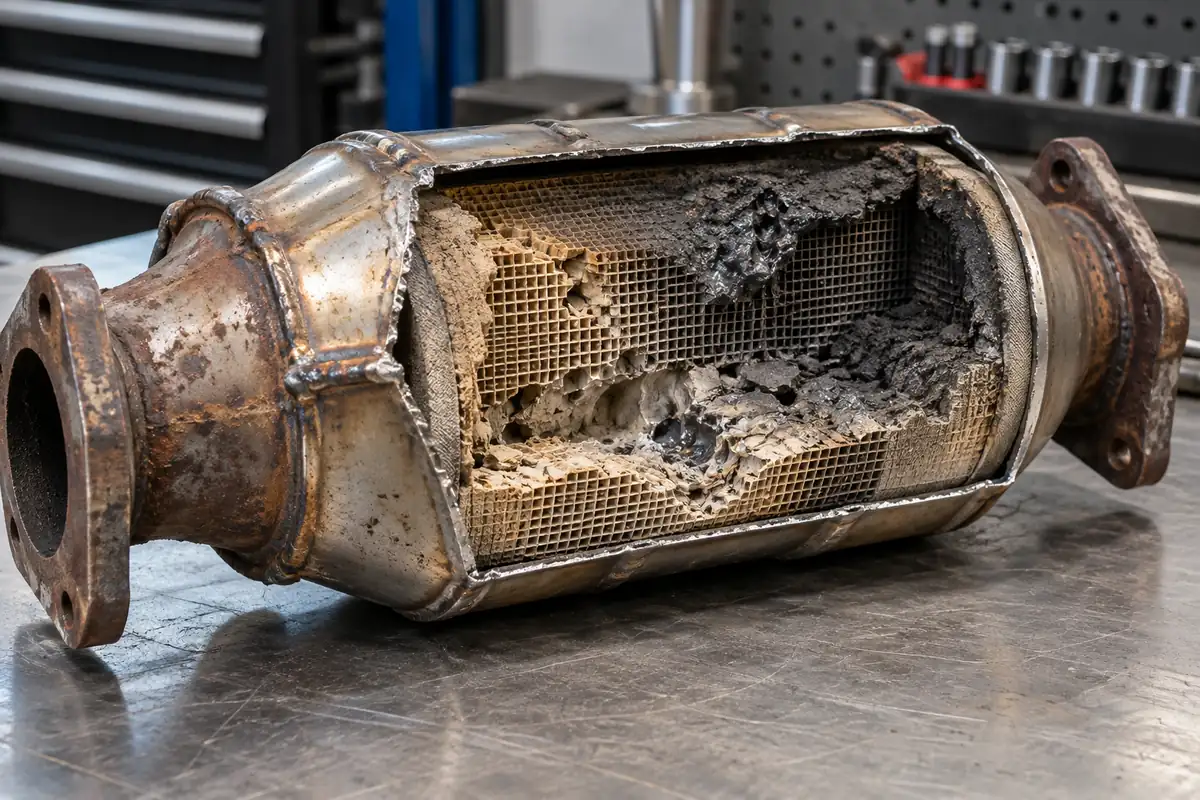
A catalytic converter operates at temperatures between 400°C and 800°C under normal conditions. The substrate inside (a ceramic or metallic honeycomb coated with platinum, palladium, and rhodium), is designed to operate within that range. When unburned fuel reaches the converter, it ignites inside the substrate rather than in the combustion chamber. Combustion inside the converter raises its internal temperature well above the normal operating range, reaching 1,200°C or higher during sustained misfire events.
At 1,100-1,200°C, the ceramic substrate begins to soften and deform. The honeycomb structure collapses, reducing the surface area available for catalytic conversion and increasing exhaust backpressure. At temperatures above 1,400°C, the substrate melts and fuses into a solid mass that completely blocks exhaust flow. Either outcome destroys the converter. A collapsed substrate produces a rattling noise from the loose ceramic fragments. A fused substrate causes loss of power, rough running, and elevated exhaust temperatures that can damage the oxygen sensors downstream.
The speed of this damage depends on how much raw fuel is reaching the converter and at what rate. A single misfiring cylinder on a 4-cylinder engine at 2,500 RPM under moderate load sends approximately one unburned charge per engine revolution to the exhaust. At 2,500 RPM, that is 2,500 partially or fully unburned fuel events per minute entering the converter. The ECU’s Type A threshold is calibrated to flash the MIL before this rate produces irreversible damage, but it does not provide unlimited time before damage begins. Pulling over within one to two minutes of the MIL beginning to flash is the correct response. The guide on OBD2 live data covers how to monitor real-time misfire counters and fuel trim data to confirm an active misfire versus a stored historical code.
What to Do When the Light Is Flashing
Reduce engine load immediately. Take your foot off the accelerator. Do not accelerate to reach an exit or a parking area at highway speed. Slow down using engine braking and coasting where possible. Pull off the road as soon as it is safe to do so. Turn the engine off. Do not restart it and drive further to a repair shop. Call for a tow.
The reason for not driving further is not simply to avoid more catalyst damage. A severe misfire that is causing the MIL to flash is also producing incomplete combustion, which means the cylinder is contributing heat without contributing torque. At sustained highway speed under load, the thermal stress on the affected cylinder (piston, rings, valves, cylinder wall), increases rapidly. A misfire that begins as an ignition fault can escalate to a mechanical fault if the engine is driven hard for too long after the misfire starts.
My a pid obd2 diagnostics explained covers this step by step.
If the light flashes briefly at low speed then returns to solid, the misfire rate dropped below the Type A threshold. The condition is still present and still needs diagnosis, but the immediate catalyst damage risk has reduced. Scan the code immediately. If the code is P0300 or a cylinder-specific Pxx0x code, treat the diagnosis as urgent even if the light is now solid. A fault that crossed the Type A threshold once will do so again under similar conditions. The guide on how to use an OBD2 scanner covers the full diagnostic sequence for reading misfire codes, including how to identify which cylinder is affected and what live data parameters to check next.
How to Read the Code Behind Either Light
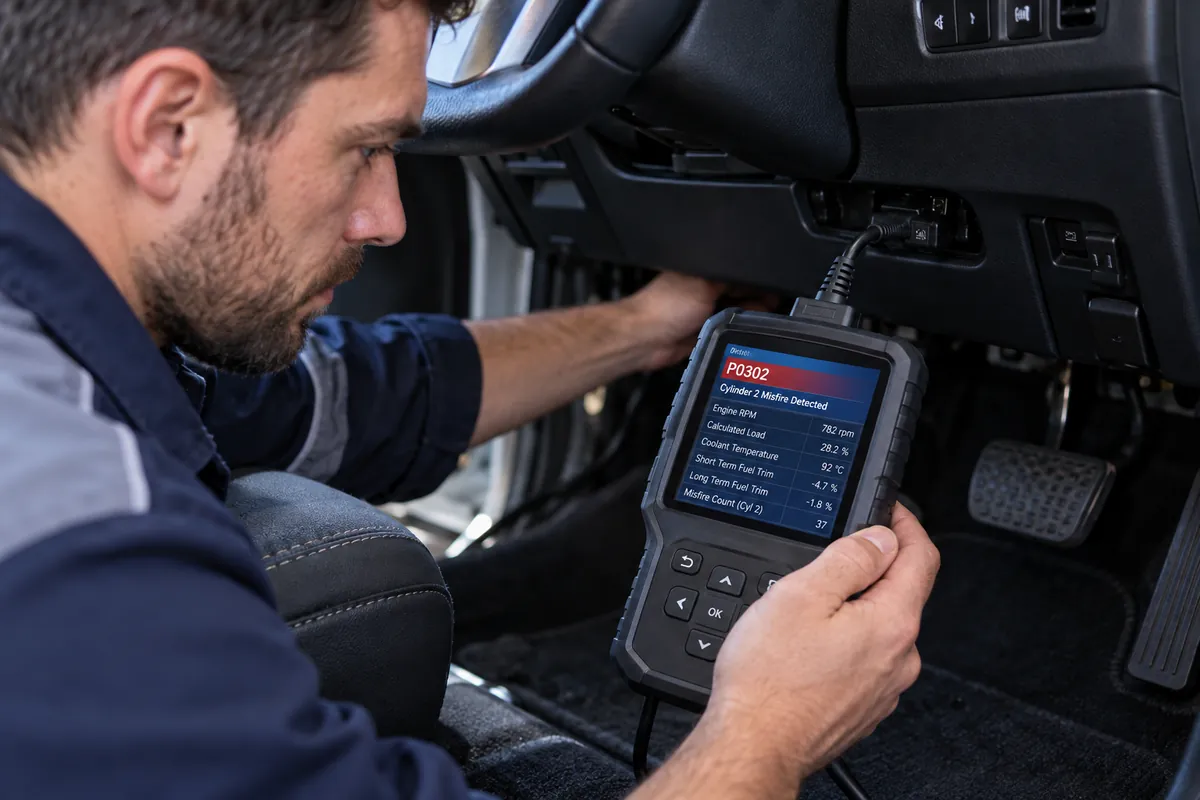
Connect the OBD2 scanner with the ignition off. Turn the key to the ON position without cranking the engine. Wait for the scanner to establish communication, this takes between 5 and 30 seconds depending on the tool and vehicle. Navigate to “Read Codes” or “Diagnostic Trouble Codes.” The scanner will display all confirmed codes. Note every code present, not just the first one listed. Misfire events often come with companion codes: P0301 for a specific cylinder plus P0300 for random misfire, or a misfire code plus an ignition coil code (P0351-P0358) identifying the coil circuit on the affected cylinder.
My my guide on diagnose misfires covers this step by step.
After reading confirmed codes, check for pending codes separately. Navigate to “Pending Codes” or “Mode $07.” A misfire code that appears in pending but not confirmed means the ECU detected it once but has not confirmed it across two drive cycles. This still represents a real fault. A misfire that is pending today will confirm after the next drive under similar conditions.
My my guide on verify repair fixed obd2 covers this step by step.
Read freeze frame data after noting the codes. The freeze frame captures the engine’s operating conditions at the exact moment the fault confirmed: RPM, load, coolant temperature, fuel trim values, and vehicle speed. For a misfire code, freeze frame RPM and load tell you whether the fault occurs at idle (low RPM, low load, likely a bad injector or vacuum leak), at highway speed (high RPM, high load, more likely ignition-related under load), or during acceleration (rapidly changing load, possibly a coil breaking down under voltage stress). The guide on OBD2 freeze frame data covers how to use the captured operating conditions to narrow down the root cause before any parts are replaced.
After the Flashing Stops: What to Check Next
If the light was flashing and is now solid, the immediate Type A misfire condition has subsided. This does not mean the fault is resolved. It means the misfire rate dropped below the catalyst damage threshold, either because conditions changed (the engine cooled, load reduced, RPM changed), or because a coil or injector that was failing intermittently temporarily recovered. The underlying fault is still present.
If the code was previously cleared without a repair, my guide on why the check engine light comes back on after a scanner clear explains the exact fault cycle that guarantees the same code will reconfirm as soon as the ECU runs the relevant monitor again.
After the light transitions from flashing to solid, scan immediately and read the freeze frame. The freeze frame was captured when the fault confirmed, not when the flashing started or stopped. Compare the freeze frame operating conditions with when the flashing occurred during your drive. If the freeze frame shows highway RPM and high load and the flashing started at highway speed, the diagnosis aligns. If the freeze frame shows idle conditions but the flashing started on a cold start, an injector fault or compression issue is more likely than an ignition coil breaking down under electrical stress.
Check the catalytic converter for damage after any sustained flashing event. The symptom of a damaged converter is exhaust restriction: power loss under load, slow throttle response, a fuel smell from the exhaust, or a rattling from under the vehicle. An OBD2 scanner cannot directly confirm converter damage, but low downstream O2 sensor voltage that no longer reads steady in live data (or a switching downstream sensor that mirrors the upstream sensor’s waveform), indicates the converter is no longer functioning. The guide on OBD2 scanner emissions testing covers how to use a scanner to evaluate converter health as part of an emissions readiness check after a misfire event.
The Bottom Line

A solid check engine light means: scan the code, assess the urgency, plan a repair. A flashing check engine light means: reduce load, pull over, turn off the engine, call a tow. The difference between the two states is not one of degree, it is a binary distinction the ECU makes between a fault that needs attention and a fault that is causing damage right now. Treating a flashing light like a solid light turns a $150 ignition coil repair into a $1,200 catalytic converter replacement plus the original coil repair.
If the light has ever flashed and is now solid, do not assume the danger has passed. The fault is still present, the misfire rate dropped temporarily, and driving under the same conditions will reproduce the flashing state. Diagnose it with the freeze frame operating conditions as your starting point and use live data misfire counters to confirm the fault is active before replacing any parts. The guide on car diagnostic costs covers what a shop charges to diagnose and repair a misfire code, and how arriving with the freeze frame data already read changes the scope and cost of the visit.
FAQs
Can anything other than a misfire cause the check engine light to flash?
On a properly functioning OBD2 system, no. The SAE J1979 specification reserves the flashing MIL state specifically for Type A misfires, those calculated to cause catalytic converter damage. If the MIL appears to flash for any other reason, the most likely explanations are a faulty instrument cluster, a wiring fault in the MIL circuit, or a BCM software issue. These produce irregular or inconsistent flashing patterns rather than the steady once-per-second flash of a Type A misfire event. An OBD2 scanner connected during the flashing will show a P0300 or cylinder-specific misfire code for a genuine misfire. If no misfire code appears during active flashing, a cluster or wiring fault is the next diagnostic step.
Is it safe to drive at all after the flashing light turns solid?
Short distances at low load and low RPM are less damaging than sustained highway driving, but the fault is still present and still capable of triggering the flashing state again. The safest action is to scan immediately, read the freeze frame, and drive directly to a repair facility at low speed without aggressive acceleration. Avoid highway speeds, full-throttle acceleration, and towing or hauling loads until the misfire is diagnosed and repaired. The misfire rate that triggers flashing rises with RPM and load, so keeping both low reduces the risk of returning to the catalyst damage threshold.
What causes a misfire severe enough to flash the check engine light?
The most common causes are a failed ignition coil on a coil-on-plug engine, a failed spark plug, a severely clogged or stuck-open fuel injector, a large vacuum leak on a specific cylinder, and low compression in one cylinder from a burned valve or damaged piston ring. Ignition coil failure is the most frequent cause on modern engines because coil-on-plug designs place each coil directly over its spark plug, and the coil is exposed to engine heat every drive cycle. A coil that breaks down under electrical load at high RPM and high voltage demand will cause a Type A misfire specifically under those conditions and may produce no fault at idle where voltage demand is lower.
How quickly does a flashing check engine light damage the catalytic converter?
The ECU’s Type A misfire threshold is calibrated to flash the MIL before the projected point of irreversible catalyst damage based on the misfire rate at the detected RPM and load. This means the light is a warning before damage occurs, not a report that damage has already happened. However, the margin is not large. Sustained driving at highway speed with a flashing light (several minutes at 60-70 mph under load), provides enough raw fuel flow to melt portions of the catalyst substrate. Stopping within the first minute or two of flashing gives the converter time to cool without reaching the melting point. The longer the driving continues after the light begins flashing, the higher the probability that some portion of the substrate has been damaged even if the car does not immediately show symptoms.
Can a flashing check engine light turn itself off without a repair?
The MIL will stop flashing and return to solid if the misfire rate drops below the Type A threshold, for example, if the engine cools, RPM drops, or an intermittent coil fault temporarily recovers. The light will then stay solid as long as the confirmed misfire code remains stored. It will return to flashing if the misfire rate crosses the Type A threshold again under similar conditions. The light will not turn itself off entirely until the fault is repaired and enough consecutive clean drive cycles allow the ECU to clear the code. Clearing the code with a scanner without repairing the fault will produce the same cycle: solid light, then flashing again when conditions reproduce the misfire.