
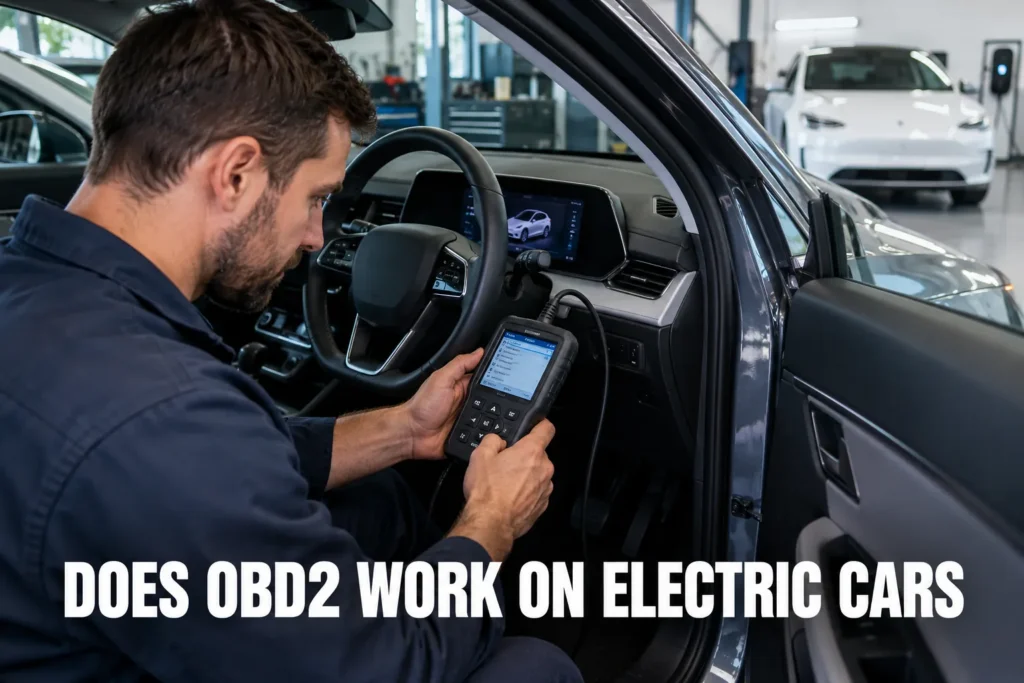
The 16-pin OBD2 port is on every production electric car. Plug in a scanner and the connection is established. But the diagnostic experience that follows is nothing like what the same scanner delivers on a petrol car. On an EV, a generic scanner typically returns a handful of basic readings, a message about unsupported PIDs, or nothing useful at all. The port works. The OBD2 standard is not the right tool for EV diagnostics. The data that actually matters on an electric car, the battery’s health, individual cell voltages, BMS fault codes, and thermal management status, sits behind manufacturer-specific protocols that the OBD2 standard was never designed to reach. My guide on which scanner tier fits the diagnostic task covers the full code reader vs scanner spectrum, including the tool limitations that apply before reaching the EV-specific access layer.

About the author: Hello! I’m Kamil Siegień, founder of OBD2 Scout. My diagnostic experience started with an engine rebuild on a 2014 Skoda Superb 1.8 TSI, where tuning from 160 to 222 hp required mastering live data and ECU behavior that basic code readers cannot handle. I am a former BMW and MINI employee and regularly use diagnostic scanners on my own Audi A4 2.0 TFSI.
This guide covers why generic OBD2 falls short on EVs, what it can and cannot access, what battery State of Health actually means as a number, why newer EVs introduce hardware-level protocol barriers, which platform-specific apps actually work, and what the upcoming SAE J1979-3 standard means for EV diagnostics from 2026 onward.
Why the Port Is There but the Standard Falls Short
The OBD2 standard was designed in the 1990s around one task: monitoring emissions-related systems on internal combustion engines. The mandatory service modes cover catalytic converter efficiency, oxygen sensor response, fuel system trim corrections, and misfire detection. Electric vehicles have none of those systems. No catalytic converter. No oxygen sensors. No fuel trim. No misfires in the ICE sense of the term. My guide on what OBD2 was designed to do and which systems it covers covers the emissions-monitoring framework the standard was built around, why the required PIDs map directly to ICE systems, and what the EV gap reveals about the original design intent.
Despite this, EVs are required to have the OBD2 port and to respond to a defined subset of generic PIDs: vehicle speed, odometer, ambient temperature, and a small number of others. The standard does not define access to the Battery Management System, the motor control unit, the thermal management system, or the charging system. Those systems communicate on CAN bus addresses that the OBD2 specification does not map to standardized access.
My a pid obd2 diagnostics explained covers this step by step.
My can bus obd2 diagnostics explained covers this step by step.
The same gap appears on the 2020+ Audi Q5 FY facelift, where CAN FD introduces higher-speed addresses for DSG and boost data that not all aftermarket scanners decode correctly, and my scanner guide for the Q5 covers which tools bridge that access gap reliably.
When a generic scanner connects to an EV and reports that the vehicle supports only a few PIDs, or returns no relevant data at all, the standard is working exactly as designed. The OBD2 mandate covers what it was built for. The systems that define EV health are simply outside its scope.
What a Generic OBD2 Scanner Can and Cannot Read on an EV
Connecting a standard OBD2 scanner to an electric car typically returns a limited but real set of data. Understanding what falls on each side of that line prevents the confusion of thinking the scanner is broken when it returns minimal results. My guide on what the standard OBD2 scan sequence looks like on a conventional vehicle covers the initialization process, what communication establishment looks like, and what a full code and live-data session returns on a gasoline vehicle — the baseline that makes EV comparison meaningful.
What a generic scanner can read on most EVs:
- Vehicle speed and odometer
- Ambient air temperature
- Some coolant or thermal loop temperature readings on PHEVs
- U-codes (network communication faults) when a module fails to respond on the CAN bus
- P-codes related to the 12V accessory system and body control modules
- Charging port fault codes on some platforms that expose them through generic PIDs
What a generic scanner cannot read:
- High-voltage battery State of Health (SOH)
- Individual cell voltages across the battery pack
- BMS fault codes stored in the battery management module
- Traction motor current, efficiency, and inverter temperature
- Thermal management system data and coolant flow status
- DC fast charging diagnostics and session logs
- Charging system fault history
- Regenerative braking calibration status
The cannot-read list is everything that determines whether an EV is operating correctly and whether its battery is healthy. The can-read list is useful for network faults and 12V system issues, but it does not touch the high-voltage powertrain in any meaningful way. For a broader look at the fault types and systems that sit outside any scanner’s reach by design, my guide to what an OBD2 scanner cannot detect covers the full scope across both EV and ICE vehicles.
What Battery State of Health Actually Means as a Number

Battery State of Health (SOH) is the single most important metric in EV diagnostics, and it is one that no generic OBD2 scanner can read. Understanding what SOH is as a number makes clear why its absence from generic diagnostic tools is a significant practical gap.
Volvo XC90 T8 PHEV owners face this same gap, and my XC90 T8 PHEV scanner guide covers the tools that go beyond generic OBD2 to reach the SPA battery management module.
SOH is the ratio of the battery’s current usable capacity to its original factory capacity, expressed as a percentage. A new battery fresh from the factory is 100% SOH. Every charge-discharge cycle and every year of calendar aging reduces that number. The rate varies by chemistry, usage, charging habits, and climate exposure, but large fleet studies consistently find that roughly 2 to 3% degradation per year is typical for modern lithium-ion EV batteries under normal use conditions.
A battery at 95% SOH after three years of ownership is healthy. A battery at 80% SOH still has the majority of its original capacity but represents measurable range reduction from new. Most automakers define 70 to 75% SOH as the warranty replacement threshold. A battery that falls below that figure within the warranty period is replaced under the manufacturer’s battery warranty, which on most modern EVs covers 8 years or 100,000 miles.
SOH is the most important number to check when evaluating a used EV. A car with low mileage but high calendar age and a 78% SOH has meaningfully less range than its original specification. A generic OBD2 scanner returns nothing from the BMS module that produced that number, which is why platform-specific tools are required for used EV evaluation. For the broader pre-purchase inspection process that combines scanner findings with a physical assessment, my guide to checking a used car with an OBD2 scanner covers the full sequence applicable to any vehicle.
The Newer Protocols Generic Scanners Cannot Reach: CAN FD and DoIP
The protocol incompatibility between generic OBD2 scanners and modern EVs goes deeper than software coverage. For the newest generation of electric vehicles, the incompatibility is at the hardware level.
Standard OBD2 uses CAN (Controller Area Network) with a maximum data frame size of 8 bytes. Battery management messages are more complex than 8 bytes can carry. Modern EVs increasingly run CAN FD, which stands for Flexible Data Rate. CAN FD supports data frames up to 64 bytes and transmits them at higher bit rates. Battery cell data, thermal management parameters, and charging system diagnostics travel over CAN FD buses inside the vehicle. A classic OBD2 scanner uses CAN hardware that cannot parse CAN FD frames. When a CAN FD frame arrives, a standard CAN controller either ignores it or throws an error. This is a hardware limitation, not a software coverage gap that an update can resolve.
For Audi Q8 owners with 2022+ models that shifted to DoIP Ethernet diagnostics, my Audi Q8 scanner guide covers which tools have the hardware to handle this architecture and which return errors or incomplete data on the newer diagnostic bus.
Some 2024 and newer European electric vehicles from Volkswagen Group and BMW are beginning to transition to DoIP, which stands for Diagnostics over Internet Protocol. DoIP runs over Ethernet rather than CAN. The OBD2 port on these vehicles still provides the 16-pin physical connector, but the high-speed diagnostic communication happens over an Ethernet channel on pins 1 and 9 of that connector. A classic OBD2 scanner has no Ethernet interface and cannot communicate with DoIP systems at all. Accessing DoIP-based diagnostics requires a scanner with an Ethernet transceiver and software that implements the DoIP protocol stack. For BMW G-series owners specifically, my guide to the best OBD2 scanners for BMW covers the DoIP-capable tools that handle the G-series Ethernet diagnostic architecture.
These are not limitations that will be addressed by a firmware update to an existing scanner. They require different hardware. My guide to the professional OBD2 scanner options covers the tools at the tier where CAN FD and DoIP capability are available for technicians working on the newest EV platforms.
EV-Specific Apps and Adapters That Actually Work
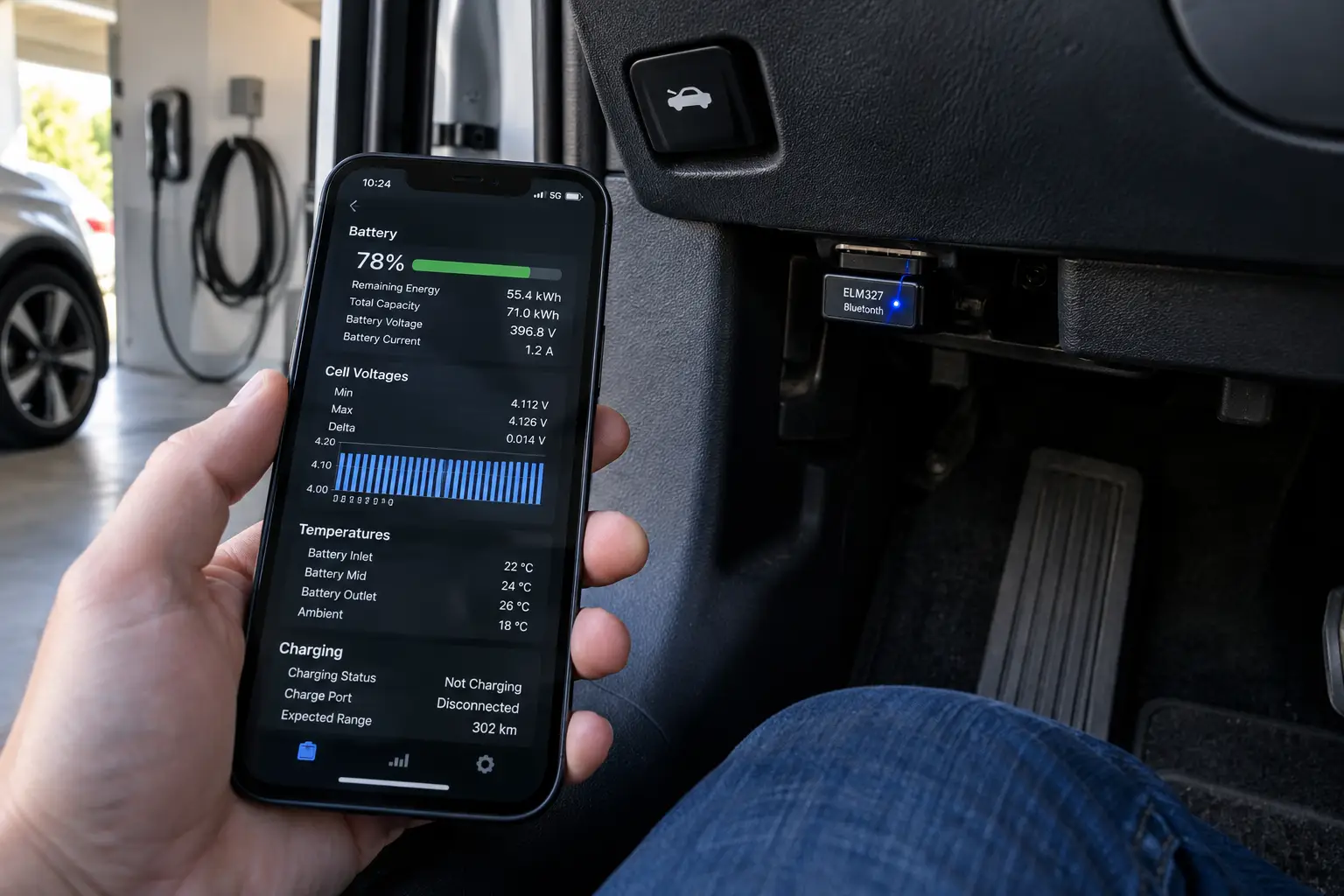
For most popular EV platforms currently on the road, platform-specific apps paired with a Bluetooth ELM327 adapter provide access to the battery data that generic OBD2 cannot reach. These apps work because they implement the manufacturer-specific CAN bus addresses and proprietary PIDs for each platform. The generic OBD2 protocol does not define those addresses; the apps do it independently through reverse engineering and manufacturer documentation. My full review of the BlueDriver Pro covers one of the most reliable Bluetooth adapters for pairing with EV diagnostic apps, including compatibility notes for the platforms discussed in this guide.
Nissan Leaf: LeafSpy Pro (available on iOS and Android for approximately $15) is the most mature and widely used EV diagnostic app. It reads exact SOH percentage, individual cell voltages across all 96 cells, charge cycle count, ambient temperature history, BMS error codes, and quick charge history. It works with any ELM327-compatible Bluetooth or Wi-Fi adapter. The Leaf is the most accessible EV for owner-level battery diagnostics. My guide to Bluetooth OBD2 adapters for EV diagnostic apps covers the ELM327-compatible options that pair reliably with Leaf Spy and similar apps, including BLE compatibility notes for iPhone users.
Tesla: Scan My Tesla reads cell voltages, SOH, motor data, and BMS parameters, but it requires a proprietary adapter that connects to the OBD2 port and communicates over Tesla’s specific protocol. Tesla has progressively locked down diagnostic access over software updates, so capability varies by vehicle software version.
My my guide on update firmware covers this step by step.
Volkswagen, Skoda, Seat, Audi (MEB platform): OBDEleven with its dedicated dongle reads battery module data, SOH, and individual module voltages on MEB-platform EVs including the ID.3, ID.4, and e-tron GT. Some advanced functions require a paid Pro subscription.
BMW, Hyundai, Kia, Renault: Car Scanner ELM OBD2 supports custom PID sets for these manufacturers that expose battery data. The app is free with the custom PID library available for download, and it works with standard ELM327 adapters. My my full Autel MK808BT Pro review covers a Bluetooth scanner with built-in manufacturer software for these brands that provides deeper access than a generic ELM327 adapter and third-party app combination.
Chevrolet Bolt: OBD Fusion with the GM Extended PID set reads pack voltage, individual module data, and thermal readings on the Bolt EV and EUV. My detailed MaxiSYS Elite II Pro review covers the professional scanner tier where built-in manufacturer EV software for GM, BMW, and European brands provides this level of access without a third-party app dependency.
In every case, the approach is the same: a standard ELM327 Bluetooth adapter as the hardware interface, and a platform-specific app that knows where to look in the manufacturer’s proprietary CAN address space. Before leaving any Bluetooth adapter in the port between drives, my guide on whether an OBD2 scanner drains the car battery covers which vehicles are affected and how to test whether the port stays powered when the ignition is off. My guide to the affordable OBD2 scanner guide covers the adapters in this price range that work reliably with EV diagnostic apps.
The SAE J1979-3 Standard: What Changes from 2026
The current situation, where battery SOH is accessible only through platform-specific apps using manufacturer-proprietary protocols, is a temporary condition. SAE J1979-3, informally called ZEVonUDS, is a new mandatory standard that changes this.
SAE J1979-3 requires electric vehicles to expose a standardized set of battery health parameters, including a mandatory standardized SOH identifier, that any compliant scanner can read through the OBD2 port using a standardized access method. The standard is built on UDS (Unified Diagnostic Services), which is already used by professional diagnostic tools on modern ICE and hybrid vehicles.
The phased implementation schedule: new electric vehicles from model year 2026 must comply with SAE J1979-3. All U.S.-market EVs, including those already in production, must comply by model year 2028. This means that by 2028, any scanner built to the J1979-3 specification can read battery State of Health from any EV without platform-specific apps, proprietary adapters, or manufacturer-specific knowledge.
My what are enhanced obd2 codes covers this step by step.
Until then, the 2026 and 2027 window is a mixed market: some EVs will expose standardized SOH data and others will not. For owners of pre-2026 EVs, the platform-specific app approach remains the only practical path to battery health data.
PHEVs and Hybrids: More Accessible Than Pure EVs
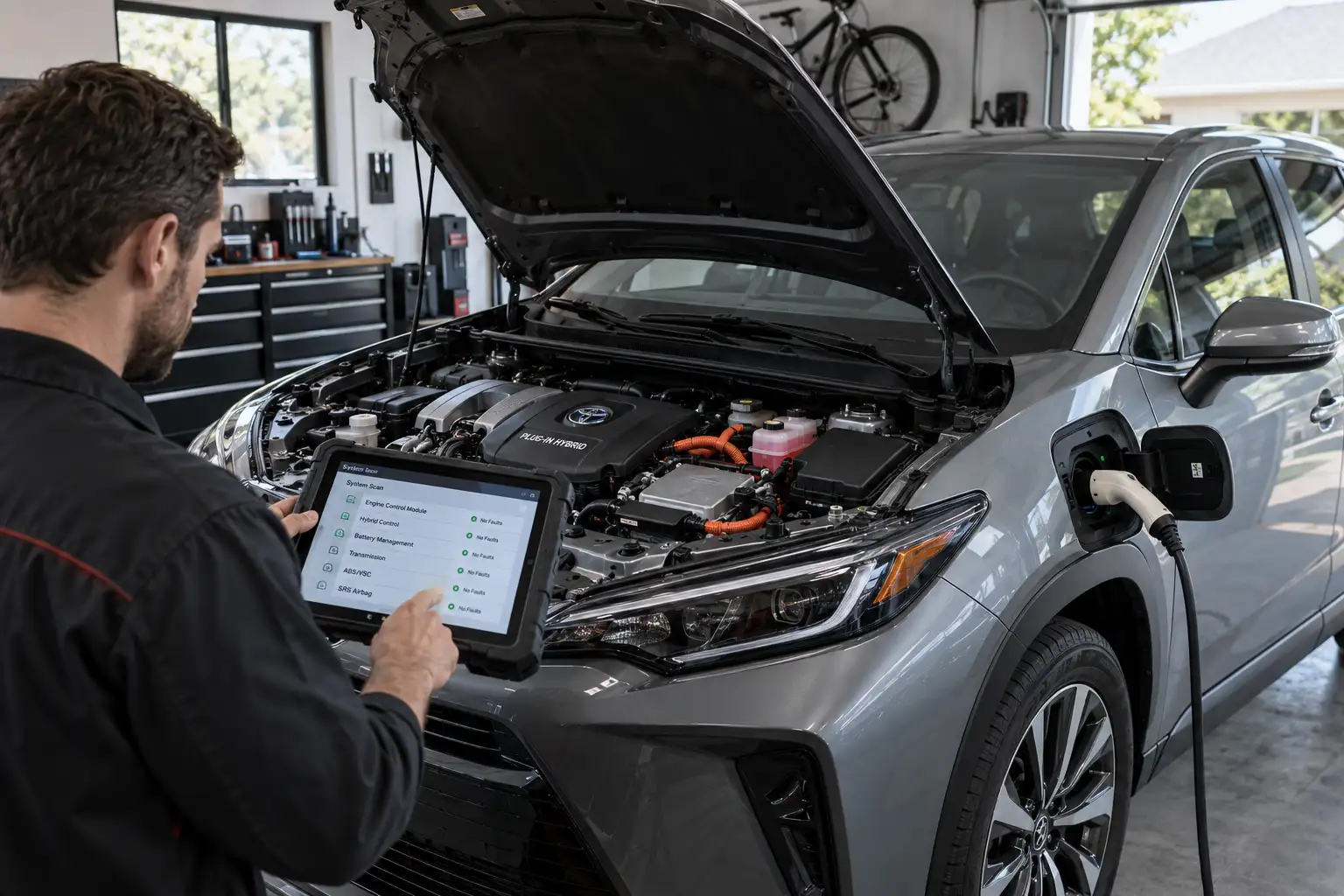
Plug-in hybrid and traditional hybrid vehicles occupy a different position in the diagnostic landscape than pure EVs. Because PHEVs carry both an internal combustion engine and an electric powertrain, they must fully support the OBD2 emissions monitoring mandate for the ICE side. This requirement, combined with the need to manage two powertrains, typically results in more accessible extended diagnostic data than pure EVs provide.
My obd2 electric vehicles ev diagnostics covers this step by step.
For Audi Q7 PHEV owners who need diagnostic access to both the combustion and hybrid battery system, my Q7 scanner recommendations cover which tools reach both powertrain sides without requiring separate software packages.
Toyota hybrids are the clearest example. Apps like Hybrid Assistant read Toyota hybrid battery module voltages, individual cell group data, battery temperature, and coolant temperature through the standard OBD2 port using extended PIDs. The level of battery transparency available on a Toyota Prius or Camry Hybrid through a $20 app and a generic ELM327 adapter exceeds what most dedicated EV diagnostic tools can read on many pure EVs. My guide to OBD2 live data covers the standard PID set that delivers this real-time stream on ICE and hybrid vehicles, and why the same parameters are inaccessible on pure EVs.
Ford PHEVs, Honda hybrids, and Mitsubishi Outlander PHEV also expose extended battery parameters through aftermarket tools, though with varying depth depending on the model and software version. For a driver choosing between a PHEV and a pure EV specifically because of diagnostic access, PHEVs generally offer more transparency to aftermarket tools in the current market. For Toyota PHEV and hybrid owners specifically, my guide to the best OBD2 scanners for Toyota covers the tools that provide the deepest hybrid battery and drive system access for that platform.
The Bottom Line
The OBD2 port is present on every electric car and a scanner will connect. What the OBD2 standard mandates on an EV, basic generic PIDs like speed and odometer, is not the same as what an EV owner needs for meaningful diagnostics. Battery SOH, cell voltages, BMS faults, and thermal management data all require platform-specific tools. For the 12V system and body modules that are accessible through the OBD2 port on EVs, my guide to the ABS and SRS scanner guide covers multi-system scanners that read those modules across EV makes.
For most EV owners today: a Bluetooth ELM327 adapter and the platform-specific app for that vehicle is the practical solution. SAE J1979-3 will standardize this access from model year 2026 onward. Newer EVs using CAN FD or DoIP require hardware-level capable tools, not software updates to existing scanners. PHEVs and hybrids currently offer more accessible battery diagnostics than most pure EVs through standard aftermarket tools.
My elm327 and what can it do explained covers this step by step.
FAQs
Does my electric car have an OBD2 port?
Yes. All production electric cars sold in the U.S. from 1996 onward are required to have the standard 16-pin OBD2 connector, typically located under the dashboard on the driver’s side within reach without tools. The port is physically identical to the one on any petrol car. The difference is in what the scanner can access through it: generic OBD2 functions return limited data on EVs because the OBD2 standard was designed for ICE emissions monitoring, not for EV powertrain diagnostics.
Can a standard OBD2 scanner read battery health on an EV?
No. Battery State of Health and the related cell-level data are stored in the Battery Management System, which communicates on manufacturer-specific CAN bus addresses that the generic OBD2 protocol does not define access to. A standard scanner can read vehicle speed, odometer, and some temperature readings, but it cannot reach the BMS module. Accessing SOH requires either a platform-specific app (LeafSpy for Nissan Leaf, OBDEleven for VW Group EVs, Car Scanner for others) or a professional scanner with manufacturer-specific EV software for that vehicle.
What is battery State of Health and why does it matter?
State of Health is the ratio of the battery’s current usable capacity to its original factory capacity, expressed as a percentage. A new battery is 100% SOH. Normal degradation is roughly 2 to 3% per year under typical use. A battery at 80% SOH delivers approximately 20% less range than when new. Most automakers set their battery warranty replacement threshold at 70 to 75% SOH. SOH is the most important number to know when evaluating a used EV purchase, because it directly determines remaining range and whether the battery is within or approaching warranty replacement territory.
Which app should I use to read EV battery data?
It depends on the vehicle. For a Nissan Leaf, LeafSpy Pro is the standard choice and reads individual cell voltages, exact SOH percentage, and BMS fault codes for approximately $15. For Tesla, Scan My Tesla requires a proprietary adapter but provides detailed cell and BMS data. For VW Group MEB-platform EVs, OBDEleven provides battery module access. For BMW, Hyundai, Kia, and Renault EVs, Car Scanner ELM OBD2 with the custom PID library for each brand works with any ELM327 Bluetooth adapter. For Chevrolet Bolt, OBD Fusion with the GM Extended PID set covers pack and module data. All of these apps require a compatible ELM327 Bluetooth or Wi-Fi adapter, which costs between $15 and $50.
Do OBD2 scanners work on hybrid cars?
Standard OBD2 scanners work fully for ICE-side diagnostics on hybrids: engine codes, oxygen sensors, catalyst efficiency, fuel trim, and I/M readiness monitors all function normally. For hybrid battery data specifically, hybrids, particularly Toyota hybrids, expose significantly more battery information through extended PIDs than most pure EVs do. Apps like Hybrid Assistant read Toyota hybrid battery module voltages, cell group data, and thermal readings through the standard OBD2 port. PHEVs generally offer more aftermarket diagnostic accessibility for battery data than pure EVs because the dual-powertrain architecture exposes more extended data.
What is SAE J1979-3 and when does it take effect?
SAE J1979-3, also called ZEVonUDS, is a new mandatory standard that requires electric vehicles to expose a standardized battery State of Health parameter readable by any compliant scanner through the OBD2 port. It eliminates the current situation where SOH is accessible only through platform-specific apps using proprietary protocols. The implementation schedule: new EVs from model year 2026 must comply, and all U.S.-market EVs must comply by model year 2028. After 2028, any J1979-3 compliant scanner reads battery SOH from any EV without manufacturer-specific software or adapters.
Why does my scanner show “no supported PIDs” on my electric car?
Because the generic OBD2 PIDs that a standard scanner requests are not supported on the high-voltage powertrain modules of an EV. Electric cars respond to a small mandatory subset of generic PIDs (speed, odometer, temperature), but the engine-related PIDs that make up the bulk of what a scanner requests have no equivalent EV module to respond to them. The scanner is not broken. The vehicle is responding correctly. The OBD2 protocol simply has no mapping to the EV-specific modules where the relevant data lives. A platform-specific app with the correct manufacturer PIDs will return the data a generic scanner cannot find.