
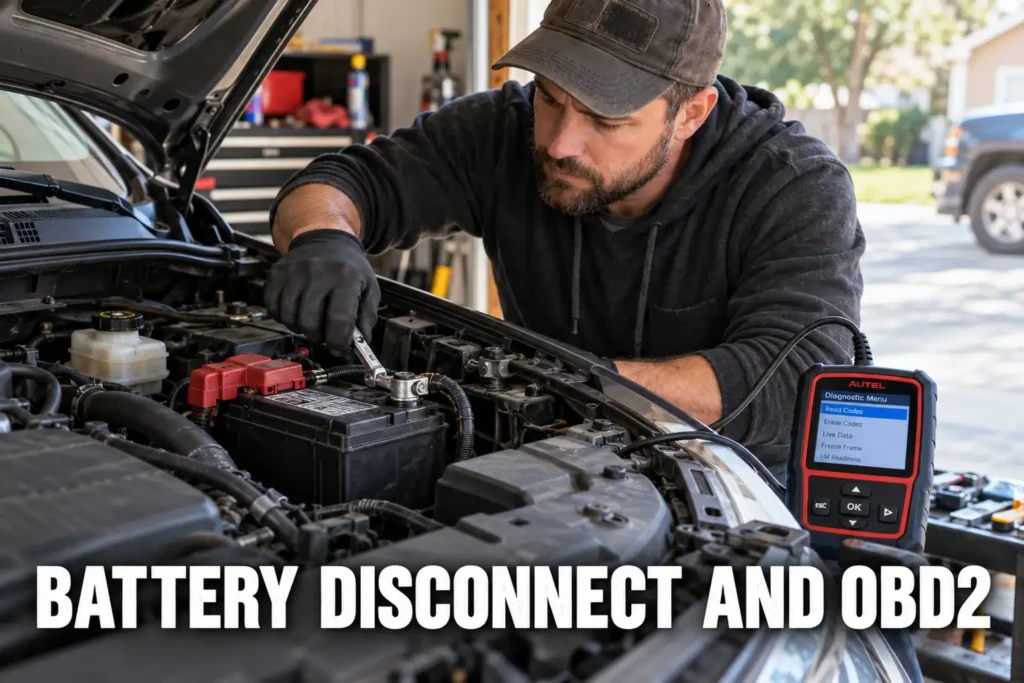
Battery Disconnect and OBD2: What Happens to Your Codes and Monitors
By Kamil Siegień / October 12, 2026
Disconnecting a car’s battery is one of the most common quick fixes people try when faced with a check engine light: pull the battery terminal, wait a few minutes, reconnect, and hope the light stays off. Sometimes it does stay off, at least briefly. But disconnecting the battery resets far more than just the check engine light, and understanding what that reset actually does explains why it creates new problems, particularly around emissions testing. This guide explains what happens to OBD2 data when the battery is disconnected, what survives the disconnect, and why clearing codes this way is less useful than it might seem.

About the author: Hello! I’m Kamil Siegień, founder of OBD2 Scout. My diagnostic experience started with an engine rebuild on a 2014 Skoda Superb 1.8 TSI, where tuning from 160 to 222 hp required mastering live data and ECU behavior that basic code readers cannot handle. I am a former BMW and MINI employee and regularly use diagnostic scanners on my own Audi A4 2.0 TFSI.
This guide covers what data the ECM stores and where, what a battery disconnect erases versus what it preserves, the specific effect on readiness monitors and emissions testing, why the underlying fault almost always returns, and the correct procedure for clearing OBD2 data when that is actually warranted.
For scanner recommendations to perform this type of work, see my scanner comparison guide.
Where the ECM Stores OBD2 Data
The ECM uses two types of memory to store diagnostic information. Volatile RAM (random access memory) requires continuous power to retain its contents: when battery voltage drops below the threshold required to maintain the keep-alive circuit (typically around 4-6V), its contents are lost. Non-volatile memory (EEPROM or Flash) retains its contents without power indefinitely: this memory survives a battery disconnect and most ECM resets.
Honda CR-V owners can find the right scanner in my best scanners for the CR-V.
The distinction matters because different categories of OBD2 data live in different memory types depending on the vehicle manufacturer’s design choices. Most OBD2 fault codes (DTCs), freeze frame data, and readiness monitor status are stored in volatile RAM on most vehicles. When the battery is disconnected long enough to discharge the keep-alive power circuit, this data is lost. The keep-alive circuit is typically a constant 12V feed to the ECM that bypasses the ignition switch — it draws only a few milliamps and is designed to maintain ECM memory during normal parking periods, not to survive battery removal.
Audi Q8 owners can find the right scanner in my top Q8 diagnostic tools.
The time required to discharge the keep-alive circuit varies. On most vehicles, one to two minutes with the battery disconnected is sufficient. Some vehicles with large capacitors in the ECM’s keep-alive supply may retain memory for up to 15 minutes. On some European vehicles (particularly BMW and Mercedes), the ECM keeps its memory alive for much longer through an internal backup capacitor. The only reliable way to confirm the memory has cleared is to reconnect the battery and use a scanner to check readiness monitor status: if all non-continuous monitors show “incomplete,” the ECM RAM has been cleared.
My my guide on obd2 mode 6 explained use for diagnosis covers this step by step.
If you are on a tight budget, my best affordable code readers covers the top value picks.
What a Battery Disconnect Erases
Stored fault codes (DTCs): On most vehicles, stored DTCs are held in volatile RAM and are erased by a battery disconnect. This includes both active codes and history codes. The check engine light extinguishes because the codes that triggered it are gone from memory. This does not mean the fault is gone: on the next drive cycle, if the fault condition still exists, the ECM’s monitors will run and detect the same problem, and the same codes will store again.
My most common reasons check engine light comes on covers this step by step.
My my guide on reset check engine light without a scanner covers this step by step.
If you prefer a wireless setup, my best Bluetooth diagnostic tools covers the best options.
One critical exception: OBD2 Mode 0A permanent DTCs cannot be cleared by battery disconnect or by any scanner code-clear command. Permanent codes were introduced in the 2010 model year under EPA regulations specifically to prevent the battery-disconnect emissions test trick. A permanent code stays stored until the ECM runs the associated monitor and confirms the fault has been resolved by passing the monitor on three consecutive drive cycles. If your vehicle has a permanent code (readable only through Mode 0A, which requires a scanner with this capability), battery disconnect has absolutely no effect on it. The check engine light will still illuminate on the next key-on cycle.
iPhone users looking for a compatible scanner can check my top iPhone-compatible scanners.
Freeze frame data: The operating conditions snapshot captured when a code first set is erased by battery disconnect. This data — which records engine load, RPM, coolant temperature, vehicle speed, fuel trim, and other parameters at the exact moment the fault was detected — is often the most diagnostically valuable piece of information about an intermittent fault. Erasing it by disconnecting the battery before diagnosis removes context that cannot be recovered. If the code never returns under identical conditions, the freeze frame data is gone permanently. This is a significant practical cost of the battery-disconnect approach that most people do not consider.
Audi Q7 owners can find the right scanner in my top Q7 diagnostic tools.
Readiness monitor status: All non-continuous readiness monitors reset to “incomplete” after a battery disconnect. The ECM treats a power loss as a system reset requiring all monitors to re-verify current system health. This is the OBD2 standard behavior: a monitor result from before the power loss cannot be trusted because anything could have changed. A vehicle that had all monitors complete before the disconnect (ready for an emissions test) must complete all monitors again from scratch.
Audi owners looking for the right scanner should check my top Audi scanner picks.
Short-term fuel trims: The ECM’s real-time adjustments to the air-fuel ratio (STFT) reset to zero. The engine runs open-loop briefly after reconnecting the battery until the ECM re-establishes closed-loop control based on live oxygen sensor feedback. This is a brief transitional state, typically lasting only a few seconds to a minute at operating temperature, and has no lasting significance for a normally functioning engine.
What a Battery Disconnect Preserves
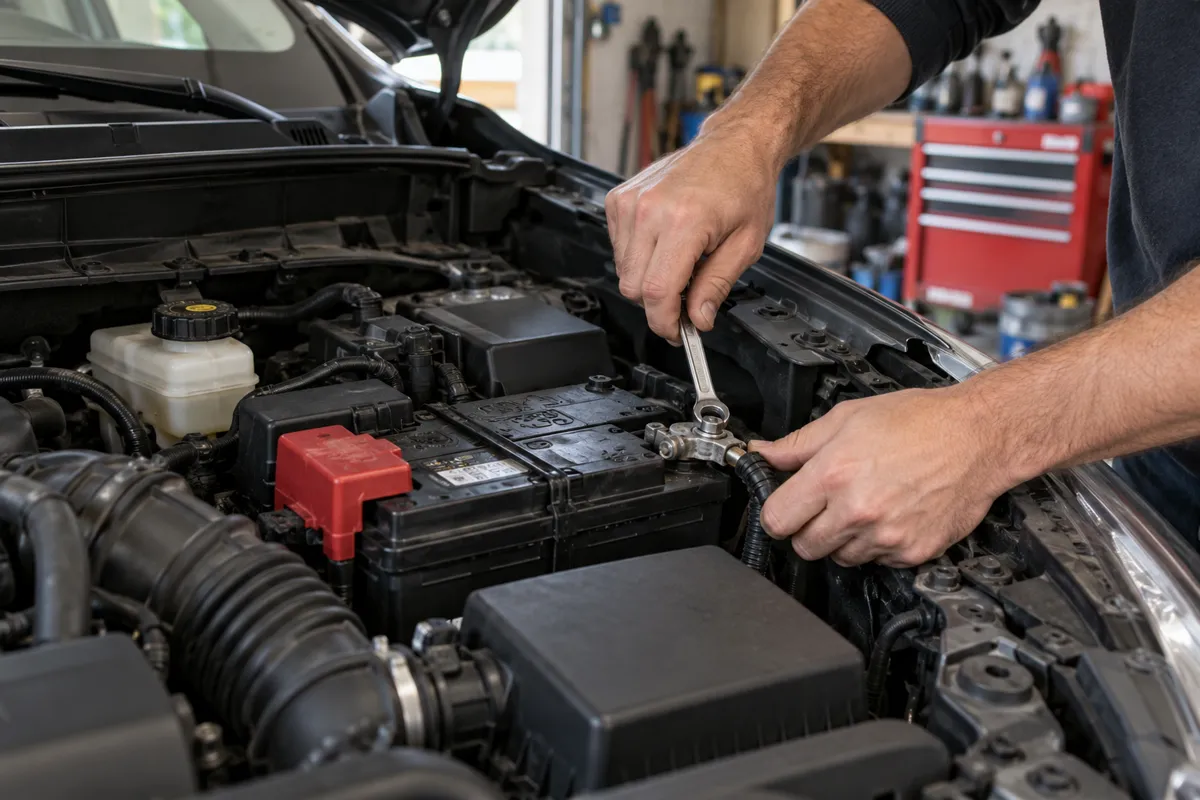
Long-term fuel trims: On most vehicles, long-term fuel trims (LTFT) are stored in non-volatile memory because they represent learned adaptations built up over thousands of drive cycles. LTFT represents the ECM’s accumulated correction to account for the specific engine’s aging characteristics — air flow meter calibration drift, injector flow rate variation, vacuum leak development. Preserving this learning across battery events is intentional: it prevents the engine from running poorly after every battery disconnect.
My my guide on diagnose vacuum leaks covers this step by step.
Honda owners looking for the right scanner should check my top Honda scanner picks.
However, some manufacturers do clear LTFT on battery disconnect or after a defined period without power. On Volkswagen Group vehicles with Motronic engine management, long-term fuel trims (stored as “adaptation values” in the ECM) are typically preserved in non-volatile memory, but some adaptation values are intentionally reset after extended power loss. On some older Honda and Toyota vehicles, LTFT may reset on battery disconnect, resulting in a brief rough-running period until the ECM re-learns normal operating trim. If the engine runs noticeably differently for the first few hundred miles after a battery reconnect, LTFT re-learning is the likely cause.
I cover this capability in more detail in my Innova 3100RS breakdown.
Deployment event codes (SRS): Airbag deployment event codes are specifically stored in non-volatile memory to preserve the crash record. A battery disconnect does not clear SRS deployment records regardless of how long the battery is disconnected. This is by design and by regulation: a vehicle that has had airbags deploy should not be able to have that history erased by any simple procedure.
My obd2 codes after car accident covers this step by step.
I cover this capability in more detail in my NT530 Plus BMW deep dive.
Permanent DTCs (Mode 0A): As described above, permanent codes survive battery disconnect by design. They also survive any scanner code-clear command. The only way to clear a permanent code is for the ECM to run the associated monitor, evaluate the system as passing, and confirm the pass on three consecutive drive cycles. Until that confirmation is complete, the permanent code — and the check engine light — remains active.
BMW owners looking for the right scanner should check my top BMW scanner picks.
Transmission shift adaptations: Most modern automatic transmission control modules (TCM) store shift adaptation values in non-volatile memory. These values represent the TCM’s learned pressure corrections for each clutch pack and shift valve, compensating for mechanical wear over time. After a battery disconnect, the TCM typically retains these values, though some manufacturers program a partial reset. A transmission that shifts differently after a battery reconnect may be re-learning adaptations: this is normal and typically resolves within 50 to 150 miles of mixed driving.
My my guide on reset transmission adaptations covers this step by step.
I explain this in more detail in my can you drive with check engine light on.
Throttle body adaptation: Electronic throttle bodies (drive-by-wire systems) store a learned minimum throttle position (the closed-stop position) that accounts for carbon buildup and mechanical variation. On many makes, this adaptation is stored in non-volatile memory and survives battery disconnect. On some vehicles (older Toyota models in particular), the throttle body adaptation does reset on battery disconnect, requiring the vehicle to re-learn idle position over the first few drive cycles. An unexpectedly rough idle or unstable idle immediately after battery reconnection often indicates a throttle body adaptation that needs to re-learn. The re-learning process typically requires idling the engine without load for 10 to 15 minutes.
Mercedes owners looking for the right scanner should check my top Mercedes scanner picks.
The Emissions Test Problem
The battery-disconnect trick before an emissions test creates a predictable and well-documented failure pattern. The sequence: vehicle develops a fault (EVAP system leak, oxygen sensor fault, catalyst efficiency code), owner disconnects battery to clear the check engine light, drives to the emissions test. The test inspector runs an OBD2 readiness scan as the first step. Every non-continuous monitor shows “incomplete.” The test fails on readiness before the inspector even evaluates codes.
Current EPA OBD2 testing guidelines allow a maximum of one incomplete monitor for 2001 and newer model year vehicles. After a battery disconnect, most vehicles have five to eight non-continuous monitors in incomplete status: the catalyst monitor, EVAP monitor, O2 sensor monitor, O2 sensor heater monitor, EGR monitor (on applicable vehicles), and secondary air injection monitor (on applicable vehicles) all reset simultaneously. A single morning of city driving completes the easy ones (O2 sensor heater, comprehensive components) but does not come close to completing the EVAP monitor, which requires an overnight cold soak and specific cold-start drive sequence.
Ford owners looking for the right scanner should check my best diagnostic tools for Ford.
The practical result of attempting the battery-disconnect shortcut for an emissions test: the vehicle fails immediately on the readiness check. Many states have a “not ready” retest policy — typically a waiting period of one to two weeks plus additional driving before retesting — that adds cost and time. And when the monitors do complete after sufficient driving, if the original fault was persistent, the original code returns and the check engine light comes back on before all monitors complete. The vehicle then fails for both the readiness check and an active code — a worse result than the original check engine light.
Permanent codes make this even more definitive: if the vehicle has a Mode 0A permanent code (which emissions test equipment checks separately from Mode 03), battery disconnect changes nothing. The check engine light re-illuminates on the next key-on cycle and the test fails on the active code regardless of monitor status.
I explain this in more detail in my check engine light on but no codes stored.
Why the Code Returns
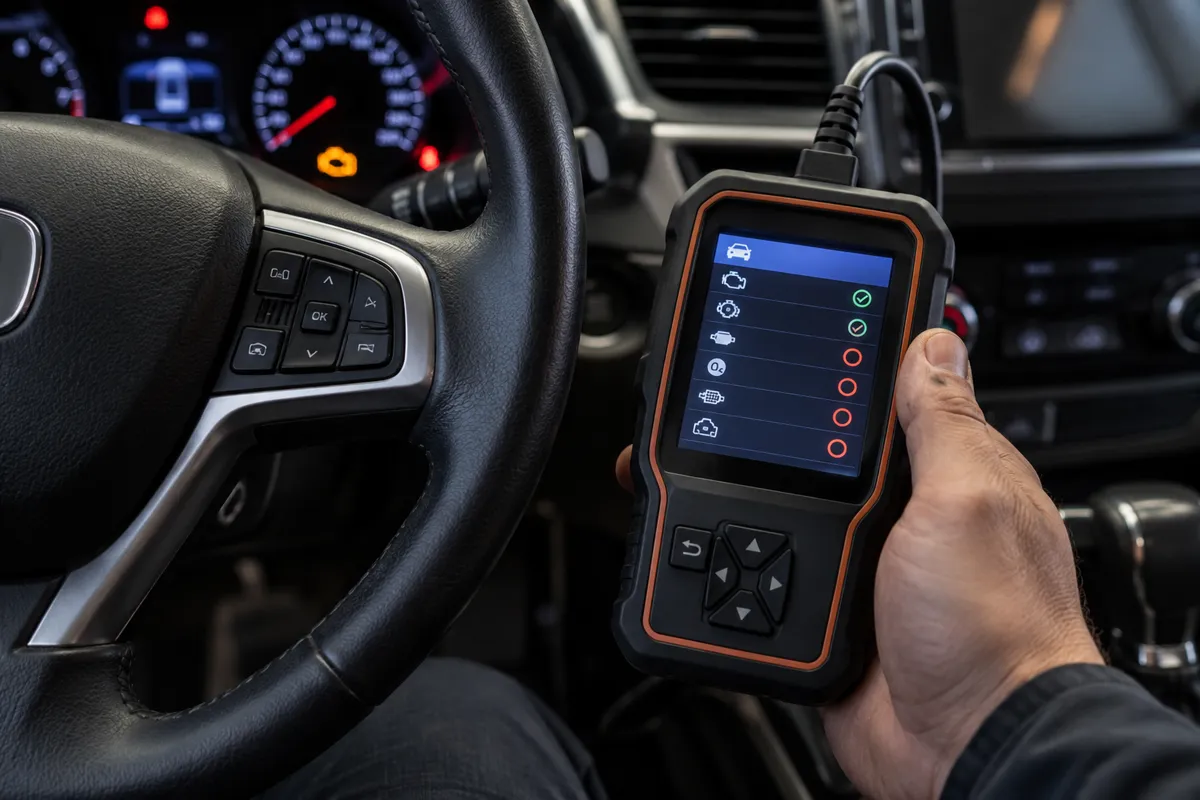
A battery disconnect does not repair anything. The physical condition causing the fault — a cracked EVAP hose, a slow-responding oxygen sensor, a partially clogged injector, a sticking EGR valve — still exists in the vehicle after the battery is reconnected. The ECM simply has no memory of having detected these conditions. On the next drive cycle, the ECM’s monitors run the same tests that previously found a fault, encounter the same conditions, and store the same code again.
Chevy owners looking for the right scanner should check my top Chevy scanner picks.
The return timeline is predictable by fault type. Sensor faults detected by the comprehensive component monitor (continuous monitor running on every drive) return within seconds to minutes of engine start: a failed MAF sensor, a stuck-open O2 sensor voltage, a coolant temperature sensor reading -40°C, or an implausible throttle position signal all trigger immediately. Misfire-induced codes return within the first few engine cycles if the misfire condition is still present. Catalyst efficiency codes (P0420) and EVAP codes may take one to several drive cycles to return because the non-continuous monitor must run through its enabling conditions before it can detect and confirm the fault again.
I explain this in more detail in my my guide on check used car.
A code that takes two weeks to return after a battery disconnect is not a sign that the problem is minor: it means the monitor only runs under specific driving conditions that took two weeks to occur. The fault was present the entire time; the monitor simply had not run yet.
I explain this in more detail in my my guide on read obd2 trouble codes.
When Battery Disconnect Is Appropriate
There are legitimate reasons to disconnect a vehicle’s battery that happen to also reset OBD2 data, even if resetting OBD2 data is not the goal: replacing the battery, performing major electrical work where live circuits present a short-circuit or shock risk, replacing the ECM, or following specific manufacturer procedures for module replacement or programming that require a power cycle. In these cases, the OBD2 reset is an expected and acceptable consequence.
Battery disconnect is also appropriate when a module replacement or software update procedure specifically requires a power cycle to initialize new parameters. Some manufacturers require a specified battery-off period (10 minutes is common) after ECM replacement before the first startup to allow capacitors to fully discharge and the ECM to boot cleanly.
My my guide on update firmware covers this step by step.
What battery disconnect is not appropriate for: clearing a check engine light to pass an emissions test, avoiding a diagnostic appointment because the light is annoying, or hoping the fault does not come back. These uses waste diagnostic information, create the readiness monitor problem, and in the case of vehicles with permanent codes, accomplish nothing at all.
Hyundai owners looking for the right scanner should check my top-rated scanners for Hyundai.
The Correct Procedure for Clearing OBD2 Data

When clearing codes is warranted after a confirmed repair, use a scanner’s code-clear function (Mode 04) rather than a battery disconnect. The Mode 04 clear command resets stored codes and monitor status in the same fundamental way a battery disconnect does — but it does not erase long-term learned adaptations (fuel trims, transmission adaptations, throttle body calibration) that the ECM stores in non-volatile memory. For the driver, this means the engine continues to run correctly immediately after the code clear rather than going through a brief re-learning period.
The correct post-repair verification sequence: connect the scanner, document all current codes and freeze frame data as a pre-clear baseline, perform the repair that addresses the root cause, clear codes with the scanner’s Mode 04 function, perform the appropriate drive cycle for the monitor associated with the repaired system, rescan to confirm the monitor shows “complete” and no code has returned. If the code returns after the monitor completes, the repair did not address the root cause and further diagnosis is required.
For intermittent faults where diagnosis is still ongoing and clearing codes would help identify whether a code is returning, use the scanner code clear rather than a battery disconnect. This preserves all learned adaptations and minimizes the vehicle’s re-learning period, while still providing the clean baseline code status needed to evaluate whether the fault recurs.
FAQs
How long do I need to leave the battery disconnected to clear the codes?
Typically two to five minutes is sufficient to discharge the keep-alive RAM on most vehicles. Some manufacturers recommend up to fifteen minutes to ensure the ECM’s capacitors fully discharge. However, there is no diagnostic advantage to a battery disconnect over a scanner code clear: a scanner clears codes without affecting non-volatile memory, while a battery disconnect also clears long-term learned adaptations that take time for the ECM to re-learn. Use a scanner when the goal is clearing codes after a confirmed repair. The battery-disconnect approach for code clearing is a holdover from pre-OBD2 vehicles that did not have scan tool code clear capability; it is obsolete practice for any vehicle with a standard OBD2 port.
My check engine light came back on immediately after reconnecting the battery. What does that mean?
The fault that stored the original code is persistent enough to trigger a code within the first key-on cycle or within the first few minutes of engine operation. Some fault conditions are detected within seconds of engine start: a sensor with a stuck voltage reading, a circuit that is open or shorted, a component that fails the ECM’s startup self-test, or a permanent code (Mode 0A) that was never clearable to begin with. If the light comes back on before the engine has even reached operating temperature, the fault is one of the “fast-fail” types detected during startup checks. This is actually useful diagnostic information: a code that returns within the first drive cycle is a fault that is active every time the engine runs, which narrows the diagnostic approach significantly compared to a code that takes days to return.
Will disconnecting the battery reset the anti-theft or radio security codes?
This depends entirely on the vehicle and the specific systems installed. Many factory radios require a security code to be re-entered after a battery disconnect: typically a four to six digit code that came with the vehicle’s documentation. If the code is lost, most manufacturers can retrieve it through the VIN at a dealer. Anti-theft and transponder key systems vary: some retain their security pairing in non-volatile memory and are unaffected by battery disconnect; others require re-pairing or present a brief “no communication” lockout period. Check the vehicle’s owner manual for the reconnection procedure before disconnecting the battery on a vehicle you are not familiar with. Some vehicles also require a power window re-calibration (driver window must be fully lowered and raised to relearn the up-stop position) and a sunroof re-initialization after battery disconnect.
Can I use a memory saver device to prevent losing OBD2 data during a battery swap?
Yes. A memory saver (also called a memory minder or keep-alive power supply) plugs into the OBD2 port or 12V accessory socket and provides low-current backup power to the ECM during a battery swap. This maintains volatile RAM and prevents monitor status loss. Memory savers are sold by vendors like Schumacher, Solar, and Duralast for $15-$40. They work by providing the ECM’s keep-alive circuit with a stable 9-12V supply through the OBD2 port while the main battery is disconnected. One practical note: a memory saver maintains ECM and BCM memory but does not maintain all modules — the SRS module and some body modules may still lose volatile data on some vehicles. For maintaining emissions readiness monitor status specifically, a memory saver is effective on most vehicles.