
Most Common Reasons the Check Engine Light Comes On: Causes Ranked by Frequency
By Kamil Siegień / October 12, 2026
The check engine light comes on for a specific confirmed fault in every case. Ten causes account for the vast majority of check engine light activations across all vehicle makes and models. Each one produces a predictable set of DTCs, follows a predictable pattern in live data, and requires a specific repair. Knowing which cause is most likely based on the symptoms the car is showing before a scan narrows the diagnosis before you connect any tool.
If you are on a tight budget, my best affordable code readers covers the top value picks.

About the author: Hello! I’m Kamil Siegień, founder of OBD2 Scout. My diagnostic experience started with an engine rebuild on a 2014 Skoda Superb 1.8 TSI, where tuning from 160 to 222 hp required mastering live data and ECU behavior that basic code readers cannot handle. I am a former BMW and MINI employee and regularly use diagnostic scanners on my own Audi A4 2.0 TFSI.
This guide covers the ten most common check engine light causes in order of frequency, the exact DTCs each one produces, what live data shows, how long each fault can safely be left before secondary damage occurs, and the typical repair cost range for each.
For scanner recommendations to perform this type of work, see my scanner comparison guide.
1. Loose, Damaged, or Missing Fuel Cap
A loose or damaged fuel cap is the single most common cause of a check engine light on vehicles under 150,000 miles. The fuel cap seals the fuel tank as part of the EVAP (evaporative emissions) system. The ECU runs a sealed pressure test on the EVAP system during certain drive cycles. A cap that is not fully tightened, cracked, or missing fails that pressure test and triggers an EVAP leak code.
For a scanner that handles ABS and SRS diagnostics, check my best OBD2 scanners for ABS and SRS.
DTCs: P0440 (general EVAP malfunction), P0442 (small EVAP leak), P0455 (large EVAP leak), P0456 (very small EVAP leak). On most vehicles, three audible clicks during installation confirm the cap is properly seated. A fuel cap that is cross-threaded produces the same codes as a missing cap because the seal is broken.
Audi owners looking for the right scanner should check my top Audi scanner picks.
The fix is to remove the cap, inspect the rubber gasket for cracks or deformation, and reinstall it fully. If the gasket is cracked or the cap does not click, a replacement cap costs $10 to $25. After reseating a good cap, the EVAP code clears within one to two drive cycles as the ECU re-runs the pressure test and passes. If the code returns with a properly seated, undamaged cap, the EVAP system has a different leak: a cracked canister hose, a failed purge valve, or a split vapor line. None of these are urgent from a drivability standpoint.
2. Oxygen Sensor Failure
Oxygen sensors are among the highest-wear electronic components on the vehicle, exposed to exhaust temperatures up to 900°C on every drive. A typical oxygen sensor lasts 60,000 to 100,000 miles on upstream (pre-catalyst) positions. Downstream sensors last longer but still fail. Most vehicles with over 100,000 miles have had at least one oxygen sensor failure.
My my guide on test o2 sensor covers this step by step.
DTCs: P0130 through P0167 cover the oxygen sensor circuit, voltage, and response time on both banks and both sensor positions. The suffix pattern B1S1 is Bank 1, Sensor 1 (upstream); B1S2 is Bank 1, Sensor 2 (downstream). A P0135 is an upstream sensor heater circuit fault on Bank 1. A P0141 is a downstream sensor heater circuit fault on Bank 1. P0133 is a slow response fault on the upstream Bank 1 sensor.
Honda owners looking for the right scanner should check my top Honda scanner picks.
Upstream sensor failure is moderate urgency. The ECU uses the upstream sensor for closed-loop fuel control. A failed upstream sensor may force the ECU into open-loop operation, running a fixed fuel map without O2 feedback. This causes persistent rich or lean running, increased fuel consumption, and accelerated catalytic converter degradation if left for months. Downstream sensor failure is low urgency: it affects emissions monitoring accuracy but does not disrupt fuel control. Repair cost for a sensor is $80 to $250 depending on position and vehicle.
I explain this in more detail in my can you drive with check engine light on.
3. Catalytic Converter Efficiency Below Threshold
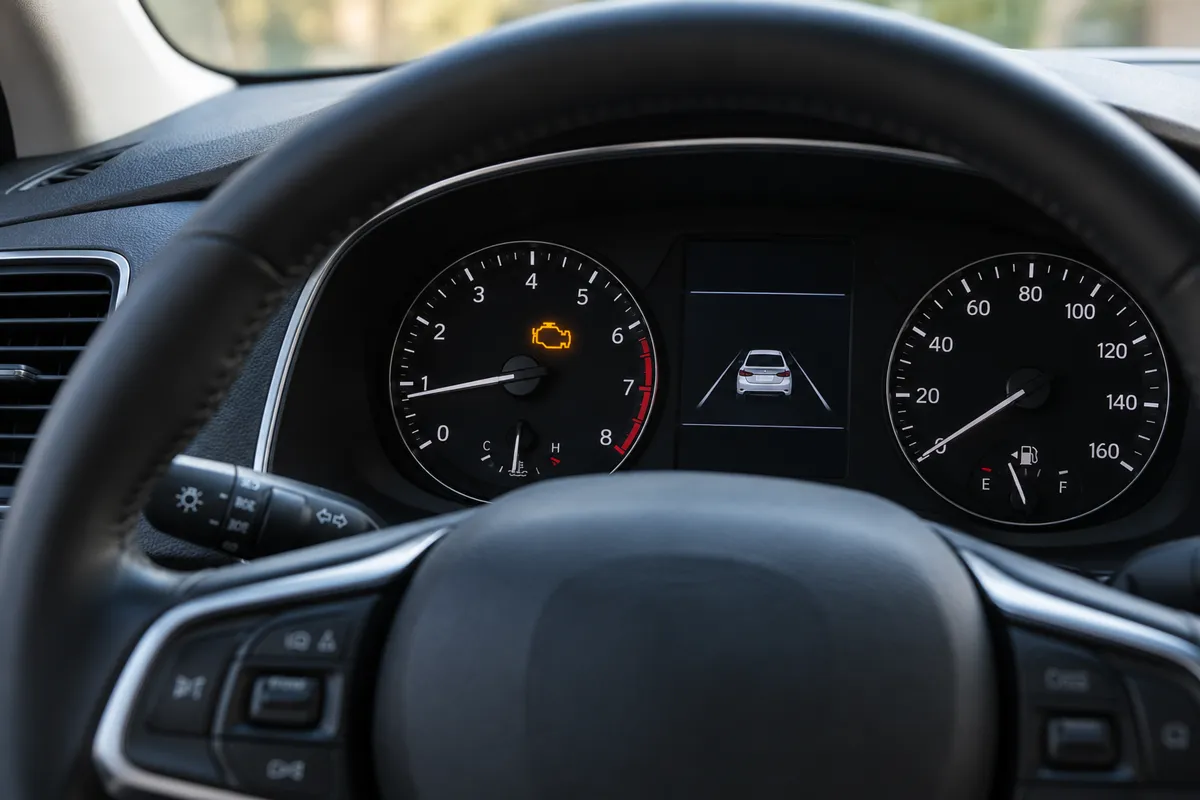
P0420 (Bank 1 catalyst efficiency below threshold) and P0430 (Bank 2) are the most frequently searched check engine light codes and represent a converter that has already degraded past the OBD2 monitoring threshold. The ECU compares the switching behavior of the upstream and downstream oxygen sensors to measure converter efficiency. When the downstream sensor starts switching in a pattern that mirrors the upstream sensor, the converter is no longer buffering exhaust chemistry, and the ECU stores the P0420 or P0430.
My my guide on test catalytic converter covers this step by step.
BMW owners looking for the right scanner should check my top BMW scanner picks.
P0420 typically does not appear until the vehicle has at least 80,000 to 100,000 miles, or after a sustained misfiring event that overheated the converter substrate. A converter that triggers P0420 has already failed as an emissions device. Continued driving does not cause additional converter damage in most cases. The mechanical consequence is slightly elevated exhaust backpressure and a guaranteed fail at state emissions inspection.
I explain this in more detail in my check engine light on but no codes stored.
Repair cost is the highest of any common check engine light cause: $400 to $2,500 depending on whether the vehicle requires an OEM converter to pass California or federal emissions standards, how many converters the vehicle has, and the vehicle’s exhaust system complexity. A P0420 code should not be addressed with a sensor spacer or tune workaround on a vehicle that must pass emissions testing.
Ford owners looking for the right scanner should check my top-rated scanners for Ford.
4. Spark Plug or Ignition Coil Failure Causing Misfire
Misfires are the fourth most common check engine light cause and among the most variable in urgency. A spark plug that is worn past its service interval produces a marginal misfire: the fuel charge fires inconsistently, causing rough idle, light hesitation, and a check engine light with a solid MIL. A coil-on-plug ignition coil that fails under high electrical load at highway speed produces a severe misfire that may flash the MIL.
Chevy owners looking for the right scanner should check my top Chevy scanner picks.
DTCs: P0300 (random or multiple cylinder misfire), P0301 through P0312 (cylinder-specific misfires, the number corresponds to the cylinder). P0350 through P0362 cover ignition coil primary and secondary circuit faults. A P0301 alongside a P0351 points directly to cylinder 1 with both a misfire and an associated coil circuit fault on the same cylinder, making the diagnosis straightforward.
My my guide on diagnose misfires covers this step by step.
Toyota owners looking for the right scanner should check my top Toyota scanner picks.
Spark plug replacement intervals vary by plug type: conventional copper plugs at 30,000 miles, platinum plugs at 60,000 miles, iridium plugs at 100,000 miles. Many vehicles arrive with misfires at 80,000 to 100,000 miles that resolve immediately after a plug set replacement. Coil failures are less predictable and can occur at any mileage, particularly on coil-on-plug designs exposed to engine heat and vibration. Spark plug cost is $20 to $150 per set depending on plug type and engine. Coil replacement is $40 to $200 per coil.
5. Mass Airflow Sensor Fault
The mass airflow (MAF) sensor measures the mass of air entering the intake manifold and provides the ECU’s primary input for calculating fuel delivery. A contaminated or failing MAF sensor produces inaccurate airflow readings that cause the ECU to deliver incorrect fuel quantities. The symptoms are rough idle, hesitation during acceleration, and poor fuel economy, often before the check engine light appears, because the ECU compensates with fuel trim corrections up to the point where corrections exceed the allowed range.
My my guide on read maf sensor data covers this step by step.
Mercedes owners looking for the right scanner should check my top Mercedes scanner picks.
DTCs: P0100 (MAF sensor circuit malfunction), P0101 (MAF sensor range/performance), P0102 (MAF circuit low input), P0103 (MAF circuit high input). A P0101 with high positive long-term fuel trim (the ECU is adding large amounts of fuel to compensate for a low MAF reading) points to a dirty or failing MAF sensor. A P0102 with a fuel trim near zero points to a sensor that is sending a low voltage signal even at idle.
Ford F-150 owners can find the right scanner in my best scanners for the F-150.
Many MAF sensor fault cases are resolved by cleaning the sensor element with MAF sensor cleaner spray without replacement. The sensor element is a heated wire or film that accumulates oil vapor contamination from the PCV system over time. Cleaning costs $8 in spray. A failed MAF sensor that does not respond to cleaning requires replacement at $50 to $400 depending on the vehicle.
6. EVAP System Leak Beyond the Fuel Cap
After the fuel cap is ruled out, EVAP leaks in the rest of the system account for a significant portion of persistent P044x codes. The EVAP system includes the charcoal canister, the purge valve solenoid, the vent valve, and the network of vapor hoses connecting the fuel tank to the canister and the canister to the intake manifold. Any of these components can leak.
My how to perform evap system test with obd2 scanner covers this step by step.
I explain this in more detail in my service engine soon light vs check engine light.
The purge valve solenoid is one of the more common failure points. It opens during certain drive conditions to allow stored fuel vapors from the canister to be drawn into the intake for combustion. A purge valve that sticks open allows unmetered air or fuel vapor into the intake manifold outside of the commanded purge event. This produces a P0441 (EVAP system incorrect purge flow) or a lean/rich code from the uncontrolled vapor flow, depending on when it sticks open.
I explain this in more detail in my my guide on check used car.
The vent valve controls airflow into the canister when the EVAP system is venting. A stuck-closed vent valve prevents the system from venting and causes EVAP pressure test failures. A failed vapor hose anywhere in the circuit produces a large leak code (P0455) or a small leak code (P0442) depending on the hose diameter and the size of the crack. Repair costs range from $15 for a replacement hose to $150 to $300 for a purge valve or canister replacement.
7. EGR Valve or EGR System Fault

The exhaust gas recirculation (EGR) system reduces NOx emissions by recirculating a portion of exhaust gas back into the intake manifold, lowering combustion temperature. The EGR valve controls this flow. Carbon deposits accumulate in the EGR valve, passages, and cooler over time, particularly on engines that do frequent short trips at low load where combustion temperatures are not high enough to burn off deposits.
DTCs: P0400 (EGR flow malfunction), P0401 (EGR insufficient flow), P0402 (EGR excessive flow), P0403 (EGR circuit malfunction), P0404 (EGR circuit range/performance), P0405 through P0409 cover the EGR valve position sensor circuit. A P0401 on a high-mileage vehicle with no other drivability symptoms usually points to a carbon-clogged EGR valve or passage that is restricting flow below the ECU’s minimum expected rate.
Honda CR-V owners can find the right scanner in my CR-V-compatible diagnostic tools.
EGR valve cleaning with intake cleaner spray can resolve P0401 on clogged but mechanically functional valves. Replacement valves range from $50 to $300 depending on whether the EGR system is vacuum-operated (older vehicles) or electronically actuated (most post-2005 vehicles). On diesel engines, EGR cooler failure is a separate and more expensive issue that produces coolant loss and a P0401 or P0403 alongside a white exhaust smoke symptom.
My j1939 heavy duty truck diagnostics obd2 covers this step by step.
8. Thermostat Fault: P0128
P0128 (coolant temperature below thermostat regulating temperature) is one of the most overlooked check engine light codes. It indicates that the engine coolant is not reaching or maintaining its designed operating temperature. The thermostat is stuck open, allowing coolant to flow through the radiator continuously and preventing the engine from warming up fully.
Audi Q8 owners can find the right scanner in my top diagnostic tools for the Q8.
The symptoms of a stuck-open thermostat are subtle: the temperature gauge reads slightly lower than normal, fuel economy decreases because the ECU runs a richer fuel map at sub-optimal coolant temperatures, and the heater produces less heat than expected in cold weather. Many drivers notice none of these symptoms and only learn of the issue through a code scan.
A stuck-open thermostat causes continuous rich running as the ECU compensates for sub-optimal combustion efficiency. Over months, this accelerates catalyst degradation and increases carbon deposit formation on intake valves and injectors. A thermostat costs $10 to $50. With labor, the repair is $100 to $250 on most vehicles. It is among the most cost-effective check engine light repairs relative to the secondary damage it prevents if left unaddressed.
I cover this capability in more detail in my BlueDriver Pro breakdown.
9. Variable Valve Timing Faults
Variable valve timing (VVT) systems are standard on virtually every gasoline engine produced since 2005. The ECU controls cam timing advance and retard through oil pressure applied to actuators on the intake and exhaust camshafts. Oil pressure, oil viscosity, and actuator solenoid function all affect VVT performance.
DTCs: P0010 through P0025 cover the VVT actuator solenoid circuit and camshaft position performance on banks 1 and 2 for both intake and exhaust cams. P0011 (intake cam over-advanced, Bank 1) and P0021 (intake cam over-advanced, Bank 2) are the most common. They indicate the camshaft is advancing beyond the ECU’s commanded position, often from a sticking VVT actuator solenoid or from oil sludge restricting the oil passages that control the actuator.
For a scanner with active test capability, see my best bidirectional OBD2 scanner.
VVT faults often accompany rough idle and poor fuel economy, particularly at cold start when oil viscosity is highest and the VVT actuator takes longer to respond. Regular oil changes with the correct viscosity grade prevent most VVT actuator solenoid faults caused by sludge. The solenoid itself is a serviceable component: $30 to $100 per solenoid. A seized VVT actuator phaser requires a more involved repair at $300 to $800 depending on whether it is on the intake or exhaust cam.
10. Crankshaft or Camshaft Position Sensor Fault
The crankshaft position sensor (CKP) and camshaft position sensor (CMP) provide the ECU with the precise rotational position and speed data it uses to control ignition timing and fuel injection. Both sensors operate in harsh environments: high heat, vibration, and oil contamination. Sensor failure ranges from intermittent signal dropout to complete failure, and the symptoms range from a subtle rough idle to a no-start condition depending on how completely the sensor has failed.
DTCs: P0335 and P0336 cover crankshaft position sensor circuit faults and range/performance. P0340 through P0349 cover camshaft position sensor faults across multiple cam positions. A P0335 alongside a no-start or stalling symptom indicates a CKP sensor that has lost its signal completely. A P0340 alongside rough idle and misfires points to a CMP sensor that is producing an inconsistent or missing signal affecting cam timing correlation.
I cover this capability in more detail in my Innova 3100RS deep dive.
CKP and CMP sensors are typically $20 to $80 in parts. The labor cost depends on sensor location: sensors mounted on an accessible position on the engine block or cylinder head are a 30-minute job, while sensors buried under intake manifolds or timing covers require more disassembly. A CKP sensor that is intermittently dropping signal is a reliability issue even if the vehicle continues to run, because complete failure at speed leaves the engine without timing reference and causes an immediate stall.
How to Prioritize Repairs When Multiple Codes Are Stored
Multiple codes stored at the same time do not always represent multiple independent faults. A failed upstream oxygen sensor can trigger secondary fuel trim codes, a catalyst efficiency code, and a secondary O2 sensor heater code all from the same root cause. Addressing the upstream sensor first may clear the secondary codes without additional parts.
The priority order for multiple codes is: address any code that poses immediate mechanical risk first (misfires with a flashing MIL, oil pressure faults, coolant temperature faults), then address codes with secondary damage risk if delayed (upstream O2 sensor, VVT faults, thermostat), then address codes that affect emissions compliance but pose no mechanical risk (downstream O2 sensor, EVAP leaks beyond the fuel cap, EGR faults on a vehicle not due for an inspection).
Reading the freeze frame data associated with each code clarifies the sequence. The freeze frame records the engine conditions at the moment each code confirmed. If multiple codes all have the same freeze frame timestamp and the same operating conditions, they likely confirmed simultaneously from a single event. If the freeze frames show different timestamps and conditions, the codes formed independently and each represents a separate fault.
FAQs
What is the most common reason for a check engine light?
A loose, damaged, or missing fuel cap is the most common cause on vehicles under 150,000 miles, producing an EVAP leak code (P0440, P0442, P0455). On higher-mileage vehicles, oxygen sensor failure surpasses the fuel cap in frequency. Catalytic converter efficiency faults (P0420, P0430) are the most common cause on vehicles over 100,000 miles that have not had recent oxygen sensor service.
Can I figure out which cause it is before connecting a scanner?
Partially. A check engine light that appeared immediately after refueling strongly suggests a fuel cap issue. A check engine light with a rough idle, hesitation, or a flashing MIL strongly suggests a misfire. A check engine light with slightly low fuel economy and no drivability symptoms could be an oxygen sensor, a thermostat, or a VVT fault. The symptoms narrow the field but a code scan is the only way to confirm which system is affected.
Is it safe to drive with any of these causes?
Fuel cap, downstream O2 sensor, and EVAP causes are safe for normal driving. Catalytic converter efficiency faults are safe for short-term driving while arranging repair. Upstream O2 sensor faults should be addressed within days. Misfires with a solid MIL require prompt diagnosis; misfires with a flashing MIL require stopping immediately. Thermostat faults, VVT faults, and CKP/CMP sensor faults should not be deferred more than a week or two because of secondary damage risk.
Why does the same check engine light code keep coming back after clearing it?
A code that returns after clearing means the fault condition is still present. The ECU re-detects it on the next applicable drive cycle and restores the confirmed DTC. Clearing a code without repairing the underlying fault accomplishes nothing except a temporary light-off. The code will return as soon as the monitor runs again under enabling conditions and detects the same failure.
How much does it cost to diagnose the check engine light?
An OBD2 code read at most auto parts stores is free and takes 60 seconds. A diagnostic fee at a shop ranges from $75 to $200 depending on the shop and region. The shop fee covers more than a code read: it includes freeze frame analysis, live data monitoring under driving conditions, and the technician’s interpretation of whether the code points to the named component or to a secondary effect from a different root cause. For straightforward codes where the code number matches a known failing component at that mileage, a free code read from a parts store is sufficient. For intermittent codes or situations where the code could represent multiple causes, a shop diagnostic is worth the cost.