
OBD2 Modes Explained: What Modes 1 Through 10 Do
By Kamil Siegień / October 12, 2026
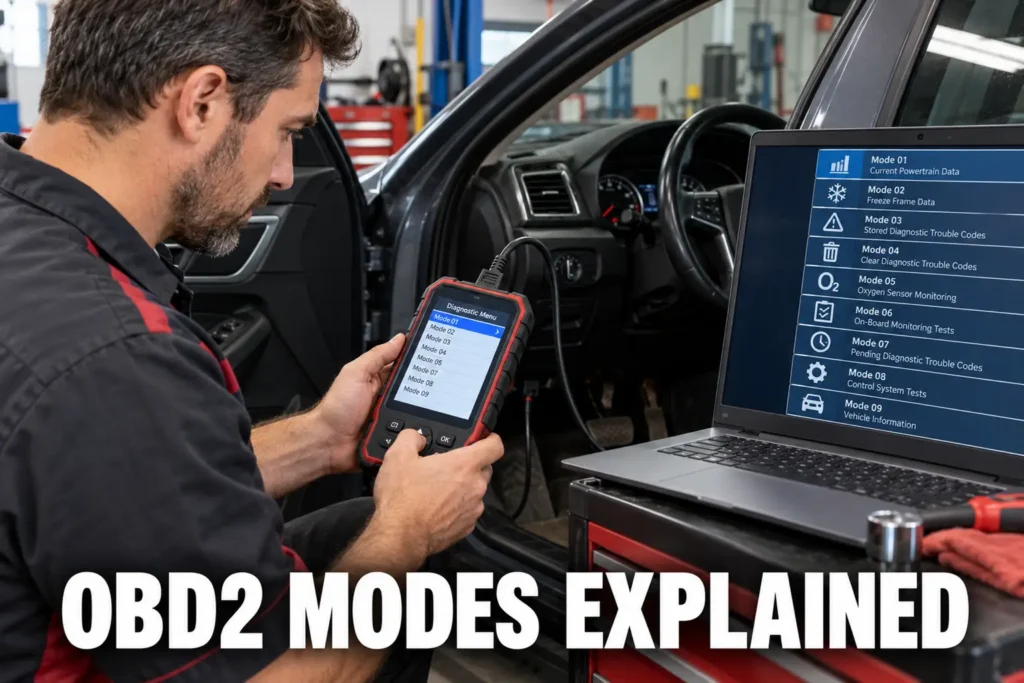
OBD2 communication is organized into ten defined services, commonly called modes. Each mode has a specific function: one returns real-time sensor data, another returns stored fault codes, another returns freeze frame data captured at a fault event, and others expose specific types of diagnostic information not covered by the primary data modes. Most scanner users work with Modes 01 and 03 without knowing it, but understanding what each mode does allows you to use your scanner’s full diagnostic capability rather than only its most visible features. Several modes contain diagnostic information that is entirely separate from the check engine light and often overlooked.
If you are on a tight budget, my top entry-level code readers covers the top value picks.

About the author: Hello! I’m Kamil Siegień, founder of OBD2 Scout. My diagnostic experience started with an engine rebuild on a 2014 Skoda Superb 1.8 TSI, where tuning from 160 to 222 hp required mastering live data and ECU behavior that basic code readers cannot handle. I am a former BMW and MINI employee and regularly use diagnostic scanners on my own Audi A4 2.0 TFSI.
This guide covers what each of the ten OBD2 modes does, the practical diagnostic value of each mode, which modes are supported on most vehicles versus which are optional or rarely implemented, and how the mode structure relates to what you see on a scanner’s diagnostic screens.
For a professional-grade tool, my best shop-grade diagnostic tools covers the top options.
Mode 01: Current Powertrain Data
Mode 01 is the live data mode. It returns real-time values for the parameters (PIDs) the vehicle currently supports, read directly from the ECM/PCM’s sensor inputs and calculated values. Engine RPM, coolant temperature, throttle position, fuel trims, oxygen sensor voltages, vehicle speed, and calculated engine load are all Mode 01 PIDs. This is what the scanner displays when you open the Live Data or Data Stream screen.
My my guide on read o2 sensor live data covers this step by step.
For a scanner that handles ABS and SRS diagnostics, check my top ABS diagnostic tools.
Mode 01 is the diagnostic workhorse: most active fault diagnosis uses Mode 01 data to observe sensor behavior under operating conditions that trigger the fault. The supported PIDs query (using the availability bitmask PIDs described in the PIDs article) shows which specific Mode 01 parameters the vehicle supports before requesting them. Mode 01 is mandatory on all OBD2-compliant vehicles from 1996 onward.
Audi owners looking for the right scanner should check my top-rated scanners for Audi.
Mode 02: Freeze Frame Data
Mode 02 stores a snapshot of Mode 01 data values captured at the moment the last DTC was confirmed and stored. The freeze frame record includes the DTC that triggered the snapshot and the values of several key parameters at that instant: typically engine speed, load, coolant temperature, fuel trims, vehicle speed, and throttle position. The freeze frame provides the operating context at the fault event, which is often essential for diagnosing intermittent faults that do not reproduce easily during a workshop visit.
Honda owners looking for the right scanner should check my top-rated scanners for Honda.
A P0171 (system lean) code with a freeze frame showing coolant temperature at 80 degrees C, RPM at 2,200, and vehicle speed at 45 mph indicates the lean condition occurs at warm highway cruise, pointing to different causes than the same code with a freeze frame showing a cold engine at idle. The freeze frame is the one piece of data that survives after the fault condition ends and often provides the diagnostic direction that Mode 01 real-time monitoring cannot.
BMW owners looking for the right scanner should check my top-rated scanners for BMW.
Mode 03: Stored DTCs
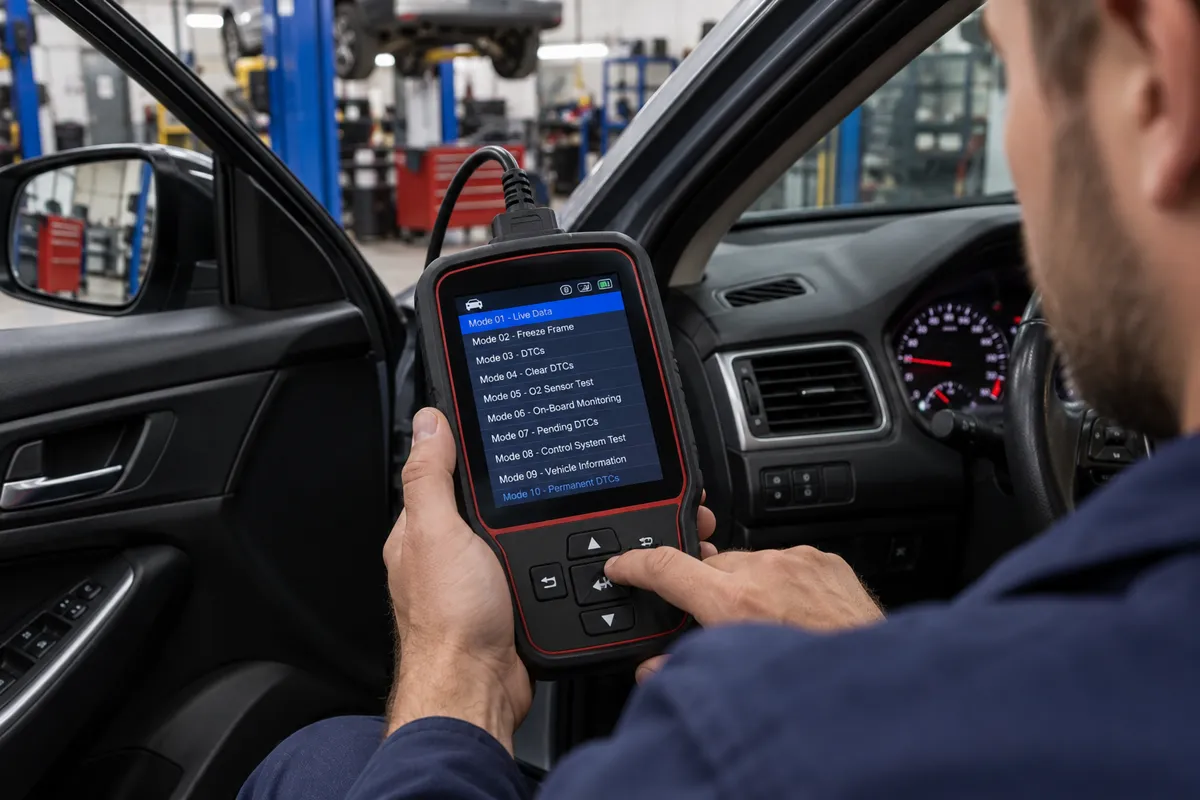
Mode 03 returns all currently stored diagnostic trouble codes from the emissions-related module. These are the codes associated with the check engine light (MIL). Mode 03 is what every code reader queries when you press “Read Codes.” The codes returned are the confirmed faults that have met the ECM’s detection criteria and are stored in non-volatile memory. A vehicle with no stored codes but an illuminated check engine light is unusual and suggests a different module’s fault (accessible only through enhanced scan) or a temporary fault that cleared but left the light on pending a drive cycle confirmation.
Ford owners looking for the right scanner should check my scanner recommendations for Ford owners.
Mode 04: Clear DTCs and Reset Drive Cycle
Mode 04 clears all stored DTCs from Mode 03, resets the Mode 02 freeze frame data, and resets all Mode 06 test results to “not run” status. It also extinguishes the MIL if it was illuminated. This is the “Clear Codes” function on every OBD2 scanner. Note that clearing codes resets all readiness monitors to “not ready” status, which means the vehicle needs to complete a drive cycle to re-run the emission readiness tests. Clearing codes immediately before an emissions test will result in a failed test due to incomplete readiness monitors even if no faults are present.
My my guide on verify repair fixed obd2 covers this step by step.
My obd2 mode 06 explained monitor test results covers this step by step.
My battery disconnect obd2 codes monitors covers this step by step.
Chevy owners looking for the right scanner should check my top-rated scanners for Chevy.
Mode 05: Oxygen Sensor Monitoring Test Results
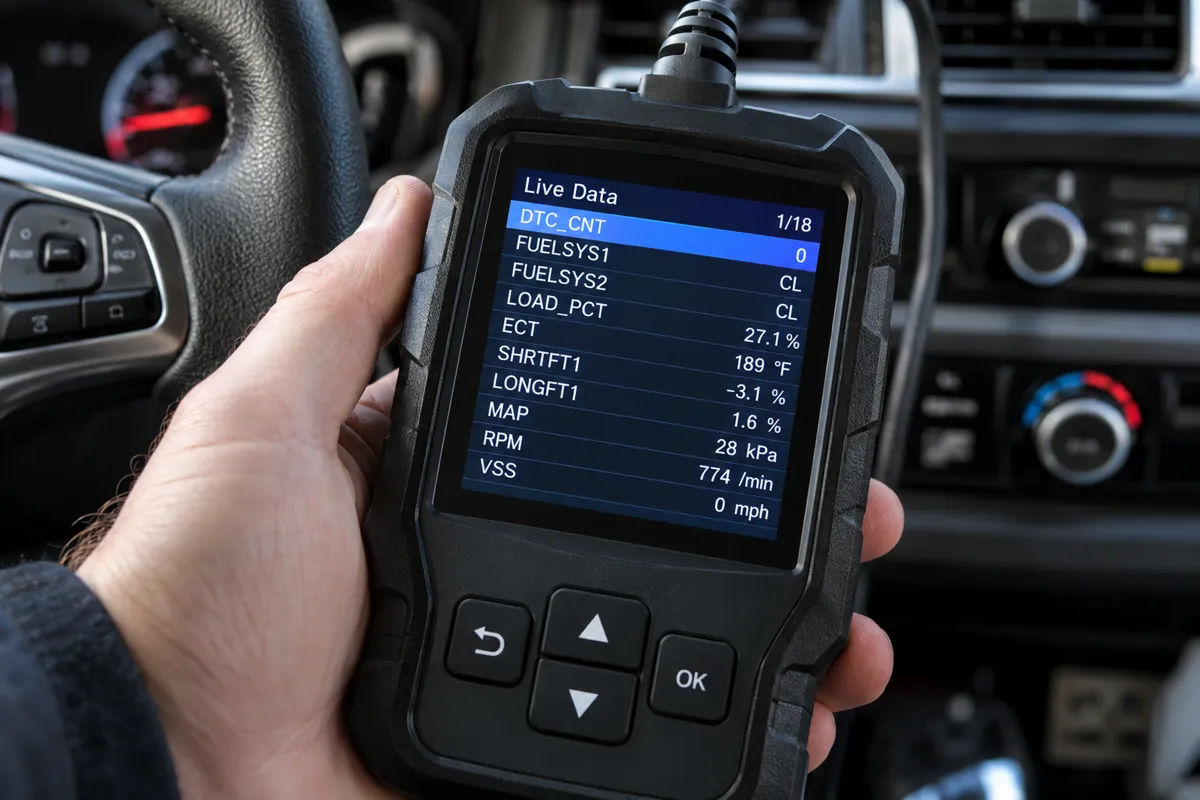
Mode 05 returns the results of the ECM’s built-in oxygen sensor tests, including the target and actual voltage thresholds for the O2 sensor’s rich-lean switching test and the O2 heater performance test. This mode was used heavily on pre-CAN vehicles (pre-2008) for oxygen sensor monitoring. On CAN-based vehicles, most of this information moved to Mode 06. Some scanners display Mode 05 data but its practical use is limited compared to Mode 06 for modern vehicles. Vehicles that use Mode 05 for O2 testing report each sensor’s minimum voltage, maximum voltage, and response time threshold alongside the measured value.
Toyota owners looking for the right scanner should check my top-rated scanners for Toyota.
Mode 06: On-Board Monitor Test Results
Mode 06 is one of the most underutilized but diagnostically valuable modes. It returns the results of the ECM’s self-test routines for individual components: the actual test measurement alongside the minimum and maximum thresholds that define pass or fail for that test. Examples include: catalytic converter efficiency test (the ECM monitors the downstream O2 sensor activity relative to the upstream sensor and compares the measured ratio to the pass/fail thresholds), EVAP system leak test (the measured evap system decay rate versus the threshold for a small or large leak), EGR flow test (measured EGR flow versus expected range), and oxygen sensor voltage and response time tests.
My my guide on test o2 sensor covers this step by step.
Mercedes owners looking for the right scanner should check my top-rated scanners for Mercedes.
The value of Mode 06 is that it shows measurements that are approaching the failure threshold before a DTC is stored. A catalytic converter test that shows a measured efficiency value just above the failure threshold (a value of 0.080 versus a failure threshold of 0.082 in the test’s native units, for example) indicates the catalyst is nearly at the point of setting a P0420 code. Monitoring Mode 06 periodically reveals deteriorating components before the check engine light appears, allowing proactive replacement rather than reactive diagnosis.
My my guide on test catalytic converter covers this step by step.
My most common reasons check engine light comes on covers this step by step.
Honda CR-V owners can find the right scanner in my best scanners for the CR-V.
Mode 07: Pending DTCs
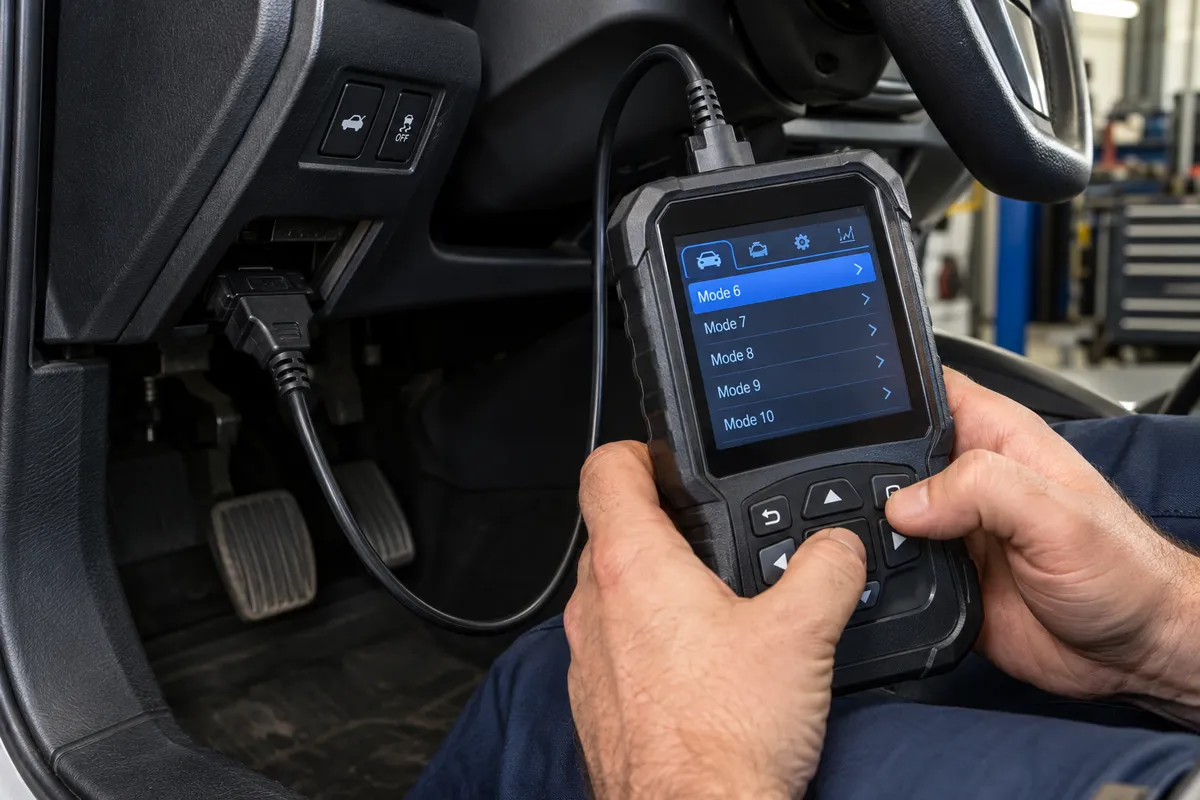
Mode 07 returns pending (not yet confirmed) diagnostic trouble codes. A pending code is one that the ECM has detected a fault condition for on one drive cycle but has not yet confirmed on a second drive cycle, which is the two-trip confirmation requirement for most DTCs. Pending codes do not illuminate the MIL and do not appear in Mode 03. They represent faults that are in the process of being confirmed: if the same fault is detected on the next drive cycle, the pending code moves to confirmed (Mode 03) and the MIL illuminates.
Audi Q8 owners can find the right scanner in my Q8-compatible diagnostic tools.
Checking Mode 07 during diagnosis reveals developing faults before the check engine light appears. It also explains situations where a customer reports intermittent symptoms without a check engine light: the fault is in Mode 07 pending status, occurring on one drive cycle but not consistently enough to confirm to Mode 03. Pending codes are a valuable early warning signal that a component is beginning to fail.
Audi Q7 owners can find the right scanner in my top diagnostic tools for the Q7.
Mode 08: Request Control of On-Board Systems
Mode 08 is the bidirectional control mode in the OBD2 standard. It allows the diagnostic tool to request control of specific on-board systems or components. The standard defines Mode 08 for specific test functions: commanding the evaporative system to run a leak test, requesting the cooling fan to activate at a specific speed, and similar standardized test commands. Mode 08 implementation is optional and vehicle-specific: many vehicles do not implement it, relying instead on manufacturer-specific bidirectional protocols outside the standard OBD2 mode structure. Scanners that offer active tests and service functions typically use manufacturer-specific extended protocols rather than Mode 08.
My a bidirectional obd2 scanner explained covers this step by step.
My my guide on perform evap system test covers this step by step.
I cover this capability in more detail in my BlueDriver Pro breakdown.
Mode 09: Vehicle Information
Mode 09 returns vehicle identification and calibration information. The most commonly used Mode 09 PID is the VIN (Vehicle Identification Number), which allows a scanner to automatically retrieve and display the vehicle’s full 17-character VIN without the driver having to enter it manually. Mode 09 also returns ECM/PCM calibration identification (the software version identifier for the module’s firmware), which is useful for verifying the correct software version is installed after an ECU replacement or reflash.
I cover this capability in more detail in my NT726 breakdown.
Mode 0A: Permanent DTCs
Mode 0A (Mode 10 in decimal) returns permanent diagnostic trouble codes. These are codes that cannot be cleared using Mode 04 (the standard clear codes function). A permanent DTC is stored when an emissions-related fault has been confirmed and the MIL illuminated. The permanent code remains even after a Mode 04 clear: it can only be removed by the ECM itself after the vehicle has completed a full OBD2 drive cycle that confirms the fault is no longer present. This mode was added to prevent technicians from clearing codes immediately before an emissions inspection to create the appearance of a clean diagnostic history. A vehicle with permanent DTCs fails the emissions inspection regardless of whether Mode 03 shows any current codes.
I explain this in more detail in my my guide on check used car.
For scanner recommendations to perform this type of work, see my top picks for the best scanners.
Using Modes Together in a Diagnostic Workflow
A complete diagnostic session uses multiple modes in sequence rather than relying on any single mode alone. The standard workflow starts with Mode 03 to identify all confirmed faults, followed by Mode 07 to catch any pending faults that have not yet confirmed. For each relevant DTC, Mode 02 provides the freeze frame operating conditions at the fault event, which narrows the diagnostic hypothesis before any live testing begins. Mode 01 live data then tests the hypothesis in real time by observing sensor behavior under the conditions the freeze frame identified.
I explain this in more detail in my check engine light on but no codes stored.
For emissions test preparation, the workflow uses Mode 01 to confirm live data is within normal range, Mode 06 to verify the key monitored components (catalyst, O2 sensors, EVAP) are showing measured values well above their failure thresholds, and Mode 01 readiness status to confirm all monitors show “complete.” A vehicle that shows a passing Mode 06 catalyst efficiency result and all monitors complete is unlikely to fail an emissions inspection from an underlying issue that was not already visible in Mode 03.
I explain this in more detail in my can you drive with check engine light on.
For post-repair verification, Mode 04 clears the fault and resets the monitors, then the vehicle is driven through the appropriate drive cycle. Mode 07 confirms no pending code was generated immediately after clearing. Mode 06 after the drive cycle confirms the relevant component’s test result passed with margin. Mode 0A confirms no permanent codes remain. This multi-mode verification approach provides objective evidence that the repair resolved the fault rather than simply clearing it.
I explain this in more detail in my service engine soon light vs check engine light.
FAQs
Which OBD2 modes are available on every vehicle?
Modes 01, 03, 04, 07, and 09 are required on all OBD2-compliant vehicles. Mode 02 (freeze frame) is required when Mode 03 is implemented and at least one DTC is stored. Mode 06 is required on CAN-based vehicles from 2008 onward and strongly recommended before that. Modes 05 and 08 are optional and infrequently implemented. Mode 0A is required on vehicles sold in the US from 2010 onward per EPA regulations.
Can I access all ten modes on any OBD2 scanner?
Most mid-range and professional scanners access all relevant modes. Basic code readers typically access only Modes 01, 03, 04, and 07. Mode 06 is accessible on scanners that have been specifically programmed to decode the OBD2 monitor test result format, which requires the scanner to know the test IDs and their descriptions for each vehicle make (the test IDs are standardized but the descriptions of what each test number measures are not). Mode 09 VIN retrieval is commonly available even on entry-level scanners.
What is the practical difference between Mode 03 and Mode 07?
Mode 03 returns confirmed DTCs that have been detected on two or more drive cycles and have illuminated the MIL. Mode 07 returns pending codes that have been detected once but not yet confirmed to Mode 03 status. A pending code that appears in Mode 07 today may appear in Mode 03 tomorrow if the same fault condition recurs. Checking both modes provides a complete picture of current and developing faults.