
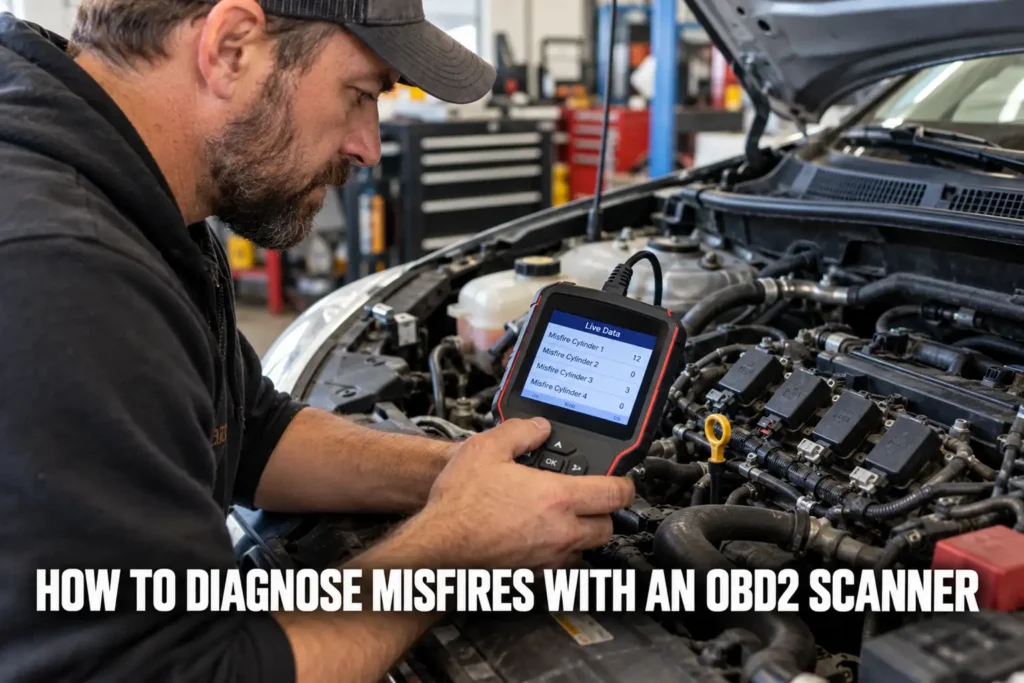
How to Diagnose Misfires with an OBD2 Scanner: Live Data, Misfire Counters, and Root Cause Analysis
By Kamil Siegień / October 12, 2026
A misfire code from an OBD2 scanner tells you which cylinder is misfiring but not why it is misfiring. Diagnosing the root cause requires reading misfire counters in live data, correlating them with fuel trim, MAP sensor, and individual cylinder data, and then applying a logical elimination sequence to distinguish between ignition, fuel, and mechanical causes. Most shops do this by replacing the most common part first. Doing it properly with a scanner costs nothing and takes 20 minutes.
My my guide on read map sensor data covers this step by step.
My my guide on read live data for misfire diagnosis covers this step by step.
For a scanner with active test capability, see my best scanners with active test.

About the author: Hello! I’m Kamil Siegień, founder of OBD2 Scout. My diagnostic experience started with an engine rebuild on a 2014 Skoda Superb 1.8 TSI, where tuning from 160 to 222 hp required mastering live data and ECU behavior that basic code readers cannot handle. I am a former BMW and MINI employee and regularly use diagnostic scanners on my own Audi A4 2.0 TFSI.
This guide covers how the ECU detects misfires, what P0300 versus P030X codes mean, how to read individual cylinder misfire counters in live data, what Type A and Type B misfires indicate, how to use Mode 6 misfire data, and how to perform the component swap test that identifies the failing part with certainty.
My my guide on obd2 mode 6 explained use for diagnosis covers this step by step.
For a professional-grade tool, my best shop-grade diagnostic tools covers the top options.
How the ECU Detects a Misfire
The ECU detects misfires by measuring crankshaft deceleration events. Every time a cylinder fires, the power stroke pushes against the crankshaft and accelerates it briefly. When a cylinder misfires (fails to combust or fires weakly), that power stroke does not occur, and the crankshaft decelerates slightly instead. The crankshaft position sensor (CKP) detects these deceleration events by measuring the time between each tooth of the crankshaft tone wheel. A firing event produces a shorter inter-tooth interval (faster rotation). A misfire event produces a longer inter-tooth interval (slower rotation).
I cover this capability in more detail in my Innova 3100RS coverage.
The ECU calculates a misfire ratio: the number of misfires detected per 200 and per 1,000 crankshaft revolutions. A misfire rate that exceeds 1 to 2% over 1,000 revolutions (Type B) triggers the catalyst damage warning threshold and illuminates the check engine light as a steady MIL. A misfire rate that exceeds 30% over 200 revolutions (Type A) is severe enough that the ECU calculates imminent catalytic converter damage and causes the MIL to flash rather than stay steady.
I explain this in more detail in my service engine soon light vs check engine light.
This detection method is sensitive to tone wheel damage, crankshaft position sensor faults, and even worn flywheel teeth. A false misfire indication can occur from a loose CKP sensor mounting, a cracked tone wheel, or high torsional vibration from a severely worn drivetrain component. These false positives produce random misfire codes (P0300) across multiple cylinders without a consistent pattern, which distinguishes them from genuine cylinder-specific misfires.
Honda owners looking for the right scanner should check my top Honda scanner picks.
Understanding Misfire Codes: P0300 vs P030X
P0300 is a random misfire code. It means the ECU detected misfire events distributed across multiple cylinders or detected misfires without attributing them to a specific cylinder. P0300 can appear alone or alongside cylinder-specific codes. When it appears alongside P0301, P0302, or similar codes, it usually means the random misfire was caused by the same cylinder misfiring so severely that it affected overall running.
If you are on a tight budget, my top entry-level code readers covers the top value picks.
P0301 through P0312 are cylinder-specific misfire codes. P0301 means cylinder 1 is misfiring. P0302 means cylinder 2, P0303 cylinder 3, and so on up to P0312 for cylinder 12. The cylinder number in the code refers to the manufacturer’s cylinder numbering convention, which varies by engine layout. On inline 4-cylinder engines, cylinders are typically numbered 1 to 4 from front to rear. On V6 and V8 engines, the numbering varies by manufacturer: Ford numbers V8 cylinders right bank front-to-back as 1,2,3,4 then left bank front-to-back as 5,6,7,8, while GM numbers opposite banks alternately.
BMW owners looking for the right scanner should check my top BMW scanner picks.
Multiple cylinder-specific codes appearing together (P0301 and P0305, for example) indicate either a shared component failure (a faulty fuel injector driver, a shared coil pack, or a low compression problem from a timing chain) or a systemic issue affecting all cylinders (extremely lean mixture, severely retarded timing, a vacuum leak on the intake manifold that affects all cylinders equally). Two adjacent cylinders misfiring often points to a shared fuel injector driver in the ECM or a shared ignition module.
My my guide on reset injector coding covers this step by step.
Ford owners looking for the right scanner should check my scanner recommendations for Ford owners.
Reading Misfire Counters in Live Data
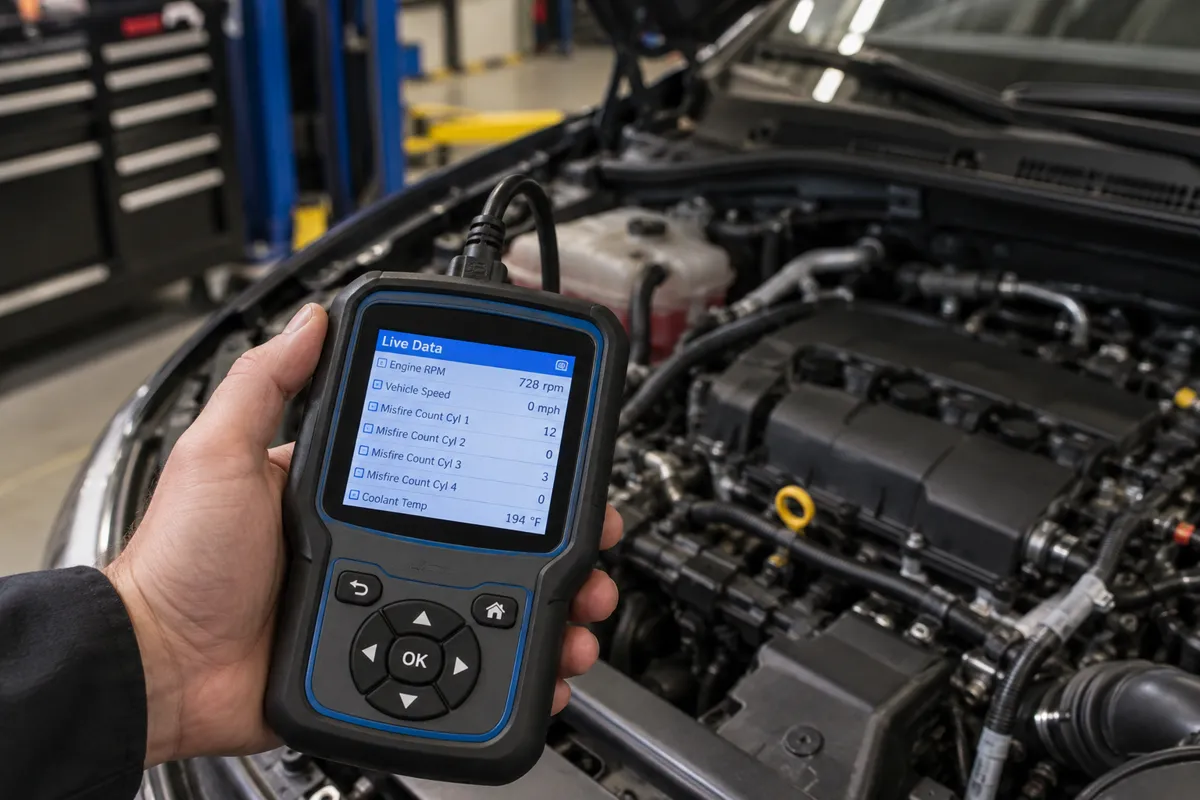
Many OBD2 scanners display individual cylinder misfire counters as a live data PID. The PID names vary: “Misfire Cylinder 1 Count,” “MisfCyl1,” or similar. These counters show the cumulative number of misfire events the ECU has detected for each cylinder since the last code clear. A counter that increments during live data observation confirms an active misfire on that cylinder in real time.
My a pid obd2 diagnostics explained covers this step by step.
Chevy owners looking for the right scanner should check my top Chevy scanner picks.
To use misfire counters in live data: clear all DTCs first (resetting the counters to zero), connect to live data and select all individual cylinder misfire count PIDs, drive the vehicle under the conditions that produce the misfire (idle, light acceleration, highway cruise, or wherever it occurs), then observe which counter increments. A counter that stays at zero means no misfire on that cylinder during that observation period. A counter that rapidly increments indicates an active ongoing misfire.
Toyota owners looking for the right scanner should check my top Toyota scanner picks.
Not all generic OBD2 scanners display individual cylinder misfire counters in Mode 1 live data. The PIDs exist in the generic OBD2 specification, but some vehicle ECUs do not expose them through the standard generic data stream. If your scanner does not show cylinder misfire counters, try accessing manufacturer-enhanced data mode (often called “enhanced OBD2” or the vehicle-specific data mode on mid-range scanners). Alternatively, Mode 6 provides the cumulative misfire counts per cylinder in a standardized format across all compliant vehicles.
My obd2 modes explained modes 1 through 10 covers this step by step.
Volvo owners looking for the right scanner should check my best OBD2 scanner for Volvo.
Mode 6 Misfire Data
Mode 6 on OBD2-compliant vehicles includes misfire data through the continuous monitor results. The misfire monitor runs continuously and stores its counts in the Mode 6 data area. Access Mode 6 through your scanner’s OBD2 mode menu or special functions. The misfire TID (Test ID) is typically TID $01 for the misfire monitor. Under it, each cylinder has its own Component ID (CID) with a cumulative misfire count and a maximum allowed threshold.
Honda CR-V owners can find the right scanner in my best scanners for the CR-V.
The Mode 6 misfire counts are not reset by the same code clear command that resets the DTC memory. They persist across key cycles and accumulate over time. This makes them useful for diagnosing intermittent misfires: a cylinder with 2,000 misfire counts in Mode 6 while the live data counter shows zero has experienced significant historic misfire activity that is not currently active. The count implicates that cylinder as the source even during a symptom-free period.
Ford F-150 owners can find the right scanner in my top diagnostic tools for the F-150.
Mode 6 also shows the rate thresholds. If your cylinder’s count is below the threshold on the Mode 6 display but still shows a significant number, the cylinder is misfiring below the DTC threshold. This is common with intermittent spark plug issues on cylinders that fire correctly most of the time but occasionally fail under specific conditions (high load, cold start, or wet conditions for a carbon-tracked plug boot).
I explain this in more detail in my can you drive with check engine light on.
Type A vs Type B Misfires: What the MIL State Tells You
The steady versus flashing MIL distinction directly indicates misfire severity. A steady MIL with a P030X code means the ECU detected a Type B misfire: the rate exceeded 1 to 2% over 1,000 crankshaft revolutions, which is above the emissions damage threshold but below the catalyst damage threshold. The engine is running poorly but is not at risk of immediate catalyst damage at current conditions.
A flashing MIL with a P030X code means a Type A misfire is active right now: the rate exceeds 30% over 200 revolutions, which the ECU calculates as sufficient to overheat the catalyst within minutes. Raw unburned fuel enters the exhaust on every misfire event, and the catalyst attempts to oxidize it, causing the substrate temperature to spike. A flashing MIL requires stopping the vehicle. Continue driving with a flashing MIL and a severe misfire causes irreversible catalyst damage within minutes at highway speeds.
The MIL can transition between states during a drive. A misfire that is intermittent may cause a steady MIL at idle but flash at highway speed under increased engine load. This tells you the misfire rate increases significantly at higher load, which narrows the cause: ignition coil failures typically worsen under high-voltage demand at higher RPM, while injector fouling misfires often worsen at low load cold-start conditions rather than high load.
I explain this in more detail in my check engine light on but no codes stored.
Using Live Data to Narrow the Cause: Ignition, Fuel, or Mechanical
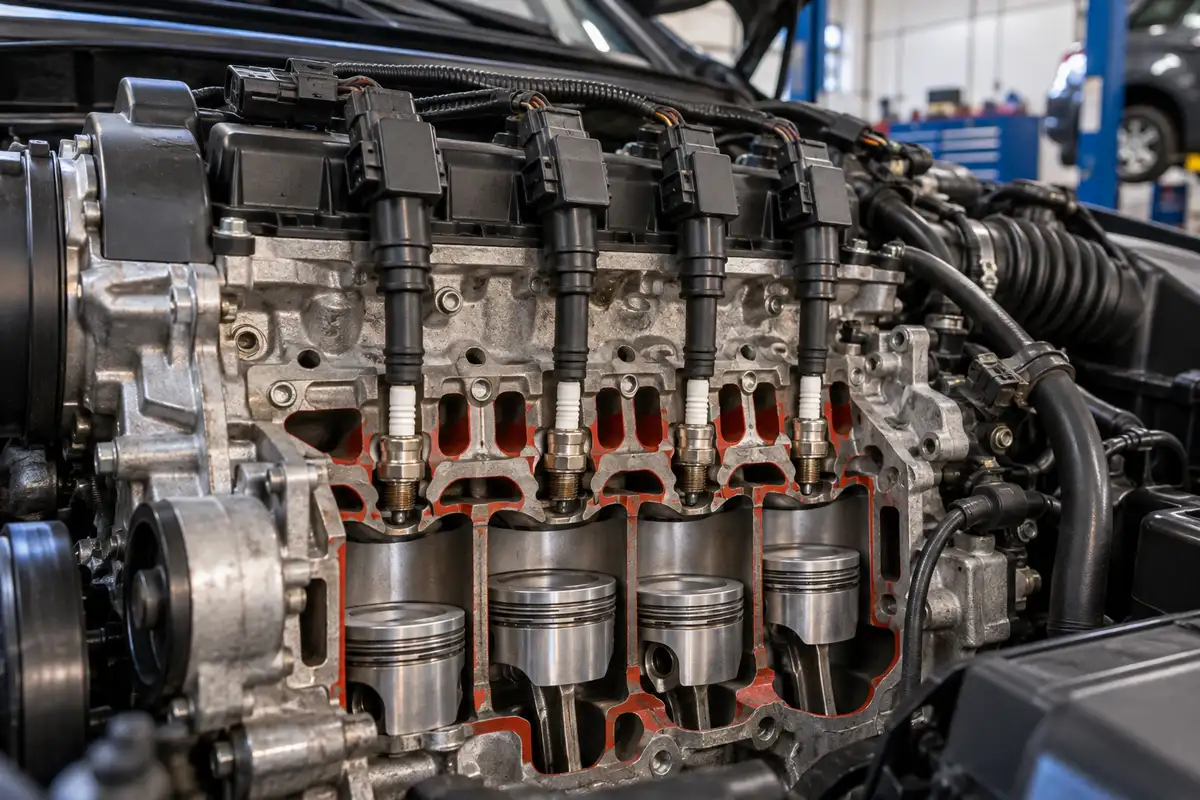
Once you know which cylinder is misfiring from the P030X code, use a systematic elimination approach. Three categories cause cylinder misfires: ignition system failure (spark plug, ignition coil, plug wire), fuel delivery failure (clogged or failed injector), and mechanical failure (low compression from worn rings, damaged valves, or burnt valve).
Audi owners looking for the right scanner should check my top Audi scanner picks.
The fastest scanner-assisted diagnostic is the fuel trim and O2 sensor cross-check. Read STFT (short-term fuel trim) on each bank with the misfire active. If the misfiring cylinder is on Bank 1 and STFT on Bank 1 is significantly positive (ECU adding fuel, greater than plus 10%), the cylinder is contributing a lean condition to Bank 1, suggesting either no fuel delivery (injector failure) or a mechanical issue (no compression means no combustion, but also no fuel consumption on that cylinder). If STFT is close to zero or slightly negative, the ignition system is more likely: the injector is delivering fuel that is not being burned.
My my guide on stft vs ltft read fuel trims covers this step by step.
Audi Q8 owners can find the right scanner in my Q8-compatible diagnostic tools.
The definitive scanner-assisted test is the component swap. For a P0301 (cylinder 1 misfire), swap the ignition coil from cylinder 1 to cylinder 2. Clear the codes and drive. If the misfire code changes from P0301 to P0302, the coil from cylinder 1 is faulty and follows the swap. If the code remains P0301, the coil is not the problem and the fault is in the spark plug, injector, or mechanical compression of cylinder 1. Swap the spark plug next using the same method. If the misfire still follows neither component, the injector or compression is the cause.
For scanner recommendations to perform this type of work, see my top-rated diagnostic tools.
Diagnosing Misfires from Specific Conditions

Misfires that occur only at cold start and clear after warm-up point to fuel delivery issues: a partially clogged injector that cannot atomize properly at cold fuel viscosity, or a failing fuel pressure regulator that provides inadequate cold-start enrichment. LTFT (long-term fuel trim) on the affected bank is often positive (lean correction) on vehicles with injector fouling, because the ECU has learned to add extra fuel to compensate for the injector’s reduced flow rate over time.
Misfires that occur only at idle and clear at higher RPM suggest a vacuum leak. Vacuum leaks cause a lean condition that is proportionally more severe at idle (where manifold vacuum is highest) than at higher RPM (where throttle opening dilutes the proportional effect of the leak). STFT at idle shows significantly positive values (plus 10 to 25%) on the affected bank that normalize closer to zero at 2,500 RPM. This pattern almost always indicates an air leak rather than an ignition or fuel problem.
I explain this in more detail in my my guide on check used car.
Misfires that appear only under high load suggest an ignition coil that cannot produce sufficient voltage under the high compression pressure at wide-open throttle. Carbon-tracked spark plug boots (a carbon path on the outside of the boot that allows voltage to short to ground instead of jumping the plug gap) produce this pattern exactly. The coil appears fine at idle where compression is moderate but fails to fire the plug reliably at peak compression pressure under full load.
I cover this capability in more detail in my BlueDriver Pro breakdown.
FAQs
What is the difference between P0300 and P0301?
P0300 means the ECU detected random misfires not attributed to a specific cylinder, or misfires distributed across multiple cylinders. P0301 means cylinder 1 specifically is misfiring at a rate above the ECU’s threshold. P0300 often appears alongside cylinder-specific codes when one cylinder misfires severely enough to affect overall running. P0300 alone without specific codes can indicate a crankshaft position sensor issue, a tone wheel fault, or a widespread fuel or timing problem affecting all cylinders.
Can I drive with a misfire code?
If the MIL is steady, the misfire rate is below the catalyst damage threshold. You can typically drive short distances at reduced load to reach a repair shop. Avoid sustained high-speed driving or heavy acceleration. If the MIL is flashing, the misfire rate is actively damaging the catalytic converter. Stop driving immediately, as continued driving causes permanent catalyst damage within minutes at highway speeds. A flashing MIL is the OBD2 system’s most urgent warning.
How do I tell if a misfire is from a spark plug or an ignition coil?
Swap the coil from the misfiring cylinder to an adjacent cylinder and clear codes. If the misfire code changes to follow the swapped coil (for example, P0301 becomes P0302 after swapping cylinder 1 and 2 coils), the coil is faulty. If the code stays on the original cylinder after the coil swap, the coil is not the cause. Then swap the spark plug using the same method. This component swap procedure is more reliable than inspecting parts visually and requires only basic tools and the scanner.
Why do I have multiple misfire codes?
Multiple cylinder misfire codes simultaneously usually indicate a shared system failure. Two cylinders sharing an ignition coil driver in older waste-spark systems produce two codes at once when that driver fails. Extremely lean mixture from a major vacuum leak, fuel delivery failure, or low fuel pressure affects all cylinders and can produce P0300 plus multiple cylinder codes. A timing chain that has stretched causes retarded timing across all cylinders and produces widespread misfires. Two adjacent cylinders on a V-engine misfiring often points to an intake manifold gasket failure between those two ports.
What live data PIDs are most useful for diagnosing misfires?
The most useful PIDs in order: individual cylinder misfire counters (to confirm which cylinder), short-term fuel trim per bank (to assess rich or lean condition), MAP sensor or MAF sensor (to detect air delivery abnormalities), coolant temperature (to confirm the engine is fully warmed), and O2 sensor upstream voltage (to correlate the misfire with fuel control response). On scanners with manufacturer-enhanced data, injector pulse width per cylinder and ignition timing per cylinder add more resolution to the diagnosis.
Why does the misfire code come back after I replaced the spark plug?
Four reasons the code returns after a plug replacement: the ignition coil on that cylinder is also failing (plugs and coils degrade together from the same heat and vibration exposure), the new plug has the wrong heat range or gap specification for that engine, the injector on that cylinder is clogged and the misfire was fuel-related rather than ignition-related, or the cylinder has low compression from a mechanical issue that no ignition service will fix. Use the component swap method to confirm the coil is working before concluding the repair is complete.