
What Is ECU Coding and When Does It Need to Be Done
By Kamil Siegień / October 12, 2026
ECU coding is the process of configuring an electronic control module with the specific options, features, and parameters that correspond to a particular vehicle’s equipment level and regional specification. Every module comes from the supplier with a set of configurable variables that remain at a default state until coding tailors them to the vehicle. When a module is replaced, it arrives uncoded: it may function in a generic mode, behave incorrectly, or refuse to operate at all until it is coded to match the vehicle’s configuration. Understanding what coding contains, when it is required, and what tools perform it separates post-repair coding from ECU tuning and clarifies why some module replacements cannot be completed with a generic code reader.
If you are on a tight budget, my best affordable code readers covers the top value picks.

About the author: Hello! I’m Kamil Siegień, founder of OBD2 Scout. My diagnostic experience started with an engine rebuild on a 2014 Skoda Superb 1.8 TSI, where tuning from 160 to 222 hp required mastering live data and ECU behavior that basic code readers cannot handle. I am a former BMW and MINI employee and regularly use diagnostic scanners on my own Audi A4 2.0 TFSI.
This guide covers what coding information a module stores, which modules require coding after replacement, the difference between coding and adaptation, the difference between coding and ECU flashing, what tools perform coding, and how to verify coding was applied correctly after a module replacement.
For a professional-grade tool, my top professional scanner picks covers the top options.
What Module Coding Contains
Module coding is a set of configuration bytes stored in a module’s non-volatile memory that tells the module which features are present, which variants are active, and which regional or model-level options apply to the vehicle. The coding data is stored as a byte string (in older VW Group systems, a single long byte string called the “coding value”) or as a set of individual parameter values with labels (in newer systems using extended coding or online coding).
If you prefer a wireless setup, my best Bluetooth diagnostic tools covers the best options.
Examples of what coding configures: whether the vehicle has rain-sensing wipers (the BCM needs to know whether to activate that function), whether the market is right-hand or left-hand drive (affects lighting direction in some modules), which engine variant is installed (the ECM needs to know whether it controls a diesel or petrol variant for calibration selection), what transmission type is paired with the engine (affects ECM shift coordination parameters), which option codes were installed at the factory (heated seats, parking sensors, panoramic roof), and which regulatory market the vehicle is configured for (affects emissions parameters, speed limiter behavior, and optional warning chimes).
Chevy owners looking for the right scanner should check my best diagnostic tools for Chevy.
A replacement module that does not receive this configuration operates with default values for all configurable items, which may mean features do not work (rain-sensing wipers do nothing because the BCM does not know they are installed), warning lights are illuminated (the module flags missing equipment that it expects but the coding does not confirm), or the module generates fault codes for systems it is not configured to expect.
Toyota owners looking for the right scanner should check my best diagnostic tools for Toyota.
Which Modules Require Coding After Replacement
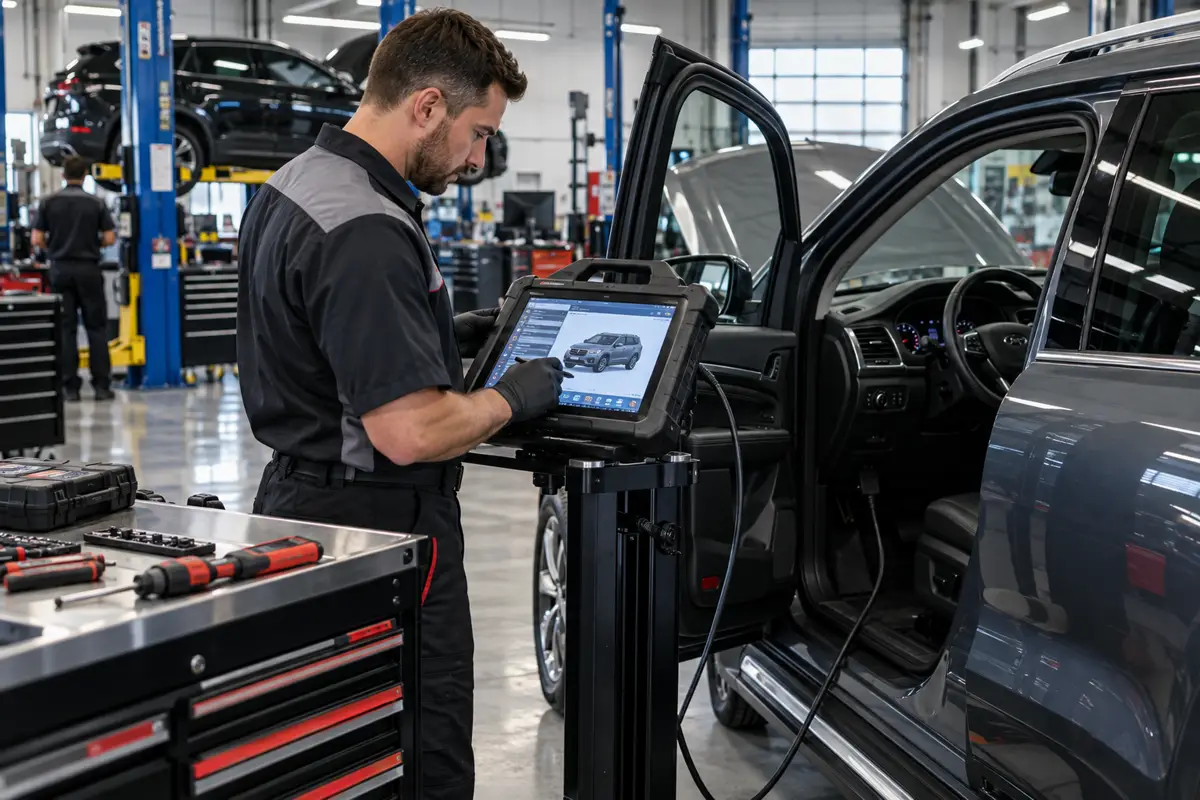
Any module that stores vehicle-specific configuration data requires coding after replacement. Modules that commonly require coding include: the ECM/PCM (engine and fuel system parameters, option codes for installed equipment), the TCM (transmission type, gear ratios, clutch configuration for dual-clutch units), the BCM (all body system options, convenience features, regional variants), the instrument cluster (vehicle identification codes, option codes, odometer data on some makes), ABS/ESC module (vehicle configuration for stability thresholds, sensor presence), airbag module (seat configuration, belt pretensioner type, crash sensor configuration), the instrument cluster, and comfort/infotainment modules.
My obd2 codes after car accident covers this step by step.
My airbag srs codes explained covers this step by step.
My my guide on reset transmission adaptations covers this step by step.
Volvo owners looking for the right scanner should check my top Volvo scanner picks.
The instrument cluster on some vehicles contains the vehicle’s odometer data. A replacement cluster requires coding and may also require a mileage transfer from the original cluster (or from the vehicle’s stored mileage in the BCM) to avoid odometer rollback, which is illegal in most jurisdictions. The coding process for clusters on affected vehicles includes writing both the configuration data and the correct mileage to the new module.
Audi Q8 owners can find the right scanner in my top diagnostic tools for the Q8.
Not every module requires coding. Some sensor modules, relays, and simple actuator controllers are plug-and-play replacements with no configurable parameters. The clearest indicator that a module requires coding: the manufacturer’s service documentation for the replacement procedure includes a coding step after physical installation, or the replacement part’s documentation states it requires configuration before use.
My a bidirectional obd2 scanner explained covers this step by step.
Audi Q7 owners can find the right scanner in my Q7-compatible diagnostic tools.
Coding vs Adaptation vs Flashing

Coding configures which features and variants are active in a module. It is a relatively quick write of configuration data, typically taking seconds to complete. The module’s software version does not change during coding: only the configuration parameters change.
Audi Q5 owners can find the right scanner in my best scanners for the Q5.
Adaptation sets learned values for physical calibration: the throttle body’s minimum position, the transmission’s clutch fill times, the steering angle sensor’s zero point. Adaptation values change continuously as the vehicle operates (the ECM updates fuel trim adaptations every drive cycle). Coding values are fixed at installation and do not change during operation unless a technician explicitly recodes the module.
Audi owners looking for the right scanner should check my best diagnostic tools for Audi.
Flashing (reprogramming) replaces the module’s software itself: the firmware version changes to a new release from the manufacturer. Flashing requires J2534 hardware and manufacturer software. Coding and adaptation remain relevant after flashing because a software update may reset certain parameters to defaults that require reconfiguration, but the coding process is separate from and subsequent to the flash.
My my guide on update firmware covers this step by step.
My a j2534 pass thru device explained covers this step by step.
Honda owners looking for the right scanner should check my best diagnostic tools for Honda.
All three are distinct operations that may be required in sequence after a module replacement: flash the module to the current software version if the replacement part arrived with an older version, code the module with the vehicle’s configuration, and then perform any required adaptations to calibrate learned values for the specific vehicle’s hardware.
BMW owners looking for the right scanner should check my best diagnostic tools for BMW.
Tools That Perform Coding

Coding requires a scanner or tool that can write to the module’s configuration memory using the manufacturer’s protocol for that make. Basic OBD2 scanners that only read Mode 03 emissions data cannot write to module configuration memory. A scanner with enhanced bidirectional coverage that specifically lists “ECU coding” or “module coding” for the target make is required.
My beginners guide reading obd2 data covers this step by step.
I explain this in more detail in my how long until check engine light resets.
For scanner recommendations to perform this type of work, see my top picks for the best scanners.
Manufacturer-specific tools provide the most complete coding capability: ISTA+ (BMW), ODIS (VW Group), Techstream (Toyota), IDS (Ford), GDS2/MDI2 (GM), and equivalent tools for other makes. VCDS from Ross-Tech provides VW Group coding capability comparable to ODIS for most coding functions without the subscription cost of dealer tools. Autel MaxiSYS, Launch X431, and similar professional-grade aftermarket scanners cover coding for the makes listed in their compatibility specifications, though their coverage depth may not always match the manufacturer tool for advanced coding functions.
I cover this capability in more detail in my MaxiSys Elite II Pro breakdown.
Verifying Coding After Module Replacement
After coding, verify the results by: reading back the coding value from the module and confirming it matches what was written, clearing any fault codes that appeared due to the uncoded module state, and functional testing of the systems the module controls. A coded BCM should have no active fault codes for missing or incorrectly configured equipment. A coded ECM should start and idle correctly without throwing configuration-related fault codes. Test each configured feature (rain-sensing wipers if coded as active, parking sensor alerts, comfort closing functions) to confirm the coding correctly activated the intended functions.
I cover this capability in more detail in my Foxwell NT530 BMW coverage.
Online Coding vs Offline Coding
Traditional module coding is performed offline: the technician reads the existing coding values from the vehicle (or from documentation), modifies the target parameter, and writes the new value to the module’s memory. The tool performs this write without needing a connection to any external server. This offline approach works on most modules in most vehicles through approximately 2015 and remains the standard for many makes and module types.
Ford owners looking for the right scanner should check my top-rated scanners for Ford.
Online coding (also called server-side coding or cloud coding) requires the tool to connect to the manufacturer’s servers to generate the correct coding value rather than computing it locally. The tool sends the vehicle’s VIN, the module’s hardware number, and the software version to the manufacturer’s server. The server validates the request, calculates the correct coding based on the vehicle’s production configuration stored in the manufacturer’s database, and returns the approved coding value to the tool for writing to the module. VW Group uses this for their SVM (Software Version Management) process on newer vehicles. BMW uses a similar server-based process for coding modules on F-series and G-series platforms.
I explain this in more detail in my check engine light on but no codes stored.
Online coding has significant implications for independent repair: it requires a valid subscription to the manufacturer’s online service, an internet connection during the coding session, and the manufacturer’s server to be operational at the time of the service. A technician who wants to code a module on a modern VW Group vehicle without an ODIS subscription cannot complete the coding, even if they have a J2534 device and VCDS, because VCDS does not have access to VW’s SVM server. This is a deliberate manufacturer decision to retain control over module configuration on their newer platforms.
I explain this in more detail in my can you drive with check engine light on.
The right-to-repair implications of online coding are actively debated. Manufacturers argue that server-side coding prevents unauthorized module substitution and ensures configurations remain within approved parameters. Independent repair advocates argue that requiring manufacturer server access for routine module replacement creates an anticompetitive service dependency. Several jurisdictions are examining whether mandatory server-dependent coding constitutes an unfair restriction on independent repair access, particularly for safety-critical modules. For now, independent shops that service current VW Group and BMW vehicles need access to the respective manufacturer’s online coding system to complete module replacement services.
I explain this in more detail in my my guide on use an.
FAQs
Will a replacement ECM work without coding?
It depends on the make and the module. Some replacement ECMs (particularly American make ECMs from Ford and GM) come pre-coded from the supplier for the target application and require only a VIN write and possibly an anti-theft relearn. European ECMs from VW, BMW, and Mercedes typically arrive in a “blank” state that requires full coding before the vehicle will start or operate correctly. The replacement part documentation and the manufacturer’s service procedure for the specific module specify whether coding is required after installation.
Can wrong coding damage a module or the vehicle?
Incorrect coding that activates a feature not present in the vehicle or sets an incorrect variant typically produces fault codes and incorrect behavior rather than physical damage. The module operates based on what its coding tells it, and if coding says an absent component is present, the module may command it and store a fault when there is no response. Incorrect engine coding on a diesel/petrol switchable variant (rare) could theoretically produce fueling strategy mismatches. For most modules, incorrect coding is recoverable by re-coding correctly: the module’s hardware is not damaged by a wrong configuration value, only by electrical faults unrelated to coding.
Is coding the same across all VW Group vehicles?
No. VW Group moved from a simple byte-string coding system (used in older vehicles through approximately 2012) to an extended long coding system and then to an online coding system in current vehicles. Older vehicles use VCDS or ODIS to enter a multi-byte coding string. Newer vehicles require the coding to be generated online by the manufacturer’s system (SVM command in VW Group terminology), which requires an active internet connection and a valid dealer subscription. The specific coding procedure for a given VW Group module depends on the vehicle’s model year and the module’s generation.
Does coding reset after battery disconnection?
No. Coding is stored in non-volatile memory that survives power interruption. Battery disconnection does not affect coding values. Adaptations (learned values) may reset on some vehicles with battery disconnection if they are stored in volatile memory, but coding itself persists. The only events that change coding values are deliberate writes via a coding tool, a software update that resets parameters to defaults, or, in rare cases, a module failure that corrupts its own non-volatile memory.