
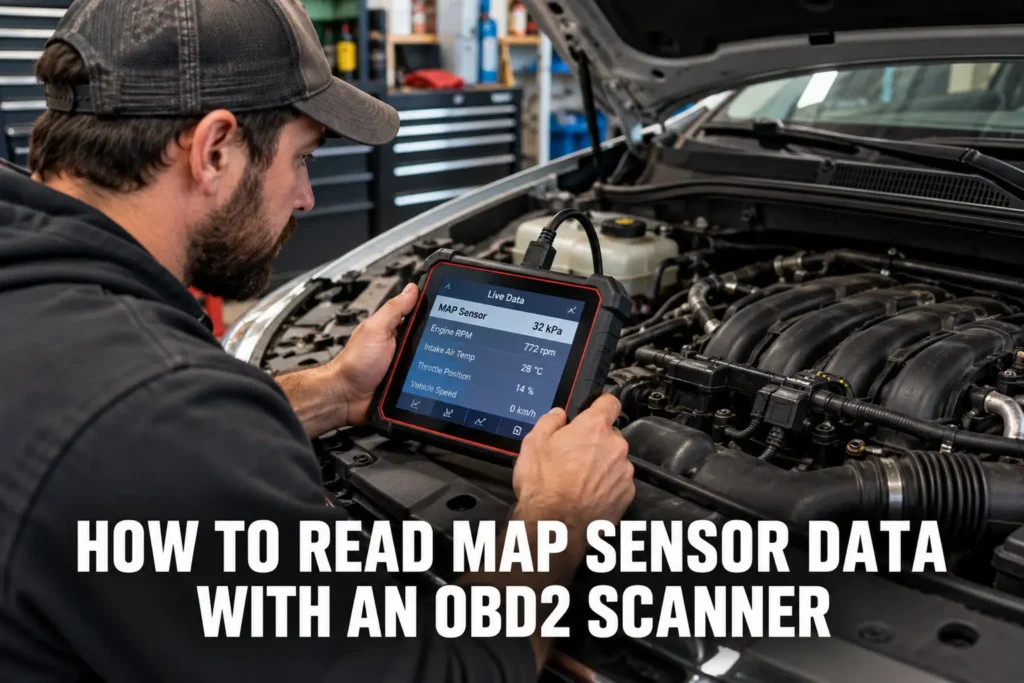
How to Read MAP Sensor Data with an OBD2 Scanner
By Kamil Siegień / October 12, 2026
The manifold absolute pressure (MAP) sensor measures the absolute pressure inside the intake manifold. On engines without a MAF sensor that use the MAP sensor as the primary load input, this reading directly determines how much fuel the ECM injects per combustion event. On turbocharged engines, the MAP sensor (or a dedicated boost pressure sensor) measures boost pressure above atmospheric, making it the primary turbocharger diagnostic parameter. Reading MAP sensor live data correctly and knowing the expected values at idle, at cruise, and at full load separates a MAP sensor fault from a vacuum system fault and identifies boost pressure problems on turbocharged vehicles without requiring an external boost gauge.
I explain this in more detail in my can you drive with check engine light on.
If you are on a tight budget, my top budget scanner picks covers the top value picks.

About the author: Hello! I’m Kamil Siegień, founder of OBD2 Scout. My diagnostic experience started with an engine rebuild on a 2014 Skoda Superb 1.8 TSI, where tuning from 160 to 222 hp required mastering live data and ECU behavior that basic code readers cannot handle. I am a former BMW and MINI employee and regularly use diagnostic scanners on my own Audi A4 2.0 TFSI.
This guide covers what MAP sensor data represents and how the scanner displays it, expected MAP values on naturally aspirated engines at different operating conditions, expected MAP values on turbocharged engines at idle and under boost, how to identify a faulty MAP sensor from its live data pattern, how MAP sensor data relates to fuel trims, and how to use MAP data to diagnose vacuum leaks versus turbocharger faults.
Audi owners looking for the right scanner should check my top Audi scanner picks.
What MAP Sensor Data Represents
Absolute pressure is the total pressure measured from true vacuum (0 kPa or 0 inHg), without reference to atmospheric pressure. At sea level, atmospheric pressure is approximately 101.3 kPa (29.92 inHg). The MAP sensor inside the intake manifold of a naturally aspirated engine at idle reads below atmospheric pressure because the engine’s pistons create suction (vacuum) in the intake manifold during their intake strokes. At idle, a healthy naturally aspirated engine produces 50 to 70 kPa of manifold pressure (roughly 20 to 25 inHg of vacuum). Under wide-open throttle (WOT), the throttle is fully open and manifold pressure rises toward atmospheric (approximately 95 to 100 kPa at WOT at sea level).
For a scanner that handles ABS and SRS diagnostics, check my top ABS diagnostic tools.
On a turbocharged engine, the turbocharger can boost manifold pressure above atmospheric. Under full boost at wide-open throttle, a turbocharged engine’s MAP sensor reads above 101.3 kPa: typically 140 to 200 kPa (about 6 to 15 psi of boost) depending on the boost pressure target. The MAP sensor range must cover both the idle vacuum and the full boost pressure, so boosted engines use MAP sensors with a higher pressure range than naturally aspirated engines.
I explain this in more detail in my my guide on read obd2 trouble codes.
For scanner recommendations to perform this type of work, see my top picks for the best scanners.
Some vehicles display MAP data in kPa (kilopascals), others in psi, others in bar, and some in inHg (inches of mercury, vacuum measurement). The scanner displays the unit the ECM reports for the MAP PID. All these units measure the same underlying pressure, so converting between them: 100 kPa = 14.5 psi = 1 bar = 29.5 inHg. For natural aspirated engines, low kPa values at idle (high vacuum) and kPa values near atmospheric at WOT. For turbocharged engines, values above atmospheric under boost.
I cover this capability in more detail in my BlueDriver Pro deep dive.
Expected MAP Values on Naturally Aspirated Engines
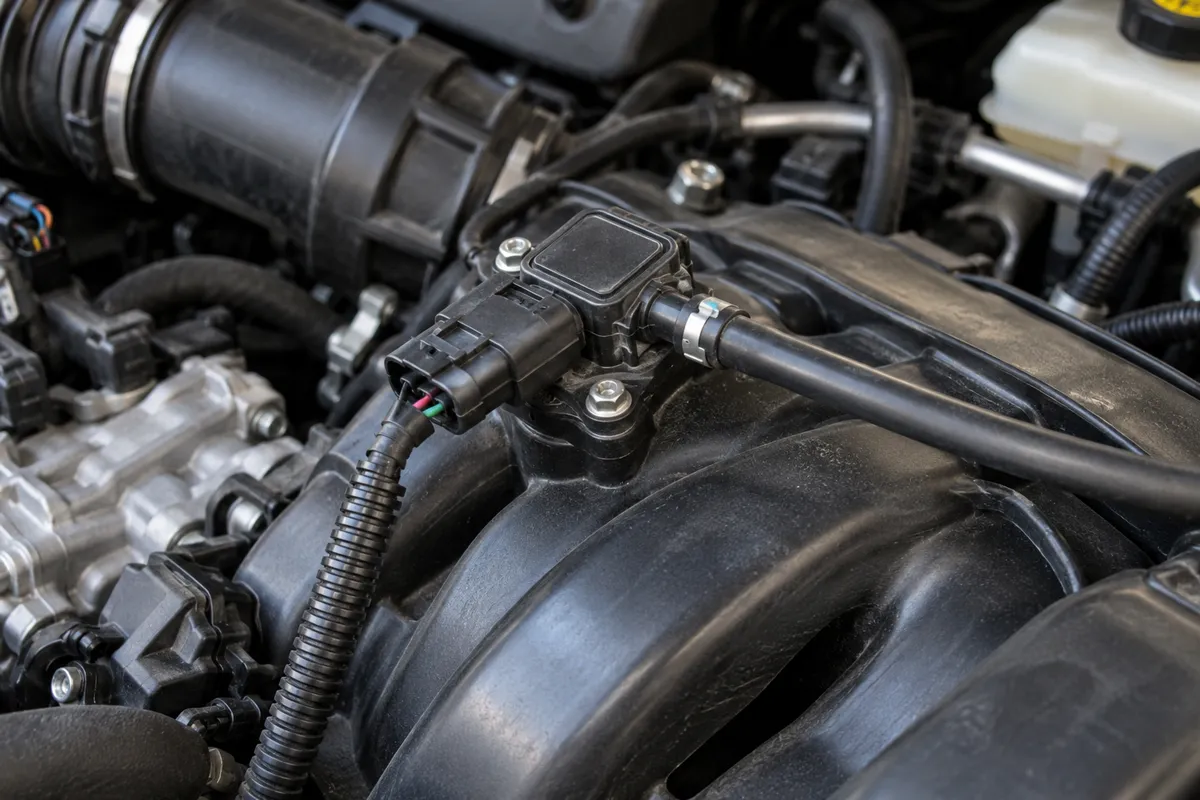
At warm idle with no load: 25 to 45 kPa (the manifold is under significant vacuum from the closed throttle plate and the engine’s pumping action). On a healthy engine at steady warm idle, this value is stable. Fluctuating MAP at idle (rapid oscillations of more than 3 to 5 kPa) indicates a rough combustion event in one or more cylinders affecting manifold vacuum.
I cover this capability in more detail in my Innova 3100RS coverage.
At steady cruise (highway speed, light throttle): 40 to 70 kPa. The throttle is partially open for light load, manifold vacuum is lower than at idle. The exact value depends on vehicle speed, transmission ratio, engine size, and elevation.
I explain this in more detail in my my guide on use an.
At wide-open throttle: 90 to 101 kPa. The throttle is fully open and the manifold fills to near atmospheric pressure. Values significantly below atmospheric at WOT indicate a restriction in the intake system (clogged air filter, damaged air box, throttle not fully opening).
I explain this in more detail in my my guide on check used car.
With the ignition on and engine off: the MAP sensor reads atmospheric pressure at the current altitude. At sea level, this is approximately 101 to 102 kPa. At 5,000 feet (1,500 m) elevation, this reads approximately 84 kPa. The ECM uses this key-on, engine-off reading to calibrate the MAP sensor’s atmospheric reference for the current altitude. If the MAP reads significantly different from the expected atmospheric pressure with the key on and engine off, the sensor or its vacuum connection is faulty.
Honda owners looking for the right scanner should check my top Honda scanner picks.
Expected MAP Values on Turbocharged Engines
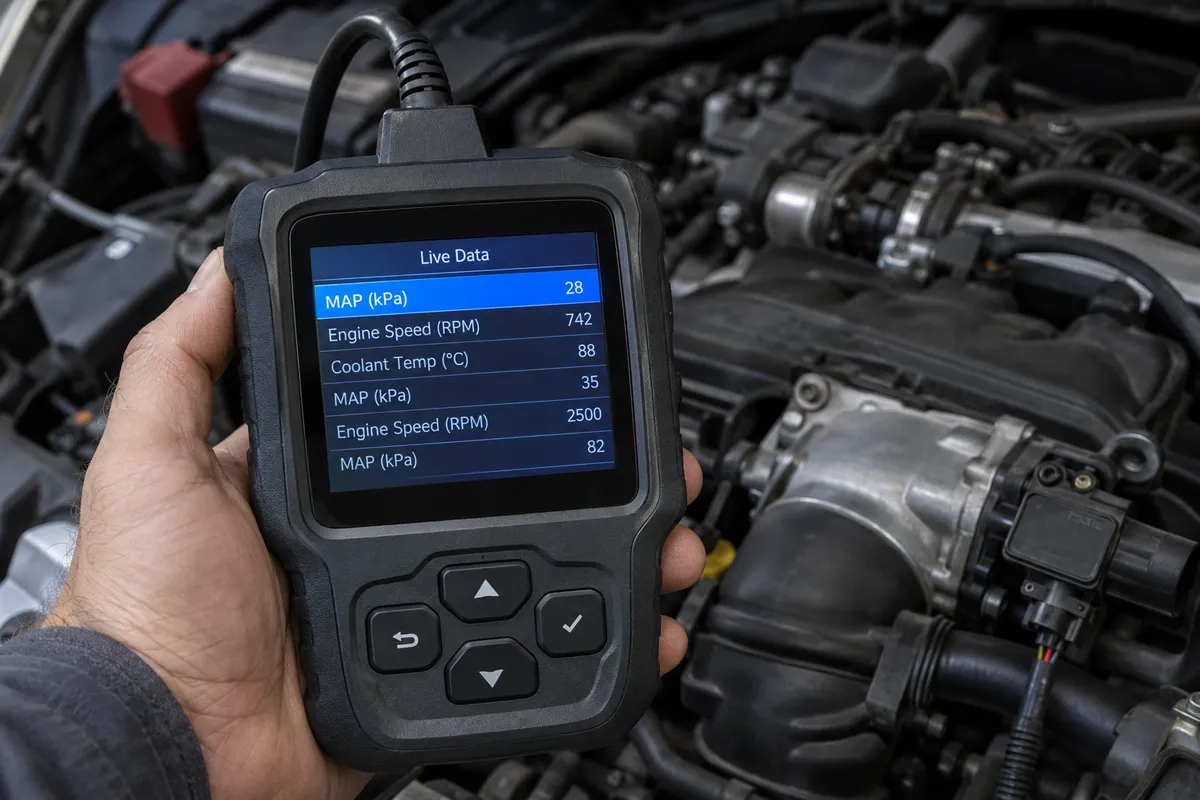
At warm idle, a turbocharged engine produces similar intake manifold vacuum to a naturally aspirated engine because the turbocharger is not boosting at idle: 30 to 55 kPa depending on the engine. At light cruise, slightly higher than a naturally aspirated engine because some positive pressure from a small amount of turbocharger activity may be present: 60 to 90 kPa. At full boost under WOT: varies by vehicle target boost pressure. A stock turbocharged vehicle targeting 10 psi (0.7 bar) of boost reads approximately 170 kPa at peak boost. A vehicle targeting 15 psi reads approximately 204 kPa.
BMW owners looking for the right scanner should check my top BMW scanner picks.
The scanner may also display a separate parameter for boost pressure (the pressure above atmospheric) rather than absolute pressure. Boost pressure is the MAP reading minus atmospheric pressure (from the barometric pressure sensor or the key-on MAP reading). If the scanner shows both parameters, boost pressure is more intuitive for turbocharger assessment: 0 bar at idle rising to the target boost under load.
Ford owners looking for the right scanner should check my top Ford scanner picks.
Identifying MAP Sensor Faults from Live Data
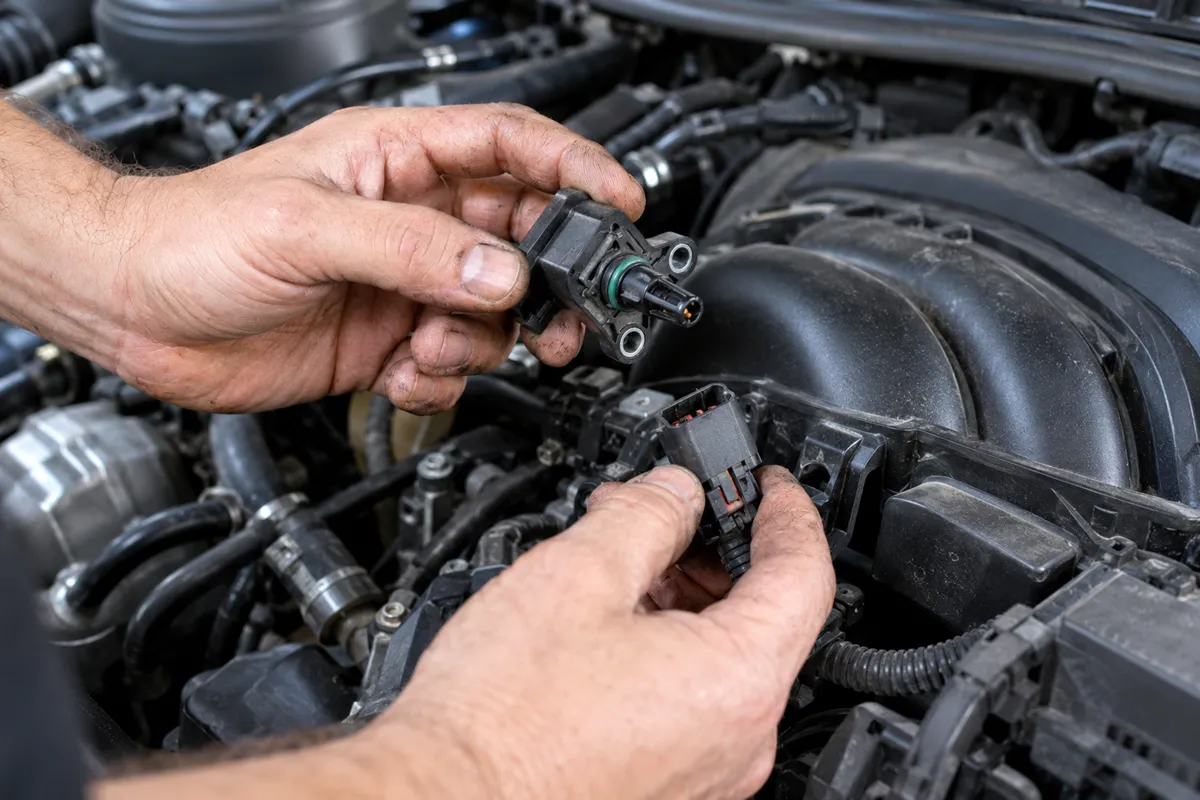
Common MAP sensor fault patterns visible in live data: a reading stuck at atmospheric pressure (the sensor is reading 100 to 102 kPa continuously regardless of engine state, even at idle) indicates a clogged or disconnected vacuum hose to the sensor, or a failed sensor. A reading stuck at a low value (below 20 kPa even at WOT) indicates a sensor output that is stuck at its low-end limit, which is a sensor failure. Erratic readings that jump randomly between values with no correlation to actual engine load indicate a signal noise issue in the sensor wiring or a sensor failure with intermittent output.
Chevy owners looking for the right scanner should check my top Chevy scanner picks.
A MAP sensor reading that is accurate at one operating condition but incorrect at another (accurate at idle but too low at WOT, or accurate at WOT but too high at idle) may indicate a sensor with a damaged calibration curve. Cross-referencing the MAP reading with the calculated engine load PID (which should track the MAP roughly in proportion) confirms whether the MAP reading diverges from expected load behavior. On MAP-only fuel control engines (no MAF sensor), a MAP sensor that reads low causes the ECM to under-fuel the engine (the ECM thinks less load is present than actual), producing lean conditions and lean-related fault codes.
Toyota owners looking for the right scanner should check my top-rated scanners for Toyota.
MAP Data for Vacuum Leak Diagnosis on Turbocharged Engines
On turbocharged engines, a boost pressure leak (a crack in an intercooler pipe, a loose hose clamp after an intercooler service, or a failed boost pressure solenoid) shows as lower-than-target boost pressure at WOT. The target boost pressure is available in scanner live data as “boost pressure target” or “requested boost pressure” on vehicles that expose this enhanced PID. Comparing the actual MAP reading to the target during a full-throttle acceleration event confirms whether the turbocharger is achieving the requested boost or falling short.
Mercedes owners looking for the right scanner should check my top Mercedes scanner picks.
A boost leak that only occurs under maximum load produces full target boost at moderate throttle but falls short at WOT: the boost pressure rises normally until the airflow is high enough to exceed what the leaking connection can maintain, at which point boost drops below target. This pattern is specific to boost leaks and distinguishes them from a wastegate or turbocharger hardware fault that limits boost at all load levels.
Honda CR-V owners can find the right scanner in my top CR-V diagnostic tools.
MAP Sensor Data and Fuel Trim Correlation
On MAP-based (speed-density) fuel control systems, the MAP sensor’s accuracy directly affects fuel trims. If the MAP sensor reads higher than actual manifold pressure, the ECM calculates more airflow than is actually entering the engine and injects more fuel: the result is a rich mixture and negative short-term fuel trim (STFT). If the MAP sensor reads lower than actual pressure, the ECM calculates less airflow and injects less fuel: lean mixture and positive STFT.
My my guide on stft vs ltft read fuel trims covers this step by step.
If you prefer a wireless setup, my top-rated Bluetooth adapters covers the best options.
A MAP sensor that is consistently off by a fixed amount across all operating conditions produces a consistent fuel trim offset at all loads. A MAP sensor that diverges from the correct reading only at specific pressures (correct at idle but wrong at high load) produces load-dependent fuel trim shifts: the STFT is normal at idle and then swings strongly positive or negative only under load. This load-dependent fuel trim pattern, where trims are normal at idle but shift significantly at highway speed or under load, is a classic indicator of a MAP sensor accuracy problem rather than a fuel injector or fuel pressure fault, which would produce a consistent offset at all loads.
My my guide on reset injector coding covers this step by step.
Ford F-150 owners can find the right scanner in my top F-150 diagnostic tools.
On engines with both a MAF and a MAP sensor, the ECM cross-validates the two signals. A MAP reading that diverges significantly from what the MAF suggests should be entering the manifold triggers a plausibility fault code for the MAP sensor (often a P010X or P011X code). If both sensors are present and both are functional, a boost leak or vacuum system fault may not produce a sensor fault code because neither sensor itself is failing, but the underlying boost or vacuum condition produces abnormal readings on both. Reading the MAP and MAF data together and comparing them against expected values for the operating condition identifies system-level faults that individual sensor codes would not flag.
Audi Q8 owners can find the right scanner in my top Q8 diagnostic tools.
FAQs
What is the difference between MAP and MAF sensors?
The MAP sensor measures manifold pressure (how compressed or vacuum the air in the intake manifold is). The MAF sensor measures the actual mass flow rate of air entering the engine in grams per second. Both sensors are used to calculate how much fuel to inject, but through different approaches. A MAP-based system (speed-density) uses MAP, RPM, and calculated volumetric efficiency to estimate airflow. A MAF-based system measures airflow directly. Many modern engines use both sensors for redundancy and cross-validation. Either sensor’s fault produces incorrect fueling: MAP faults cause incorrect fuel delivery on MAP-based systems; MAF faults on MAF-based systems.
What causes a MAP sensor to read incorrectly?
The most common MAP sensor issue is a blocked, cracked, or disconnected vacuum hose between the sensor and the intake manifold. The sensor cannot measure manifold pressure if its vacuum port is blocked: it reads atmospheric pressure regardless of engine state. Other causes include: a contaminated sensor port (oil from a PCV leak can foul the port), a sensor that failed internally, or wiring harness damage to the sensor’s signal or reference voltage wires. Physical sensor failure is less common than vacuum hose issues.
Why does my MAP reading increase when I decelerate?
During deceleration with the throttle closed, the ECM cuts fuel injection on most modern vehicles (overrun fuel cutoff). The engine acts as a vacuum pump with no fuel combustion, creating very high manifold vacuum. MAP readings drop to the lowest values observed during normal driving. However, if you mean the MAP reading increases (pressure rises toward atmospheric) during deceleration, this indicates an unusually high idle speed or an air bypass that is reducing vacuum more than expected. A sticking IACV or open EGR valve during deceleration can reduce manifold vacuum by admitting air, causing the MAP to read higher than expected during deceleration events.
Can I use MAP data to check if my throttle is opening fully?
Yes. With the vehicle accelerated to WOT at highway speed (on a safe road), the MAP reading should approach atmospheric pressure (approximately 95 to 102 kPa at sea level). If MAP at WOT significantly under-reads atmospheric (below 85 kPa at sea level with no boost), the throttle may not be opening fully (a drive-by-wire calibration issue, a mechanically stuck throttle plate, or a throttle body bore restriction), or there is an intake restriction upstream of the throttle preventing full atmospheric pressure from reaching the manifold. Cross-reference with the throttle position sensor reading to confirm whether the throttle is commanding full open even if MAP does not reflect it.